My thoughts on the transition to IPv6
How it is happening and how to join it
Marco d’Itri
<md@seeweb.it>
@rfc1036
Seeweb s.r.l.
ION Malta 2017 - 18 september 2017
1/13
2/13
Marco, an IPv6 early adopter
IPv6 user since 2000.
Enabled IPv6 for 130000 web sites in 2007.
Manages the network of a cloud infrastructure provider.
My thoughts on the transition to IPv6 Marco d’Itri
3/13
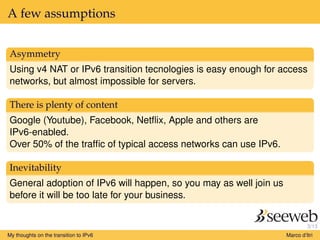
A few assumptions
Asymmetry
Using v4 NAT or IPv6 transition tecnologies is easy enough for access
networks, but almost impossible for servers.
There is plenty of content
Google (Youtube), Facebook, Netflix, Apple and others are
IPv6-enabled.
Over 50% of the traffic of typical access networks can use IPv6.
Inevitability
General adoption of IPv6 will happen, so you may as well join us
before it will be too late for your business.
My thoughts on the transition to IPv6 Marco d’Itri
4/13
Transition steps
Before the transition (when we still had new IPv4 addresses).
The transition (now).
After the transition (when IPv4 connectivity will be optional).
There will be no flag days, and the transition is in progress!
My thoughts on the transition to IPv6 Marco d’Itri
5/13
Before the transition
When we still had new IPv4 addresses
Anybody could get enough IPv4 addresses, just by asking nicely.
Some had IPv6 connectivity, but it was rarely actually needed.
Everybody had to have IPv4 connectivity.
In the RIPE region this stage ended on 14 September 2012.
My thoughts on the transition to IPv6 Marco d’Itri
6/13
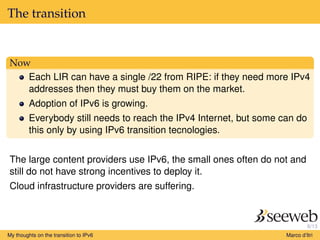
The transition
Now
Each LIR can have a single /22 from RIPE: if they need more IPv4
addresses then they must buy them on the market.
Adoption of IPv6 is growing.
Everybody still needs to reach the IPv4 Internet, but some can do
this only by using IPv6 transition tecnologies.
The large content providers use IPv6, the small ones often do not and
still do not have strong incentives to deploy it.
Cloud infrastructure providers are suffering.
My thoughts on the transition to IPv6 Marco d’Itri
7/13
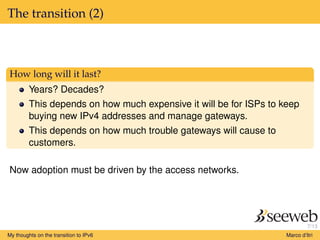
The transition (2)
How long will it last?
Years? Decades?
This depends on how much expensive it will be for ISPs to keep
buying new IPv4 addresses and manage gateways.
This depends on how much trouble gateways will cause to
customers.
Now adoption must be driven by the access networks.
My thoughts on the transition to IPv6 Marco d’Itri
8/13
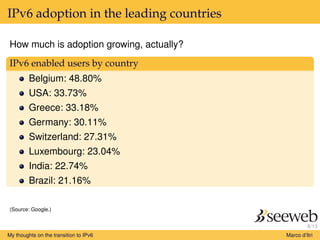
IPv6 adoption in the leading countries
How much is adoption growing, actually?
IPv6 enabled users by country
Belgium: 48.80%
USA: 33.73%
Greece: 33.18%
Germany: 30.11%
Switzerland: 27.31%
Luxembourg: 23.04%
India: 22.74%
Brazil: 21.16%
(Source: Google.)
My thoughts on the transition to IPv6 Marco d’Itri
9/13
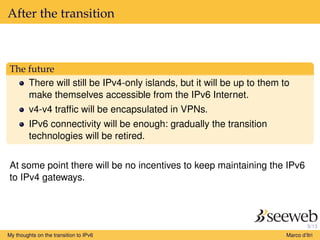
After the transition
The future
There will still be IPv4-only islands, but it will be up to them to
make themselves accessible from the IPv6 Internet.
v4-v4 traffic will be encapsulated in VPNs.
IPv6 connectivity will be enough: gradually the transition
technologies will be retired.
At some point there will be no incentives to keep maintaining the IPv6
to IPv4 gateways.
My thoughts on the transition to IPv6 Marco d’Itri
10/13
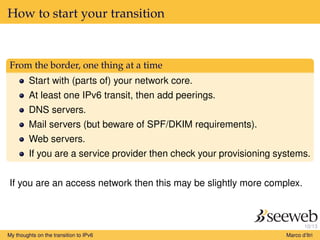
How to start your transition
From the border, one thing at a time
Start with (parts of) your network core.
At least one IPv6 transit, then add peerings.
DNS servers.
Mail servers (but beware of SPF/DKIM requirements).
Web servers.
If you are a service provider then check your provisioning systems.
If you are an access network then this may be slightly more complex.
My thoughts on the transition to IPv6 Marco d’Itri
11/13
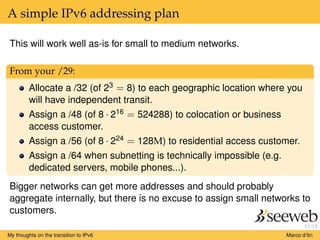
A simple IPv6 addressing plan
This will work well as-is for small to medium networks.
From your /29:
Allocate a /32 (of 23 = 8) to each geographic location where you
will have independent transit.
Assign a /48 (of 8 · 216 = 524288) to colocation or business
access customer.
Assign a /56 (of 8 · 224 = 128M) to residential access customer.
Assign a /64 when subnetting is technically impossible (e.g.
dedicated servers, mobile phones...).
Bigger networks can get more addresses and should probably
aggregate internally, but there is no excuse to assign small networks to
customers.
My thoughts on the transition to IPv6 Marco d’Itri
12/13
A simple IPv6 addressing plan (2)
Try to encode useful information in your network and host addresses.
E.g. use a /124 for PtP networks
The interface on each side can be named ::a and ::b.
Nibble-aligned for easy management of rDNS.
Leaves many bits available for aggregation and encoding
information.
You may encode information like the POP, router, interface, etc... This
makes addresses self-documenting and easy to assign automatically.
My thoughts on the transition to IPv6 Marco d’Itri
13/13
Domande?
https://www.linux.it/ md/text/ionmalta2017-ipv6.pdf
(Google . . . Marco d’Itri . . . I feel lucky)
My thoughts on the transition to IPv6 Marco d’Itri

ION Malta - Seeweb Thoughts on IPv6 Transition

  • 1.
    My thoughts onthe transition to IPv6 How it is happening and how to join it Marco d’Itri <md@seeweb.it> @rfc1036 Seeweb s.r.l. ION Malta 2017 - 18 september 2017 1/13
  • 2.
    2/13 Marco, an IPv6early adopter IPv6 user since 2000. Enabled IPv6 for 130000 web sites in 2007. Manages the network of a cloud infrastructure provider. My thoughts on the transition to IPv6 Marco d’Itri
  • 3.
    3/13 A few assumptions Asymmetry Usingv4 NAT or IPv6 transition tecnologies is easy enough for access networks, but almost impossible for servers. There is plenty of content Google (Youtube), Facebook, Netflix, Apple and others are IPv6-enabled. Over 50% of the traffic of typical access networks can use IPv6. Inevitability General adoption of IPv6 will happen, so you may as well join us before it will be too late for your business. My thoughts on the transition to IPv6 Marco d’Itri
  • 4.
    4/13 Transition steps Before thetransition (when we still had new IPv4 addresses). The transition (now). After the transition (when IPv4 connectivity will be optional). There will be no flag days, and the transition is in progress! My thoughts on the transition to IPv6 Marco d’Itri
  • 5.
    5/13 Before the transition Whenwe still had new IPv4 addresses Anybody could get enough IPv4 addresses, just by asking nicely. Some had IPv6 connectivity, but it was rarely actually needed. Everybody had to have IPv4 connectivity. In the RIPE region this stage ended on 14 September 2012. My thoughts on the transition to IPv6 Marco d’Itri
  • 6.
    6/13 The transition Now Each LIRcan have a single /22 from RIPE: if they need more IPv4 addresses then they must buy them on the market. Adoption of IPv6 is growing. Everybody still needs to reach the IPv4 Internet, but some can do this only by using IPv6 transition tecnologies. The large content providers use IPv6, the small ones often do not and still do not have strong incentives to deploy it. Cloud infrastructure providers are suffering. My thoughts on the transition to IPv6 Marco d’Itri
  • 7.
    7/13 The transition (2) Howlong will it last? Years? Decades? This depends on how much expensive it will be for ISPs to keep buying new IPv4 addresses and manage gateways. This depends on how much trouble gateways will cause to customers. Now adoption must be driven by the access networks. My thoughts on the transition to IPv6 Marco d’Itri
  • 8.
    8/13 IPv6 adoption inthe leading countries How much is adoption growing, actually? IPv6 enabled users by country Belgium: 48.80% USA: 33.73% Greece: 33.18% Germany: 30.11% Switzerland: 27.31% Luxembourg: 23.04% India: 22.74% Brazil: 21.16% (Source: Google.) My thoughts on the transition to IPv6 Marco d’Itri
  • 9.
    9/13 After the transition Thefuture There will still be IPv4-only islands, but it will be up to them to make themselves accessible from the IPv6 Internet. v4-v4 traffic will be encapsulated in VPNs. IPv6 connectivity will be enough: gradually the transition technologies will be retired. At some point there will be no incentives to keep maintaining the IPv6 to IPv4 gateways. My thoughts on the transition to IPv6 Marco d’Itri
  • 10.
    10/13 How to startyour transition From the border, one thing at a time Start with (parts of) your network core. At least one IPv6 transit, then add peerings. DNS servers. Mail servers (but beware of SPF/DKIM requirements). Web servers. If you are a service provider then check your provisioning systems. If you are an access network then this may be slightly more complex. My thoughts on the transition to IPv6 Marco d’Itri
  • 11.
    11/13 A simple IPv6addressing plan This will work well as-is for small to medium networks. From your /29: Allocate a /32 (of 23 = 8) to each geographic location where you will have independent transit. Assign a /48 (of 8 · 216 = 524288) to colocation or business access customer. Assign a /56 (of 8 · 224 = 128M) to residential access customer. Assign a /64 when subnetting is technically impossible (e.g. dedicated servers, mobile phones...). Bigger networks can get more addresses and should probably aggregate internally, but there is no excuse to assign small networks to customers. My thoughts on the transition to IPv6 Marco d’Itri
  • 12.
    12/13 A simple IPv6addressing plan (2) Try to encode useful information in your network and host addresses. E.g. use a /124 for PtP networks The interface on each side can be named ::a and ::b. Nibble-aligned for easy management of rDNS. Leaves many bits available for aggregation and encoding information. You may encode information like the POP, router, interface, etc... This makes addresses self-documenting and easy to assign automatically. My thoughts on the transition to IPv6 Marco d’Itri
  • 13.
    13/13 Domande? https://www.linux.it/ md/text/ionmalta2017-ipv6.pdf (Google .. . Marco d’Itri . . . I feel lucky) My thoughts on the transition to IPv6 Marco d’Itri