SIEMENS SIPROTEC
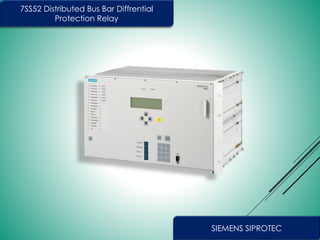
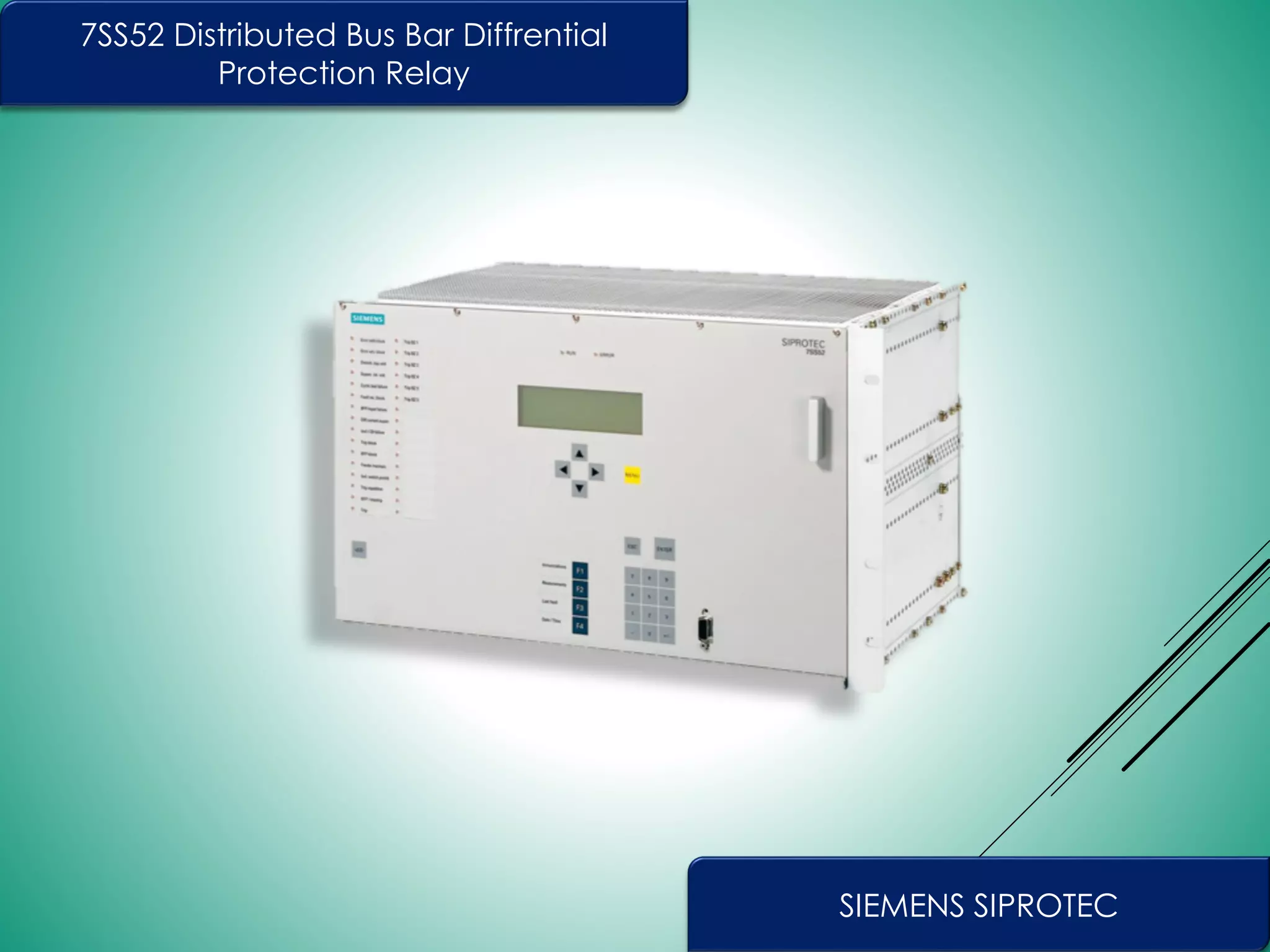
7SS52 Distributed Bus Bar Diffrential
Protection Relay
 The SIPROTEC 7SS52 numerical protection is a selective,
reliable and fast protection for busbar faults and breaker
failure in medium, high and extra-high voltage substations
with various possible busbar configurations.
 The protection is suitable for all switchgear types with iron-
core or linearized current transformers. The short tripping time
is especially advantageous for applications with high fault
levels or where fast fault clearance is required for power
system stability.
 The modular hardware allows the protection to be optimally
matched to the busbar configuration. The decentralized
arrangement allows the cabling costs in the substation to be
drastically reduced. The 7SS52 busbar protection caters for
single, double or triple busbar systems with or without and
quadruple busbar systems without transfer bus with up to: 48
bays, 16 bus couplers, and 24 sectionalizing disconnectors
and 12 busbar sections
 Busbar differential protection
 Selective zone tripping
 Very short tripping time (<15 ms)
 Extreme stability against external fault, short saturation-free time (≥2
ms)
 Phase-segregated measuring systems
 Integrated check zone
 48 bays can be configured
 12 busbar sections can be protected
 Bay-selective intertripping
 Breaker failure protection (single-phase with/without current)
 5 operation modes, selectable per bay
 Separate parameterization possible for busbar and line faults
 Independently settable delay times for all operation modes
 2-stage operation bay trip repeat/trip busbar
 Intertrip facility (via teleprotection interface)
 “Low-current” mode using the circuitbreaker auxiliary contacts
 End-fault protection with intertrip or bus zone trip
 Backup overcurrent protection per bay unit (definite-time or inverse-time)
 Independent breaker failure protection per bay unit
 Distributed or centralized installation
 Easy expansion capability
 Integrated commissioning aids
 Centralized user-friendly configuration/parameterization with DIGSI
 Universal hardware
 FO interface
– IEC 60870-5-103 protocol
 Electrical interface
– IEC 61850 protocol with EN 100 module (firmware V4.6)
The 7SS52 distributed numerical busbar and breaker failure protection
system is a selective, reliable and fast protection for busbar faults and
breaker failure in medium, high and extra-high voltage substations with
various possible busbar configurations. The protection is suitable for all
switchgear types with iron-core or linearized current transformers. The
short tripping time is especially advantageous for applications with
high fault levels or where fast fault clearance is required for power
system stability.
The modular hardware design allows the protection system to be
optimally matched to the busbar configuration. The distributed
arrangement allows the cabling costs between bay and substation to
be drastically reduced. The 7SS52 busbar protection caters for single,
double, triple and quadruple busbar systems with or without transfer
bus with up to:
– 48 bays
– 16 bus couplers
– 24 sectionalizing disconnectors
– 12 busbar sections
The distributed bay units measure the 3 phase currents in each
bay. The rated input current is 1 or 5 A and therefore eliminates
the need for interposing current transformers. The disconnector
status, breaker failure protection triggering, bay out-of- service
and other bay status information is derived via marshallable
binary inputs in the bay units. The complete information
exchange is conveyed to the central unit via a fiber-optic
interface. The bay unit also has an interface on the front side for
connection to a PC for operation and diagnosis. The trip and
intertrip commands are issued via trip contacts in the bay units.
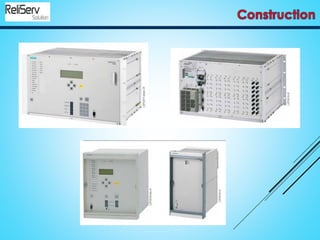
The 7XP20 standard housing is available in a flush or surface
mounting version (7SS523).
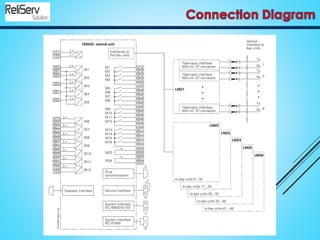
The central unit is connected to the bay units via fiber-optic
communication links. The connection is built up in a star
configuration. The central unit also contains serial ports for
system configuration via PC or communication with a substation
control system, an integrated LC Display with keypad and
marshallable binary inputs, LEDs and alarm relays. The central
unit is available in a 19" SIPAC module rack version for either
cubicle or wall mounting.
Serial communication
With respect to communication, particular emphasis is placed on the
customer requirements in energy automation:
• Every data item is time-stamped at the source, i.e. where it originates.
• Already during the process of communication, information is assigned to
the cause thereof (e.g. assignment of the indication "circuit-breaker TRIP" to
the corresponding command).
• The communication system automatically handles the transfer of large
data blocks (e.g. fault recordings or parameter data files). The user has
access to these features without any additional programming effort.
The main function of the 7SS52 is busbar protection, and has the
following characteristics:
• Evaluation of differential currents, with stabilization by through-
currents based on the proven performance of the Siemens
busbar protection 7SS1 and 7SS50/51, currently in service
worldwide
• Selective busbar protection for busbars with up to 12 busbar
sections and 48 bays
• Integrated “check zone” (evaluation of all busbar section
currents without use of the disconnector replica)
• Very short tripping time (15 ms typical)
• Selective detection of short-circuits, also for faults on the
transfer bus, with transfer trip to the remote end.
• Detection and clearance of faults between the current
transformer and the circuitbreaker via current measurement and
selective unbalancing.
• Tripping only when all three fault detection modules recognize
a busbar fault (2 measurement processors and check zone
processor)
• Selective output tripping relays per feeder in bay units.
Mob No:
Website:
Email-ID:
Address:

7SS52 Distributed Bus Bar Diffrential Protection Relay

  • 1.
    SIEMENS SIPROTEC 7SS52 DistributedBus Bar Diffrential Protection Relay
  • 2.
     The SIPROTEC7SS52 numerical protection is a selective, reliable and fast protection for busbar faults and breaker failure in medium, high and extra-high voltage substations with various possible busbar configurations.  The protection is suitable for all switchgear types with iron- core or linearized current transformers. The short tripping time is especially advantageous for applications with high fault levels or where fast fault clearance is required for power system stability.  The modular hardware allows the protection to be optimally matched to the busbar configuration. The decentralized arrangement allows the cabling costs in the substation to be drastically reduced. The 7SS52 busbar protection caters for single, double or triple busbar systems with or without and quadruple busbar systems without transfer bus with up to: 48 bays, 16 bus couplers, and 24 sectionalizing disconnectors and 12 busbar sections
  • 3.
     Busbar differentialprotection  Selective zone tripping  Very short tripping time (<15 ms)  Extreme stability against external fault, short saturation-free time (≥2 ms)  Phase-segregated measuring systems  Integrated check zone  48 bays can be configured  12 busbar sections can be protected  Bay-selective intertripping
  • 4.
     Breaker failureprotection (single-phase with/without current)  5 operation modes, selectable per bay  Separate parameterization possible for busbar and line faults  Independently settable delay times for all operation modes  2-stage operation bay trip repeat/trip busbar  Intertrip facility (via teleprotection interface)  “Low-current” mode using the circuitbreaker auxiliary contacts  End-fault protection with intertrip or bus zone trip  Backup overcurrent protection per bay unit (definite-time or inverse-time)  Independent breaker failure protection per bay unit
  • 5.
     Distributed orcentralized installation  Easy expansion capability  Integrated commissioning aids  Centralized user-friendly configuration/parameterization with DIGSI  Universal hardware  FO interface – IEC 60870-5-103 protocol  Electrical interface – IEC 61850 protocol with EN 100 module (firmware V4.6)
  • 6.
    The 7SS52 distributednumerical busbar and breaker failure protection system is a selective, reliable and fast protection for busbar faults and breaker failure in medium, high and extra-high voltage substations with various possible busbar configurations. The protection is suitable for all switchgear types with iron-core or linearized current transformers. The short tripping time is especially advantageous for applications with high fault levels or where fast fault clearance is required for power system stability. The modular hardware design allows the protection system to be optimally matched to the busbar configuration. The distributed arrangement allows the cabling costs between bay and substation to be drastically reduced. The 7SS52 busbar protection caters for single, double, triple and quadruple busbar systems with or without transfer bus with up to: – 48 bays – 16 bus couplers – 24 sectionalizing disconnectors – 12 busbar sections
  • 7.
    The distributed bayunits measure the 3 phase currents in each bay. The rated input current is 1 or 5 A and therefore eliminates the need for interposing current transformers. The disconnector status, breaker failure protection triggering, bay out-of- service and other bay status information is derived via marshallable binary inputs in the bay units. The complete information exchange is conveyed to the central unit via a fiber-optic interface. The bay unit also has an interface on the front side for connection to a PC for operation and diagnosis. The trip and intertrip commands are issued via trip contacts in the bay units. The 7XP20 standard housing is available in a flush or surface mounting version (7SS523). The central unit is connected to the bay units via fiber-optic communication links. The connection is built up in a star configuration. The central unit also contains serial ports for system configuration via PC or communication with a substation control system, an integrated LC Display with keypad and marshallable binary inputs, LEDs and alarm relays. The central unit is available in a 19" SIPAC module rack version for either cubicle or wall mounting.
  • 9.
    Serial communication With respectto communication, particular emphasis is placed on the customer requirements in energy automation: • Every data item is time-stamped at the source, i.e. where it originates. • Already during the process of communication, information is assigned to the cause thereof (e.g. assignment of the indication "circuit-breaker TRIP" to the corresponding command). • The communication system automatically handles the transfer of large data blocks (e.g. fault recordings or parameter data files). The user has access to these features without any additional programming effort.
  • 11.
    The main functionof the 7SS52 is busbar protection, and has the following characteristics: • Evaluation of differential currents, with stabilization by through- currents based on the proven performance of the Siemens busbar protection 7SS1 and 7SS50/51, currently in service worldwide • Selective busbar protection for busbars with up to 12 busbar sections and 48 bays • Integrated “check zone” (evaluation of all busbar section currents without use of the disconnector replica) • Very short tripping time (15 ms typical) • Selective detection of short-circuits, also for faults on the transfer bus, with transfer trip to the remote end. • Detection and clearance of faults between the current transformer and the circuitbreaker via current measurement and selective unbalancing. • Tripping only when all three fault detection modules recognize a busbar fault (2 measurement processors and check zone processor) • Selective output tripping relays per feeder in bay units.
  • 12.