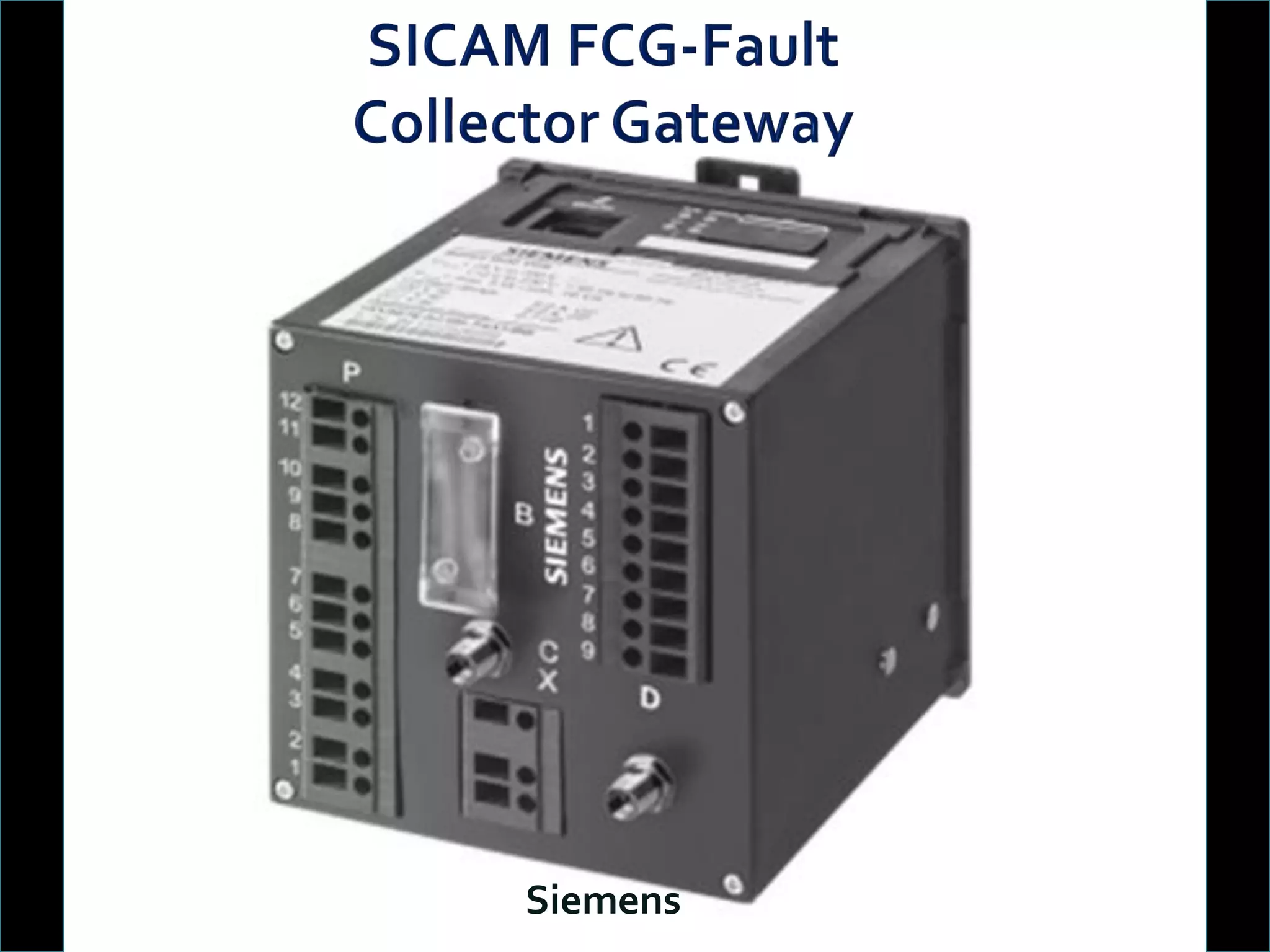
Siemens
The SICAM Fault Collector Gateway (FCG) device receives both the
load current values and distribution line faults via the SICAM Fault
Sensor Indicator (FSI).The received information status and events
are transmitted to the control center based on the IEC 60870-5-104
protocol or to the Siemens FLiC service using the XMPP protocol.
The fault detected by SICAM FSI is communicated to SICAM FCG via
short-range radio (SRR) communication within a distance of 100
meters.
SICAM FCG provides 6 binary inputs and 3 binary outputs. SICAM
FCG can be configured and diagnosed locally using the Web GUI by
connecting to a PC or laptop computer or remotely via General
Packet Radio Service (GPRS).
Description
The SICAM FCG has a plastic housing and it is strongly
recommended to mount it within a metal cabinet for additional
protection.The Global System for Mobile Communications (GSM)
and short-range radio antenna are mounted outside the metallic
cabinet.
SICAM FSI firmware and parameters can be updated from the
SICAM FCG.
SICAM FCGWeb GUI allows you to configure the parameters, display
error and event log, upgrade of firmware, and download the
configuration.
Description
Binary Interfaces
On the terminal block L, all the 3 binary inputs are independent and
have a fixed threshold of 8V. On the terminal block P, 2 binary inputs
have a common root (P8, P9, and P10), 1 binary input (P11, P12) is
independent.
These binary inputs have selectable thresholds of DC 19V, DC 88V, or
DC 176V.
Therefore an optimal adjustment to the pickup voltage can be made in
the case of increased interference level.
The binary outputs are designed as relay contacts.The terminal block P
has 2 relay outputs Normally open (NO) and one relay output change
over (CO).The relays can switch voltages up to AC/DC 250V and
currents up to AC/DC 5 A.
Functions
Communication
SICAM FCG is a gateway device on the communication network
between the SICAM FSIs and the control center. It provides interfaces
and supports communication protocols to the SICAM FSIs (via short-
range radio) and to the control center (via mobile networks).The
gateway contains an interworking function for the communication
exchanged between SICAM FSIs and the control center.
The various device communication interfaces and protocols are
available for the communication between the SICAM FCG and the
control center.
SICAM FCG has an Ethernet interface which supports the device
parameterization and the monitoring.
The communication interface supports the device parameterization
and the transmission of messages and measured values.The
information is transmitted in telegrams in a secured way.
Functions
GMS Module
The module supports 4 frequency bands: 850 MHz, 900 MHz, 1800
MHz, and 1900 MHz.
The communication to the control center can be executed based on
the IEC 60870-5-104 via internet protocol security (IPSec) tunnel and
GSM.
You can execute the configuration and local diagnostic remotely via
GSM.The communication to the Siemens FLiC service is based on
XMPP and GSM.
Short-Range Radio Module
The short-range radio module communicates directly with SICAM FSI
via a radio link in the license-free 2400-MHz band and up to 100
meters. Any overhead distribution line fault or other status change
detected by SICAM FSI is communicated to the SICAM FCG through
the short-range radio module
Functions
Time Synchronization
In operation, the device needs the date and time for all time-relevant
processes.This ensures a uniform time basis and a time stamp for the
communication with peripheral devices.The following types of time
synchronization are performed according to the parameterization:
External time synchronization via NetworkTime Protocol (NTP)
(recommended, see 7.3.1 time
synchronization).
Internal time synchronization via Real-TimeClock (RTC) (if there is no
external time synchronization).
Functions
Unplanned outages
Keeping your grids up and running
Using sophisticated tools and solutions for fast grid restoration
Unplanned outages cannot always be avoided. Flexible solutions for
local and remote monitoring enable the fast and efficient restoration of
cable grids and overhead lines.
OPEX savings
Optimizing business operations
Comprehensive and efficient ways for municipalities and DSOs to get
the most out of their OPEX
The growing demand for power from industries and households can be
fulfilled simply.With modern technologies and innovative solutions
such as optimized voltage and capacity management, self-healing
grids, and by avoiding losses of any kind.
Application
Fault localization
Fault reporting – fast, flexible, and direct
Fault localization in the cloud – the cloud-based service for fault
detection by Siemens
The basis for fast and efficient fault management was previously
bound to the control room. Fault localization in the cloud is a new,
cloud-based service, which makes it possible to send fault information
– including the fault location – directly to the maintenance crews,
without the need for a grid control center.
Application
Mob No:
Mr. Piyush Rathi- +91-9819614841
Website:
www.reliservsolution.com
Email-ID:
piyush@reliserv.in
sales1@reliserv.in
Address:
Office No: 9, Space Heights,
Plot No. 53/54 , Sector 34,
Kamothe,Navi Mumbai- 410209
Contact Us

SICAM FCG-Fault Collector Gateway

  • 1.
  • 2.
    The SICAM FaultCollector Gateway (FCG) device receives both the load current values and distribution line faults via the SICAM Fault Sensor Indicator (FSI).The received information status and events are transmitted to the control center based on the IEC 60870-5-104 protocol or to the Siemens FLiC service using the XMPP protocol. The fault detected by SICAM FSI is communicated to SICAM FCG via short-range radio (SRR) communication within a distance of 100 meters. SICAM FCG provides 6 binary inputs and 3 binary outputs. SICAM FCG can be configured and diagnosed locally using the Web GUI by connecting to a PC or laptop computer or remotely via General Packet Radio Service (GPRS). Description
  • 3.
    The SICAM FCGhas a plastic housing and it is strongly recommended to mount it within a metal cabinet for additional protection.The Global System for Mobile Communications (GSM) and short-range radio antenna are mounted outside the metallic cabinet. SICAM FSI firmware and parameters can be updated from the SICAM FCG. SICAM FCGWeb GUI allows you to configure the parameters, display error and event log, upgrade of firmware, and download the configuration. Description
  • 4.
    Binary Interfaces On theterminal block L, all the 3 binary inputs are independent and have a fixed threshold of 8V. On the terminal block P, 2 binary inputs have a common root (P8, P9, and P10), 1 binary input (P11, P12) is independent. These binary inputs have selectable thresholds of DC 19V, DC 88V, or DC 176V. Therefore an optimal adjustment to the pickup voltage can be made in the case of increased interference level. The binary outputs are designed as relay contacts.The terminal block P has 2 relay outputs Normally open (NO) and one relay output change over (CO).The relays can switch voltages up to AC/DC 250V and currents up to AC/DC 5 A. Functions
  • 5.
    Communication SICAM FCG isa gateway device on the communication network between the SICAM FSIs and the control center. It provides interfaces and supports communication protocols to the SICAM FSIs (via short- range radio) and to the control center (via mobile networks).The gateway contains an interworking function for the communication exchanged between SICAM FSIs and the control center. The various device communication interfaces and protocols are available for the communication between the SICAM FCG and the control center. SICAM FCG has an Ethernet interface which supports the device parameterization and the monitoring. The communication interface supports the device parameterization and the transmission of messages and measured values.The information is transmitted in telegrams in a secured way. Functions
  • 6.
    GMS Module The modulesupports 4 frequency bands: 850 MHz, 900 MHz, 1800 MHz, and 1900 MHz. The communication to the control center can be executed based on the IEC 60870-5-104 via internet protocol security (IPSec) tunnel and GSM. You can execute the configuration and local diagnostic remotely via GSM.The communication to the Siemens FLiC service is based on XMPP and GSM. Short-Range Radio Module The short-range radio module communicates directly with SICAM FSI via a radio link in the license-free 2400-MHz band and up to 100 meters. Any overhead distribution line fault or other status change detected by SICAM FSI is communicated to the SICAM FCG through the short-range radio module Functions
  • 7.
    Time Synchronization In operation,the device needs the date and time for all time-relevant processes.This ensures a uniform time basis and a time stamp for the communication with peripheral devices.The following types of time synchronization are performed according to the parameterization: External time synchronization via NetworkTime Protocol (NTP) (recommended, see 7.3.1 time synchronization). Internal time synchronization via Real-TimeClock (RTC) (if there is no external time synchronization). Functions
  • 8.
    Unplanned outages Keeping yourgrids up and running Using sophisticated tools and solutions for fast grid restoration Unplanned outages cannot always be avoided. Flexible solutions for local and remote monitoring enable the fast and efficient restoration of cable grids and overhead lines. OPEX savings Optimizing business operations Comprehensive and efficient ways for municipalities and DSOs to get the most out of their OPEX The growing demand for power from industries and households can be fulfilled simply.With modern technologies and innovative solutions such as optimized voltage and capacity management, self-healing grids, and by avoiding losses of any kind. Application
  • 9.
    Fault localization Fault reporting– fast, flexible, and direct Fault localization in the cloud – the cloud-based service for fault detection by Siemens The basis for fast and efficient fault management was previously bound to the control room. Fault localization in the cloud is a new, cloud-based service, which makes it possible to send fault information – including the fault location – directly to the maintenance crews, without the need for a grid control center. Application
  • 10.
    Mob No: Mr. PiyushRathi- +91-9819614841 Website: www.reliservsolution.com Email-ID: piyush@reliserv.in sales1@reliserv.in Address: Office No: 9, Space Heights, Plot No. 53/54 , Sector 34, Kamothe,Navi Mumbai- 410209 Contact Us