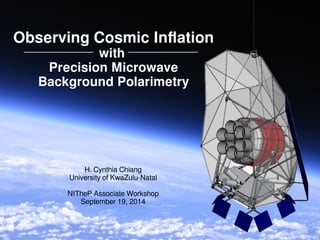
Observing Cosmic Inflation 
with 
Precision Microwave 
Background Polarimetry 
H. Cynthia Chiang 
University of KwaZulu-Natal 
NITheP Associate Workshop 
September 19, 2014
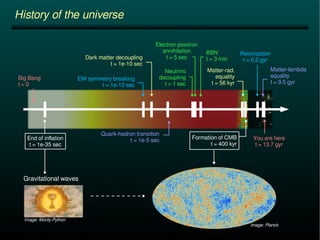
History of the universe 
Big Bang 
t = 0 
End of inflation 
t = 1e-35 sec 
Dark matter decoupling 
t = 1e-10 sec 
EW symmetry breaking 
t = 1e-12 sec 
Electron-positron 
annihilation 
Neutrino 
decoupling 
t = 1 sec 
Quark-hadron transition 
t = 1e-5 sec 
t = 5 sec BBN 
t = 3 min 
Matter-rad. 
equality 
t = 56 kyr 
Formation of CMB 
t = 400 kyr 
Reionization 
t = 0.2 gyr 
Matter-lambda 
equality 
t = 9.5 gyr 
You are here 
t = 13.7 gyr 
Image: Planck 
Gravitational waves 
Image: Monty Python
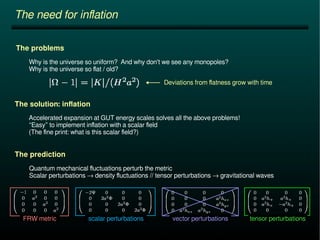
The need for inflation 
The problems 
Why is the universe so uniform? And why don't we see any monopoles? 
Why is the universe so flat / old? 
Deviations from flatness grow with time 
The solution: inflation 
Accelerated expansion at GUT energy scales solves all the above problems! 
“Easy” to implement inflation with a scalar field 
(The fine print: what is this scalar field?) 
The prediction 
Quantum mechanical fluctuations perturb the metric 
Scalar perturbations → density fluctuations // tensor perturbations → gravitational waves 
FRW metric scalar perturbations vector perturbations tensor perturbations
Image: M. Hedman 
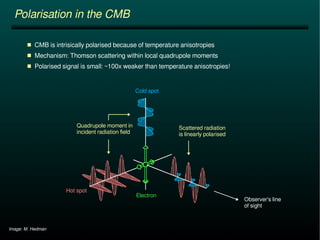
Quadrupole moment in 
incident radiation field Scattered radiation 
is linearly polarised 
Cold spot 
Hot spot 
Electron Observer's line 
of sight 
Polarisation in the CMB 
 CMB is intrisically polarised because of temperature anisotropies 
 Mechanism: Thomson scattering within local quadrupole moments 
 Polarised signal is small: ~100x weaker than temperature anisotropies!
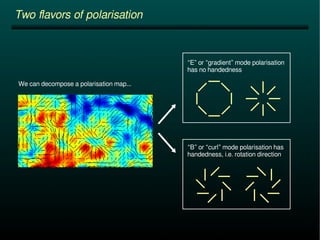
“E” or “gradient” mode polarisation 
has no handedness 
“B” or “curl” mode polarisation has 
handedness, i.e. rotation direction 
Two flavors of polarisation 
We can decompose a polarisation map...
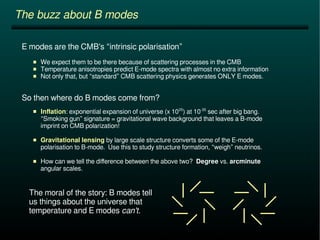
The buzz about B modes 
E modes are the CMB's “intrinsic polarisation” 
 We expect them to be there because of scattering processes in the CMB 
 Temperature anisotropies predict E-mode spectra with almost no extra information 
 Not only that, but “standard” CMB scattering physics generates ONLY E modes. 
So then where do B modes come from? 
 Inflation: exponential expansion of universe (x 1025) at 10-35 sec after big bang. 
“Smoking gun” signature = gravitational wave background that leaves a B-mode 
imprint on CMB polarization! 
 Gravitational lensing by large scale structure converts some of the E-mode 
polarisation to B-mode. Use this to study structure formation, “weigh” neutrinos. 
 How can we tell the difference between the above two? Degree vs. arcminute 
angular scales. 
The moral of the story: B modes tell 
us things about the universe that 
temperature and E modes can't.
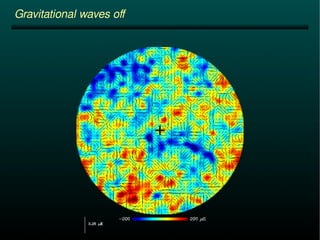
Gravitational waves of
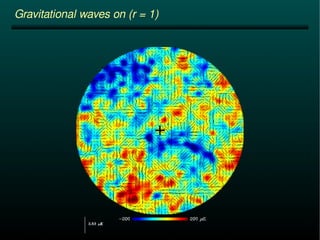
Gravitational waves on (r = 1)
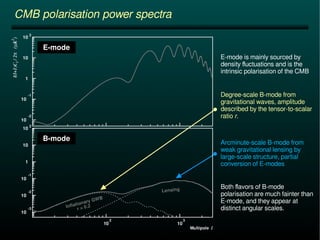
CMB polarisation power spectra 
E-mode is mainly sourced by 
density fluctuations and is the 
intrinsic polarisation of the CMB 
Degree-scale B-mode from 
gravitational waves, amplitude 
described by the tensor-to-scalar 
ratio r. 
Arcminute-scale B-mode from 
weak gravitational lensing by 
large-scale structure, partial 
conversion of E-modes 
Both flavors of B-mode 
polarisation are much fainter than 
E-mode, and they appear at 
distinct angular scales. 
E-mode 
B-mode
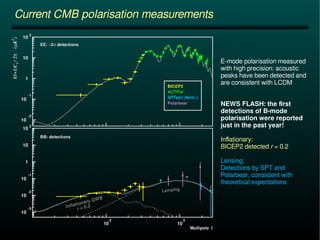
Current CMB polarisation measurements 
E-mode polarisation measured 
with high precision: acoustic 
peaks have been detected and 
are consistent with LCDM 
NEWS FLASH: the first 
detections of B-mode 
polarisation were reported 
just in the past year! 
Inflationary: 
BICEP2 detected r = 0.2 
Lensing: 
Detections by SPT and 
Polarbear, consistent with 
theoretical expectations
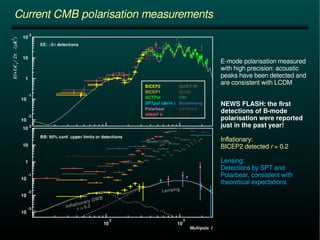
Current CMB polarisation measurements 
E-mode polarisation measured 
with high precision: acoustic 
peaks have been detected and 
are consistent with LCDM 
NEWS FLASH: the first 
detections of B-mode 
polarisation were reported 
just in the past year! 
Inflationary: 
BICEP2 detected r = 0.2 
Lensing: 
Detections by SPT and 
Polarbear, consistent with 
theoretical expectations
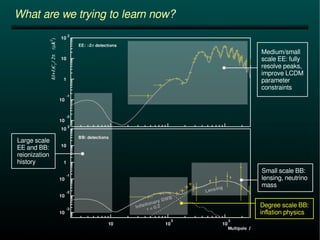
What are we trying to learn now? 
Large scale 
EE and BB: 
reionization 
history 
Medium/small 
scale EE: fully 
resolve peaks, 
improve LCDM 
parameter 
constraints 
Small scale BB: 
lensing, neutrino 
mass 
Degree scale BB: 
inflation physics
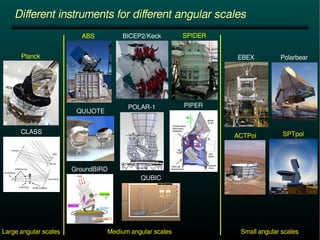
Diferent instruments for diferent angular scales 
EBEX 
PIPER 
QUBIC 
QUIJOTE 
Planck 
ACTPol SPTpol 
ABS BICEP2/Keck 
GroundBIRD 
Polarbear 
SPIDER 
CLASS 
POLAR-1 
Large angular scales Medium angular scales Small angular scales
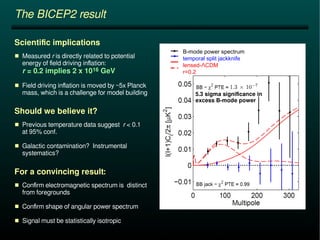
The BICEP2 result 
Scientific implications 
 Measured r is directly related to potential 
energy of field driving inflation: 
r = 0.2 implies 2 x 10¹⁶ GeV 
 Field driving inflation is moved by ~5x Planck 
mass, which is a challenge for model building 
Should we believe it? 
 Previous temperature data suggest r < 0.1 
at 95% conf. 
 Galactic contamination? Instrumental 
systematics? 
For a convincing result: 
 Confirm electromagnetic spectrum is distinct 
from foregrounds 
 Confirm shape of angular power spectrum 
 Signal must be statistically isotropic 
B-mode power spectrum 
temporal split jackknife 
lensed-ΛCDM 
r=0.2 
5.3 sigma significance in 
excess B-mode power
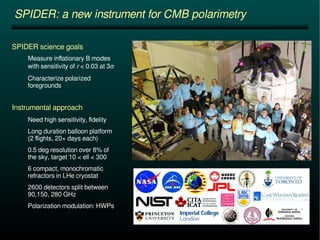
SPIDER: a new instrument for CMB polarimetry 
SPIDER science goals 
Measure inflationary B modes 
with sensitivity of r < 0.03 at 3 
Characterize polarized 
foregrounds 
Instrumental approach 
Need high sensitivity, fidelity 
Long duration balloon platform 
(2 flights, 20+ days each) 
0.5 deg resolution over 8% of 
the sky, target 10 < ell < 300 
6 compact, monochromatic 
refractors in LHe cryostat 
2600 detectors split between 
90,150, 280 GHz 
Polarization modulation: HWPs
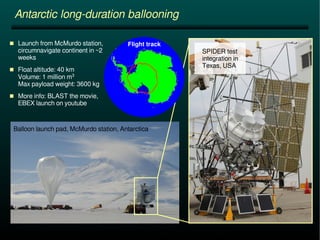
Antarctic long-duration ballooning 
Balloon launch pad, McMurdo station, Antarctica 
SPIDER test 
integration in 
Texas, USA 
 Launch from McMurdo station, Flight track 
circumnavigate continent in ~2 
weeks 
 Float altitude: 40 km 
Volume: 1 million m3 
Max payload weight: 3600 kg 
 More info: BLAST the movie, 
EBEX launch on youtube
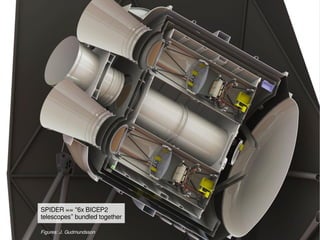
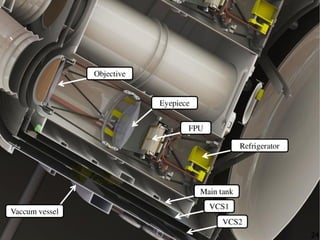
SPIDER == “6x BICEP2 
telescopes” bundled together 
Figures: J. Gudmundsson
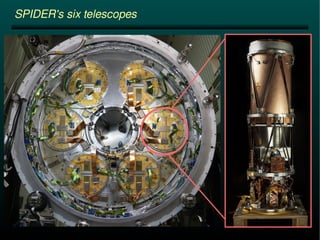
SPIDER's six telescopes
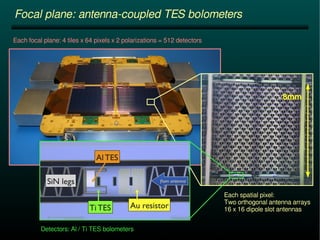
Focal plane: antenna-coupled TES bolometers 
8mm 
Each spatial pixel: 
Two orthogonal antenna arrays 
16 x 16 dipole slot antennas 
Each focal plane: 4 tiles x 64 pixels x 2 polarizations = 512 detectors 
Detectors: Al / Ti TES bolometers
SPIDER flight plan 
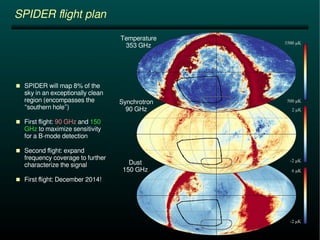
 SPIDER will map 8% of the 
sky in an exceptionally clean 
region (encompasses the 
“southern hole”) 
 First flight: 90 GHz and 150 
GHz to maximize sensitivity 
for a B-mode detection 
 Second flight: expand 
frequency coverage to further 
characterize the signal 
 First flight: December 2014! 
Temperature 
353 GHz 
Synchrotron 
90 GHz 
Dust 
150 GHz
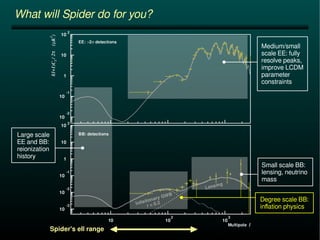
Large scale 
EE and BB: 
reionization 
history 
Medium/small 
scale EE: fully 
resolve peaks, 
improve LCDM 
parameter 
constraints 
Small scale BB: 
lensing, neutrino 
mass 
Degree scale BB: 
inflation physics 
What will Spider do for you? 
Spider's ell range
What will Spider do for you? 
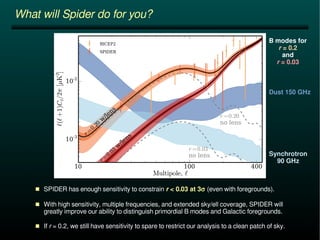
B modes for 
r = 0.2 
and 
r = 0.03 
Dust 150 GHz 
Synchrotron 
90 GHz 
 SPIDER has enough sensitivity to constrain r < 0.03 at 3 (even with foregrounds). 
 With high sensitivity, multiple frequencies, and extended sky/ell coverage, SPIDER will 
greatly improve our ability to distinguish primordial B modes and Galactic foregrounds. 
 If r = 0.2, we still have sensitivity to spare to restrict our analysis to a clean patch of sky.
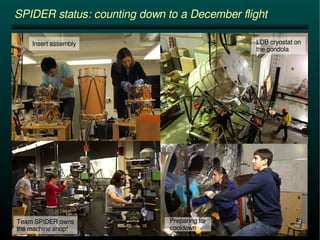
SPIDER status: counting down to a December flight 
Insert assembly LDB cryostat on 
Preparing for 
cooldown 
Team SPIDER owns 
the machine shop! 
the gondola
McMurdo 2014!
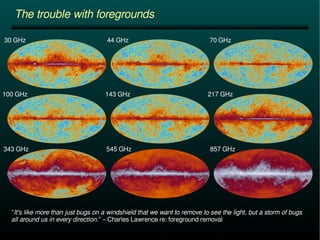
The trouble with foregrounds 
30 GHz 44 GHz 70 GHz 
100 GHz 143 GHz 217 GHz 
343 GHz 545 GHz 857 GHz 
“It's like more than just bugs on a windshield that we want to remove to see the light, but a storm of bugs 
all around us in every direction.” – Charles Lawrence re: foreground removal

September 2014 NITheP Associate meeting Dr Chiang presentation

  • 1.
    Observing Cosmic Inflation with Precision Microwave Background Polarimetry H. Cynthia Chiang University of KwaZulu-Natal NITheP Associate Workshop September 19, 2014
  • 2.
    History of theuniverse Big Bang t = 0 End of inflation t = 1e-35 sec Dark matter decoupling t = 1e-10 sec EW symmetry breaking t = 1e-12 sec Electron-positron annihilation Neutrino decoupling t = 1 sec Quark-hadron transition t = 1e-5 sec t = 5 sec BBN t = 3 min Matter-rad. equality t = 56 kyr Formation of CMB t = 400 kyr Reionization t = 0.2 gyr Matter-lambda equality t = 9.5 gyr You are here t = 13.7 gyr Image: Planck Gravitational waves Image: Monty Python
  • 3.
    The need forinflation The problems Why is the universe so uniform? And why don't we see any monopoles? Why is the universe so flat / old? Deviations from flatness grow with time The solution: inflation Accelerated expansion at GUT energy scales solves all the above problems! “Easy” to implement inflation with a scalar field (The fine print: what is this scalar field?) The prediction Quantum mechanical fluctuations perturb the metric Scalar perturbations → density fluctuations // tensor perturbations → gravitational waves FRW metric scalar perturbations vector perturbations tensor perturbations
  • 4.
    Image: M. Hedman Quadrupole moment in incident radiation field Scattered radiation is linearly polarised Cold spot Hot spot Electron Observer's line of sight Polarisation in the CMB  CMB is intrisically polarised because of temperature anisotropies  Mechanism: Thomson scattering within local quadrupole moments  Polarised signal is small: ~100x weaker than temperature anisotropies!
  • 5.
    “E” or “gradient”mode polarisation has no handedness “B” or “curl” mode polarisation has handedness, i.e. rotation direction Two flavors of polarisation We can decompose a polarisation map...
  • 6.
    The buzz aboutB modes E modes are the CMB's “intrinsic polarisation”  We expect them to be there because of scattering processes in the CMB  Temperature anisotropies predict E-mode spectra with almost no extra information  Not only that, but “standard” CMB scattering physics generates ONLY E modes. So then where do B modes come from?  Inflation: exponential expansion of universe (x 1025) at 10-35 sec after big bang. “Smoking gun” signature = gravitational wave background that leaves a B-mode imprint on CMB polarization!  Gravitational lensing by large scale structure converts some of the E-mode polarisation to B-mode. Use this to study structure formation, “weigh” neutrinos.  How can we tell the difference between the above two? Degree vs. arcminute angular scales. The moral of the story: B modes tell us things about the universe that temperature and E modes can't.
  • 7.
  • 8.
  • 9.
    CMB polarisation powerspectra E-mode is mainly sourced by density fluctuations and is the intrinsic polarisation of the CMB Degree-scale B-mode from gravitational waves, amplitude described by the tensor-to-scalar ratio r. Arcminute-scale B-mode from weak gravitational lensing by large-scale structure, partial conversion of E-modes Both flavors of B-mode polarisation are much fainter than E-mode, and they appear at distinct angular scales. E-mode B-mode
  • 10.
    Current CMB polarisationmeasurements E-mode polarisation measured with high precision: acoustic peaks have been detected and are consistent with LCDM NEWS FLASH: the first detections of B-mode polarisation were reported just in the past year! Inflationary: BICEP2 detected r = 0.2 Lensing: Detections by SPT and Polarbear, consistent with theoretical expectations
  • 11.
    Current CMB polarisationmeasurements E-mode polarisation measured with high precision: acoustic peaks have been detected and are consistent with LCDM NEWS FLASH: the first detections of B-mode polarisation were reported just in the past year! Inflationary: BICEP2 detected r = 0.2 Lensing: Detections by SPT and Polarbear, consistent with theoretical expectations
  • 12.
    What are wetrying to learn now? Large scale EE and BB: reionization history Medium/small scale EE: fully resolve peaks, improve LCDM parameter constraints Small scale BB: lensing, neutrino mass Degree scale BB: inflation physics
  • 13.
    Diferent instruments fordiferent angular scales EBEX PIPER QUBIC QUIJOTE Planck ACTPol SPTpol ABS BICEP2/Keck GroundBIRD Polarbear SPIDER CLASS POLAR-1 Large angular scales Medium angular scales Small angular scales
  • 14.
    The BICEP2 result Scientific implications  Measured r is directly related to potential energy of field driving inflation: r = 0.2 implies 2 x 10¹⁶ GeV  Field driving inflation is moved by ~5x Planck mass, which is a challenge for model building Should we believe it?  Previous temperature data suggest r < 0.1 at 95% conf.  Galactic contamination? Instrumental systematics? For a convincing result:  Confirm electromagnetic spectrum is distinct from foregrounds  Confirm shape of angular power spectrum  Signal must be statistically isotropic B-mode power spectrum temporal split jackknife lensed-ΛCDM r=0.2 5.3 sigma significance in excess B-mode power
  • 15.
    SPIDER: a newinstrument for CMB polarimetry SPIDER science goals Measure inflationary B modes with sensitivity of r < 0.03 at 3 Characterize polarized foregrounds Instrumental approach Need high sensitivity, fidelity Long duration balloon platform (2 flights, 20+ days each) 0.5 deg resolution over 8% of the sky, target 10 < ell < 300 6 compact, monochromatic refractors in LHe cryostat 2600 detectors split between 90,150, 280 GHz Polarization modulation: HWPs
  • 16.
    Antarctic long-duration ballooning Balloon launch pad, McMurdo station, Antarctica SPIDER test integration in Texas, USA  Launch from McMurdo station, Flight track circumnavigate continent in ~2 weeks  Float altitude: 40 km Volume: 1 million m3 Max payload weight: 3600 kg  More info: BLAST the movie, EBEX launch on youtube
  • 17.
    SPIDER == “6xBICEP2 telescopes” bundled together Figures: J. Gudmundsson
  • 19.
  • 20.
    Focal plane: antenna-coupledTES bolometers 8mm Each spatial pixel: Two orthogonal antenna arrays 16 x 16 dipole slot antennas Each focal plane: 4 tiles x 64 pixels x 2 polarizations = 512 detectors Detectors: Al / Ti TES bolometers
  • 21.
    SPIDER flight plan  SPIDER will map 8% of the sky in an exceptionally clean region (encompasses the “southern hole”)  First flight: 90 GHz and 150 GHz to maximize sensitivity for a B-mode detection  Second flight: expand frequency coverage to further characterize the signal  First flight: December 2014! Temperature 353 GHz Synchrotron 90 GHz Dust 150 GHz
  • 22.
    Large scale EEand BB: reionization history Medium/small scale EE: fully resolve peaks, improve LCDM parameter constraints Small scale BB: lensing, neutrino mass Degree scale BB: inflation physics What will Spider do for you? Spider's ell range
  • 23.
    What will Spiderdo for you? B modes for r = 0.2 and r = 0.03 Dust 150 GHz Synchrotron 90 GHz  SPIDER has enough sensitivity to constrain r < 0.03 at 3 (even with foregrounds).  With high sensitivity, multiple frequencies, and extended sky/ell coverage, SPIDER will greatly improve our ability to distinguish primordial B modes and Galactic foregrounds.  If r = 0.2, we still have sensitivity to spare to restrict our analysis to a clean patch of sky.
  • 24.
    SPIDER status: countingdown to a December flight Insert assembly LDB cryostat on Preparing for cooldown Team SPIDER owns the machine shop! the gondola
  • 25.
  • 26.
    The trouble withforegrounds 30 GHz 44 GHz 70 GHz 100 GHz 143 GHz 217 GHz 343 GHz 545 GHz 857 GHz “It's like more than just bugs on a windshield that we want to remove to see the light, but a storm of bugs all around us in every direction.” – Charles Lawrence re: foreground removal