Partnering with Practice-based
Research Networks (PBRN)
Paul B. McGinnis, MPA
Community Health, Quality and Practice Development Director
Oregon Rural Practice-based Research Network
Oregon Health & Science University
April 17, 2013
• Describe the “real-world” laboratories of practice-
based research
• Show examples of PBRN work
• Share experiences in working with Cooperative
Extension
Learning Objectives
What Topics Interest You?
Green LA, et al. N Engl J Med 2001;344:2021-5.
The “Ecology” of Medical Care
The Reach of Research
• It is estimated that it takes an average of 17
years for 14% of original research to reach
practice and benefit patients.
(Balas and Boren. Yearbook of Medical Informatics 2000:65-70)
This is part of what a Clinical Translation Science Award
(CTSA) is meant to address
Primary Care Practice-Based Research
Networks (PBRNs)
• A group of ambulatory primary care practices affiliated to
investigate questions related to community practice
• The majority of daily patient/clinician interactions occur
in ambulatory settings, especially smaller (3-10 clinician)
practices
• Uses the community as a laboratory
• Provides access to important, neglected phenomena
• Designed for research on clinical practice and quality
improvement activities
“Blue Highways” on the NIH Roadmap
Westfall JM, Mold J, Fagnan, LJ. JAMA 2007;297:403-406.
• 152 PBRNs
• 16,900 practices
• Average 101
practices/PBRN
• 69,000 clinicians
• Average of 4.9
studies/PBRN
• 69% have an EHR
AHRQ Registered PBRNs
www.ohsu.edu/orprn
Oregon Rural Practice-Based Research Network
The mission of ORPRN is to improve the health of rural populations in Oregon
through conducting and promoting health research in partnerships with the
communities and practitioners we serve.
• Founded in 2002
• A rural PBRN
• 49 practices in 37 communities caring for
>235,500 patients
• 157 member clinicians
• Diverse practice ownership and type (Physician
owned, FQHC, RHC, Hospital-based)
• Governed by a member clinician Steering
Committee
Health Extension in New Mexico: An Academic Health
Center and the Social Determinants of Disease
The Agricultural Cooperative Extension Service model offers academic health centers
methodologies for community engagement that can address the social determinants of
disease. The University of New Mexico Health Sciences Center developed Health Extension
Rural Offices (HEROs) as a vehicle for its model of health extension. Health extension agents
are located in rural communities across the state and are supported by regional coordinators
and the Office of the Vice President for Community Health at the Health Sciences Center. The
role of agents is to work with different sectors of the community in identifying high-priority
health needs and linking those needs with university resources in education, clinical service
and research. Community needs, interventions, and outcomes are monitored by county
health report cards. The Health Sciences Center is a large and varied resource, the breadth
and accessibility of which are mostly unknown to communities. Community health needs
vary, and agents are able to tap into an array of existing health center resources to address
those needs. Agents serve a broader purpose beyond immediate, strictly medical needs by
addressing underlying social determinants of disease, such as school retention, food
insecurity, and local economic development. Developing local capacity to address local needs
has become an overriding concern. Community-based health extension agents can effectively
bridge those needs with academic health center resources and extend those resources to
address the underlying social determinants of disease.
Kaufman A, Powell W, Alfero C, et al Ann Fam Med. 2010 January; 8(1): 73–81.
Oregon Experience
• Local Cooperative Extension Faculty serve on
Community Health Improvement Partnerships
(CHIPs)
• Childhood Obesity Research and Nutritional
Education (MOO, PATCH, Pick of the Month)
• Expert Guidance from Main Campus Faculty on
Creating Linkages between Clinics and
Community-based Resources to Manage Obesity
(Guidebook)
• Community Advisory Councils as part of
Coordinated Care Organizations
Why Research?
• Communities want to solve problems. Policy
makers and funders want to put resources into
programs that are “evidence-based.”
• Which comes first… the chicken or the egg?
Complexity Science and the Ecology of
Health Care
5
Local Community
3
Clinical
Encounter
2
Clinician
1
Patient
4
Practice
6
Health System
Crabtree BF et al. “Understanding practice from the ground up,”
The Journal of Family Practice 2001; 50(10):883.
Modifiable Factors Associated with
Deaths, US, 1990
0 100,000 200,000 300,000 400,000 500,000
Illicit Drugs
Motor Vehicles
Sexual Behavior
Firearms
Toxic Agents
Infections
Alcohol
Inactivity & Diet
Tobacco
Source: McGinnis JM, Foege WH. JAMA 1993;270:2207-12.
Practice-based Research is Community
Engagement
Westfall, Fagnan, Handley, McGinnis, Zittleman et al. JABFM.2009
Research as a Community Asset
ORPRN Newsletter, January 2010.
http://www.ohsu.edu/research/orprn/news/newsletter/JANUARY%20NEWSLETTER.pdf
• Aim 1. Transform four community-based health coalitions in
rural Oregon into receptive partners with the capacity to do
community-based participatory research (CBPR).
• Aim 2. Increase the capacity of academic researchers to
understand and engage in collaborative community-based
research with rural communities, practices and patients.
• Aim 3. Collaborate with three CTSAs to develop and
disseminate effective tools for CTSAs and PBRNs to create
research partnerships between academics and rural
communities.
Community Research Enhancement and
Education Development (CREED)
Adding Research to the CHIP Model—CHIP to CHIRP
(McGinnis PB. Family & Community Health.2010)
PUBLIC POLICY
COMMUNITY
ORGANIZATIONAL
INTERPERSONAL
knowledge, attitudes, skills
INDIVIDUAL
The Socio-Ecological Model
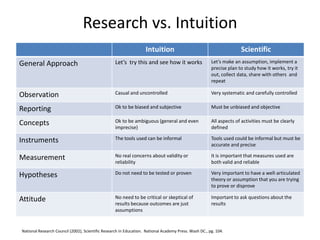
Research vs. Intuition
Intuition Scientific
General Approach Let’s try this and see how it works Let’s make an assumption, implement a
precise plan to study how it works, try it
out, collect data, share with others and
repeat
Observation Casual and uncontrolled Very systematic and carefully controlled
Reporting Ok to be biased and subjective Must be unbiased and objective
Concepts Ok to be ambiguous (general and even
imprecise)
All aspects of activities must be clearly
defined
Instruments The tools used can be informal Tools used could be informal but must be
accurate and precise
Measurement No real concerns about validity or
reliability
It is important that measures used are
both valid and reliable
Hypotheses Do not need to be tested or proven Very important to have a well-articulated
theory or assumption that you are trying
to prove or disprove
Attitude No need to be critical or skeptical of
results because outcomes are just
assumptions
Important to ask questions about the
results
National Research Council (2002), Scientific Research in Education. National Academy Press. Wash DC., pg. 104.
Why Research? In Their Own Words
• Skill Development
– My background is a Science Major. I know about Petri dish
research but I’m interested in learning about hands on
human research.
– I am interested in learning how community members can
enhance their skills [through research training]
– I do outreach in the Latino Community and I don’t know
what goes on behind the scenes [with research] to develop
programs. I’d like to learn more.
• Impact/Benefit to Community
– I’m trying to understand how to have an impact in my
community.
– [Research can help us] look at what works and what
doesn’t work.
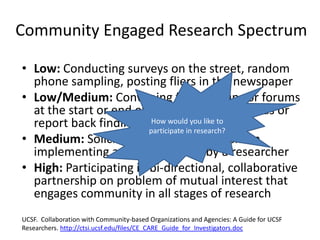
Community Engaged Research Spectrum
• Low: Conducting surveys on the street, random
phone sampling, posting fliers in the newspaper
• Low/Medium: Convening focus groups or forums
at the start or end of a study to assess needs or
report back findings
• Medium: Soliciting community to assist in
implementing a study designed by a researcher
• High: Participating in bi-directional, collaborative
partnership on problem of mutual interest that
engages community in all stages of research
UCSF. Collaboration with Community-based Organizations and Agencies: A Guide for UCSF
Researchers. http://ctsi.ucsf.edu/files/CE_CARE_Guide_for_Investigators.doc
How would you like to
participate in research?
Community Engaged Research vs.
“Helicopter Research”
...Drive by research, mosquito research...
“Outside research teams
swooped down from the
skies, swarmed all over
town, asked nosey questions
that were none of their
business and then
disappeared—never to be
heard of again.”
Slide adapted with permission from Dr. Ann Macaulay, McGill University
Montour LT, Macaulay AC, Adelson N. Diabetes Mellitus and Arteriosclerosis:
Returning research results to the Mohawk Community. CMA Journal 1988;
34:1591-93.
New Model of “Drive by Research”

Partnering with practice based research networks (pbrn)

  • 1.
    Partnering with Practice-based ResearchNetworks (PBRN) Paul B. McGinnis, MPA Community Health, Quality and Practice Development Director Oregon Rural Practice-based Research Network Oregon Health & Science University April 17, 2013
  • 2.
    • Describe the“real-world” laboratories of practice- based research • Show examples of PBRN work • Share experiences in working with Cooperative Extension Learning Objectives
  • 3.
  • 4.
    Green LA, etal. N Engl J Med 2001;344:2021-5. The “Ecology” of Medical Care
  • 5.
    The Reach ofResearch • It is estimated that it takes an average of 17 years for 14% of original research to reach practice and benefit patients. (Balas and Boren. Yearbook of Medical Informatics 2000:65-70) This is part of what a Clinical Translation Science Award (CTSA) is meant to address
  • 6.
    Primary Care Practice-BasedResearch Networks (PBRNs) • A group of ambulatory primary care practices affiliated to investigate questions related to community practice • The majority of daily patient/clinician interactions occur in ambulatory settings, especially smaller (3-10 clinician) practices • Uses the community as a laboratory • Provides access to important, neglected phenomena • Designed for research on clinical practice and quality improvement activities
  • 7.
    “Blue Highways” onthe NIH Roadmap Westfall JM, Mold J, Fagnan, LJ. JAMA 2007;297:403-406.
  • 8.
    • 152 PBRNs •16,900 practices • Average 101 practices/PBRN • 69,000 clinicians • Average of 4.9 studies/PBRN • 69% have an EHR AHRQ Registered PBRNs
  • 9.
    www.ohsu.edu/orprn Oregon Rural Practice-BasedResearch Network The mission of ORPRN is to improve the health of rural populations in Oregon through conducting and promoting health research in partnerships with the communities and practitioners we serve.
  • 10.
    • Founded in2002 • A rural PBRN • 49 practices in 37 communities caring for >235,500 patients • 157 member clinicians • Diverse practice ownership and type (Physician owned, FQHC, RHC, Hospital-based) • Governed by a member clinician Steering Committee
  • 11.
    Health Extension inNew Mexico: An Academic Health Center and the Social Determinants of Disease The Agricultural Cooperative Extension Service model offers academic health centers methodologies for community engagement that can address the social determinants of disease. The University of New Mexico Health Sciences Center developed Health Extension Rural Offices (HEROs) as a vehicle for its model of health extension. Health extension agents are located in rural communities across the state and are supported by regional coordinators and the Office of the Vice President for Community Health at the Health Sciences Center. The role of agents is to work with different sectors of the community in identifying high-priority health needs and linking those needs with university resources in education, clinical service and research. Community needs, interventions, and outcomes are monitored by county health report cards. The Health Sciences Center is a large and varied resource, the breadth and accessibility of which are mostly unknown to communities. Community health needs vary, and agents are able to tap into an array of existing health center resources to address those needs. Agents serve a broader purpose beyond immediate, strictly medical needs by addressing underlying social determinants of disease, such as school retention, food insecurity, and local economic development. Developing local capacity to address local needs has become an overriding concern. Community-based health extension agents can effectively bridge those needs with academic health center resources and extend those resources to address the underlying social determinants of disease. Kaufman A, Powell W, Alfero C, et al Ann Fam Med. 2010 January; 8(1): 73–81.
  • 12.
    Oregon Experience • LocalCooperative Extension Faculty serve on Community Health Improvement Partnerships (CHIPs) • Childhood Obesity Research and Nutritional Education (MOO, PATCH, Pick of the Month) • Expert Guidance from Main Campus Faculty on Creating Linkages between Clinics and Community-based Resources to Manage Obesity (Guidebook) • Community Advisory Councils as part of Coordinated Care Organizations
  • 13.
    Why Research? • Communitieswant to solve problems. Policy makers and funders want to put resources into programs that are “evidence-based.” • Which comes first… the chicken or the egg?
  • 14.
    Complexity Science andthe Ecology of Health Care 5 Local Community 3 Clinical Encounter 2 Clinician 1 Patient 4 Practice 6 Health System Crabtree BF et al. “Understanding practice from the ground up,” The Journal of Family Practice 2001; 50(10):883.
  • 15.
    Modifiable Factors Associatedwith Deaths, US, 1990 0 100,000 200,000 300,000 400,000 500,000 Illicit Drugs Motor Vehicles Sexual Behavior Firearms Toxic Agents Infections Alcohol Inactivity & Diet Tobacco Source: McGinnis JM, Foege WH. JAMA 1993;270:2207-12.
  • 16.
    Practice-based Research isCommunity Engagement Westfall, Fagnan, Handley, McGinnis, Zittleman et al. JABFM.2009
  • 17.
    Research as aCommunity Asset ORPRN Newsletter, January 2010. http://www.ohsu.edu/research/orprn/news/newsletter/JANUARY%20NEWSLETTER.pdf
  • 18.
    • Aim 1.Transform four community-based health coalitions in rural Oregon into receptive partners with the capacity to do community-based participatory research (CBPR). • Aim 2. Increase the capacity of academic researchers to understand and engage in collaborative community-based research with rural communities, practices and patients. • Aim 3. Collaborate with three CTSAs to develop and disseminate effective tools for CTSAs and PBRNs to create research partnerships between academics and rural communities. Community Research Enhancement and Education Development (CREED)
  • 19.
    Adding Research tothe CHIP Model—CHIP to CHIRP (McGinnis PB. Family & Community Health.2010)
  • 20.
  • 21.
    Research vs. Intuition IntuitionScientific General Approach Let’s try this and see how it works Let’s make an assumption, implement a precise plan to study how it works, try it out, collect data, share with others and repeat Observation Casual and uncontrolled Very systematic and carefully controlled Reporting Ok to be biased and subjective Must be unbiased and objective Concepts Ok to be ambiguous (general and even imprecise) All aspects of activities must be clearly defined Instruments The tools used can be informal Tools used could be informal but must be accurate and precise Measurement No real concerns about validity or reliability It is important that measures used are both valid and reliable Hypotheses Do not need to be tested or proven Very important to have a well-articulated theory or assumption that you are trying to prove or disprove Attitude No need to be critical or skeptical of results because outcomes are just assumptions Important to ask questions about the results National Research Council (2002), Scientific Research in Education. National Academy Press. Wash DC., pg. 104.
  • 22.
    Why Research? InTheir Own Words • Skill Development – My background is a Science Major. I know about Petri dish research but I’m interested in learning about hands on human research. – I am interested in learning how community members can enhance their skills [through research training] – I do outreach in the Latino Community and I don’t know what goes on behind the scenes [with research] to develop programs. I’d like to learn more. • Impact/Benefit to Community – I’m trying to understand how to have an impact in my community. – [Research can help us] look at what works and what doesn’t work.
  • 23.
    Community Engaged ResearchSpectrum • Low: Conducting surveys on the street, random phone sampling, posting fliers in the newspaper • Low/Medium: Convening focus groups or forums at the start or end of a study to assess needs or report back findings • Medium: Soliciting community to assist in implementing a study designed by a researcher • High: Participating in bi-directional, collaborative partnership on problem of mutual interest that engages community in all stages of research UCSF. Collaboration with Community-based Organizations and Agencies: A Guide for UCSF Researchers. http://ctsi.ucsf.edu/files/CE_CARE_Guide_for_Investigators.doc How would you like to participate in research?
  • 24.
    Community Engaged Researchvs. “Helicopter Research” ...Drive by research, mosquito research... “Outside research teams swooped down from the skies, swarmed all over town, asked nosey questions that were none of their business and then disappeared—never to be heard of again.” Slide adapted with permission from Dr. Ann Macaulay, McGill University Montour LT, Macaulay AC, Adelson N. Diabetes Mellitus and Arteriosclerosis: Returning research results to the Mohawk Community. CMA Journal 1988; 34:1591-93.
  • 25.
    New Model of“Drive by Research”

Editor's Notes

  • #3 Impetus for PBRNs, AHRQ Master Contract process
  • #7 Majority of daily patient/clinician interactions occur in ambulatory settingsMajority of prescriptions for medications written in ambulatory settings While growth of HMOs and large integrated healthcare systems has been dramatic, >50% of Americans still receive primary care services in smaller (3-10 clinician) practicesSignificant amount of care in these settings flies under radar of most national quality monitoring efforts“Practice-based research networks are designed for research on clinical practice and quality improvement activities. These networks generate both primary and specialty care data, often using data gathered prospectively for the purpose of research (in contrast to most existing data from practice, which document routine clinical care and may have important limitations for research purposes). These data may thus provide detailed clinical information from settings not captured in large integrated systems.” – 2010 IOM Report: Initial National Priorities for Comparative Effectiveness Research, page 151
  • #9 Data from the AHRQ PBRN Resource Center, June 2011 presented at the Annual AHRQ/PBRN meeting
  • #11 2/3 of the clinicians are physicians and 1/3 equally divided among NPs and PAs80% family medicine, 12% pediatrics, 8% internal medicine1 out 5 rural Oregonians receives their care in an ORPRN affiliated practice60% of the practices are physician owned
  • #16  2000 update published in JAMA, 2004 by Mokdad, et al. showed inactivity & diet contributing to death at the 400,000 mark with tobacco at 435,000 deathsIn 2011 obesity has risen to the top of the listDecreasing cardiovascular risk factors may have a larger impact on mortality than the use of beta blockers, anticoagulants, and statins
  • #17 PBRNs directly engage the medical practice community (solid line) and community members (dashed line). PBRNs may engage the community members through the practice (dotted line). A community may be geographic, demographic, disease specific, or a combination.Participatory research is not a method; it is an orientation to research that embraces sharing of power. Participatory research builds on long term relationships that outlast any specific research project. These relationships from the foundation of a sustained conversation that includes 2-way communication and shared decision making. PBR and PBRNs have solved 2 of the major problems that have vexed clinical researchers. PBRNs have solved the “location” problem by moving research into community practices where people get most of their care and addressing important clinical questions with large and diverse populations. PBR has solved the “orientation” problem by using the principles of community engagement and conducting research with their communities of practices, clinicians, patients, and community members so that the research is highly relevant and action-oriented.
  • #18 Community research has moved beyond the 1933 Tuskegee Syphilis Study and now represents an economic and health benefit to communities.We use a participatory model as contrasted with helicopter research or mosquito research
  • #19 CHIRP contrasts with investigator-initiated research testing hypotheses that advance the research agenda and reputation of the researchers compared to the needs and desires of the end-user—clinicians, patients, and communityFirst CREED symposia is Monday, October 24th. We will be oriented the community to the academic research community and go from practice to bedside to the bench
  • #20 It is all about Partnerships: Community Health Improvement Partnership (CHIP) to the Community Health Improvement & Research Partnership (CHIRP)
  • #23 Very positive about collaboration!!!
  • #24 On (wicked witch)….In (Never Cry Wolf)….With (holding hands around the world)