7 Activities with
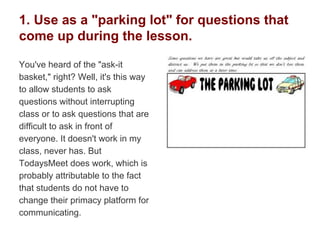
1. Use as a "parking lot" for questions that
come up during the lesson.
You've heard of the "ask-it
basket," right? Well, it's this way
to allow students to ask
questions without interrupting
class or to ask questions that are
difficult to ask in front of
everyone. It doesn't work in my
class, never has. But
TodaysMeet does work, which is
probably attributable to the fact
that students do not have to
change their primacy platform for
communicating.
2. Send links to all students in the
classroom quickly.
Although there are other ways to
do this, using TodaysMeet to
send links will keep discussion
info in context with the learning
materials.
3. Use guiding questions before students
watch a video.
Access to guiding questions can
be made available before the
learning activity to allow, for
example, those students who
feel more comfortable with a
lesson preview before class can
be at ease and ready to learn.
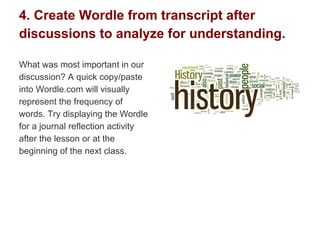
4. Create Wordle from transcript after
discussions to analyze for understanding.
What was most important in our
discussion? A quick copy/paste
into Wordle.com will visually
represent the frequency of
words. Try displaying the Wordle
for a journal reflection activity
after the lesson or at the
beginning of the next class.
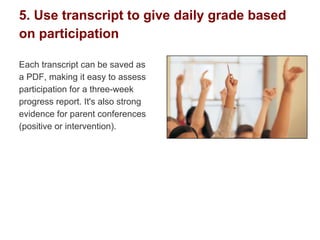
5. Use transcript to give daily grade based
on participation
Each transcript can be saved as
a PDF, making it easy to assess
participation for a three-week
progress report. It's also strong
evidence for parent conferences
(positive or intervention).
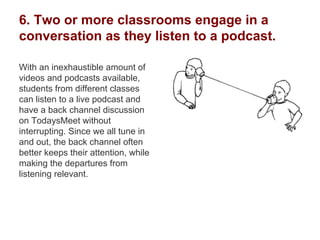
6. Two or more classrooms engage in a
conversation as they listen to a podcast.
With an inexhaustible amount of
videos and podcasts available,
students from different classes
can listen to a live podcast and
have a back channel discussion
on TodaysMeet without
interrupting. Since we all tune in
and out, the back channel often
better keeps their attention, while
making the departures from
listening relevant.
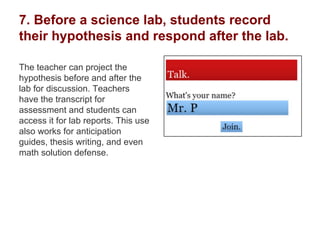
7. Before a science lab, students record
their hypothesis and respond after the lab.
The teacher can project the
hypothesis before and after the
lab for discussion. Teachers
have the transcript for
assessment and students can
access it for lab reports. This use
also works for anticipation
guides, thesis writing, and even
math solution defense.
Brought to you by

7 activities with TodaysMeet

  • 1.
  • 2.
    1. Use asa "parking lot" for questions that come up during the lesson. You've heard of the "ask-it basket," right? Well, it's this way to allow students to ask questions without interrupting class or to ask questions that are difficult to ask in front of everyone. It doesn't work in my class, never has. But TodaysMeet does work, which is probably attributable to the fact that students do not have to change their primacy platform for communicating.
  • 3.
    2. Send linksto all students in the classroom quickly. Although there are other ways to do this, using TodaysMeet to send links will keep discussion info in context with the learning materials.
  • 4.
    3. Use guidingquestions before students watch a video. Access to guiding questions can be made available before the learning activity to allow, for example, those students who feel more comfortable with a lesson preview before class can be at ease and ready to learn.
  • 5.
    4. Create Wordlefrom transcript after discussions to analyze for understanding. What was most important in our discussion? A quick copy/paste into Wordle.com will visually represent the frequency of words. Try displaying the Wordle for a journal reflection activity after the lesson or at the beginning of the next class.
  • 6.
    5. Use transcriptto give daily grade based on participation Each transcript can be saved as a PDF, making it easy to assess participation for a three-week progress report. It's also strong evidence for parent conferences (positive or intervention).
  • 7.
    6. Two ormore classrooms engage in a conversation as they listen to a podcast. With an inexhaustible amount of videos and podcasts available, students from different classes can listen to a live podcast and have a back channel discussion on TodaysMeet without interrupting. Since we all tune in and out, the back channel often better keeps their attention, while making the departures from listening relevant.
  • 8.
    7. Before ascience lab, students record their hypothesis and respond after the lab. The teacher can project the hypothesis before and after the lab for discussion. Teachers have the transcript for assessment and students can access it for lab reports. This use also works for anticipation guides, thesis writing, and even math solution defense.
  • 9.