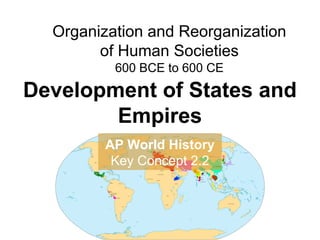
Development of States and
Empires
AP World History
Key Concept 2.2
Organization and Reorganization
of Human Societies
600 BCE to 600 CE
What were the common
characteristics among the
Classical Empires?
2.2.I Key States and Empires
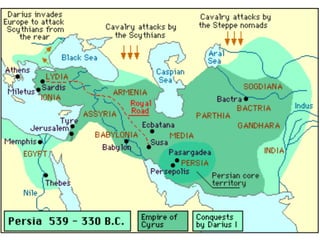
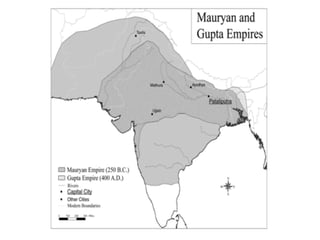
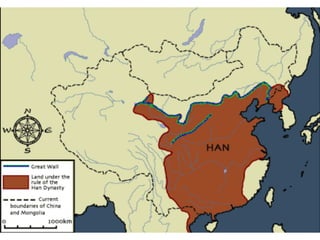
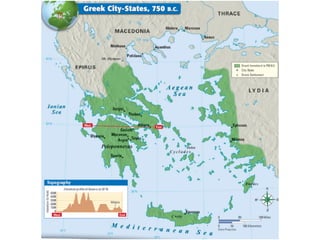
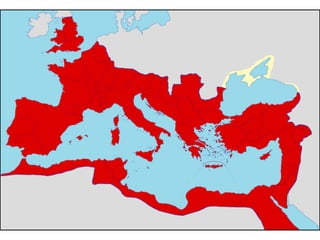
Where were the key states and empires in the
Classical Period?
● Southwest Asia:
Persian Empires
● East Asia: Qin and Han
Empire
● South Asia: Maurya
and Gupta Empires
● Mediterranean region:
Phoenicia and its colonies,
Greek city-states and
colonies, and Hellenistic
and Roman Empires
● Mesoamerica:
Teotihuacan, Maya city-
states
● Andean South America:
Moche
How did the Classical empires compare
in number and size?
Make notes about the
size, boundaries, and
location of each
classical empire.
2.2.II Imperial Organization (Political)
How did states develop new ways of governing
the people and the land?
● Centralized governments
● Legal systems
● Bureaucracies
● Diplomacy
● Supply lines
● Roads, walls, fortifications
● Local military
● Currency
Examples
Make notes
about
illustrative
examples,
those specific
things, events,
people,
developments,
etc. that define
turns in history.
Persia
Greece
Rome
Han
Persia: Cyrus 580-529 BCE
• Tolerant ruler
• Allowed conquered peoples
to keep their institutions
• Greeks called him a “Law-
Giver” and the Hebrews
called him “Anointed of the
Lord”
• Allowed more than 40,000
Jews to return to Palestine
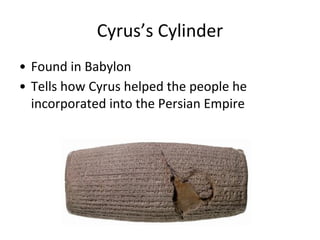
Cyrus’s Cylinder
• Found in Babylon
• Tells how Cyrus helped the people he
incorporated into the Persian Empire
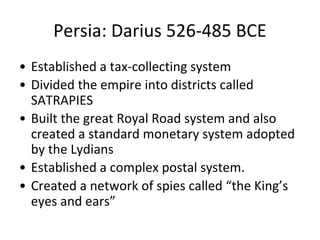
Persia: Darius 526-485 BCE
• Established a tax-collecting system
• Divided the empire into districts called
SATRAPIES
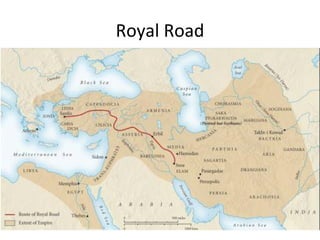
• Built the great Royal Road system and also
created a standard monetary system adopted
by the Lydians
• Established a complex postal system.
• Created a network of spies called “the King’s
eyes and ears”
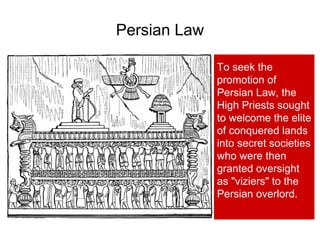
Persian Law
To seek the
promotion of
Persian Law, the
High Priests sought
to welcome the elite
of conquered lands
into secret societies
who were then
granted oversight
as "viziers" to the
Persian overlord.
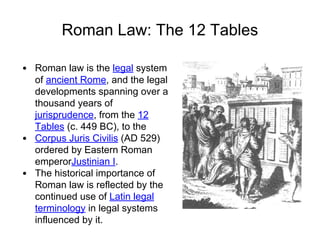
Roman Law: The 12 Tables
• Roman law is the legal system
of ancient Rome, and the legal
developments spanning over a
thousand years of
jurisprudence, from the 12
Tables (c. 449 BC), to the
• Corpus Juris Civilis (AD 529)
ordered by Eastern Roman
emperorJustinian I.
• The historical importance of
Roman law is reflected by the
continued use of Latin legal
terminology in legal systems
influenced by it.
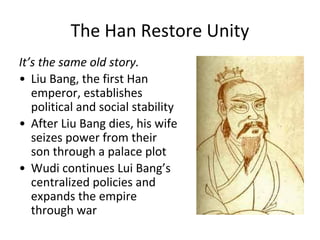
The Han Restore Unity
It’s the same old story.
• Liu Bang, the first Han
emperor, establishes
political and social stability
• After Liu Bang dies, his wife
seizes power from their
son through a palace plot
• Wudi continues Lui Bang’s
centralized policies and
expands the empire
through war
hausa.cri.cn
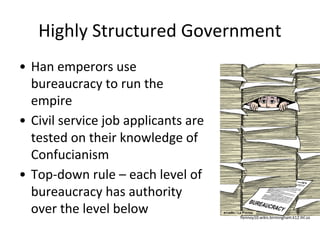
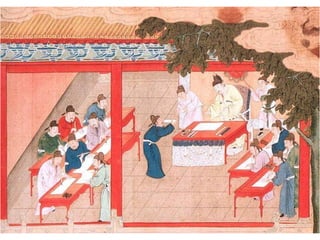
Highly Structured Government
• Han emperors use
bureaucracy to run the
empire
• Civil service job applicants are
tested on their knowledge of
Confucianism
• Top-down rule – each level of
bureaucracy has authority
over the level below flennoy10.wikis.birmingham.k12.mi.us
What new political methods were created in order to
rule the larger empires in the Classical Era?
• Administrative institutions
– centralized governments, elaborate legal systems,
and bureaucracies
How did imperial governments let their population
know that the government was “in charge?”
• Diplomacy; developing supply lines; building
fortifications, defensive walls, and roads
• Drawing new groups of military officers and
soldiers from the local populations or
conquered peoples
• Well trained and extensive military
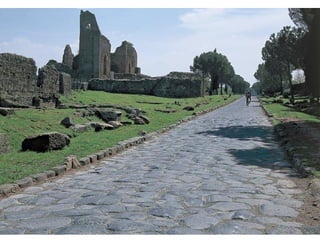
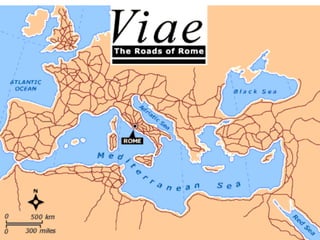
– Military presence on Roman roads was so
extensive,
– Travel and trade were safer, much faster
Royal Road
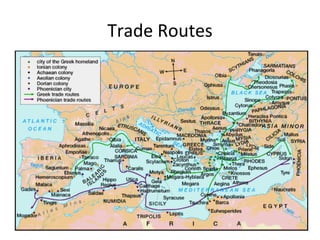
What role did trade play in creating
and maintaining empires?
• Promotion of trade
and economic
integration by
– Building and
maintaining roads
and
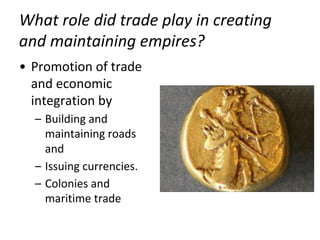
– Issuing currencies.
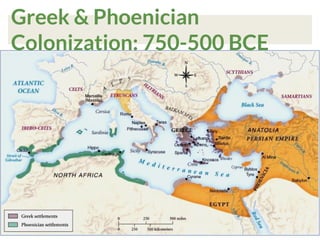
– Colonies and
maritime trade
Greek & Phoenician
Colonization: 750-500 BCE
Trade Routes
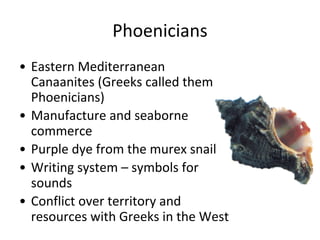
Phoenicians
• Eastern Mediterranean
Canaanites (Greeks called them
Phoenicians)
• Manufacture and seaborne
commerce
• Purple dye from the murex snail
• Writing system – symbols for
sounds
• Conflict over territory and
resources with Greeks in the West
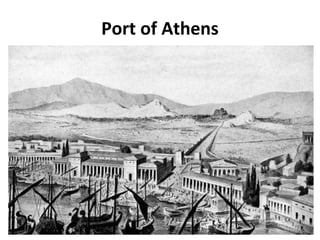
Port of Athens
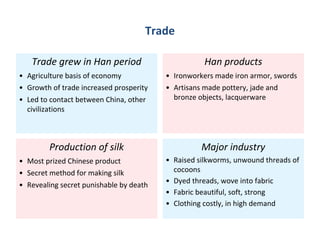
Trade grew in Han period
• Agriculture basis of economy
• Growth of trade increased prosperity
• Led to contact between China, other
civilizations
Production of silk
• Most prized Chinese product
• Secret method for making silk
• Revealing secret punishable by death
Han products
• Ironworkers made iron armor, swords
• Artisans made pottery, jade and
bronze objects, lacquerware
Major industry
• Raised silkworms, unwound threads of
cocoons
• Dyed threads, wove into fabric
• Fabric beautiful, soft, strong
• Clothing costly, in high demand
Trade
Delian League
• By 479 BC, Greeks defeated Persians on land in
Asia Minor and stopped their advance.
• Athens emerged from the war as the most
powerful city-state in Greece.
• To continue the struggle against Persia, it
organized the Delian League, an alliance with
the other Greek city states.
• Athens dominated the Delian League and used
its wealth to create an Athenian empire.
What techniques did Classical empires use
to administer their territories?
• What new political methods were created in
order to rule the larger empires in the Classical
Era?
• How did imperial governments let their
population know that the government was “in
charge?”
• What role did trade play in creating and
maintaining empires?
Summarize
2.2.III Economic and Social
How did social and economic dimensions
develop in the Classical Period?
● Role of Cities
● Social hierarchies
● Labor management
(production of food)
● Rewards to elites
● Patriarchy
Examples
Persepolis
Athens
Rome
Chang’an
Corvee
Slavery
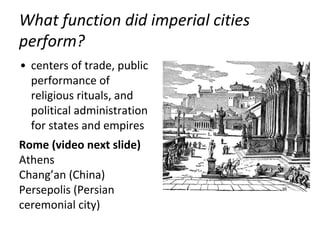
What function did imperial cities
perform?
• centers of trade, public
performance of
religious rituals, and
political administration
for states and empires
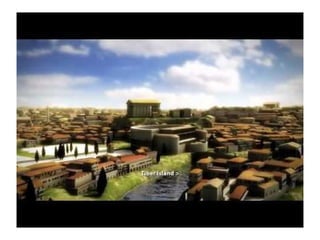
Rome (video next slide)
Athens
Chang’an (China)
Persepolis (Persian
ceremonial city)
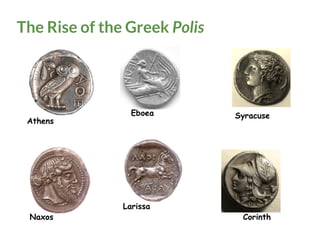
The Rise of the Greek Polis
Athens
Naxos Corinth
Syracuse
Larissa
Eboea
Athens
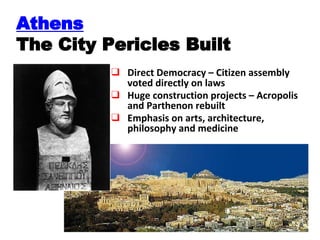
The City Pericles Built
❑ Direct Democracy – Citizen assembly
voted directly on laws
❑ Huge construction projects – Acropolis
and Parthenon rebuilt
❑ Emphasis on arts, architecture,
philosophy and medicine
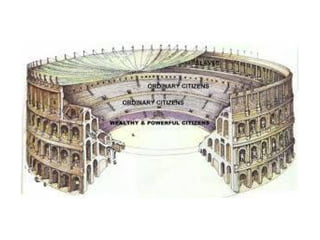
What social classes & occupations were
common in empires?
• empires displayed hierarchies that included
cultivators, laborers, slaves, artisans,
merchants, elites and caste groups.
• range of labor systems to maintain the
production of food and provide rewards for
the loyalty of the elites including corvée,
slavery, rents and tributes, peasant
communities and family and household
production
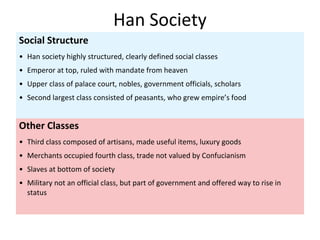
Other Classes
• Third class composed of artisans, made useful items, luxury goods
• Merchants occupied fourth class, trade not valued by Confucianism
• Slaves at bottom of society
• Military not an official class, but part of government and offered way to rise in
status
Social Structure
• Han society highly structured, clearly defined social classes
• Emperor at top, ruled with mandate from heaven
• Upper class of palace court, nobles, government officials, scholars
• Second largest class consisted of peasants, who grew empire’s food
Han Society
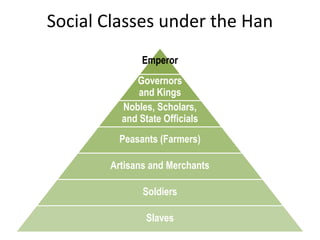
Social Classes under the Han
Emperor
Governors
and Kings
Nobles, Scholars,
and State Officials
Peasants (Farmers)
Artisans and Merchants
Soldiers
Slaves
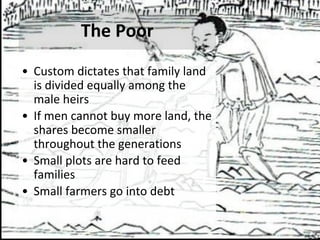
The Poor
• Custom dictates that family land
is divided equally among the
male heirs
• If men cannot buy more land, the
shares become smaller
throughout the generations
• Small plots are hard to feed
families
• Small farmers go into debt
The Rich
• Large landowners were not
required to pay taxes
• The more land they
acquired, the more the tax
base decreased
• Poor are taxed more
• Gap between rich and poor
increases
trocadero.com
What labor systems provided the
workers for Classical Empires?
• Rome
– Wide spread use of slave labor from conquered
territories
– Slave labor forced small farmers out of business.
Led to mass unemployment and poverty.
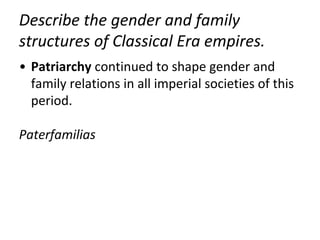
Describe the gender and family
structures of Classical Era empires.
• Patriarchy continued to shape gender and
family relations in all imperial societies of this
period.
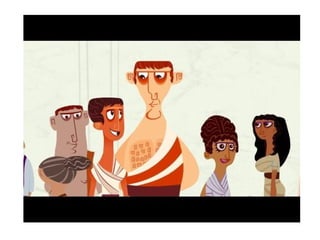
Paterfamilias
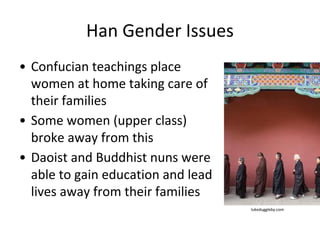
Han Gender Issues
• Confucian teachings place
women at home taking care of
their families
• Some women (upper class)
broke away from this
• Daoist and Buddhist nuns were
able to gain education and lead
lives away from their families
lukeduggleby.com
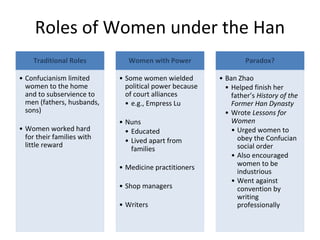
Roles of Women under the Han
Traditional Roles
• Confucianism limited
women to the home
and to subservience to
men (fathers, husbands,
sons)
• Women worked hard
for their families with
little reward
Women with Power
• Some women wielded
political power because
of court alliances
• e.g., Empress Lu
• Nuns
• Educated
• Lived apart from
families
• Medicine practitioners
• Shop managers
• Writers
Paradox?
• Ban Zhao
• Helped finish her
father’s History of the
Former Han Dynasty
• Wrote Lessons for
Women
• Urged women to
obey the Confucian
social order
• Also encouraged
women to be
industrious
• Went against
convention by
writing
professionally
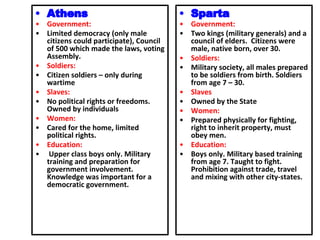
• Athens
• Government:
• Limited democracy (only male
citizens could participate), Council
of 500 which made the laws, voting
Assembly.
• Soldiers:
• Citizen soldiers – only during
wartime
• Slaves:
• No political rights or freedoms.
Owned by individuals
• Women:
• Cared for the home, limited
political rights.
• Education:
• Upper class boys only. Military
training and preparation for
government involvement.
Knowledge was important for a
democratic government.
• Sparta
• Government:
• Two kings (military generals) and a
council of elders. Citizens were
male, native born, over 30.
• Soldiers:
• Military society, all males prepared
to be soldiers from birth. Soldiers
from age 7 – 30.
• Slaves
• Owned by the State
• Women:
• Prepared physically for fighting,
right to inherit property, must
obey men.
• Education:
• Boys only. Military based training
from age 7. Taught to fight.
Prohibition against trade, travel
and mixing with other city-states.
What unique social and economic
characteristics existed in empires?
• What function did imperial cities perform?
• What social classes & occupations were
common in empires?
• What labor systems provided the workers for
Classical Empires?
• Describe the gender and family structures of
Classical Era empires.
Summarize
2.2.IV Transformation of Empires
How did empires decline, collapse, and
transform into successor empires or states?
● Environmental
damage
● Concentration of
wealth
● Frontier conflicts
Examples
Han, Rome, Gupta
Deforestation
Han and Xiongnu
Gupta and Huns
Romans and
northern neighborsDeforestation in Roman Empire Slides
Causes: Creating Demand
• Building supplies
• Wood for fuel
• Clearing land for agriculture
• Grazing destroyed ability of trees for
reproduce
• Julius Caesar ordered troops to cut
down trees to avoid sneak attacks
• Ship-building was of economic and
military significance
• Expansion of urban areas
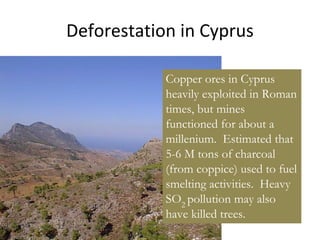
Deforestation in Cyprus
Copper ores in Cyprus
heavily exploited in Roman
times, but mines
functioned for about a
millenium. Estimated that
5-6 M tons of charcoal
(from coppice) used to fuel
smelting activities. Heavy
SO2
pollution may also
have killed trees.
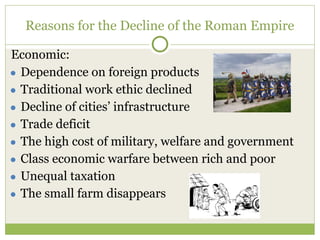
Reasons for the Decline of the Roman Empire
Economic:
● Dependence on foreign products
● Traditional work ethic declined
● Decline of cities’ infrastructure
● Trade deficit
● The high cost of military, welfare and government
● Class economic warfare between rich and poor
● Unequal taxation
● The small farm disappears
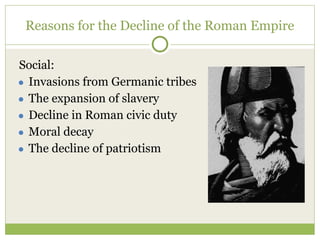
Reasons for the Decline of the Roman Empire
Social:
● Invasions from Germanic tribes
● The expansion of slavery
● Decline in Roman civic duty
● Moral decay
● The decline of patriotism
Reasons for the Decline of the Roman Empire
Political:
● Problems of succession (the next emperor)
● Empire became too large for the government,
and reform came too little and too late
● Government became dominated by the rich and
military elites
● Citizens lost their interest in the government
● The military lost its prestige
Reasons for the Decline of the Han Empire
● Social:
○ Landholding elite held all of the power
○ Disease
● Political:
○ Political fighting between eunuchs, Confucian scholars
and nobles
○ Government corruption and bribery
○ Power in the hands of local landholders and governors
(decentralization)
○ Because of no centralized power, China was vulnerable
● Political and Social:
○ Only wealthy elite could gain political position
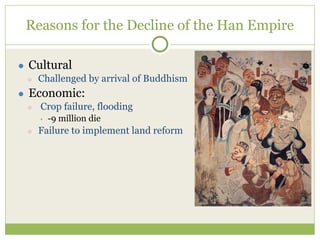
Reasons for the Decline of the Han Empire
● Cultural
○ Challenged by arrival of Buddhism
● Economic:
○ Crop failure, flooding
• -9 million die
○ Failure to implement land reform
Comparative Practice
For each …
1. List one similarity and one difference.
2. Provide three two examples for each item
(6 total).
How were the decline of the Roman Empire
and the Han Dynasty similar and different?
Brought to you by ...
Click or touch for website

2.2 Classical Empires

  • 1.
    Development of Statesand Empires AP World History Key Concept 2.2 Organization and Reorganization of Human Societies 600 BCE to 600 CE
  • 2.
    What were thecommon characteristics among the Classical Empires?
  • 3.
    2.2.I Key Statesand Empires Where were the key states and empires in the Classical Period? ● Southwest Asia: Persian Empires ● East Asia: Qin and Han Empire ● South Asia: Maurya and Gupta Empires ● Mediterranean region: Phoenicia and its colonies, Greek city-states and colonies, and Hellenistic and Roman Empires ● Mesoamerica: Teotihuacan, Maya city- states ● Andean South America: Moche
  • 4.
    How did theClassical empires compare in number and size? Make notes about the size, boundaries, and location of each classical empire.
  • 10.
    2.2.II Imperial Organization(Political) How did states develop new ways of governing the people and the land? ● Centralized governments ● Legal systems ● Bureaucracies ● Diplomacy ● Supply lines ● Roads, walls, fortifications ● Local military ● Currency Examples Make notes about illustrative examples, those specific things, events, people, developments, etc. that define turns in history. Persia Greece Rome Han
  • 11.
    Persia: Cyrus 580-529BCE • Tolerant ruler • Allowed conquered peoples to keep their institutions • Greeks called him a “Law- Giver” and the Hebrews called him “Anointed of the Lord” • Allowed more than 40,000 Jews to return to Palestine
  • 12.
    Cyrus’s Cylinder • Foundin Babylon • Tells how Cyrus helped the people he incorporated into the Persian Empire
  • 13.
    Persia: Darius 526-485BCE • Established a tax-collecting system • Divided the empire into districts called SATRAPIES • Built the great Royal Road system and also created a standard monetary system adopted by the Lydians • Established a complex postal system. • Created a network of spies called “the King’s eyes and ears”
  • 14.
    Persian Law To seekthe promotion of Persian Law, the High Priests sought to welcome the elite of conquered lands into secret societies who were then granted oversight as "viziers" to the Persian overlord.
  • 15.
    Roman Law: The12 Tables • Roman law is the legal system of ancient Rome, and the legal developments spanning over a thousand years of jurisprudence, from the 12 Tables (c. 449 BC), to the • Corpus Juris Civilis (AD 529) ordered by Eastern Roman emperorJustinian I. • The historical importance of Roman law is reflected by the continued use of Latin legal terminology in legal systems influenced by it.
  • 16.
    The Han RestoreUnity It’s the same old story. • Liu Bang, the first Han emperor, establishes political and social stability • After Liu Bang dies, his wife seizes power from their son through a palace plot • Wudi continues Lui Bang’s centralized policies and expands the empire through war hausa.cri.cn
  • 17.
    Highly Structured Government •Han emperors use bureaucracy to run the empire • Civil service job applicants are tested on their knowledge of Confucianism • Top-down rule – each level of bureaucracy has authority over the level below flennoy10.wikis.birmingham.k12.mi.us
  • 19.
    What new politicalmethods were created in order to rule the larger empires in the Classical Era? • Administrative institutions – centralized governments, elaborate legal systems, and bureaucracies
  • 20.
    How did imperialgovernments let their population know that the government was “in charge?” • Diplomacy; developing supply lines; building fortifications, defensive walls, and roads • Drawing new groups of military officers and soldiers from the local populations or conquered peoples • Well trained and extensive military – Military presence on Roman roads was so extensive, – Travel and trade were safer, much faster
  • 21.
  • 24.
    What role didtrade play in creating and maintaining empires? • Promotion of trade and economic integration by – Building and maintaining roads and – Issuing currencies. – Colonies and maritime trade
  • 25.
  • 26.
  • 27.
    Phoenicians • Eastern Mediterranean Canaanites(Greeks called them Phoenicians) • Manufacture and seaborne commerce • Purple dye from the murex snail • Writing system – symbols for sounds • Conflict over territory and resources with Greeks in the West
  • 28.
  • 29.
    Trade grew inHan period • Agriculture basis of economy • Growth of trade increased prosperity • Led to contact between China, other civilizations Production of silk • Most prized Chinese product • Secret method for making silk • Revealing secret punishable by death Han products • Ironworkers made iron armor, swords • Artisans made pottery, jade and bronze objects, lacquerware Major industry • Raised silkworms, unwound threads of cocoons • Dyed threads, wove into fabric • Fabric beautiful, soft, strong • Clothing costly, in high demand Trade
  • 30.
    Delian League • By479 BC, Greeks defeated Persians on land in Asia Minor and stopped their advance. • Athens emerged from the war as the most powerful city-state in Greece. • To continue the struggle against Persia, it organized the Delian League, an alliance with the other Greek city states. • Athens dominated the Delian League and used its wealth to create an Athenian empire.
  • 31.
    What techniques didClassical empires use to administer their territories? • What new political methods were created in order to rule the larger empires in the Classical Era? • How did imperial governments let their population know that the government was “in charge?” • What role did trade play in creating and maintaining empires? Summarize
  • 32.
    2.2.III Economic andSocial How did social and economic dimensions develop in the Classical Period? ● Role of Cities ● Social hierarchies ● Labor management (production of food) ● Rewards to elites ● Patriarchy Examples Persepolis Athens Rome Chang’an Corvee Slavery
  • 33.
    What function didimperial cities perform? • centers of trade, public performance of religious rituals, and political administration for states and empires Rome (video next slide) Athens Chang’an (China) Persepolis (Persian ceremonial city)
  • 35.
    The Rise ofthe Greek Polis Athens Naxos Corinth Syracuse Larissa Eboea
  • 36.
    Athens The City PericlesBuilt ❑ Direct Democracy – Citizen assembly voted directly on laws ❑ Huge construction projects – Acropolis and Parthenon rebuilt ❑ Emphasis on arts, architecture, philosophy and medicine
  • 37.
    What social classes& occupations were common in empires? • empires displayed hierarchies that included cultivators, laborers, slaves, artisans, merchants, elites and caste groups. • range of labor systems to maintain the production of food and provide rewards for the loyalty of the elites including corvée, slavery, rents and tributes, peasant communities and family and household production
  • 39.
    Other Classes • Thirdclass composed of artisans, made useful items, luxury goods • Merchants occupied fourth class, trade not valued by Confucianism • Slaves at bottom of society • Military not an official class, but part of government and offered way to rise in status Social Structure • Han society highly structured, clearly defined social classes • Emperor at top, ruled with mandate from heaven • Upper class of palace court, nobles, government officials, scholars • Second largest class consisted of peasants, who grew empire’s food Han Society
  • 40.
    Social Classes underthe Han Emperor Governors and Kings Nobles, Scholars, and State Officials Peasants (Farmers) Artisans and Merchants Soldiers Slaves
  • 41.
    The Poor • Customdictates that family land is divided equally among the male heirs • If men cannot buy more land, the shares become smaller throughout the generations • Small plots are hard to feed families • Small farmers go into debt
  • 42.
    The Rich • Largelandowners were not required to pay taxes • The more land they acquired, the more the tax base decreased • Poor are taxed more • Gap between rich and poor increases trocadero.com
  • 43.
    What labor systemsprovided the workers for Classical Empires? • Rome – Wide spread use of slave labor from conquered territories – Slave labor forced small farmers out of business. Led to mass unemployment and poverty.
  • 45.
    Describe the genderand family structures of Classical Era empires. • Patriarchy continued to shape gender and family relations in all imperial societies of this period. Paterfamilias
  • 47.
    Han Gender Issues •Confucian teachings place women at home taking care of their families • Some women (upper class) broke away from this • Daoist and Buddhist nuns were able to gain education and lead lives away from their families lukeduggleby.com
  • 48.
    Roles of Womenunder the Han Traditional Roles • Confucianism limited women to the home and to subservience to men (fathers, husbands, sons) • Women worked hard for their families with little reward Women with Power • Some women wielded political power because of court alliances • e.g., Empress Lu • Nuns • Educated • Lived apart from families • Medicine practitioners • Shop managers • Writers Paradox? • Ban Zhao • Helped finish her father’s History of the Former Han Dynasty • Wrote Lessons for Women • Urged women to obey the Confucian social order • Also encouraged women to be industrious • Went against convention by writing professionally
  • 49.
    • Athens • Government: •Limited democracy (only male citizens could participate), Council of 500 which made the laws, voting Assembly. • Soldiers: • Citizen soldiers – only during wartime • Slaves: • No political rights or freedoms. Owned by individuals • Women: • Cared for the home, limited political rights. • Education: • Upper class boys only. Military training and preparation for government involvement. Knowledge was important for a democratic government. • Sparta • Government: • Two kings (military generals) and a council of elders. Citizens were male, native born, over 30. • Soldiers: • Military society, all males prepared to be soldiers from birth. Soldiers from age 7 – 30. • Slaves • Owned by the State • Women: • Prepared physically for fighting, right to inherit property, must obey men. • Education: • Boys only. Military based training from age 7. Taught to fight. Prohibition against trade, travel and mixing with other city-states.
  • 50.
    What unique socialand economic characteristics existed in empires? • What function did imperial cities perform? • What social classes & occupations were common in empires? • What labor systems provided the workers for Classical Empires? • Describe the gender and family structures of Classical Era empires. Summarize
  • 51.
    2.2.IV Transformation ofEmpires How did empires decline, collapse, and transform into successor empires or states? ● Environmental damage ● Concentration of wealth ● Frontier conflicts Examples Han, Rome, Gupta Deforestation Han and Xiongnu Gupta and Huns Romans and northern neighborsDeforestation in Roman Empire Slides
  • 52.
    Causes: Creating Demand •Building supplies • Wood for fuel • Clearing land for agriculture • Grazing destroyed ability of trees for reproduce • Julius Caesar ordered troops to cut down trees to avoid sneak attacks • Ship-building was of economic and military significance • Expansion of urban areas
  • 53.
    Deforestation in Cyprus Copperores in Cyprus heavily exploited in Roman times, but mines functioned for about a millenium. Estimated that 5-6 M tons of charcoal (from coppice) used to fuel smelting activities. Heavy SO2 pollution may also have killed trees.
  • 54.
    Reasons for theDecline of the Roman Empire Economic: ● Dependence on foreign products ● Traditional work ethic declined ● Decline of cities’ infrastructure ● Trade deficit ● The high cost of military, welfare and government ● Class economic warfare between rich and poor ● Unequal taxation ● The small farm disappears
  • 55.
    Reasons for theDecline of the Roman Empire Social: ● Invasions from Germanic tribes ● The expansion of slavery ● Decline in Roman civic duty ● Moral decay ● The decline of patriotism
  • 56.
    Reasons for theDecline of the Roman Empire Political: ● Problems of succession (the next emperor) ● Empire became too large for the government, and reform came too little and too late ● Government became dominated by the rich and military elites ● Citizens lost their interest in the government ● The military lost its prestige
  • 57.
    Reasons for theDecline of the Han Empire ● Social: ○ Landholding elite held all of the power ○ Disease ● Political: ○ Political fighting between eunuchs, Confucian scholars and nobles ○ Government corruption and bribery ○ Power in the hands of local landholders and governors (decentralization) ○ Because of no centralized power, China was vulnerable ● Political and Social: ○ Only wealthy elite could gain political position
  • 58.
    Reasons for theDecline of the Han Empire ● Cultural ○ Challenged by arrival of Buddhism ● Economic: ○ Crop failure, flooding • -9 million die ○ Failure to implement land reform
  • 59.
    Comparative Practice For each… 1. List one similarity and one difference. 2. Provide three two examples for each item (6 total). How were the decline of the Roman Empire and the Han Dynasty similar and different?
  • 60.
    Brought to youby ... Click or touch for website