MEEG 202 Strength
of Materials
26-06-201226-06-2012
Beam Deflections Using Singularity
Functions
Admin
• Preview Example Problems
BEFORE Class
• Homework #4 Due Thursday
• Next class Thursday 1-4
 Please be on Time
Lesson Objectives
1. Understand the meaning of a singularity
functions.
2. Be able to integrate singularity functions.
3. Be able to calculate the deflection of a
beam by using singularity functions.beam by using singularity functions.
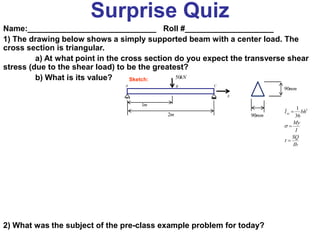
Surprise Quiz
Name:_____________________________ Roll #____________________
1) The drawing below shows a simply supported beam with a center load. The
cross section is triangular.
a) At what point in the cross section do you expect the transverse shear
stress (due to the shear load) to be the greatest?
b) What is its value? Sketch:
x
A
m2
C
m1
kN50
B
mm90
mm90
My
bhIxx  3
36
1
2) What was the subject of the pre-class example problem for today?
Ib
SQ
I
My




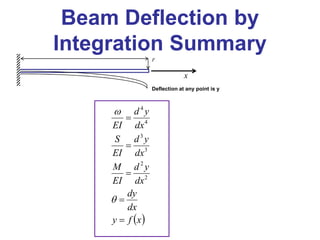
Beam Deflection by
Integration Summary
F
x
Deflection at any point is y
dx
yd
EI


4
4
 xfy
dx
dy
dx
yd
EI
M
dx
yd
EI
S
dxEI






2
2
3
3
4
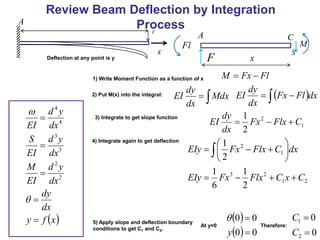
Review Beam Deflection by Integration
ProcessF
x
Deflection at any point is y
dx
yd
EI


4
4
xF
S
M
A
Fl
FlFxM 
2) Put M(x) into the integral:
 Mdx
dx
dy
EI    dxFlFx
dx
dy
EI
3) Integrate to get slope function 21
CFlxFx
dy
EI 
C
A
1) Write Moment Function as a function of x
 xfy
dx
dy
dx
yd
EI
M
dx
yd
EI
S
dxEI






2
2
3
3
4
3) Integrate to get slope function
1
2
2
1
CFlxFx
dx
dy
EI 
4) Integrate again to get deflection
21
23
1
2
2
1
6
1
2
1
CxCFlxFxEIy
dxCFlxFxEIy







 
5) Apply slope and deflection boundary
conditions to get C1 and C2.
 
  00
00


y

At y=0
0
0
2
1


C
C
Therefore:
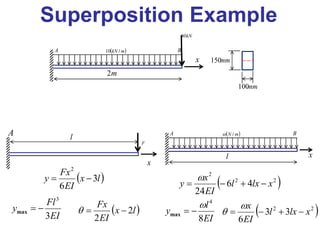
Superposition Example
 mkN /10
x
A
m2
B
kN40
mm150
mm100
F
x
A l
EI
Fl
y
3
3
max  lx
EI
Fx
2
2

 mN /
x
A
l
B
EI
l
y
8
4

max  22
33
6
xlxl
EI
x



 lx
EI
Fx
y 3
6
2

 22
2
46
24
xlxl
EI
x
y 

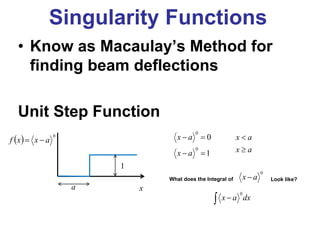
Singularity Functions
• Know as Macaulay’s Method for
finding beam deflections
Unit Step FunctionUnit Step Function
x
1
a
  0
axxf 
1
0
0
0


ax
ax
What does the Integral of
ax
ax


0
ax  Look like?
dxax 
0
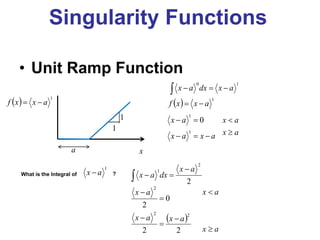
Singularity Functions
• Unit Ramp Function
1
  1
axxf 
ax 
1
0 ax 
10
axdxax 
  1
axxf 
x
1
a
axax
ax


1
0
What is the Integral of
ax
ax


1
ax  ?
1
2
2
1 ax
dxax


 
22
0
2
22
2
axax
ax





ax
ax


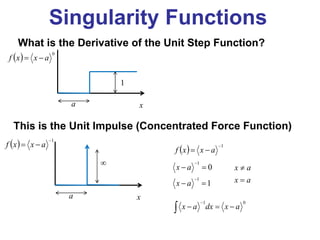
Singularity Functions
What is the Derivative of the Unit Step Function?
x
  0
axxf 
1
a
This is the Unit Impulse (Concentrated Force Function)
  1
 axxf
1
0
1
1




ax
ax
ax
ax


01
axdxax 

x
  1
 axxf

a
This is the Unit Impulse (Concentrated Force Function)
Singularity Functions
x
  1
 axxf

a
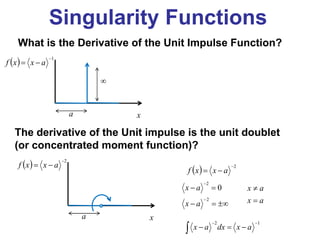
What is the Derivative of the Unit Impulse Function?
The derivative of the Unit impulse is the unit doublet
(or concentrated moment function)?
  2
 axxf




2
2
0
ax
ax
ax
ax


12 
 axdxax
x
  2
 axxf
a
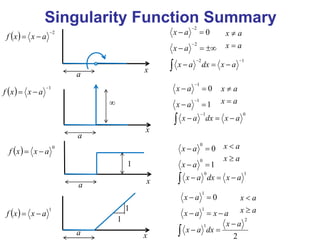
Singularity Function Summary




2
2
0
ax
ax
ax
ax


12 
 axdxax
x
  2
 axxf
a
1
0
1
1




ax
ax
ax
ax


01
axdxax 

  1
 axxf

x
1
a
  0
axxf 
1
0
0
0


ax
ax
ax
ax


10
axdxax 
axdxax 
x
a
x
1
a
  1
axxf  axax
ax


1
1
0
ax
ax


1
2
2
1 ax
dxax


Singularity Function
Process
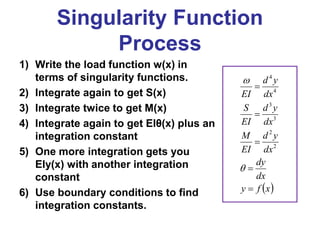
1) Write the load function w(x) in
terms of singularity functions.
2) Integrate again to get S(x)
3) Integrate twice to get M(x)
4) Integrate again to get EIθ(x) plus an dx
yd
EI
S
dx
yd
EI



3
3
4
4
4) Integrate again to get EIθ(x) plus an
integration constant
5) One more integration gets you
EIy(x) with another integration
constant
6) Use boundary conditions to find
integration constants.
 xfy
dx
dy
dx
yd
EI
M
dxEI




2
2
3
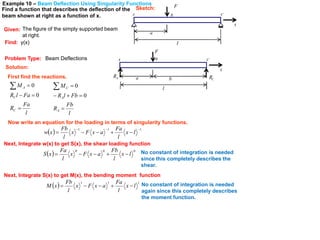
Find a function that describes the deflection of the
beam shown at right as a function of x.
Solution:
Problem Type:
Find:
Given: The figure of the simply supported beam
at right.
y(x)
Beam Deflections
Example 10 – Beam Deflection Using Singularity Functions
First find the reactions.
l
Fa
R
FalR
M
C
C
A



0
0
Now write an equation for the loading in terms of singularity functions.
Sketch:
x
A
l
C
a
F
x
A
l
C
a
F
B
B
AR CR
l
Fb
R
FblR
M
A
A
C



0
0
b
Now write an equation for the loading in terms of singularity functions.
Next, Integrate w(x) to get S(x), the shear loading function
No constant of integration is needed
since this completely describes the
shear.
  111 
 lx
l
Fa
axFx
l
Fb
xw
  000
lx
l
Fb
axFx
l
Fa
xS 
Next, Integrate S(x) to get M(x), the bending moment function
No constant of integration is needed
again since this completely describes
the moment function.
  111
lx
l
Fa
axFx
l
Fb
xM 
Note that the first term in the singularity function will always be evaluated as x2 since x is
always greater than 0 and the last term will always be zero since x≤l. We can then simplify
the last two equations.
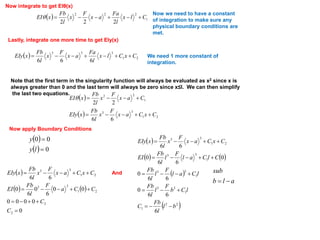
Now integrate to get EIθ(x)
  1
222
222
Clx
l
Fa
ax
F
x
l
Fb
xEI 
Now we need to have a constant
of integration to make sure any
physical boundary conditions are
met.
Lastly, integrate one more time to get EIy(x)
  21
333
666
CxClx
l
Fa
ax
F
x
l
Fb
xEIy  We need 1 more constant of
integration.
  1
22
22
Cax
F
x
l
Fb
xEI 
  21
33
66
CxCax
F
x
l
Fb
xEIy 
66l
 
  0
00


ly
y
Now apply Boundary Conditions
And 
   
0
0000
00
6
0
6
0
66
2
2
21
33
21
33




C
C
CCa
F
l
Fb
EI
CxCax
F
x
l
Fb
xEIy
 
   
 
 22
1
1
33
1
33
1
33
21
33
6
66
0
66
0
0
66
0
66
bl
l
Fb
C
lCb
F
l
l
Fb
lCal
F
l
l
Fb
ClCal
F
l
l
Fb
EI
CxCax
F
x
l
Fb
xEIy





alb
sub

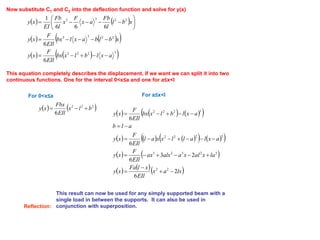
Now substitute C1 and C2 into the deflection function and solve for y(x)
This equation completely describes the displacement, if we want we can split it into two
continuous functions. One for the interval 0<x≤a and one for a≤x<l
   
    
    3222
2233
2233
6
6
666
1
axlblxbx
EIl
F
xy
xblbaxlbx
EIl
F
xy
xbl
l
Fb
ax
F
x
l
Fb
EI
xy









   222
6
blx
EIl
Fbx
xy 
For 0<x≤a For a≤x<l
      axlblxbx
EIl
F
xy
6
3222

Reflection:
This result can now be used for any simply supported beam with a
single load in between the supports. It can also be used in
conjunction with superposition.
         
   
    lxax
EIl
xlFa
xy
laxalxaalxax
EIl
F
xy
axlallxxal
EIl
F
xy
alb
EIl
2
6
23
6
6
6
22
32323
3222






To do for next time
• Next Class on Thursday 1-4
 We will practice beam deflection
problems

Beam deflections using singularity functions

  • 1.
    MEEG 202 Strength ofMaterials 26-06-201226-06-2012 Beam Deflections Using Singularity Functions
  • 2.
    Admin • Preview ExampleProblems BEFORE Class • Homework #4 Due Thursday • Next class Thursday 1-4  Please be on Time
  • 3.
    Lesson Objectives 1. Understandthe meaning of a singularity functions. 2. Be able to integrate singularity functions. 3. Be able to calculate the deflection of a beam by using singularity functions.beam by using singularity functions.
  • 4.
    Surprise Quiz Name:_____________________________ Roll#____________________ 1) The drawing below shows a simply supported beam with a center load. The cross section is triangular. a) At what point in the cross section do you expect the transverse shear stress (due to the shear load) to be the greatest? b) What is its value? Sketch: x A m2 C m1 kN50 B mm90 mm90 My bhIxx  3 36 1 2) What was the subject of the pre-class example problem for today? Ib SQ I My    
  • 5.
    Beam Deflection by IntegrationSummary F x Deflection at any point is y dx yd EI   4 4  xfy dx dy dx yd EI M dx yd EI S dxEI       2 2 3 3 4
  • 6.
    Review Beam Deflectionby Integration ProcessF x Deflection at any point is y dx yd EI   4 4 xF S M A Fl FlFxM  2) Put M(x) into the integral:  Mdx dx dy EI    dxFlFx dx dy EI 3) Integrate to get slope function 21 CFlxFx dy EI  C A 1) Write Moment Function as a function of x  xfy dx dy dx yd EI M dx yd EI S dxEI       2 2 3 3 4 3) Integrate to get slope function 1 2 2 1 CFlxFx dx dy EI  4) Integrate again to get deflection 21 23 1 2 2 1 6 1 2 1 CxCFlxFxEIy dxCFlxFxEIy          5) Apply slope and deflection boundary conditions to get C1 and C2.     00 00   y  At y=0 0 0 2 1   C C Therefore:
  • 7.
    Superposition Example  mkN/10 x A m2 B kN40 mm150 mm100 F x A l EI Fl y 3 3 max  lx EI Fx 2 2   mN / x A l B EI l y 8 4  max  22 33 6 xlxl EI x     lx EI Fx y 3 6 2   22 2 46 24 xlxl EI x y  
  • 8.
    Singularity Functions • Knowas Macaulay’s Method for finding beam deflections Unit Step FunctionUnit Step Function x 1 a   0 axxf  1 0 0 0   ax ax What does the Integral of ax ax   0 ax  Look like? dxax  0
  • 9.
    Singularity Functions • UnitRamp Function 1   1 axxf  ax  1 0 ax  10 axdxax    1 axxf  x 1 a axax ax   1 0 What is the Integral of ax ax   1 ax  ? 1 2 2 1 ax dxax     22 0 2 22 2 axax ax      ax ax  
  • 10.
    Singularity Functions What isthe Derivative of the Unit Step Function? x   0 axxf  1 a This is the Unit Impulse (Concentrated Force Function)   1  axxf 1 0 1 1     ax ax ax ax   01 axdxax   x   1  axxf  a This is the Unit Impulse (Concentrated Force Function)
  • 11.
    Singularity Functions x  1  axxf  a What is the Derivative of the Unit Impulse Function? The derivative of the Unit impulse is the unit doublet (or concentrated moment function)?   2  axxf     2 2 0 ax ax ax ax   12   axdxax x   2  axxf a
  • 12.
    Singularity Function Summary     2 2 0 ax ax ax ax   12  axdxax x   2  axxf a 1 0 1 1     ax ax ax ax   01 axdxax     1  axxf  x 1 a   0 axxf  1 0 0 0   ax ax ax ax   10 axdxax  axdxax  x a x 1 a   1 axxf  axax ax   1 1 0 ax ax   1 2 2 1 ax dxax  
  • 13.
    Singularity Function Process 1) Writethe load function w(x) in terms of singularity functions. 2) Integrate again to get S(x) 3) Integrate twice to get M(x) 4) Integrate again to get EIθ(x) plus an dx yd EI S dx yd EI    3 3 4 4 4) Integrate again to get EIθ(x) plus an integration constant 5) One more integration gets you EIy(x) with another integration constant 6) Use boundary conditions to find integration constants.  xfy dx dy dx yd EI M dxEI     2 2 3
  • 14.
    Find a functionthat describes the deflection of the beam shown at right as a function of x. Solution: Problem Type: Find: Given: The figure of the simply supported beam at right. y(x) Beam Deflections Example 10 – Beam Deflection Using Singularity Functions First find the reactions. l Fa R FalR M C C A    0 0 Now write an equation for the loading in terms of singularity functions. Sketch: x A l C a F x A l C a F B B AR CR l Fb R FblR M A A C    0 0 b Now write an equation for the loading in terms of singularity functions. Next, Integrate w(x) to get S(x), the shear loading function No constant of integration is needed since this completely describes the shear.   111   lx l Fa axFx l Fb xw   000 lx l Fb axFx l Fa xS  Next, Integrate S(x) to get M(x), the bending moment function No constant of integration is needed again since this completely describes the moment function.   111 lx l Fa axFx l Fb xM 
  • 15.
    Note that thefirst term in the singularity function will always be evaluated as x2 since x is always greater than 0 and the last term will always be zero since x≤l. We can then simplify the last two equations. Now integrate to get EIθ(x)   1 222 222 Clx l Fa ax F x l Fb xEI  Now we need to have a constant of integration to make sure any physical boundary conditions are met. Lastly, integrate one more time to get EIy(x)   21 333 666 CxClx l Fa ax F x l Fb xEIy  We need 1 more constant of integration.   1 22 22 Cax F x l Fb xEI    21 33 66 CxCax F x l Fb xEIy  66l     0 00   ly y Now apply Boundary Conditions And      0 0000 00 6 0 6 0 66 2 2 21 33 21 33     C C CCa F l Fb EI CxCax F x l Fb xEIy          22 1 1 33 1 33 1 33 21 33 6 66 0 66 0 0 66 0 66 bl l Fb C lCb F l l Fb lCal F l l Fb ClCal F l l Fb EI CxCax F x l Fb xEIy      alb sub 
  • 16.
    Now substitute C1and C2 into the deflection function and solve for y(x) This equation completely describes the displacement, if we want we can split it into two continuous functions. One for the interval 0<x≤a and one for a≤x<l              3222 2233 2233 6 6 666 1 axlblxbx EIl F xy xblbaxlbx EIl F xy xbl l Fb ax F x l Fb EI xy             222 6 blx EIl Fbx xy  For 0<x≤a For a≤x<l       axlblxbx EIl F xy 6 3222  Reflection: This result can now be used for any simply supported beam with a single load in between the supports. It can also be used in conjunction with superposition.                   lxax EIl xlFa xy laxalxaalxax EIl F xy axlallxxal EIl F xy alb EIl 2 6 23 6 6 6 22 32323 3222      
  • 17.
    To do fornext time • Next Class on Thursday 1-4  We will practice beam deflection problems