bibbidi N-BObbiDY boo
Magic Acceleration of N-Body Simulation
E. Del Sozzo, M. Rabozzi, M. Nanni, M. D. Santambrogio
emanuele.delsozzo@polimi.it
marco.rabozzi@polimi.it
marco3.nanni@mail.polimi.it
marco.santambrogio@polimi.it
Xilinx Open Hardware 2017 Contest
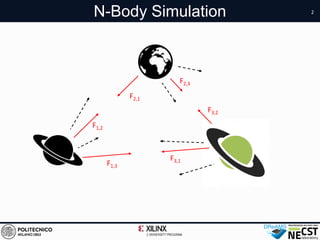
N-Body Simulation 2
F1,2
F1,3
F2,1
F3,1
F2,3
F3,2
N-Body Simulation 3
A highly scalable and efficient parallel design
for All-Pairs N-Body simulation on FPGA
4
Proposed Solution
semi-dataflow architecture tiling approach
1. Hardware/Software Partitioning
2. Data transfer
3. Semi-dataflow architecture
4. Tiling
5
Implementation
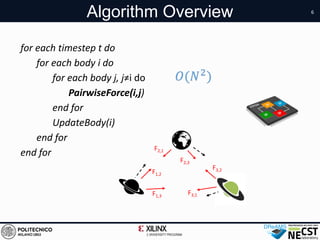
Algorithm Overview 6
for each timestep t do
for each body i do
for each body j, j≠i do
PairwiseForce(i,j)
end for
UpdateBody(i)
end for
end for
F1,2
F1,3
F2,1
F2,3
F3,1
F3,2
𝑂(𝑁2
)
7
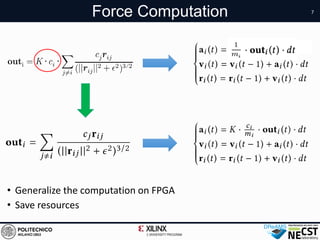
Force Computation
• Generalize the computation on FPGA
• Save resources
1. Hardware/Software Partitioning
2. Data transfer
3. Semi-dataflow architecture
4. Tiling
8
Implementation
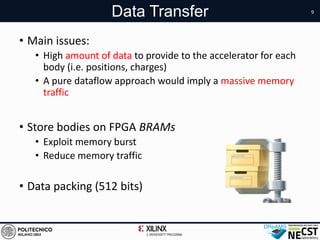
• Main issues:
• High amount of data to provide to the accelerator for each
body (i.e. positions, charges)
• A pure dataflow approach would imply a massive memory
traffic
• Store bodies on FPGA BRAMs
• Exploit memory burst
• Reduce memory traffic
• Data packing (512 bits)
9
Data Transfer
1. Hardware/Software Partitioning
2. Data transfer
3. Semi-dataflow architecture
4. Tiling
10
Implementation
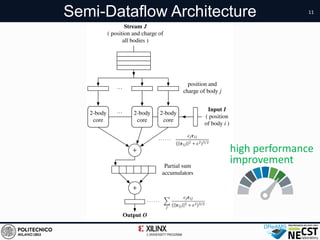
11
Semi-Dataflow Architecture
high performance
improvement
1. Hardware/Software Partitioning
2. Data transfer
3. Semi-dataflow architecture
4. Tiling
12
Implementation
13
Tiling
n-body kernel
(48 x 2-body core)
+
TileBuffer I
( position of bodies
to update)
DDR
TileBuffer J
( position and chargeof
referencebodies)
TileBuffer O
||ri j || ||ri j ||
whereG isthegravitational constant,mi isthemassof body i,
and ri j = ri − rj istheposition vector from body i and j. Thisop-
eration, repeated for each body j, wherej , i, may besummarized
asfollows:
TotPairwiseForce(i) =
X
j , i
PairwiseForce(i,j) =
= Gmi ·
X
j , i
mj ri j
||ri j ||3
(2)
Generally,in thecontext of astrophysical simulations,asoftening
factor 2 > 0 isadded to thedenominator [5]. Thepurposeof this
factor isto avoid collisionsbetween bodies, which isreasonableif
thebodiesrepresent galaxies. Asaconsequence, Equation (2) may
berewritten asfollows:
TotPairwiseForce(i) ⇡ Gmi ·
X
j
mj ri j
(||ri j ||2 + 2)3/ 2
8i (3)
1.2 UpdateBody
The second computational step of the simulation updates the in-
formation about position and velocity of each body within the
system. In particular, thesimulation updatesabody by meansof
itstotal pairwiseforceusing an integrator over asmall timestep
dt. To thisend, in order to integrateover time, thesimulation com-
putes the acceleration vector a of each body i starting from the
Tot Pai r wi seFor ce asfollows:
ai ⇡ G ·
X
j
cj ri j
(||ri j ||2 + 2)3/ 2
8i (4)
Then, thesimulation computestheposition r and velocity v of
body i at timet thanksto theacceleration a and thepreviousr and
v, aswell asintegration timestep dt. Heretheformulasdescribing
der to understand what were the main b
mentation. As we expected, the outcom
identi ed the computation of Tot Pai r w
asthebottleneck of All-Pairsapproach. A
hardware-accelerateTot Pai r wi seFor ce
ing in software the Updat eBody functio
have a general implementation on Field
ray (FPGA) suitablefor all theapplicatio
welightly modi ed both theoutput of To
asUpdat eBody function. Thus, theresult
thefollowing:
outi =
X
j , i
cj ri j
(||ri j ||2 +
wherecj isageneric forcecharge(e.g.
tational eld, acoulomb chargein caseof
a consequence, the new formulas of the
following:
8>>>><
>>>>
:
ai (t) = K · ci
mi
·outi (t
vi (t) = vi (t − 1) + ai (
ri (t) = ri (t − 1) + vi (t
whereK istheconstant typical of cert
tional constant, Coulomb constant). Of co
contest, wejust need to multiply for theg
decided to modify thecodein such away
rst of all, to makethecomputation on th
sible,then to avoid sendingunnecessary d
consequence, saving resources(likeDSPs
when apply tiling).Finally,K· ci
mi
can beea
pliedtotheUpdat eBody function.Themo
approach isreported in Algorithm 2, whe
refersto our hardwareacceleration proce
14
Results
Resource Total Used Total Available Utilization (%)
BRAM_18K 1558 2060 75.6
DSP48E 2028 2800 72.4
FLIP-FLOP 243363 607200 40.1
LUT 262275 303600 86.4
15
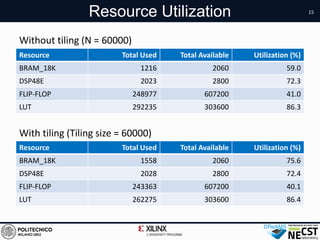
Resource Utilization
Resource Total Used Total Available Utilization (%)
BRAM_18K 1216 2060 59.0
DSP48E 2023 2800 72.3
FLIP-FLOP 248977 607200 41.0
LUT 292235 303600 86.3
Without tiling (N = 60000)
With tiling (Tiling size = 60000)
16
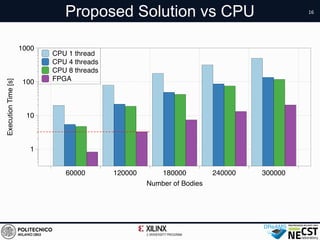
Proposed Solution vs CPU
17
Proposed Solution vs SoA
Platform Type
Cores /
Pipelines
Performance Performance/Power
Ref.
[Mpairs/s] [GFLOPS] [Mpairs/s/W] [GFLOPS/W]
Grape-8 ASIC 2 x 48 - 2 x 480 - 20.5 [4]
Intel i7-6700 CPU 4 766.90 13.80 11.80 0.212
Tegra Kepler GPU 192 192.0 - 96 - [5]
Tesla K80 GPU 2 x 2496 6312 - 63.12 - [5]
8800GTX GPU - ~ 1500 - - - [6]
Cyclone II FPGA 16 - 15.39 - - [7]
Zynq-7020 FPGA 9 1200.5 - 923.46* - [5]
Vectis MAX3 FPGA 1 2978 - 21.3 - [8]
VC707 FPGA 48 4400.45 79.21 220.02 3.96
*Computed from FPGA power consumption only
~ 92% of theoretical performance
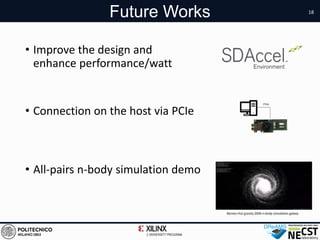
Future Works
• Connection on the host via PCIe
18
• Improve the design and
enhance performance/watt
• All-pairs n-body simulation demo
Barnes-Hut gravity 200k n-body simulation galaxy
Thanks for your attention 19
Bibbidi N-Bobbidy boo at NECST
(https://www.facebook.com/BibbidiNBobbidyboo/)
Bibbidy N-BObbiDY boo at NECST
(https://www.slideshare.net/bibbidyN-BObbiDYboo)
Emanuele Del Sozzo
emanuele.delsozzo@polimi.it
Marco Rabozzi
marco.rabozzi@polimi.it
Marco Nanni
marco3.nanni@mail.polimi.it
Marco D. Santambrogio
marco.santambrogio@polimi.it
@N_BodyAtNECST
(https://twitter.com/N_BodyAtNECST)

6. Implementation

  • 1.
    bibbidi N-BObbiDY boo MagicAcceleration of N-Body Simulation E. Del Sozzo, M. Rabozzi, M. Nanni, M. D. Santambrogio emanuele.delsozzo@polimi.it marco.rabozzi@polimi.it marco3.nanni@mail.polimi.it marco.santambrogio@polimi.it Xilinx Open Hardware 2017 Contest
  • 2.
  • 3.
  • 4.
    A highly scalableand efficient parallel design for All-Pairs N-Body simulation on FPGA 4 Proposed Solution semi-dataflow architecture tiling approach
  • 5.
    1. Hardware/Software Partitioning 2.Data transfer 3. Semi-dataflow architecture 4. Tiling 5 Implementation
  • 6.
    Algorithm Overview 6 foreach timestep t do for each body i do for each body j, j≠i do PairwiseForce(i,j) end for UpdateBody(i) end for end for F1,2 F1,3 F2,1 F2,3 F3,1 F3,2 𝑂(𝑁2 )
  • 7.
    7 Force Computation • Generalizethe computation on FPGA • Save resources
  • 8.
    1. Hardware/Software Partitioning 2.Data transfer 3. Semi-dataflow architecture 4. Tiling 8 Implementation
  • 9.
    • Main issues: •High amount of data to provide to the accelerator for each body (i.e. positions, charges) • A pure dataflow approach would imply a massive memory traffic • Store bodies on FPGA BRAMs • Exploit memory burst • Reduce memory traffic • Data packing (512 bits) 9 Data Transfer
  • 10.
    1. Hardware/Software Partitioning 2.Data transfer 3. Semi-dataflow architecture 4. Tiling 10 Implementation
  • 11.
  • 12.
    1. Hardware/Software Partitioning 2.Data transfer 3. Semi-dataflow architecture 4. Tiling 12 Implementation
  • 13.
    13 Tiling n-body kernel (48 x2-body core) + TileBuffer I ( position of bodies to update) DDR TileBuffer J ( position and chargeof referencebodies) TileBuffer O ||ri j || ||ri j || whereG isthegravitational constant,mi isthemassof body i, and ri j = ri − rj istheposition vector from body i and j. Thisop- eration, repeated for each body j, wherej , i, may besummarized asfollows: TotPairwiseForce(i) = X j , i PairwiseForce(i,j) = = Gmi · X j , i mj ri j ||ri j ||3 (2) Generally,in thecontext of astrophysical simulations,asoftening factor 2 > 0 isadded to thedenominator [5]. Thepurposeof this factor isto avoid collisionsbetween bodies, which isreasonableif thebodiesrepresent galaxies. Asaconsequence, Equation (2) may berewritten asfollows: TotPairwiseForce(i) ⇡ Gmi · X j mj ri j (||ri j ||2 + 2)3/ 2 8i (3) 1.2 UpdateBody The second computational step of the simulation updates the in- formation about position and velocity of each body within the system. In particular, thesimulation updatesabody by meansof itstotal pairwiseforceusing an integrator over asmall timestep dt. To thisend, in order to integrateover time, thesimulation com- putes the acceleration vector a of each body i starting from the Tot Pai r wi seFor ce asfollows: ai ⇡ G · X j cj ri j (||ri j ||2 + 2)3/ 2 8i (4) Then, thesimulation computestheposition r and velocity v of body i at timet thanksto theacceleration a and thepreviousr and v, aswell asintegration timestep dt. Heretheformulasdescribing der to understand what were the main b mentation. As we expected, the outcom identi ed the computation of Tot Pai r w asthebottleneck of All-Pairsapproach. A hardware-accelerateTot Pai r wi seFor ce ing in software the Updat eBody functio have a general implementation on Field ray (FPGA) suitablefor all theapplicatio welightly modi ed both theoutput of To asUpdat eBody function. Thus, theresult thefollowing: outi = X j , i cj ri j (||ri j ||2 + wherecj isageneric forcecharge(e.g. tational eld, acoulomb chargein caseof a consequence, the new formulas of the following: 8>>>>< >>>> : ai (t) = K · ci mi ·outi (t vi (t) = vi (t − 1) + ai ( ri (t) = ri (t − 1) + vi (t whereK istheconstant typical of cert tional constant, Coulomb constant). Of co contest, wejust need to multiply for theg decided to modify thecodein such away rst of all, to makethecomputation on th sible,then to avoid sendingunnecessary d consequence, saving resources(likeDSPs when apply tiling).Finally,K· ci mi can beea pliedtotheUpdat eBody function.Themo approach isreported in Algorithm 2, whe refersto our hardwareacceleration proce
  • 14.
  • 15.
    Resource Total UsedTotal Available Utilization (%) BRAM_18K 1558 2060 75.6 DSP48E 2028 2800 72.4 FLIP-FLOP 243363 607200 40.1 LUT 262275 303600 86.4 15 Resource Utilization Resource Total Used Total Available Utilization (%) BRAM_18K 1216 2060 59.0 DSP48E 2023 2800 72.3 FLIP-FLOP 248977 607200 41.0 LUT 292235 303600 86.3 Without tiling (N = 60000) With tiling (Tiling size = 60000)
  • 16.
  • 17.
    17 Proposed Solution vsSoA Platform Type Cores / Pipelines Performance Performance/Power Ref. [Mpairs/s] [GFLOPS] [Mpairs/s/W] [GFLOPS/W] Grape-8 ASIC 2 x 48 - 2 x 480 - 20.5 [4] Intel i7-6700 CPU 4 766.90 13.80 11.80 0.212 Tegra Kepler GPU 192 192.0 - 96 - [5] Tesla K80 GPU 2 x 2496 6312 - 63.12 - [5] 8800GTX GPU - ~ 1500 - - - [6] Cyclone II FPGA 16 - 15.39 - - [7] Zynq-7020 FPGA 9 1200.5 - 923.46* - [5] Vectis MAX3 FPGA 1 2978 - 21.3 - [8] VC707 FPGA 48 4400.45 79.21 220.02 3.96 *Computed from FPGA power consumption only ~ 92% of theoretical performance
  • 18.
    Future Works • Connectionon the host via PCIe 18 • Improve the design and enhance performance/watt • All-pairs n-body simulation demo Barnes-Hut gravity 200k n-body simulation galaxy
  • 19.
    Thanks for yourattention 19 Bibbidi N-Bobbidy boo at NECST (https://www.facebook.com/BibbidiNBobbidyboo/) Bibbidy N-BObbiDY boo at NECST (https://www.slideshare.net/bibbidyN-BObbiDYboo) Emanuele Del Sozzo emanuele.delsozzo@polimi.it Marco Rabozzi marco.rabozzi@polimi.it Marco Nanni marco3.nanni@mail.polimi.it Marco D. Santambrogio marco.santambrogio@polimi.it @N_BodyAtNECST (https://twitter.com/N_BodyAtNECST)