Performance Optimization of Smoothed Particle
Hydrodynamics for Multi/Many-Core Architectures
Dr. Fabio Baruffa fabio.baruffa@lrz.de
Leibniz Supercomputing Centre
MC² Series: Colfax Research Webinar, http://mc2series.com
March 7th
, 2017
2
Work contributors
● Member of the IPCC @ LRZ
● Expert in performance
optimization and HPC systems
● Member of the IPCC @ LRZ
● Expert in computational
astrophysics and simulations
Dr. Fabio Baruffa
Sr. HPC Application Specialist
Leibniz Supercomputing Centre
Dr. Luigi Iapichino
Scientific Computing Expert
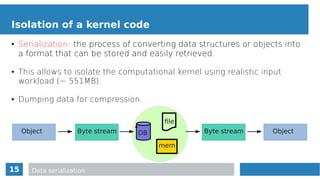
Leibniz Supercomputing Centre
Email contacts: fabio.baruffa@lrz.de luigi.iapichino@lrz.de
3
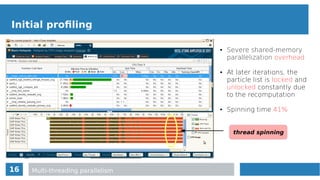
Intel®
Parallel Computing Centers (IPCC)
● The IPCCs are an Intel initiative for code
modernization of technical computing codes.
● The work primary focus on code optimization
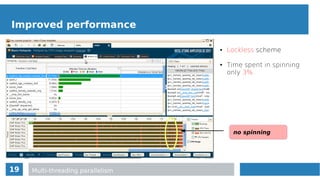
increasing parallelism and scalability on
multi/many core architectures.
● Currently ~70 IPCCs are funded worldwide.
● Our target is to prepare the simulation software
for new platforms achieving high
nodel-level performance and multi-node
scalability.
4
Outline of the talk
Preprint of this work: https://arxiv.org/abs/1612.06090
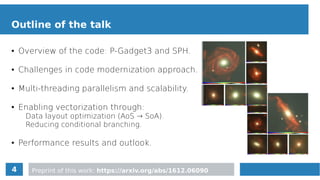
● Overview of the code: P-Gadget3 and SPH.
● Challenges in code modernization approach.
● Multi-threading parallelism and scalability.
● Enabling vectorization through:
Data layout optimization (AoS → SoA).
Reducing conditional branching.
● Performance results and outlook.
5
Gadget intro
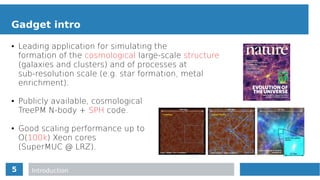
● Leading application for simulating the
formation of the cosmological large-scale structure
(galaxies and clusters) and of processes at
sub-resolution scale (e.g. star formation, metal
enrichment).
● Publicly available, cosmological
TreePM N-body + SPH code.
● Good scaling performance up to
O(100k) Xeon cores
(SuperMUC @ LRZ).
Introduction
6
Smoothed particle hydrodynamics (SPH)
Introduction
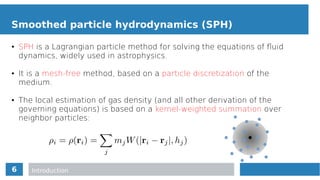
● SPH is a Lagrangian particle method for solving the equations of fluid
dynamics, widely used in astrophysics.
● It is a mesh-free method, based on a particle discretization of the
medium.
● The local estimation of gas density (and all other derivation of the
governing equations) is based on a kernel-weighted summation over
neighbor particles:
7
Gadget features
Introduction
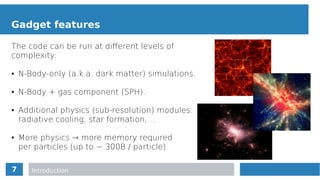
The code can be run at different levels of
complexity:
● N-Body-only (a.k.a. dark matter) simulations.
● N-Body + gas component (SPH).
● Additional physics (sub-resolution) modules:
radiative cooling, star formation,…
● More physics → more memory required
per particles (up to ~ 300B / particle).
8
Features of the code
Gadget features
● Gadget has been first developed in the late 90s as serial code, has later
evolved as an MPI and a hybrid code.
● After the last public release Gadget-2, many research groups all over the
world have developed their own branches.
● The branch used for this project (P-Gadget3) has been used for more than
30 research papers over the last two years.
● The code have ~200 files, ~400k code lines, extensive use of #IFDEF, ext.
libs (fftw,hdf5).
9
Basic principles of our development
Basic principle of our development
● Our intention is to ensure:
● Portability on all modern architectures (Intel®
Xeon/MIC, Power, GPU,…);
● Readability for non-experts in HPC;
● Consistency with all the existing functionalities.
● We perform code modifications which are minimally invasive.
● The domain scientists have to be able to modify the code without coping
with performance questions.
10
Code modernization approach
Code modernization
● Scalar optimization: compiler flags, data casting, precision consistency.
● Vectorization: prepare the code for SIMD, avoid vector dependencies.
● Memory access: improve data layout, cache access.
● Multi-threading: enable OpenMP, manage scheduling and pinning.
● Communication: enable MPI, offloading computation.
https://software.intel.com/en-us/articles/what-
is-code-modernization; colfaxresearch.com
11
Code modernization approach
Code modernization
● Scalar optimization: compiler flags, data casting, precision consistency.
● Vectorization: prepare the code for SIMD, avoid vector dependencies.
● Memory access: improve data layout, cache access.
● Multi-threading: enable OpenMP, manage scheduling and pinning.
● Communication: enable MPI, offloading computation.
https://software.intel.com/en-us/articles/what-
is-code-modernization; colfaxresearch.com
Preparation for the next generation processors and efficient usage of the current
hardware
12
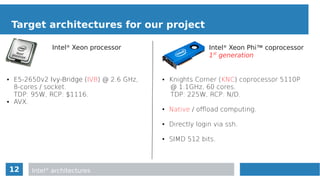
Target architectures for our project
Intel®
architectures
● E5-2650v2 Ivy-Bridge (IVB) @ 2.6 GHz,
8-cores / socket.
TDP: 95W, RCP: $1116.
● AVX.
Intel®
Xeon processor Intel®
Xeon Phi™ coprocessor
1st
generation
● Knights Corner (KNC) coprocessor 5110P
@ 1.1GHz, 60 cores.
TDP: 225W, RCP: N/D.
● Native / offload computing.
● Directly login via ssh.
● SIMD 512 bits.
13
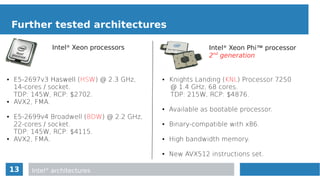
Further tested architectures
Intel®
architectures
● E5-2697v3 Haswell (HSW) @ 2.3 GHz,
14-cores / socket.
TDP: 145W, RCP: $2702.
● AVX2, FMA.
● E5-2699v4 Broadwell (BDW) @ 2.2 GHz,
22-cores / socket.
TDP: 145W, RCP: $4115.
● AVX2, FMA.
Intel®
Xeon processors
● Knights Landing (KNL) Processor 7250
@ 1.4 GHz, 68 cores.
TDP: 215W, RCP: $4876.
● Available as bootable processor.
● Binary-compatible with x86.
● High bandwidth memory.
● New AVX512 instructions set.
Intel®
Xeon Phi™ processor
2nd
generation
14
Optimization strategy
●
We isolate the representative code kernel subfind_density and run it in as
a stand-alone application, avoiding the overhead from the whole simulation.
●
As most code components, it consists of two sub-phases of nearly equal
execution time (40 to 45% for each of them), namely the neighbour-finding
phase and the remaining physics computations.
●
Our physics workload: ~ 500k particles. This is a typical workload per node of
simulations with moderate resolution.
●
We focus mainly on node-level performance.
●
We use tools from the Intel®
Parallel Studio XE (VTune Amplifier and Advisor).
Simulation details:
www.magneticum.org
15
Isolation of a kernel code
Data serialization
● Serialization: the process of converting data structures or objects into
a format that can be stored and easily retrieved.
● This allows to isolate the computational kernel using realistic input
workload (~ 551MB).
● Dumping data for compression.
Object Byte stream Byte streamByte stream ObjectDB
file
mem
16
Initial profiling
Multi-threading parallelism
thread spinning
● Severe shared-memory
parallelization overhead
● At later iterations, the
particle list is locked and
unlocked constantly due
to the recomputation
● Spinning time 41%
17
Algorithm pseudocode
Subfind algorithm
more_particles = partlist.length;
while(more_particles){
  int i=0;                 
  while(!error && i<partlist.length){
  #pragma omp parallel
  {
    #pragma omp critical
    {
   p = partlist[i++];  
    }
    if(!must_compute(p)) continue;
    ngblist = find_neighbours(p);
    sort(ngblist);
    for(auto n:select(ngblist,K)) 
       compute_interaction(p,n);
  }
  more_particles = mark_for_recomputation(partlist);
}
while loop over the full particle list
each thread gets the next particle
(private p) to process
check for computation
actual computation
18
Removing lock contention
Subfind algorithm
todo_partlist = partlist;
while(partlist.length){
  error=0;
  #pragma omp parallel for schedule(dynamic)
  for(auto p:todo_partlist){
    if(something_is_wrog) error=1;
    ngblist = find_neighbours(p);
    sort(ngblist);
    for(auto n:select(ngblist,K)) 
       compute_interaction(p,n);
  }
//...check for any error
  todo_particles = mark_for_recomputation(partlist);
}
creating a todo particle list
iterations over the todo list
(private ngblist)
actual computation
No-checks for computation
19
Improved performance
Multi-threading parallelism
no spinning
● Lockless scheme
● Time spent in spinning
only 3%
20
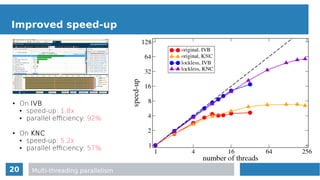
Improved speed-up
Multi-threading parallelism
● On IVB
● speed-up: 1.8x
● parallel efficiency: 92%
● On KNC
● speed-up: 5.2x
● parallel efficiency: 57%
21
Obstacles to efficient auto-vectorization
for(n = 0, n < neighboring_particles, n++ ){
    j = ngblist[n];   
           
    if (particle n within smoothing_length){   
                        
       inlined_function1(…, &w);
       inlined_function2(…, &w);
       rho   += P_AoS[j].mass*w;
       vel_x += P_AoS[j].vel_x;
       …
       v2 += vel_x*vel_x + … vel_z*vel_z;      
   }
Target loop
for loop over neighbors
check for computation
computing physics
Particles properties via
AoS
22
struct ParticleAoS
{
  float pos[3];
  float vel[3];
  float mass;
}
struct ParticleSoA
{
  float *pos_x, *pos_y, *pos_z;
  float *vel_x, *vel_y, *vel_z;
  float mass;
}
Data layout
pos[0]
...
pos[1]
pos[2]
vel[0]
...
pos[0]
pos[1]
pos[2]
...
mass
xi+1
xi+2
xi+3
xi+4
xi+5
xi+6
xi
xi+7
...
pos_x
...
pos_x
pos_x
pos_x
pos_x
pos_x
pos_x
pos_x
pos_x
...
xi+1
xi+2
xi+3
xi+4
xi+5
xi+6
xi
xi+7
...particles[i]particles[i+1]
p.pos_x[i]
p.pos_x[i+1]
p.pos_x[i+2]
p.pos_x[i+3]
p.pos_x[i+4]
p.pos_x[i+5]
p.pos_x[i+6]
p.pos_x[i+7]
p.pos_x[i+8]
Memory Memory
Vector
Register
Vector
Register
AoS SoA
Data layout: AoS vs SoA
Automatically vectorized loops can
contain loads from not contiguous
memory locations → non-unit stride
● The compiler has issued hardware
gather/scatter instructions.
 
23
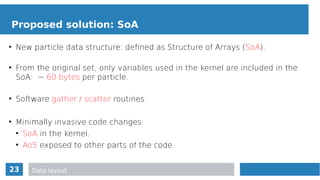
Proposed solution: SoA
●
New particle data structure: defined as Structure of Arrays (SoA).
●
From the original set, only variables used in the kernel are included in the
SoA: ~ 60 bytes per particle.
●
Software gather / scatter routines.
●
Minimally invasive code changes:
●
SoA in the kernel.
●
AoS exposed to other parts of the code.
Data layout
24
Implementation details
Data layout
struct ParticleSoA
{
  float *pos_x, … , *vel_x, …, mass;
}
Particle_SoA P_SoA;
P_SoA.pos_x = malloc(N*sizeof(float));
…
       
…
rho   += P_AoS[j].mass*w;
vel_x += P_AoS[j].vel_x;
…
       
…
rho   += P_SoA.mass[j]*w;
vel_x += P_SoA.vel_x[j];
…
       
struct ParticleAoS
{
  float pos[3], vel[3], mass;
}
Particle_AoS *P_AoS;
P_AoS = malloc(N*sizeof(Particle_AoS);
    
void gather_Pdata(struct Particle_SoA *dst, struct Particle_AoS *src, int N )
for(int i = 0, i < N, i++ ){
    dst ­> pos_x[i] = src[i].pos[1]; dst ­> pos_y[i] = src[i].pos[2]; … 
}   
25
AoS to SoA: performance outcomes
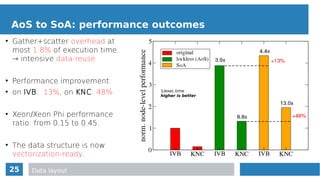
●
Gather+scatter overhead at
most 1.8% of execution time.
→ intensive data-reuse
●
Performance improvement:
●
on IVB: 13%, on KNC: 48%
●
Xeon/Xeon Phi performance
ratio: from 0.15 to 0.45.
●
The data structure is now
vectorization-ready.
Data layout
1/exec.time
higher is better
26
Optimizing for vectorization
●
Modern multi/many-core architectures rely on vectorization as an additional
layer of parallelism to deliver performance.
●
Mind the constraint: keep Gadget readable and portable for the wide user
community! Wherever possible, avoid programming in intrinsics.
●
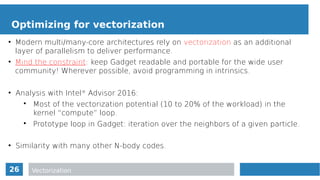
Analysis with Intel®
Advisor 2016:
• Most of the vectorization potential (10 to 20% of the workload) in the
kernel “compute” loop.
• Prototype loop in Gadget: iteration over the neighbors of a given particle.
●
Similarity with many other N-body codes.
Vectorization
27
Vectorization: improvements from IVB to KNL
●
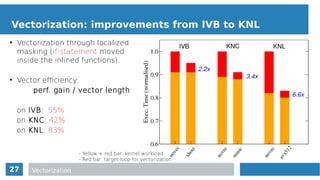
Vectorization through localized
masking (if-statement moved
inside the inlined functions).
●
Vector efficiency:
perf. gain / vector length
on IVB: 55%
on KNC: 42%
on KNL: 83%
Vectorization
- Yellow + red bar: kernel workload
- Red bar: target loop for vectorization
28
Node-level performance comparison between HSW,
KNC and KNL
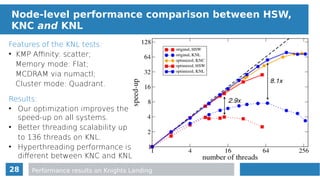
Features of the KNL tests:
●
KMP Affinity: scatter;
Memory mode: Flat;
MCDRAM via numactl;
Cluster mode: Quadrant.
Results:
●
Our optimization improves the
speed-up on all systems.
●
Better threading scalability up
to 136 threads on KNL.
●
Hyperthreading performance is
different between KNC and KNL.
Performance results on Knights Landing
29
Performance comparison: first results including KNL
and Broadwell
●
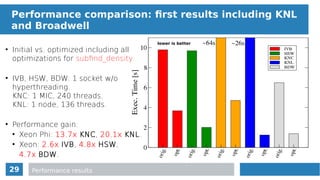
Initial vs. optimized including all
optimizations for subfind_density
●
IVB, HSW, BDW: 1 socket w/o
hyperthreading.
KNC: 1 MIC, 240 threads.
KNL: 1 node, 136 threads.
●
Performance gain:
●
Xeon Phi: 13.7x KNC, 20.1x KNL.
●
Xeon: 2.6x IVB, 4.8x HSW,
4.7x BDW.
Performance results
lower is better
30
Summary and outlook
●
Code modernization as the iterative process for improving the performance of an
HPC application.
●
Our IPCC example: P-Gadget3.
Threading parallelism
Data layout Key points of our work, guided by analysis tools.
Vectorization
●
This effort is (mostly) portable! Good performance found on new architectures (KNL
and BDW) basically out-of-the-box.
●
For KNL, architecture-specific features (MCDRAM, large vector registers and NUMA
characteristics) are currently under investigation for different workloads.
●
Investment on the future of well-established community applications, and crucial for
the effective use of forthcoming HPC facilities.
https://arxiv.org/abs/1612.06090
31
Acknowledgements
●
Research supported by the Intel®
Parallel Computing Center program.
●
Project coauthors: Nicolay J. Hammer (LRZ), Vasileios Karakasis (CSCS).
●
P-Gadget3 developers: Klaus Dolag, Margarita Petkova, Antonio Ragagnin.
●
Research collaborator at Technical University of Munich (TUM): Nikola Tchipev.
●
TCEs at Intel: Georg Zitzlsberger, Heinrich Bockhorst.
●
Thanks to the IXPUG community for useful discussion.
●
Special thanks to Colfax Research for proposing this contribution to the MC² Series,
and for granting access to their computing facilities.

Performance Optimization of SPH Algorithms for Multi/Many-Core Architectures

  • 1.
    Performance Optimization ofSmoothed Particle Hydrodynamics for Multi/Many-Core Architectures Dr. Fabio Baruffa fabio.baruffa@lrz.de Leibniz Supercomputing Centre MC² Series: Colfax Research Webinar, http://mc2series.com March 7th , 2017
  • 2.
    2 Work contributors ● Memberof the IPCC @ LRZ ● Expert in performance optimization and HPC systems ● Member of the IPCC @ LRZ ● Expert in computational astrophysics and simulations Dr. Fabio Baruffa Sr. HPC Application Specialist Leibniz Supercomputing Centre Dr. Luigi Iapichino Scientific Computing Expert Leibniz Supercomputing Centre Email contacts: fabio.baruffa@lrz.de luigi.iapichino@lrz.de
  • 3.
    3 Intel® Parallel Computing Centers(IPCC) ● The IPCCs are an Intel initiative for code modernization of technical computing codes. ● The work primary focus on code optimization increasing parallelism and scalability on multi/many core architectures. ● Currently ~70 IPCCs are funded worldwide. ● Our target is to prepare the simulation software for new platforms achieving high nodel-level performance and multi-node scalability.
  • 4.
    4 Outline of thetalk Preprint of this work: https://arxiv.org/abs/1612.06090 ● Overview of the code: P-Gadget3 and SPH. ● Challenges in code modernization approach. ● Multi-threading parallelism and scalability. ● Enabling vectorization through: Data layout optimization (AoS → SoA). Reducing conditional branching. ● Performance results and outlook.
  • 5.
    5 Gadget intro ● Leadingapplication for simulating the formation of the cosmological large-scale structure (galaxies and clusters) and of processes at sub-resolution scale (e.g. star formation, metal enrichment). ● Publicly available, cosmological TreePM N-body + SPH code. ● Good scaling performance up to O(100k) Xeon cores (SuperMUC @ LRZ). Introduction
  • 6.
    6 Smoothed particle hydrodynamics(SPH) Introduction ● SPH is a Lagrangian particle method for solving the equations of fluid dynamics, widely used in astrophysics. ● It is a mesh-free method, based on a particle discretization of the medium. ● The local estimation of gas density (and all other derivation of the governing equations) is based on a kernel-weighted summation over neighbor particles:
  • 7.
    7 Gadget features Introduction The codecan be run at different levels of complexity: ● N-Body-only (a.k.a. dark matter) simulations. ● N-Body + gas component (SPH). ● Additional physics (sub-resolution) modules: radiative cooling, star formation,… ● More physics → more memory required per particles (up to ~ 300B / particle).
  • 8.
    8 Features of thecode Gadget features ● Gadget has been first developed in the late 90s as serial code, has later evolved as an MPI and a hybrid code. ● After the last public release Gadget-2, many research groups all over the world have developed their own branches. ● The branch used for this project (P-Gadget3) has been used for more than 30 research papers over the last two years. ● The code have ~200 files, ~400k code lines, extensive use of #IFDEF, ext. libs (fftw,hdf5).
  • 9.
    9 Basic principles ofour development Basic principle of our development ● Our intention is to ensure: ● Portability on all modern architectures (Intel® Xeon/MIC, Power, GPU,…); ● Readability for non-experts in HPC; ● Consistency with all the existing functionalities. ● We perform code modifications which are minimally invasive. ● The domain scientists have to be able to modify the code without coping with performance questions.
  • 10.
    10 Code modernization approach Codemodernization ● Scalar optimization: compiler flags, data casting, precision consistency. ● Vectorization: prepare the code for SIMD, avoid vector dependencies. ● Memory access: improve data layout, cache access. ● Multi-threading: enable OpenMP, manage scheduling and pinning. ● Communication: enable MPI, offloading computation. https://software.intel.com/en-us/articles/what- is-code-modernization; colfaxresearch.com
  • 11.
    11 Code modernization approach Codemodernization ● Scalar optimization: compiler flags, data casting, precision consistency. ● Vectorization: prepare the code for SIMD, avoid vector dependencies. ● Memory access: improve data layout, cache access. ● Multi-threading: enable OpenMP, manage scheduling and pinning. ● Communication: enable MPI, offloading computation. https://software.intel.com/en-us/articles/what- is-code-modernization; colfaxresearch.com Preparation for the next generation processors and efficient usage of the current hardware
  • 12.
    12 Target architectures forour project Intel® architectures ● E5-2650v2 Ivy-Bridge (IVB) @ 2.6 GHz, 8-cores / socket. TDP: 95W, RCP: $1116. ● AVX. Intel® Xeon processor Intel® Xeon Phi™ coprocessor 1st generation ● Knights Corner (KNC) coprocessor 5110P @ 1.1GHz, 60 cores. TDP: 225W, RCP: N/D. ● Native / offload computing. ● Directly login via ssh. ● SIMD 512 bits.
  • 13.
    13 Further tested architectures Intel® architectures ●E5-2697v3 Haswell (HSW) @ 2.3 GHz, 14-cores / socket. TDP: 145W, RCP: $2702. ● AVX2, FMA. ● E5-2699v4 Broadwell (BDW) @ 2.2 GHz, 22-cores / socket. TDP: 145W, RCP: $4115. ● AVX2, FMA. Intel® Xeon processors ● Knights Landing (KNL) Processor 7250 @ 1.4 GHz, 68 cores. TDP: 215W, RCP: $4876. ● Available as bootable processor. ● Binary-compatible with x86. ● High bandwidth memory. ● New AVX512 instructions set. Intel® Xeon Phi™ processor 2nd generation
  • 14.
    14 Optimization strategy Optimization strategy ● Weisolate the representative code kernel subfind_density and run it in as a stand-alone application, avoiding the overhead from the whole simulation. ● As most code components, it consists of two sub-phases of nearly equal execution time (40 to 45% for each of them), namely the neighbour-finding phase and the remaining physics computations. ● Our physics workload: ~ 500k particles. This is a typical workload per node of simulations with moderate resolution. ● We focus mainly on node-level performance. ● We use tools from the Intel® Parallel Studio XE (VTune Amplifier and Advisor). Simulation details: www.magneticum.org
  • 15.
    15 Isolation of akernel code Data serialization ● Serialization: the process of converting data structures or objects into a format that can be stored and easily retrieved. ● This allows to isolate the computational kernel using realistic input workload (~ 551MB). ● Dumping data for compression. Object Byte stream Byte streamByte stream ObjectDB file mem
  • 16.
    16 Initial profiling Multi-threading parallelism threadspinning ● Severe shared-memory parallelization overhead ● At later iterations, the particle list is locked and unlocked constantly due to the recomputation ● Spinning time 41%
  • 17.
  • 18.
    18 Removing lock contention Subfindalgorithm todo_partlist = partlist; while(partlist.length){   error=0;   #pragma omp parallel for schedule(dynamic)   for(auto p:todo_partlist){     if(something_is_wrog) error=1;     ngblist = find_neighbours(p);     sort(ngblist);     for(auto n:select(ngblist,K))         compute_interaction(p,n);   } //...check for any error   todo_particles = mark_for_recomputation(partlist); } creating a todo particle list iterations over the todo list (private ngblist) actual computation No-checks for computation
  • 19.
    19 Improved performance Multi-threading parallelism nospinning ● Lockless scheme ● Time spent in spinning only 3%
  • 20.
    20 Improved speed-up Multi-threading parallelism ●On IVB ● speed-up: 1.8x ● parallel efficiency: 92% ● On KNC ● speed-up: 5.2x ● parallel efficiency: 57%
  • 21.
    21 Obstacles to efficientauto-vectorization for(n = 0, n < neighboring_particles, n++ ){     j = ngblist[n];                    if (particle n within smoothing_length){                                    inlined_function1(…, &w);        inlined_function2(…, &w);        rho   += P_AoS[j].mass*w;        vel_x += P_AoS[j].vel_x;        …        v2 += vel_x*vel_x + … vel_z*vel_z;          } Target loop for loop over neighbors check for computation computing physics Particles properties via AoS
  • 22.
    22 struct ParticleAoS {   float pos[3];   float vel[3];   float mass; } struct ParticleSoA {   float *pos_x, *pos_y, *pos_z;   float *vel_x, *vel_y, *vel_z;   float mass; } Data layout pos[0] ... pos[1] pos[2] vel[0] ... pos[0] pos[1] pos[2] ... mass xi+1 xi+2 xi+3 xi+4 xi+5 xi+6 xi xi+7 ... pos_x ... pos_x pos_x pos_x pos_x pos_x pos_x pos_x pos_x ... xi+1 xi+2 xi+3 xi+4 xi+5 xi+6 xi xi+7 ...particles[i]particles[i+1] p.pos_x[i] p.pos_x[i+1] p.pos_x[i+2] p.pos_x[i+3] p.pos_x[i+4] p.pos_x[i+5] p.pos_x[i+6] p.pos_x[i+7] p.pos_x[i+8] Memory Memory Vector Register Vector Register AoSSoA Data layout: AoS vs SoA Automatically vectorized loops can contain loads from not contiguous memory locations → non-unit stride ● The compiler has issued hardware gather/scatter instructions.  
  • 23.
    23 Proposed solution: SoA ● Newparticle data structure: defined as Structure of Arrays (SoA). ● From the original set, only variables used in the kernel are included in the SoA: ~ 60 bytes per particle. ● Software gather / scatter routines. ● Minimally invasive code changes: ● SoA in the kernel. ● AoS exposed to other parts of the code. Data layout
  • 24.
  • 25.
    25 AoS to SoA:performance outcomes ● Gather+scatter overhead at most 1.8% of execution time. → intensive data-reuse ● Performance improvement: ● on IVB: 13%, on KNC: 48% ● Xeon/Xeon Phi performance ratio: from 0.15 to 0.45. ● The data structure is now vectorization-ready. Data layout 1/exec.time higher is better
  • 26.
    26 Optimizing for vectorization ● Modernmulti/many-core architectures rely on vectorization as an additional layer of parallelism to deliver performance. ● Mind the constraint: keep Gadget readable and portable for the wide user community! Wherever possible, avoid programming in intrinsics. ● Analysis with Intel® Advisor 2016: • Most of the vectorization potential (10 to 20% of the workload) in the kernel “compute” loop. • Prototype loop in Gadget: iteration over the neighbors of a given particle. ● Similarity with many other N-body codes. Vectorization
  • 27.
    27 Vectorization: improvements fromIVB to KNL ● Vectorization through localized masking (if-statement moved inside the inlined functions). ● Vector efficiency: perf. gain / vector length on IVB: 55% on KNC: 42% on KNL: 83% Vectorization - Yellow + red bar: kernel workload - Red bar: target loop for vectorization
  • 28.
    28 Node-level performance comparisonbetween HSW, KNC and KNL Features of the KNL tests: ● KMP Affinity: scatter; Memory mode: Flat; MCDRAM via numactl; Cluster mode: Quadrant. Results: ● Our optimization improves the speed-up on all systems. ● Better threading scalability up to 136 threads on KNL. ● Hyperthreading performance is different between KNC and KNL. Performance results on Knights Landing
  • 29.
    29 Performance comparison: firstresults including KNL and Broadwell ● Initial vs. optimized including all optimizations for subfind_density ● IVB, HSW, BDW: 1 socket w/o hyperthreading. KNC: 1 MIC, 240 threads. KNL: 1 node, 136 threads. ● Performance gain: ● Xeon Phi: 13.7x KNC, 20.1x KNL. ● Xeon: 2.6x IVB, 4.8x HSW, 4.7x BDW. Performance results lower is better
  • 30.
    30 Summary and outlook ● Codemodernization as the iterative process for improving the performance of an HPC application. ● Our IPCC example: P-Gadget3. Threading parallelism Data layout Key points of our work, guided by analysis tools. Vectorization ● This effort is (mostly) portable! Good performance found on new architectures (KNL and BDW) basically out-of-the-box. ● For KNL, architecture-specific features (MCDRAM, large vector registers and NUMA characteristics) are currently under investigation for different workloads. ● Investment on the future of well-established community applications, and crucial for the effective use of forthcoming HPC facilities. https://arxiv.org/abs/1612.06090
  • 31.
    31 Acknowledgements ● Research supported bythe Intel® Parallel Computing Center program. ● Project coauthors: Nicolay J. Hammer (LRZ), Vasileios Karakasis (CSCS). ● P-Gadget3 developers: Klaus Dolag, Margarita Petkova, Antonio Ragagnin. ● Research collaborator at Technical University of Munich (TUM): Nikola Tchipev. ● TCEs at Intel: Georg Zitzlsberger, Heinrich Bockhorst. ● Thanks to the IXPUG community for useful discussion. ● Special thanks to Colfax Research for proposing this contribution to the MC² Series, and for granting access to their computing facilities.