
OpenCL Programming & Optimization Case StudyPerhaad Mistry & Dana Schaa,Northeastern University Computer ArchitectureResearch Lab, with Benedict R. Gaster, AMD© 2011
Instructor NotesLecture discusses parallel implementation of a simple embarrassingly parallel nbody algorithmWe aim to provide some correspondence between the architectural techniques discussed in the optimization lectures and a real scientific computation algorithmWe implement a N-body formulation of gravitational attraction between bodiesTwo possible optimizations on a naïve nbody implementationData reuse vs.  non data reuse Unrolling of inner loop Simple example based on the AMD Nbody SDK exampleExample provided allows user to:Change data size to study scalingSwitch data reuse on or offChange unrolling factor of n-body loopRun example without parameters for help on how to run the example and define optimizations to be applied to OpenCL kernel2Perhaad Mistry & Dana Schaa, Northeastern Univ Computer Architecture Research Lab, with Ben Gaster, AMD © 2011
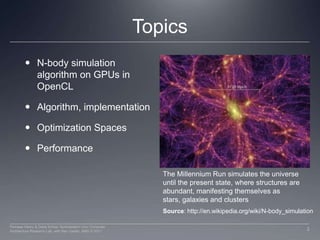
TopicsN-body simulation algorithm on GPUs in OpenCLAlgorithm, implementationOptimization SpacesPerformanceThe Millennium Run simulates the universe until the present state, where structures are abundant, manifesting themselves as stars, galaxies and clustersSource: http://en.wikipedia.org/wiki/N-body_simulation3Perhaad Mistry & Dana Schaa, Northeastern Univ Computer Architecture Research Lab, with Ben Gaster, AMD © 2011
MotivationWe know how to optimize a program in OpenCL by taking advantage of the underlying architectureWe have seen how to utilize threads to hide latencyWe have also seen how to take advantage of the different memory spaces available in today’s GPUs.How do we apply this to an real world useful scientific computing algorithm?Our aim is to use the architecture specific optimizations discussed in previous lectures4Perhaad Mistry & Dana Schaa, Northeastern Univ Computer Architecture Research Lab, with Ben Gaster, AMD © 2011
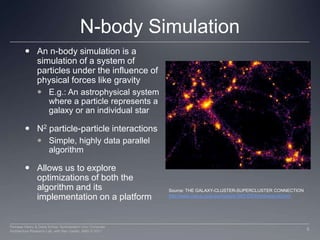
N-body SimulationAn n-body simulation is a simulation of a system of particles under the influence of physical forces like gravity E.g.: An astrophysical system  where a particle represents a galaxy or an individual starN2 particle-particle interactionsSimple, highly data parallel algorithm Allows us to explore optimizations of both the algorithm and its implementation on a platformSource: THE GALAXY-CLUSTER-SUPERCLUSTER CONNECTIONhttp://www.casca.ca/ecass/issues/1997-DS/West/west-bil.html5Perhaad Mistry & Dana Schaa, Northeastern Univ Computer Architecture Research Lab, with Ben Gaster, AMD © 2011
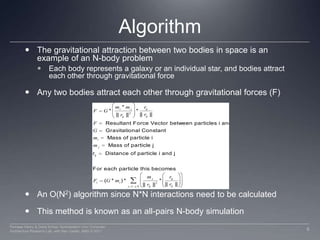
AlgorithmThe gravitational attraction between two bodies in space is an example of an N-body problemEach body represents a galaxy or an individual star, and bodies attract each other through gravitational forceAny two bodies attract each other through gravitational forces (F)An O(N2) algorithm since N*N interactions need to be calculatedThis method is known as an all-pairs N-body simulation 6Perhaad Mistry & Dana Schaa, Northeastern Univ Computer Architecture Research Lab, with Ben Gaster, AMD © 2011
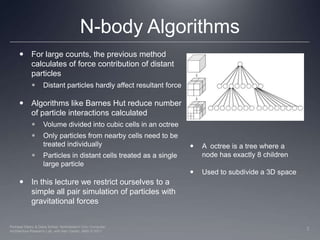
N-body AlgorithmsFor large counts, the previous method calculates of force contribution of distant particles Distant particles hardly affect resultant forceAlgorithms like Barnes Hut reduce number of particle interactions calculatedVolume divided into cubic cells in an octreeOnly particles from nearby cells need to be treated individually Particles in distant cells treated as a single large particleIn this lecture we restrict ourselves to a simple all pair simulation of particles with gravitational forcesA  octree is a tree where a node has exactly 8 childrenUsed to subdivide a 3D space7Perhaad Mistry & Dana Schaa, Northeastern Univ Computer Architecture Research Lab, with Ben Gaster, AMD © 2011
Basic Implementation – All pairsAll-pairs technique is used to calculate close-field forcesWhy bother, if infeasible for large particle counts ?Algorithms like Barnes Hut  calculate far field forces using near-field resultsNear field still uses all pairsSo, implementing all pairs improves performance of both near and far field calculationsEasy serial algorithmCalculate force by each particle Accumulate of force and displacement in result vectorfor(i=0; i<n; i++){	    ax = ay = az = 0;   // Loop over all particles "j”     for (j=0; j<n; j++)  {        //Calculate Displacement	dx=x[j]-x[i];	dy=y[j]-y[i];	dz=z[j]-z[i];	// small eps is delta added for dx,dy,dz = 0	invr= 1.0/sqrt(dx*dx+dy*dy+dz*dz +eps);	invr3 = invr*invr*invr;	f=m[ j ]*invr3;	// Accumulate acceleration 	ax += f*dx; 	ay += f*dy;	az += f*dx;    }   // Use ax, ay, az to update particle positions}8Perhaad Mistry & Dana Schaa, Northeastern Univ Computer Architecture Research Lab, with Ben Gaster, AMD © 2011
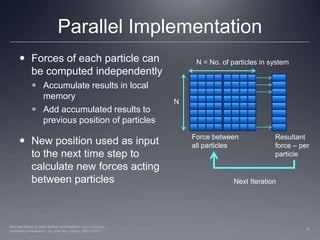
Parallel ImplementationForces of each particle can be computed independentlyAccumulate results in local memory Add accumulated results to previous position of particlesNew position used as input to the next time step to calculate new forces acting between particlesN = No. of particles in systemN NForce between all particles Resultant force – per particleNext Iteration9Perhaad Mistry & Dana Schaa, Northeastern Univ Computer Architecture Research Lab, with Ben Gaster, AMD © 2011
Naïve Parallel Implementation__kernel void nbody( 	__global float4 * initial_pos,	__global float4 * final_pos,Int N, __local float4 * result) {int localid = get_local_id(0);int globalid = get_global_id(0);    result [localid] = 0;for( int i=0 ; i<N;i++)  {	//! Calculate interaction between          //! particle globalid and particle i   GetForce( globalid, i,			initial_pos, final_pos,			&result [localid]) ;	}finalpos[ globalid] = result[ localid];}Disadvantages of implementation where each work item reads data independentlyNo reuse since redundant reads of parameters for multiple work-itemsMemory  access= N reads*N threads=  N2Similar to naïve non blocking matrix multiplication in Lecture 5p items /workgroupN = No. of particlesAll N particles read in by each work item10Perhaad Mistry & Dana Schaa, Northeastern Univ Computer Architecture Research Lab, with Ben Gaster, AMD © 2011
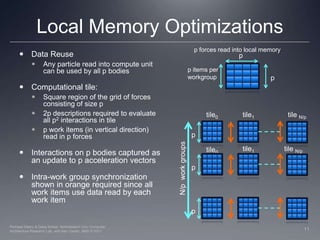
Local Memory Optimizationsp forces read into local memoryData ReuseAny particle read into compute unit can be used by all p bodiesComputational tile:Square region of the grid of forces consisting of size p2p descriptions required to evaluate all p2 interactions in tilep work items (in vertical direction) read in p forcesInteractions on p bodies captured as an update to p acceleration vectorsIntra-work group synchronization shown in orange required since all work items use data read by each work itempp items per workgroupptile1tile N/ptile0tile1tile N/ptile0pppN/p  work groups11Perhaad Mistry & Dana Schaa, Northeastern Univ Computer Architecture Research Lab, with Ben Gaster, AMD © 2011
OpenCL ImplementationKernel CodeData reuse using local memory Without reuse N*p items read per work groupWith reuse p*(N/p) = N items read per work groupAll work items use data read in by each work itemSIGNIFICANT improvement: p is work group size (at least 128 in OpenCL, discussed in occupancy)Loop nest shows how a work item traverses all tilesInner loop accumulates contribution of all particles within tilefor (int i = 0; i < numTiles; ++i)    {        // load one tile into local memory        int idx = i * localSize + tid;localPos[tid] = pos[idx];barrier(CLK_LOCAL_MEM_FENCE);       // calculate acceleration effect due to each body      for( int j = 0; j < localSize; ++j )     {            // Calculate acceleration caused by particle j on i            float4 r = localPos[j] – myPos;            float distSqr = r.x * r.x  +  r.y * r.y  +  r.z * r.z;            float invDist = 1.0f / sqrt(distSqr + epsSqr);	 float s = localPos[j].w * invDistCube;            // accumulate effect of all particles            acc += s * r;        }        // Synchronize so that next tile can be loadedbarrier(CLK_LOCAL_MEM_FENCE);    }}12Perhaad Mistry & Dana Schaa, Northeastern Univ Computer Architecture Research Lab, with Ben Gaster, AMD © 2011
PerformanceEffect of optimizations compared for two GPU platformsExactly same code, only recompiled for platformDevices ComparedAMD GPU = 5870 Stream SDK 2.2 Nvidia GPU = GTX 480 with CUDA 3.1Time measured for OpenCL kernel using OpenCL event counters (covered in in Lecture 11)Device IO and other overheads like compilation time are not relevant to our discussion of optimizing a compute kernelEvents are provided in the OpenCL spec to query obtain timestamps for different state of OpenCL commands13Perhaad Mistry & Dana Schaa, Northeastern Univ Computer Architecture Research Lab, with Ben Gaster, AMD © 2011
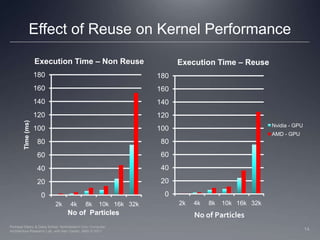
Effect of Reuse on Kernel Performance14Perhaad Mistry & Dana Schaa, Northeastern Univ Computer Architecture Research Lab, with Ben Gaster, AMD © 2011
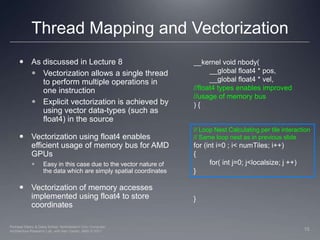
Thread Mapping and Vectorization__kernel void nbody(	__global float4 * pos,	__global float4 * vel,//float4 types enables improved //usage of memory bus) {}As discussed in Lecture 8Vectorization allows a single thread to perform multiple operations in one instructionExplicit vectorization is achieved by using vector data-types (such as float4) in the sourceVectorization using float4 enables efficient usage of memory bus for AMD GPUs Easy in this case due to the vector nature of the data which are simply spatial coordinatesVectorization of memory accesses implemented using float4 to store coordinates// Loop Nest Calculating per tile interaction// Same loop nest as in previous slidefor (int i=0 ; i< numTiles; i++){	for( int j=0; j<localsize; j ++)}15Perhaad Mistry & Dana Schaa, Northeastern Univ Computer Architecture Research Lab, with Ben Gaster, AMD © 2011
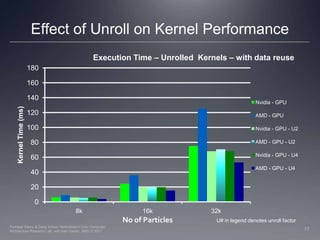
Performance - Loop Unrolling We also attempt loop unrolling of the reuse local memory implementationWe unroll the innermost loop within the threadLoop unrolling can be used to improve performance by removing overhead of branchingHowever this is very beneficial only for tight loops where the branching overhead is comparable to the size of the loop bodyExperiment on optimized local memory implementationExecutable size is not a concern for GPU kernelsWe implement unrolling by factors of 2 and 4 and we see substantial performance gains across platformsDecreasing returns for larger unrolling factors seen16Perhaad Mistry & Dana Schaa, Northeastern Univ Computer Architecture Research Lab, with Ben Gaster, AMD © 2011
Effect of Unroll on Kernel PerformanceU# in legend denotes unroll factor17Perhaad Mistry & Dana Schaa, Northeastern Univ Computer Architecture Research Lab, with Ben Gaster, AMD © 2011
Performance ConclusionsFrom the performance data we see:Unrolling greatly benefits the AMD GPU for our algorithmThis can be attributed to better packing of the VLIW instructions within the loop Better packing is enabled by the increased amount of computation uninterrupted by a conditional statement when we unroll a loopThe Nvidia Fermi performance doesn’t benefit as much from the reuse and tilingThis can be attributed to the caching which is possible in the Fermi GPUs. The caching could enable data reuse.As seen the Fermi performance is very close for both with and without reuseNote: You can even run this example on the CPU to see performance differences18Perhaad Mistry & Dana Schaa, Northeastern Univ Computer Architecture Research Lab, with Ben Gaster, AMD © 2011
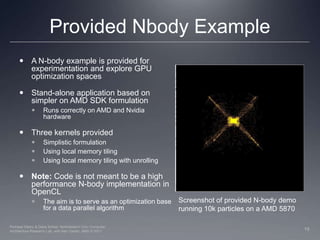
Provided Nbody ExampleA N-body example is provided for experimentation and explore GPU optimization spacesStand-alone application based on simpler on AMD SDK formulationRuns correctly on AMD and Nvidia hardware Three kernels providedSimplistic formulation Using local memory tilingUsing local memory tiling with unrollingNote: Code is not meant to be a high performance N-body implementation in OpenCLThe aim is to serve as an optimization base for a data parallel algorithmScreenshot of provided N-body demo running 10k particles on a AMD 5870 19Perhaad Mistry & Dana Schaa, Northeastern Univ Computer Architecture Research Lab, with Ben Gaster, AMD © 2011
References for Nbody SimulationAMD Stream Computing SDK and the Nvidia GPU Computing SDK provide example implementations of N-body simulationsOur implementation extends the AMD SDK example. The Nvidia implementation implementation is a different version of the N-body algorithmOther referencesNvidia GPU Gemshttp://http.developer.nvidia.com/GPUGems3/gpugems3_ch31.htmlBrown Deer Technologyhttp://www.browndeertechnology.com/docs/BDT_OpenCL_Tutorial_NBody.html20Perhaad Mistry & Dana Schaa, Northeastern Univ Computer Architecture Research Lab, with Ben Gaster, AMD © 2011
SummaryWe have studied a application as an optimization case study for OpenCL programmingWe have understood how architecture aware optimizations to data and code improve performance Optimizations discussed do not use device specific features like Warp size, so our implementation yields performance improvement while maintaining correctness on both AMD and Nvidia GPUs21Perhaad Mistry & Dana Schaa, Northeastern Univ Computer Architecture Research Lab, with Ben Gaster, AMD © 2011
Other ResourcesWell known optimization case studies for GPU programmingCUDPP and Thrust provide CUDA implementations of parallel prefix sum, reductions and parallel sorting The parallelization strategies and GPU specific optimizations in CUDA implementations can usually be applied to OpenCL as wellCUDPP http://code.google.com/p/cudpp/Thrust http://code.google.com/p/thrust/Histogram on GPUsThe Nvidia and AMD GPU computing SDK provide different implementations for 64 and 256 bin Histograms Diagonal Sparse Matrix Vector Multiplication - OpenCL Optimization example on AMD GPUs and multi-core CPUshttp://developer.amd.com/documentation/articles/Pages/OpenCL-Optimization-Case-Study.aspxGPU Gems which provides a wide range of CUDA optimization studies22Perhaad Mistry & Dana Schaa, Northeastern Univ Computer Architecture Research Lab, with Ben Gaster, AMD © 2011

Lec09 nbody-optimization

  • 1.
    OpenCL Programming &Optimization Case StudyPerhaad Mistry & Dana Schaa,Northeastern University Computer ArchitectureResearch Lab, with Benedict R. Gaster, AMD© 2011
  • 2.
    Instructor NotesLecture discussesparallel implementation of a simple embarrassingly parallel nbody algorithmWe aim to provide some correspondence between the architectural techniques discussed in the optimization lectures and a real scientific computation algorithmWe implement a N-body formulation of gravitational attraction between bodiesTwo possible optimizations on a naïve nbody implementationData reuse vs. non data reuse Unrolling of inner loop Simple example based on the AMD Nbody SDK exampleExample provided allows user to:Change data size to study scalingSwitch data reuse on or offChange unrolling factor of n-body loopRun example without parameters for help on how to run the example and define optimizations to be applied to OpenCL kernel2Perhaad Mistry & Dana Schaa, Northeastern Univ Computer Architecture Research Lab, with Ben Gaster, AMD © 2011
  • 3.
    TopicsN-body simulation algorithmon GPUs in OpenCLAlgorithm, implementationOptimization SpacesPerformanceThe Millennium Run simulates the universe until the present state, where structures are abundant, manifesting themselves as stars, galaxies and clustersSource: http://en.wikipedia.org/wiki/N-body_simulation3Perhaad Mistry & Dana Schaa, Northeastern Univ Computer Architecture Research Lab, with Ben Gaster, AMD © 2011
  • 4.
    MotivationWe know howto optimize a program in OpenCL by taking advantage of the underlying architectureWe have seen how to utilize threads to hide latencyWe have also seen how to take advantage of the different memory spaces available in today’s GPUs.How do we apply this to an real world useful scientific computing algorithm?Our aim is to use the architecture specific optimizations discussed in previous lectures4Perhaad Mistry & Dana Schaa, Northeastern Univ Computer Architecture Research Lab, with Ben Gaster, AMD © 2011
  • 5.
    N-body SimulationAn n-bodysimulation is a simulation of a system of particles under the influence of physical forces like gravity E.g.: An astrophysical system where a particle represents a galaxy or an individual starN2 particle-particle interactionsSimple, highly data parallel algorithm Allows us to explore optimizations of both the algorithm and its implementation on a platformSource: THE GALAXY-CLUSTER-SUPERCLUSTER CONNECTIONhttp://www.casca.ca/ecass/issues/1997-DS/West/west-bil.html5Perhaad Mistry & Dana Schaa, Northeastern Univ Computer Architecture Research Lab, with Ben Gaster, AMD © 2011
  • 6.
    AlgorithmThe gravitational attractionbetween two bodies in space is an example of an N-body problemEach body represents a galaxy or an individual star, and bodies attract each other through gravitational forceAny two bodies attract each other through gravitational forces (F)An O(N2) algorithm since N*N interactions need to be calculatedThis method is known as an all-pairs N-body simulation 6Perhaad Mistry & Dana Schaa, Northeastern Univ Computer Architecture Research Lab, with Ben Gaster, AMD © 2011
  • 7.
    N-body AlgorithmsFor largecounts, the previous method calculates of force contribution of distant particles Distant particles hardly affect resultant forceAlgorithms like Barnes Hut reduce number of particle interactions calculatedVolume divided into cubic cells in an octreeOnly particles from nearby cells need to be treated individually Particles in distant cells treated as a single large particleIn this lecture we restrict ourselves to a simple all pair simulation of particles with gravitational forcesA octree is a tree where a node has exactly 8 childrenUsed to subdivide a 3D space7Perhaad Mistry & Dana Schaa, Northeastern Univ Computer Architecture Research Lab, with Ben Gaster, AMD © 2011
  • 8.
    Basic Implementation –All pairsAll-pairs technique is used to calculate close-field forcesWhy bother, if infeasible for large particle counts ?Algorithms like Barnes Hut calculate far field forces using near-field resultsNear field still uses all pairsSo, implementing all pairs improves performance of both near and far field calculationsEasy serial algorithmCalculate force by each particle Accumulate of force and displacement in result vectorfor(i=0; i<n; i++){ ax = ay = az = 0; // Loop over all particles "j” for (j=0; j<n; j++) { //Calculate Displacement dx=x[j]-x[i]; dy=y[j]-y[i]; dz=z[j]-z[i]; // small eps is delta added for dx,dy,dz = 0 invr= 1.0/sqrt(dx*dx+dy*dy+dz*dz +eps); invr3 = invr*invr*invr; f=m[ j ]*invr3; // Accumulate acceleration ax += f*dx; ay += f*dy; az += f*dx; } // Use ax, ay, az to update particle positions}8Perhaad Mistry & Dana Schaa, Northeastern Univ Computer Architecture Research Lab, with Ben Gaster, AMD © 2011
  • 9.
    Parallel ImplementationForces ofeach particle can be computed independentlyAccumulate results in local memory Add accumulated results to previous position of particlesNew position used as input to the next time step to calculate new forces acting between particlesN = No. of particles in systemN NForce between all particles Resultant force – per particleNext Iteration9Perhaad Mistry & Dana Schaa, Northeastern Univ Computer Architecture Research Lab, with Ben Gaster, AMD © 2011
  • 10.
    Naïve Parallel Implementation__kernelvoid nbody( __global float4 * initial_pos, __global float4 * final_pos,Int N, __local float4 * result) {int localid = get_local_id(0);int globalid = get_global_id(0); result [localid] = 0;for( int i=0 ; i<N;i++) { //! Calculate interaction between //! particle globalid and particle i GetForce( globalid, i, initial_pos, final_pos, &result [localid]) ; }finalpos[ globalid] = result[ localid];}Disadvantages of implementation where each work item reads data independentlyNo reuse since redundant reads of parameters for multiple work-itemsMemory access= N reads*N threads= N2Similar to naïve non blocking matrix multiplication in Lecture 5p items /workgroupN = No. of particlesAll N particles read in by each work item10Perhaad Mistry & Dana Schaa, Northeastern Univ Computer Architecture Research Lab, with Ben Gaster, AMD © 2011
  • 11.
    Local Memory Optimizationspforces read into local memoryData ReuseAny particle read into compute unit can be used by all p bodiesComputational tile:Square region of the grid of forces consisting of size p2p descriptions required to evaluate all p2 interactions in tilep work items (in vertical direction) read in p forcesInteractions on p bodies captured as an update to p acceleration vectorsIntra-work group synchronization shown in orange required since all work items use data read by each work itempp items per workgroupptile1tile N/ptile0tile1tile N/ptile0pppN/p work groups11Perhaad Mistry & Dana Schaa, Northeastern Univ Computer Architecture Research Lab, with Ben Gaster, AMD © 2011
  • 12.
    OpenCL ImplementationKernel CodeDatareuse using local memory Without reuse N*p items read per work groupWith reuse p*(N/p) = N items read per work groupAll work items use data read in by each work itemSIGNIFICANT improvement: p is work group size (at least 128 in OpenCL, discussed in occupancy)Loop nest shows how a work item traverses all tilesInner loop accumulates contribution of all particles within tilefor (int i = 0; i < numTiles; ++i) { // load one tile into local memory int idx = i * localSize + tid;localPos[tid] = pos[idx];barrier(CLK_LOCAL_MEM_FENCE); // calculate acceleration effect due to each body for( int j = 0; j < localSize; ++j ) { // Calculate acceleration caused by particle j on i float4 r = localPos[j] – myPos; float distSqr = r.x * r.x + r.y * r.y + r.z * r.z; float invDist = 1.0f / sqrt(distSqr + epsSqr); float s = localPos[j].w * invDistCube; // accumulate effect of all particles acc += s * r; } // Synchronize so that next tile can be loadedbarrier(CLK_LOCAL_MEM_FENCE); }}12Perhaad Mistry & Dana Schaa, Northeastern Univ Computer Architecture Research Lab, with Ben Gaster, AMD © 2011
  • 13.
    PerformanceEffect of optimizationscompared for two GPU platformsExactly same code, only recompiled for platformDevices ComparedAMD GPU = 5870 Stream SDK 2.2 Nvidia GPU = GTX 480 with CUDA 3.1Time measured for OpenCL kernel using OpenCL event counters (covered in in Lecture 11)Device IO and other overheads like compilation time are not relevant to our discussion of optimizing a compute kernelEvents are provided in the OpenCL spec to query obtain timestamps for different state of OpenCL commands13Perhaad Mistry & Dana Schaa, Northeastern Univ Computer Architecture Research Lab, with Ben Gaster, AMD © 2011
  • 14.
    Effect of Reuseon Kernel Performance14Perhaad Mistry & Dana Schaa, Northeastern Univ Computer Architecture Research Lab, with Ben Gaster, AMD © 2011
  • 15.
    Thread Mapping andVectorization__kernel void nbody( __global float4 * pos, __global float4 * vel,//float4 types enables improved //usage of memory bus) {}As discussed in Lecture 8Vectorization allows a single thread to perform multiple operations in one instructionExplicit vectorization is achieved by using vector data-types (such as float4) in the sourceVectorization using float4 enables efficient usage of memory bus for AMD GPUs Easy in this case due to the vector nature of the data which are simply spatial coordinatesVectorization of memory accesses implemented using float4 to store coordinates// Loop Nest Calculating per tile interaction// Same loop nest as in previous slidefor (int i=0 ; i< numTiles; i++){ for( int j=0; j<localsize; j ++)}15Perhaad Mistry & Dana Schaa, Northeastern Univ Computer Architecture Research Lab, with Ben Gaster, AMD © 2011
  • 16.
    Performance - LoopUnrolling We also attempt loop unrolling of the reuse local memory implementationWe unroll the innermost loop within the threadLoop unrolling can be used to improve performance by removing overhead of branchingHowever this is very beneficial only for tight loops where the branching overhead is comparable to the size of the loop bodyExperiment on optimized local memory implementationExecutable size is not a concern for GPU kernelsWe implement unrolling by factors of 2 and 4 and we see substantial performance gains across platformsDecreasing returns for larger unrolling factors seen16Perhaad Mistry & Dana Schaa, Northeastern Univ Computer Architecture Research Lab, with Ben Gaster, AMD © 2011
  • 17.
    Effect of Unrollon Kernel PerformanceU# in legend denotes unroll factor17Perhaad Mistry & Dana Schaa, Northeastern Univ Computer Architecture Research Lab, with Ben Gaster, AMD © 2011
  • 18.
    Performance ConclusionsFrom theperformance data we see:Unrolling greatly benefits the AMD GPU for our algorithmThis can be attributed to better packing of the VLIW instructions within the loop Better packing is enabled by the increased amount of computation uninterrupted by a conditional statement when we unroll a loopThe Nvidia Fermi performance doesn’t benefit as much from the reuse and tilingThis can be attributed to the caching which is possible in the Fermi GPUs. The caching could enable data reuse.As seen the Fermi performance is very close for both with and without reuseNote: You can even run this example on the CPU to see performance differences18Perhaad Mistry & Dana Schaa, Northeastern Univ Computer Architecture Research Lab, with Ben Gaster, AMD © 2011
  • 19.
    Provided Nbody ExampleAN-body example is provided for experimentation and explore GPU optimization spacesStand-alone application based on simpler on AMD SDK formulationRuns correctly on AMD and Nvidia hardware Three kernels providedSimplistic formulation Using local memory tilingUsing local memory tiling with unrollingNote: Code is not meant to be a high performance N-body implementation in OpenCLThe aim is to serve as an optimization base for a data parallel algorithmScreenshot of provided N-body demo running 10k particles on a AMD 5870 19Perhaad Mistry & Dana Schaa, Northeastern Univ Computer Architecture Research Lab, with Ben Gaster, AMD © 2011
  • 20.
    References for NbodySimulationAMD Stream Computing SDK and the Nvidia GPU Computing SDK provide example implementations of N-body simulationsOur implementation extends the AMD SDK example. The Nvidia implementation implementation is a different version of the N-body algorithmOther referencesNvidia GPU Gemshttp://http.developer.nvidia.com/GPUGems3/gpugems3_ch31.htmlBrown Deer Technologyhttp://www.browndeertechnology.com/docs/BDT_OpenCL_Tutorial_NBody.html20Perhaad Mistry & Dana Schaa, Northeastern Univ Computer Architecture Research Lab, with Ben Gaster, AMD © 2011
  • 21.
    SummaryWe have studieda application as an optimization case study for OpenCL programmingWe have understood how architecture aware optimizations to data and code improve performance Optimizations discussed do not use device specific features like Warp size, so our implementation yields performance improvement while maintaining correctness on both AMD and Nvidia GPUs21Perhaad Mistry & Dana Schaa, Northeastern Univ Computer Architecture Research Lab, with Ben Gaster, AMD © 2011
  • 22.
    Other ResourcesWell knownoptimization case studies for GPU programmingCUDPP and Thrust provide CUDA implementations of parallel prefix sum, reductions and parallel sorting The parallelization strategies and GPU specific optimizations in CUDA implementations can usually be applied to OpenCL as wellCUDPP http://code.google.com/p/cudpp/Thrust http://code.google.com/p/thrust/Histogram on GPUsThe Nvidia and AMD GPU computing SDK provide different implementations for 64 and 256 bin Histograms Diagonal Sparse Matrix Vector Multiplication - OpenCL Optimization example on AMD GPUs and multi-core CPUshttp://developer.amd.com/documentation/articles/Pages/OpenCL-Optimization-Case-Study.aspxGPU Gems which provides a wide range of CUDA optimization studies22Perhaad Mistry & Dana Schaa, Northeastern Univ Computer Architecture Research Lab, with Ben Gaster, AMD © 2011

Editor's Notes

  • #7 Well known formulation which says force between bodies is proportional to their mass and inversely proportional to square of the distance.
  • #8 There are better ways to calculate interactions rather than the naïve n2 method.Barnes Hutt allows us to divide the space, this reduces number of particles to be calculated.The number of particles reduces because multiple far field objects are combined into one
  • #9 Basic C code O(n2)
  • #10 Parallelization of the outer loop of the program. Each particle calculates all its interactions independent of every other particle
  • #11 Naïve implementation where all threads work independently
  • #12 Since each work item needs to calculate interactions with all particles we can introduce data reuse by tiling the grid space.The reuse is enabled such that when a work item reads in some data, all the other work items calculate the interaction too.
  • #13 Data reuse based implementation.Synchronize call is needed in order to allow for each work item to read in its data before being used by other work items
  • #15 Scaling for larger particle sizes for two different implementations for AMD and Nvidia GPUs.Note: These have not been unrolled yet
  • #17 Unrolling of the inner loop to increase the computational intensity of the inner loop
  • #19 General conclusions and benefits of optimizations on different platforms
  • #20 Details of provided example