Done By: Ahmad Taweel
Piper Alpha Disaster
1
Outline
 About Piper Alpha Platform
 The Happening Event Timeline
 Cause of the Disaster
 Effect of the Disaster
 Key Failures
 Improvement and Prevention
 Conclusion
2
About Piper Alpha (1/5)
 It was discovered in 1973 by Occidental
Petroleum (Caledonia)
 In 1975 Piper Alpha Oil Rig was constructed
 On July 6th 1988, an explosion of the
Piper Alpha platform
3
About Piper Alpha (2/5)
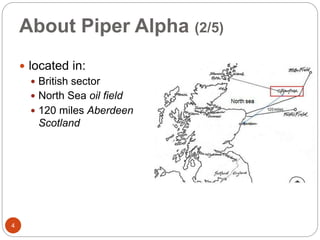
 located in:
 British sector
 North Sea oil field
 120 miles Aberdeen
Scotland
4
About Piper Alpha (3/5)
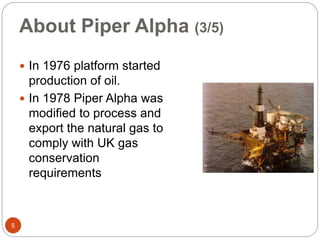
 In 1976 platform started
production of oil.
 In 1978 Piper Alpha was
modified to process and
export the natural gas to
comply with UK gas
conservation
requirements
5
About Piper Alpha (4/5)
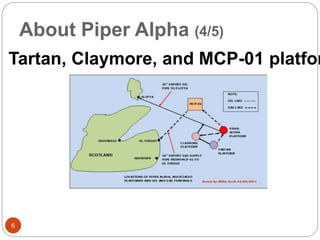
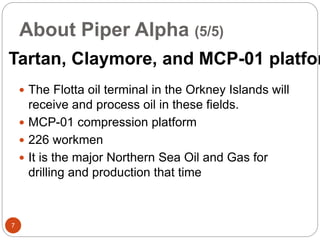
Tartan, Claymore, and MCP-01 platfor
6
About Piper Alpha (5/5)
 The Flotta oil terminal in the Orkney Islands will
receive and process oil in these fields.
 MCP-01 compression platform
 226 workmen
 It is the major Northern Sea Oil and Gas for
drilling and production that time
Tartan, Claymore, and MCP-01 platfor
7
The happening Event Timeline
(1/6)
 12 noon - 6:00 PM:
 Pump A Failed
 Removed safety valve
 Maintenance
 Replaced by blind flange
 Permit that the Pump A wont be working till 6:pm
8
The happening Event Timeline
(2/6)
 9:45 PM - 10:00 PM:
 Pump B fails
 Pump A permit
 Pump A activated
 Gas leak
 Explosion
9
The happening Event Timeline
(3/6)
 10:04 PM:
 Evacuation started
 Emergency shutdown activated
 Firefighting system inaccessible since it is in the
control room
 Gathered on the deck
10
The happening Event Timeline
(4/6)
 10:20 PM:
 Tartan and Claymore platforms oil pipeline
connected to Piper Alpha supplied more oil to the
fire
 Tartan and Claymore platforms gas pipeline
connected to Piper Alpha bursts and leaked gas
 Causing Explosion
11
The happening Event Timeline
(5/6)
 10:30 PM:
 Tharos attempted to assist Piper Alpha
 Burst of MCP-01
12
The happening Event Timeline
(6/6)
 11:20 PM:
 Final gas pipeline burst
 Block were platform members gathered falls into the
sea
 Rest of the platform continued falling
13
Cause of the disaster
 Safety valve on Pump A was replaced by blind
flange for maintenance
 Crew members reactivated Pump A
 Leaking
 Explosions
 Emergency Shutdown system failed
 Fire intensified
 Helicopters couldn’t help
14
Effect of the disaster
 165 workmen dead (out of 226)
 2 men from the rescue boat
 US$ 3.4 billion cost in property damage
 100 kg of hydrocarbons loss
 61 survivor
 Bad injuries
 Loss body parts
15
Key Failures
 Design Failures
 Management
Failures
 Procedural Failures
16
Design Failures (1/4)
 Firewalls between modules not upgraded to blast
proof tilesː
 The fire barriers (tiles) between modules were not
upgraded
 When the initial explosion occurred in module C, the
tiles acted as shrapnel and caused damage to
modules B and D
17
Design Failures (2/4)
 Control room adjacent to gas compression
moduleː
 Adjacent to module C without proper shielding
 Failure in module C cause damage to the control
room
18
Design Failures (3/4)
 Primary supply lines from other oil rigs permitted
backflowː
 Main supply lines on Piper Alpha failed
 Piper Alpha could not stop the flow itself
 Supply lines from the Tartan and Claymore
platforms fed Piper Alpha's fire
19
Design Failures (4/4)
 Tharos rescue vessel design flawsː
 Evacuation gangwayː
 Couldn’t extended enough to rescue all personnel
 Fire pump issuesː
 The pumps became flooded, needed 10 minutes to restart
 Fire pumps too powerful for personnelː
 Too powerful to use while personnel on board
20
Management Failures (1/2)
 Normal operation during major construction,
maintenance, and upgradesː
 The safety valve maintenance wasn’t finished, and
they didn’t noticed the blind flange plate
21
Management Failures (2/2)
 Oil feeds from Tartan and Claymore weren’t
shut off until too lateː
 Supervisors
 noticed the fire
 didn’t know the damage
 Didn’t know if they have the authority to shut down
production on their platforms
22
Procedural Failures (1/3)
 Engineer neglected to inform on-duty
custodian of Pump A’s conditionː
 Custodian wasn’t informed that the safety valve had
been removed from Pump A
23
Procedural Failures (2/3)
 Evacuation protocols broke downː
 The radio and control room were not functional
 Personnel were alarmed
24
Procedural Failures (3/3)
 Firefighting system was set to manualː
 Manual activation
 Inaccessible
 No way to fight the fire
25
Improvement and Prevention
 Safety training
 Emergency response training
 How to respond to emergencies
 Active and passive fire protection systems
 Secondary escape equipment’s
 Provide annual safety training
26
Conclusion (1/2)
 Most tragic gas and oil accident
 Errors and questionable decisions
 Initial leak was the result of poor maintenance
procedures
 Improper structural design
27
Conclusion (2/2)
 Companies’ management should not aim to
save more money
 Understaffed facilities
 Less experienced operators
 Companies’ responsibilities to subject their
employees on
 Safety training
 Emergency response training
28
Thank You
29

Piper Alpha Disaster

  • 1.
    Done By: AhmadTaweel Piper Alpha Disaster 1
  • 2.
    Outline  About PiperAlpha Platform  The Happening Event Timeline  Cause of the Disaster  Effect of the Disaster  Key Failures  Improvement and Prevention  Conclusion 2
  • 3.
    About Piper Alpha(1/5)  It was discovered in 1973 by Occidental Petroleum (Caledonia)  In 1975 Piper Alpha Oil Rig was constructed  On July 6th 1988, an explosion of the Piper Alpha platform 3
  • 4.
    About Piper Alpha(2/5)  located in:  British sector  North Sea oil field  120 miles Aberdeen Scotland 4
  • 5.
    About Piper Alpha(3/5)  In 1976 platform started production of oil.  In 1978 Piper Alpha was modified to process and export the natural gas to comply with UK gas conservation requirements 5
  • 6.
    About Piper Alpha(4/5) Tartan, Claymore, and MCP-01 platfor 6
  • 7.
    About Piper Alpha(5/5)  The Flotta oil terminal in the Orkney Islands will receive and process oil in these fields.  MCP-01 compression platform  226 workmen  It is the major Northern Sea Oil and Gas for drilling and production that time Tartan, Claymore, and MCP-01 platfor 7
  • 8.
    The happening EventTimeline (1/6)  12 noon - 6:00 PM:  Pump A Failed  Removed safety valve  Maintenance  Replaced by blind flange  Permit that the Pump A wont be working till 6:pm 8
  • 9.
    The happening EventTimeline (2/6)  9:45 PM - 10:00 PM:  Pump B fails  Pump A permit  Pump A activated  Gas leak  Explosion 9
  • 10.
    The happening EventTimeline (3/6)  10:04 PM:  Evacuation started  Emergency shutdown activated  Firefighting system inaccessible since it is in the control room  Gathered on the deck 10
  • 11.
    The happening EventTimeline (4/6)  10:20 PM:  Tartan and Claymore platforms oil pipeline connected to Piper Alpha supplied more oil to the fire  Tartan and Claymore platforms gas pipeline connected to Piper Alpha bursts and leaked gas  Causing Explosion 11
  • 12.
    The happening EventTimeline (5/6)  10:30 PM:  Tharos attempted to assist Piper Alpha  Burst of MCP-01 12
  • 13.
    The happening EventTimeline (6/6)  11:20 PM:  Final gas pipeline burst  Block were platform members gathered falls into the sea  Rest of the platform continued falling 13
  • 14.
    Cause of thedisaster  Safety valve on Pump A was replaced by blind flange for maintenance  Crew members reactivated Pump A  Leaking  Explosions  Emergency Shutdown system failed  Fire intensified  Helicopters couldn’t help 14
  • 15.
    Effect of thedisaster  165 workmen dead (out of 226)  2 men from the rescue boat  US$ 3.4 billion cost in property damage  100 kg of hydrocarbons loss  61 survivor  Bad injuries  Loss body parts 15
  • 16.
    Key Failures  DesignFailures  Management Failures  Procedural Failures 16
  • 17.
    Design Failures (1/4) Firewalls between modules not upgraded to blast proof tilesː  The fire barriers (tiles) between modules were not upgraded  When the initial explosion occurred in module C, the tiles acted as shrapnel and caused damage to modules B and D 17
  • 18.
    Design Failures (2/4) Control room adjacent to gas compression moduleː  Adjacent to module C without proper shielding  Failure in module C cause damage to the control room 18
  • 19.
    Design Failures (3/4) Primary supply lines from other oil rigs permitted backflowː  Main supply lines on Piper Alpha failed  Piper Alpha could not stop the flow itself  Supply lines from the Tartan and Claymore platforms fed Piper Alpha's fire 19
  • 20.
    Design Failures (4/4) Tharos rescue vessel design flawsː  Evacuation gangwayː  Couldn’t extended enough to rescue all personnel  Fire pump issuesː  The pumps became flooded, needed 10 minutes to restart  Fire pumps too powerful for personnelː  Too powerful to use while personnel on board 20
  • 21.
    Management Failures (1/2) Normal operation during major construction, maintenance, and upgradesː  The safety valve maintenance wasn’t finished, and they didn’t noticed the blind flange plate 21
  • 22.
    Management Failures (2/2) Oil feeds from Tartan and Claymore weren’t shut off until too lateː  Supervisors  noticed the fire  didn’t know the damage  Didn’t know if they have the authority to shut down production on their platforms 22
  • 23.
    Procedural Failures (1/3) Engineer neglected to inform on-duty custodian of Pump A’s conditionː  Custodian wasn’t informed that the safety valve had been removed from Pump A 23
  • 24.
    Procedural Failures (2/3) Evacuation protocols broke downː  The radio and control room were not functional  Personnel were alarmed 24
  • 25.
    Procedural Failures (3/3) Firefighting system was set to manualː  Manual activation  Inaccessible  No way to fight the fire 25
  • 26.
    Improvement and Prevention Safety training  Emergency response training  How to respond to emergencies  Active and passive fire protection systems  Secondary escape equipment’s  Provide annual safety training 26
  • 27.
    Conclusion (1/2)  Mosttragic gas and oil accident  Errors and questionable decisions  Initial leak was the result of poor maintenance procedures  Improper structural design 27
  • 28.
    Conclusion (2/2)  Companies’management should not aim to save more money  Understaffed facilities  Less experienced operators  Companies’ responsibilities to subject their employees on  Safety training  Emergency response training 28
  • 29.