Orthopedic Surgery
Fractures
DR MEHWISH IQBAL
DPT,MS-OMPT
By the end of this session you should be
able to describe:
able to describe:
What is a fracture?
What is a fracture?
 Types of fractures..
Types of fractures..
 Causes..
Causes..
 Clinical Features..
Clinical Features..
 Healing of fractures..
Healing of fractures..
 Complications..
Complications..
Principles of management..
Principles of management..
Definition
“Loss of continuity in the substance of a
bone is called a fracture.”
Spectrum extends from a microscopic
fracture to a hair line fracture and than to
grossly notable fractures.
Types of fractures
 Open
 Closed
Types (cont,d)
 Avulsion fracture:
Muscle or ligament pulls on a bone fracturing it.
 Comminuted fracture:
Bone is shattered into many pieces
 Compression fracture:
Collapse of bone usually vertebra in osteoporosis
 Fracture dislocation:
 Greenstick fracture:
One side of bone fractures, not complete and bone bends
 Hair line fracture:
 Impacted fracture:
Fragments of bone got impacted
 Intraarticular fracture:
Types (cont,d)
 Longitudinal fracture:
Along the length of bone
 Oblique fracture:
Fracture is diagonal to bones long axis
 Pathological fracture:
 Spiral fracture:
Atleast one part of bone has twisted
 Stress fracture:
Bone breaks because of repeated stresses and strains e.g. athletes
 Transverse fracture:
A straight break right across a bone
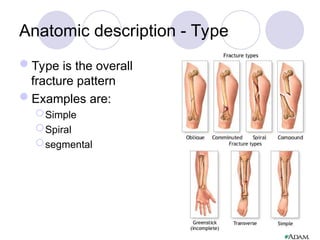
Anatomic description - Type
Type is the overall
fracture pattern
Examples are:
Simple
Spiral
segmental
Anatomic description of fractures
Type
Comminution
Location
Displacement
Anatomic description - Comminution
Comminution is the measure of the
number of pieces of broken bone that
there are.
Examples are: non-comminuted or mildly
comminuted or severely comminuted
Anatomic description - Location
Location is the anatomic location of the
fracture usually described by giving the
bone involved and location on the bone
Examples are: distal radial shaft, proximal
1/3 humeral shaft, intra-articular distal
tibial
Anatomic description - Displacement
Displacement is the amount the pieces of
a fracture have moved from their normal
location
Can be displaced or non-displaced
Subdivided into 3 sub-categories:
translation, angulation, and shortening
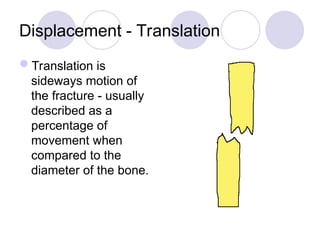
Displacement - Translation
Translation is
sideways motion of
the fracture - usually
described as a
percentage of
movement when
compared to the
diameter of the bone.
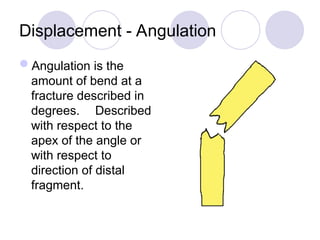
Displacement - Angulation
Angulation is the
amount of bend at a
fracture described in
degrees. Described
with respect to the
apex of the angle or
with respect to
direction of distal
fragment.
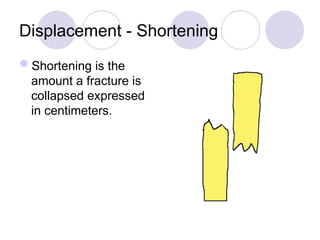
Displacement - Shortening
Shortening is the
amount a fracture is
collapsed expressed
in centimeters.
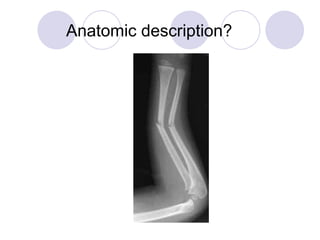
Anatomic description?
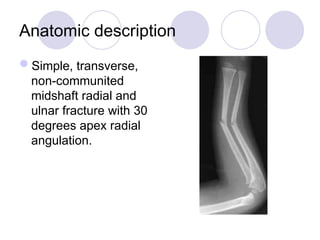
Anatomic description
Simple, transverse,
non-communited
midshaft radial and
ulnar fracture with 30
degrees apex radial
angulation.
Why classify fractures?
Classification or description of fractures is
only used when it is useful in providing
treatment or outcomes.
Types of classifications
Anatomic description
AO classification for Long bone fracture
( Humerus, Radius/ Ulna, Femur, Tibia/
Fibula)
Salter-Harris classification for Epiphysial
plate fracture
Gustillo anderson classification for
open fracture
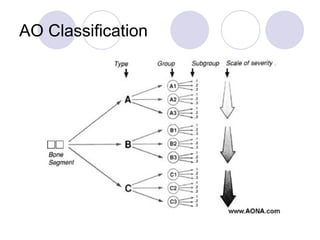
AO Classification
AO Classification
1st
number = long bone
2nd
number = bone segment
Letter = fracture type (A,B,C)
Then 3rd
& 4th
numbers classify fracture group
& subgroup
Oblique fracture Proximal Femoral Shaft :
(32 A2.1)
3 … the bone … femur
(1= Humerus, 2= Radius/ Ulna, 3= Femur, 4= Tibia/
Fibula)
2 … the segment … diaphysis
(1= Epiphysis, 2= Diaphysis, 3= Metaphysis)
A … the type … least severe
(A= least severe, B= Intermediate, C= Most severe)
 2 … the group … Gp. 2 includes oblique fractures
 1 … the subgroup … 1 includes fracture in proximal
part of diaphysis
Salter-Harris Classification
Only used for pediatric fractures that
involve the growth plate (Physis)
Five types (I-V)
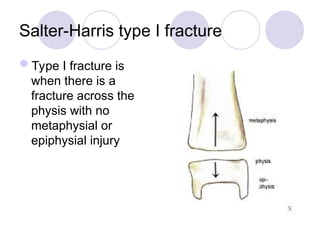
Salter-Harris type I fracture
Type I fracture is
when there is a
fracture across the
physis with no
metaphysial or
epiphysial injury
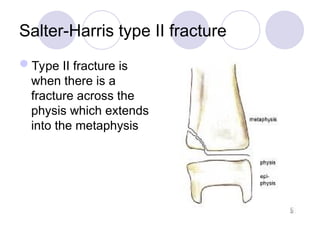
Salter-Harris type II fracture
Type II fracture is
when there is a
fracture across the
physis which extends
into the metaphysis
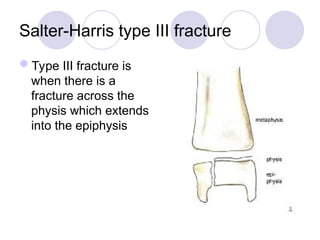
Salter-Harris type III fracture
Type III fracture is
when there is a
fracture across the
physis which extends
into the epiphysis
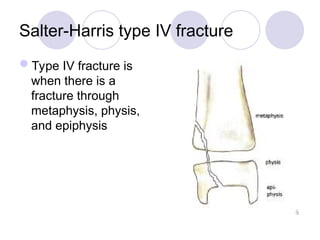
Salter-Harris type IV fracture
Type IV fracture is
when there is a
fracture through
metaphysis, physis,
and epiphysis
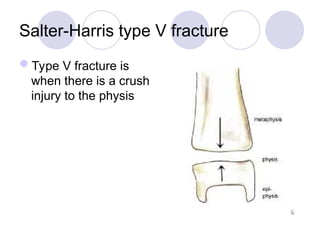
Salter-Harris type V fracture
Type V fracture is
when there is a crush
injury to the physis
Gustillo classification
The Gustillo classification is used to
classify open fracture - ones in which the
skin has been disrupted
Three grades that try to quantify the
amount of soft tissue damage associated
with the fracture
Open fractures - grade 1
wound less than 1 cm with minimal soft
tissue injury
wound bed is clean
bone injury is simple with minimal
comminution
With IM nailing, average time to union
is 21-28 weeks
Open fractures - grade 2
wound is greater than 1 cm with
moderate soft tissue injury
wound bed is moderately contaminated
fracture contains moderate
comminution
With IM nailing, average time to union
is 26-28 weeks
Open fractures - grade 3A
wound greater than 10 cm with
crushed tissue and contamination
soft tissue coverage of bone is usually
possible
With IM nailing, average time to union
is 30-35 weeks
Open fractures - grade 3B
wound greater than 10 cm with
crushed tissue and contamination
soft tissue is inadequate and requires
regional or free flap
with IM nailing, average time to union
is 30-35 weeks
Open fractures - grade 3C
is fracture in which there is a major
vascular injury requiring repair for limb
salvage
in some cases it will be necessary to
consider BKA following tibial fracture
Causes of Fractures
Fall (Elderly)
RTA (Younger)
Underlying illnesses that weaken
bones.. Pathological fractures e.g;
Osteoporosis, infection, tumor
Repeated stresses & strains e.g;
athletes .. Stress fractures
Clinical Features
 Depends which bone affected, patients age, general health, severity
of injury.
 Pain
 Swelling
 Bruising
 Discoloured area around affected area
 Angulation
 Inabbility to bear weight
 Inability to move/ painful active or passive movements
 Grating sensation/ crepitus
 Bleeding if open fractures
 If large bone leading to occult bleeding … pallor and dizziness,
feeling of sickness & nausea
Healing of Fractures
Proper alignment & immobility, healing is
straightforward
Osteoclasts absorbs old & damaged bone
Osteoblasts create new bone
Callus is new bone formed around
fracture site
Setting a Break
Bone is constantly in a state of turnover, even
Bone is constantly in a state of turnover, even
when not damaged or injured.
In order for the fracture to heal without any
In order for the fracture to heal without any
deformity, a good ‘reduction,’ or placement, of
the bones must be attained.
If the reduction cannot be satisfactorily
If the reduction cannot be satisfactorily
achieved then a further procedure may be
necessary, such as an
necessary, such as an operation with fixation
with fixation
of the bone with plates, screws or nails.
Factors affecting healing process
Patient,s age
Bone affected
Type of fracture
Patient general health condition
Smokers
Complications in Fracture Healing
Heals in wrong position
Known as Malunion … either heals in wrong position
or fracture shifts
Disruption of bone growth
If fracture affects growth plate, subsequent deformity
Persistent bone or bone marrow infection
If break in skin … can lead to chronic osteomyelitis
Bone death (Avascular necrosis)
If bone loses its essential blood supply
Principles of General Fracture
Management (REST)
Rest
Elevation
Support & Immobilization:
Bones are aligned in anatomical position &
must stay align during process of healing.
Temperature (warmth)
Methods of Immobilization
Plaster casts or plastic functional braces
Metal plates & screws
Intra medullary nails
External fixators
Definition:
Open Reduction Internal Fixation.
Open reduction internal fixation is a method of surgically repairing a fractured bone.
Generally, this involves either the use of plates and screws or an intramedullary (IM) rod to stabilize the bone.
O.R.I.F.
O.R.I.F.
Definition:
Definition: Intra medullary nails or
Intra medullary nails or
rods are devices used to stabilize
fractures and allow for bone healing.
IM nails are inserted into the
IM nails are inserted into the
medullary (bone marrow) canal in the
center of the long bones of the
extremities (e.g. femur, tibia, etc.).
Intra medullary Rods

ORTHROPEDIC SURGERY FRACTURES INTRODUCTION.ppt

  • 1.
  • 2.
    By the endof this session you should be By the end of this session you should be able to describe: able to describe: What is a fracture? What is a fracture?  Types of fractures.. Types of fractures..  Causes.. Causes..  Clinical Features.. Clinical Features..  Healing of fractures.. Healing of fractures..  Complications.. Complications.. Principles of management.. Principles of management..
  • 4.
    Definition “Loss of continuityin the substance of a bone is called a fracture.” Spectrum extends from a microscopic fracture to a hair line fracture and than to grossly notable fractures.
  • 5.
    Types of fractures Open  Closed
  • 6.
    Types (cont,d)  Avulsionfracture: Muscle or ligament pulls on a bone fracturing it.  Comminuted fracture: Bone is shattered into many pieces  Compression fracture: Collapse of bone usually vertebra in osteoporosis  Fracture dislocation:  Greenstick fracture: One side of bone fractures, not complete and bone bends  Hair line fracture:  Impacted fracture: Fragments of bone got impacted  Intraarticular fracture:
  • 7.
    Types (cont,d)  Longitudinalfracture: Along the length of bone  Oblique fracture: Fracture is diagonal to bones long axis  Pathological fracture:  Spiral fracture: Atleast one part of bone has twisted  Stress fracture: Bone breaks because of repeated stresses and strains e.g. athletes  Transverse fracture: A straight break right across a bone
  • 8.
    Anatomic description -Type Type is the overall fracture pattern Examples are: Simple Spiral segmental
  • 9.
    Anatomic description offractures Type Comminution Location Displacement
  • 10.
    Anatomic description -Comminution Comminution is the measure of the number of pieces of broken bone that there are. Examples are: non-comminuted or mildly comminuted or severely comminuted
  • 11.
    Anatomic description -Location Location is the anatomic location of the fracture usually described by giving the bone involved and location on the bone Examples are: distal radial shaft, proximal 1/3 humeral shaft, intra-articular distal tibial
  • 12.
    Anatomic description -Displacement Displacement is the amount the pieces of a fracture have moved from their normal location Can be displaced or non-displaced Subdivided into 3 sub-categories: translation, angulation, and shortening
  • 13.
    Displacement - Translation Translationis sideways motion of the fracture - usually described as a percentage of movement when compared to the diameter of the bone.
  • 14.
    Displacement - Angulation Angulationis the amount of bend at a fracture described in degrees. Described with respect to the apex of the angle or with respect to direction of distal fragment.
  • 15.
    Displacement - Shortening Shorteningis the amount a fracture is collapsed expressed in centimeters.
  • 16.
  • 17.
    Anatomic description Simple, transverse, non-communited midshaftradial and ulnar fracture with 30 degrees apex radial angulation.
  • 18.
    Why classify fractures? Classificationor description of fractures is only used when it is useful in providing treatment or outcomes.
  • 19.
    Types of classifications Anatomicdescription AO classification for Long bone fracture ( Humerus, Radius/ Ulna, Femur, Tibia/ Fibula) Salter-Harris classification for Epiphysial plate fracture Gustillo anderson classification for open fracture
  • 20.
  • 21.
    AO Classification 1st number =long bone 2nd number = bone segment Letter = fracture type (A,B,C) Then 3rd & 4th numbers classify fracture group & subgroup
  • 22.
    Oblique fracture ProximalFemoral Shaft : (32 A2.1) 3 … the bone … femur (1= Humerus, 2= Radius/ Ulna, 3= Femur, 4= Tibia/ Fibula) 2 … the segment … diaphysis (1= Epiphysis, 2= Diaphysis, 3= Metaphysis) A … the type … least severe (A= least severe, B= Intermediate, C= Most severe)  2 … the group … Gp. 2 includes oblique fractures  1 … the subgroup … 1 includes fracture in proximal part of diaphysis
  • 23.
    Salter-Harris Classification Only usedfor pediatric fractures that involve the growth plate (Physis) Five types (I-V)
  • 24.
    Salter-Harris type Ifracture Type I fracture is when there is a fracture across the physis with no metaphysial or epiphysial injury
  • 25.
    Salter-Harris type IIfracture Type II fracture is when there is a fracture across the physis which extends into the metaphysis
  • 26.
    Salter-Harris type IIIfracture Type III fracture is when there is a fracture across the physis which extends into the epiphysis
  • 27.
    Salter-Harris type IVfracture Type IV fracture is when there is a fracture through metaphysis, physis, and epiphysis
  • 28.
    Salter-Harris type Vfracture Type V fracture is when there is a crush injury to the physis
  • 29.
    Gustillo classification The Gustilloclassification is used to classify open fracture - ones in which the skin has been disrupted Three grades that try to quantify the amount of soft tissue damage associated with the fracture
  • 30.
    Open fractures -grade 1 wound less than 1 cm with minimal soft tissue injury wound bed is clean bone injury is simple with minimal comminution With IM nailing, average time to union is 21-28 weeks
  • 31.
    Open fractures -grade 2 wound is greater than 1 cm with moderate soft tissue injury wound bed is moderately contaminated fracture contains moderate comminution With IM nailing, average time to union is 26-28 weeks
  • 32.
    Open fractures -grade 3A wound greater than 10 cm with crushed tissue and contamination soft tissue coverage of bone is usually possible With IM nailing, average time to union is 30-35 weeks
  • 33.
    Open fractures -grade 3B wound greater than 10 cm with crushed tissue and contamination soft tissue is inadequate and requires regional or free flap with IM nailing, average time to union is 30-35 weeks
  • 34.
    Open fractures -grade 3C is fracture in which there is a major vascular injury requiring repair for limb salvage in some cases it will be necessary to consider BKA following tibial fracture
  • 35.
    Causes of Fractures Fall(Elderly) RTA (Younger) Underlying illnesses that weaken bones.. Pathological fractures e.g; Osteoporosis, infection, tumor Repeated stresses & strains e.g; athletes .. Stress fractures
  • 36.
    Clinical Features  Dependswhich bone affected, patients age, general health, severity of injury.  Pain  Swelling  Bruising  Discoloured area around affected area  Angulation  Inabbility to bear weight  Inability to move/ painful active or passive movements  Grating sensation/ crepitus  Bleeding if open fractures  If large bone leading to occult bleeding … pallor and dizziness, feeling of sickness & nausea
  • 37.
    Healing of Fractures Properalignment & immobility, healing is straightforward Osteoclasts absorbs old & damaged bone Osteoblasts create new bone Callus is new bone formed around fracture site
  • 38.
    Setting a Break Boneis constantly in a state of turnover, even Bone is constantly in a state of turnover, even when not damaged or injured. when not damaged or injured. In order for the fracture to heal without any In order for the fracture to heal without any deformity, a good ‘reduction,’ or placement, of deformity, a good ‘reduction,’ or placement, of the bones must be attained. the bones must be attained. If the reduction cannot be satisfactorily If the reduction cannot be satisfactorily achieved then a further procedure may be achieved then a further procedure may be necessary, such as an necessary, such as an operation with fixation with fixation of the bone with plates, screws or nails. of the bone with plates, screws or nails.
  • 39.
    Factors affecting healingprocess Patient,s age Bone affected Type of fracture Patient general health condition Smokers
  • 40.
    Complications in FractureHealing Heals in wrong position Known as Malunion … either heals in wrong position or fracture shifts Disruption of bone growth If fracture affects growth plate, subsequent deformity Persistent bone or bone marrow infection If break in skin … can lead to chronic osteomyelitis Bone death (Avascular necrosis) If bone loses its essential blood supply
  • 41.
    Principles of GeneralFracture Management (REST) Rest Elevation Support & Immobilization: Bones are aligned in anatomical position & must stay align during process of healing. Temperature (warmth)
  • 42.
    Methods of Immobilization Plastercasts or plastic functional braces Metal plates & screws Intra medullary nails External fixators
  • 43.
    Definition: Open Reduction InternalFixation. Open reduction internal fixation is a method of surgically repairing a fractured bone. Generally, this involves either the use of plates and screws or an intramedullary (IM) rod to stabilize the bone. O.R.I.F. O.R.I.F.
  • 44.
    Definition: Definition: Intra medullarynails or Intra medullary nails or rods are devices used to stabilize rods are devices used to stabilize fractures and allow for bone healing. fractures and allow for bone healing. IM nails are inserted into the IM nails are inserted into the medullary (bone marrow) canal in the medullary (bone marrow) canal in the center of the long bones of the center of the long bones of the extremities (e.g. femur, tibia, etc.). extremities (e.g. femur, tibia, etc.). Intra medullary Rods Intra medullary Rods