TYPES OF GROUP
CONTROLLED
INSTRUCTION
Introduction:
 When instruction is organised in
such a manner that students carry out the
instructional activities together in a group
it is called group controlled instruction.
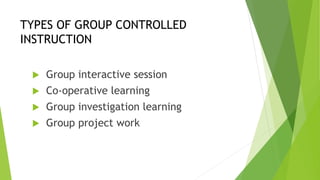
TYPES OF GROUP CONTROLLED
INSTRUCTION
 Group interactive session
 Co-operative learning
 Group investigation learning
 Group project work
Group interactive session
 This teaching technique involves dividing the class into
small groups, each consisting of five or six students and
assigning them different topics or sub-topics of a subject
and ask the group members to discuss among themselves
the content elements of the topic/sub-topic assigned
to their group and engage in learning activities.
Types of interactive groups
 Learning cycle group
 Co-operative group
 Peer group
I) Learning cycle group technique
 Based on the learning ability of the students,the
class could be divided into equated groups of
learners.Then,the different sub-topics of a lesson
in the subject will be assigned to the different
groups.
 Students should be asked to discuss and learn the
contents of the sub-topic.After 10 or 15
minutes,the sub-topics will be rotated among the
groups.
2) Co-operative group technique
 In this method, students in the class with
different abilities will be divided into groups,
each with 5 or 6 students.Each group will have a
few students in each category.A particular
segment in the lesson will be given to all the
groups.
3) Peer group technique
 In this technique, close friends in a class will be
allowed to function as a 'learning group’.Three
or four such groups will be formed and a
particular segment of a lesson will be given for
discussion to all the groups.
Uses of group interactive session
 Students learn through mutual interactions.
 Gifted students,teach other students in their
group are helpful to the teacher.
 This teaching technique is effective for review
and revision.
Limitations of group interactive session
 Slow learners in the group may not take active
part in the group discussion.
 It may be difficult to supervise all the groups
involved in discussion at the same time and give
needed guidance.
Co-operative learning
 It is a learning process which provides students to
get opportunities to learn in a group by forming a
number of teams , each consisting of a small
number of students of different levels of ability
for understanding the concept . They share their
knowledge, understanding and application of tbe
different aspects of the content material,or the
course units and attain prefixed level of learning
proficiency.
Advantages of cooperative learning
 Students learn better in a cooperative
environment as it helps to keep them away from
the stress of competing with others and excel.
 Cooperative learning promotes group feeling and
reduces students anxiety.
 Cooperative learning develops healthy
interactions among students.
 It promotes leadership qualities among students.
Limitations of cooperative learning
 Teacher may fear that due to their less of control
and authority on students.
 Most of the schools may not have the necessary
curriculum materials.
 Students who are shy by nature do not like to
interact with fellow students and get clarification
when in doubt.
GROUP INVESTIGATION LEARNING
 The students in the class will be divided into
several groups each with 3 or 4 students and each
group will be given a phenomenon or event as the
subject matter for learning.Each group will
investigate the learning assignment and submit its
report.
Uses of group investigation learning
 This technique utilizes students curiosity to
investigate any phenoma.
 As students involvement is more in this type of
learning becomes easier .
 This technique could be used in all classes.
 It promotes abilities like logical thinking,
analyzing,the collected data .
 It promotes leadership qualities.
Limitations of group investigation
method
 It requires students involvement more.
 It increases the workload of the teacher.
 It is not suitable to classes where learning
abilities are found to be low.
Group project work
 This is yet another design of cooperative learning
Instead of dividing the students in the class into
several teams and giving each team a project,all
the students in a class may join together as a
team and take up a project may be identified and
shared by the groups among themselves,each
consisting 5 or 6 students and complete the whole
project.
Advantages of group project work
 As it promotes rapport,sense of equality, ability
to function cooperatively involvement in school
events etc…
 It develops social values and school norms among
the students.
 It develops in students the quality of undertaking
any job with full involvement.
Limitations of group project work
 This teaching technique is not suitable to teach
all subject topics.
 It is more expensive and time consuming.
 Teacher’s continuous monitoring is necessary.
 Only a few in the group will work with sincerity .
Conclusion
 Group activities enables students to discover
deeper meaning in the content and improve
thinking skills.The most effective use of group
work is that which engages students with higher-
level content that is thought provoking.

583643571-Group-controlled-instruction.pptx

  • 1.
  • 2.
    Introduction:  When instructionis organised in such a manner that students carry out the instructional activities together in a group it is called group controlled instruction.
  • 3.
    TYPES OF GROUPCONTROLLED INSTRUCTION  Group interactive session  Co-operative learning  Group investigation learning  Group project work
  • 4.
    Group interactive session This teaching technique involves dividing the class into small groups, each consisting of five or six students and assigning them different topics or sub-topics of a subject and ask the group members to discuss among themselves the content elements of the topic/sub-topic assigned to their group and engage in learning activities.
  • 5.
    Types of interactivegroups  Learning cycle group  Co-operative group  Peer group
  • 6.
    I) Learning cyclegroup technique  Based on the learning ability of the students,the class could be divided into equated groups of learners.Then,the different sub-topics of a lesson in the subject will be assigned to the different groups.  Students should be asked to discuss and learn the contents of the sub-topic.After 10 or 15 minutes,the sub-topics will be rotated among the groups.
  • 7.
    2) Co-operative grouptechnique  In this method, students in the class with different abilities will be divided into groups, each with 5 or 6 students.Each group will have a few students in each category.A particular segment in the lesson will be given to all the groups.
  • 8.
    3) Peer grouptechnique  In this technique, close friends in a class will be allowed to function as a 'learning group’.Three or four such groups will be formed and a particular segment of a lesson will be given for discussion to all the groups.
  • 9.
    Uses of groupinteractive session  Students learn through mutual interactions.  Gifted students,teach other students in their group are helpful to the teacher.  This teaching technique is effective for review and revision.
  • 10.
    Limitations of groupinteractive session  Slow learners in the group may not take active part in the group discussion.  It may be difficult to supervise all the groups involved in discussion at the same time and give needed guidance.
  • 11.
    Co-operative learning  Itis a learning process which provides students to get opportunities to learn in a group by forming a number of teams , each consisting of a small number of students of different levels of ability for understanding the concept . They share their knowledge, understanding and application of tbe different aspects of the content material,or the course units and attain prefixed level of learning proficiency.
  • 12.
    Advantages of cooperativelearning  Students learn better in a cooperative environment as it helps to keep them away from the stress of competing with others and excel.  Cooperative learning promotes group feeling and reduces students anxiety.  Cooperative learning develops healthy interactions among students.  It promotes leadership qualities among students.
  • 13.
    Limitations of cooperativelearning  Teacher may fear that due to their less of control and authority on students.  Most of the schools may not have the necessary curriculum materials.  Students who are shy by nature do not like to interact with fellow students and get clarification when in doubt.
  • 14.
    GROUP INVESTIGATION LEARNING The students in the class will be divided into several groups each with 3 or 4 students and each group will be given a phenomenon or event as the subject matter for learning.Each group will investigate the learning assignment and submit its report.
  • 15.
    Uses of groupinvestigation learning  This technique utilizes students curiosity to investigate any phenoma.  As students involvement is more in this type of learning becomes easier .  This technique could be used in all classes.  It promotes abilities like logical thinking, analyzing,the collected data .  It promotes leadership qualities.
  • 16.
    Limitations of groupinvestigation method  It requires students involvement more.  It increases the workload of the teacher.  It is not suitable to classes where learning abilities are found to be low.
  • 17.
    Group project work This is yet another design of cooperative learning Instead of dividing the students in the class into several teams and giving each team a project,all the students in a class may join together as a team and take up a project may be identified and shared by the groups among themselves,each consisting 5 or 6 students and complete the whole project.
  • 18.
    Advantages of groupproject work  As it promotes rapport,sense of equality, ability to function cooperatively involvement in school events etc…  It develops social values and school norms among the students.  It develops in students the quality of undertaking any job with full involvement.
  • 19.
    Limitations of groupproject work  This teaching technique is not suitable to teach all subject topics.  It is more expensive and time consuming.  Teacher’s continuous monitoring is necessary.  Only a few in the group will work with sincerity .
  • 20.
    Conclusion  Group activitiesenables students to discover deeper meaning in the content and improve thinking skills.The most effective use of group work is that which engages students with higher- level content that is thought provoking.