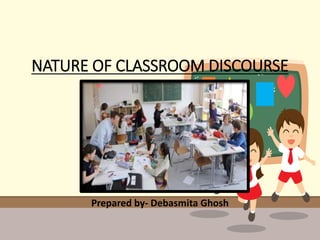
NATURE OF CLASSROOM DISCOURSE
Prepared by- Debasmita Ghosh
ABSTRACT
Classroom discourse is an
indispensable element of teaching
and learning. It is the teacher’s
capability to handle learner’s
contributions which will settle the
success or fail of a lesson. The
present presentation focuses on
classroom discourse and the
significance of classroom
discourse, the nature of
classroom discourse, the mode of
interaction in the classroom, the
types of classroom interaction
and the role of teacher. Finally, it
is concluded that to what extent
the teacher should be
experienced to manage the
classroom in a communicative
way which will lead to more
learning.
Classroom discourse is an interaction between
teachers and learners and between learners and
learners. It is generally claimed to form an isolated
discourse domain. Teachers and students construct
an understanding of their roles and relationships, and
the expectations for their involvement in the
classroom. To be successful, students must develop
the communicative competence.
Goal of the presentation
Interaction in classroom
condition is very pleasant for
language learning. Therefore
some strategies are adopted
which are very beneficial for the
learners who are aiming for the
betterment of the language skill
and fluency.
SIGNIFICANCE OF NATURE OF
CLASSROOM DISCOURSE
• It brings clarity and
distinctiveness in the speech.
• During interaction teachers have
the scope to identify the talent,
intelligence and excellence of the
pupils.
• Learners can be prompted to
think and do something new In
subject area.
•It provides learners the scope of
speaking and probing into his/her
subjects.
•Learners can acquaint themselves
with the new topics of
interactions.
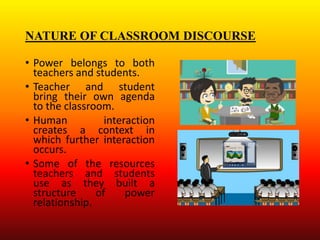
NATURE OF CLASSROOM DISCOURSE
• Power belongs to both
teachers and students.
• Teacher and student
bring their own agenda
to the classroom.
• Human interaction
creates a context in
which further interaction
occurs.
• Some of the resources
teachers and students
use as they built a
structure of power
relationship.
MODES OF INTERACTION IN CLASSROOM
Teacher - Student
Teacher - Two Students
Students - Students
Small peer group
Teacher – All Classroom Students
All students of the Classroom
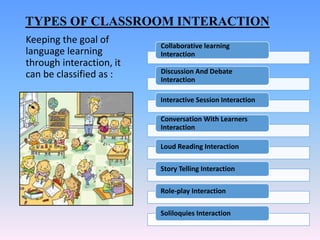
TYPES OF CLASSROOM INTERACTION
Collaborative learning
Interaction
Discussion And Debate
Interaction
Interactive Session Interaction
Conversation With Learners
Interaction
Loud Reading Interaction
Story Telling Interaction
Role-play Interaction
Soliloquies Interaction
Keeping the goal of
language learning
through interaction, it
can be classified as :
ROLE OF TEACHER
A teacher keeps a learning atmosphere congenial.
A teacher encourages the students to have a go
for some innovative idea, plan and strategies.
A teacher has the chance of sharing the
advantages of group interactions.
A teacher must be caring enough to study the
gesture and body language of the students.
Usefulness Of Classroom Interaction
Interaction is a two way-street. Clarity is
achieved through regular participation between
both the teachers and the students. So learners
gain confidence and assurance to present
themselves in front of many. Both teacher and
learner are equally benefitted through equal
participation.
My Opinion
From the above discussion, we can conclude that
the quality of student learning is closely
associated with the quality of classroom
discourse. In my opinion, to achieve this goal of
language learning, we ought to improve our self-
teaching skills. If we can improve the quality of
classroom discourse, we can certainly raise the
quality of student learning.
THANK YOU

B.ed Classroom.pptx

  • 1.
    NATURE OF CLASSROOMDISCOURSE Prepared by- Debasmita Ghosh
  • 2.
    ABSTRACT Classroom discourse isan indispensable element of teaching and learning. It is the teacher’s capability to handle learner’s contributions which will settle the success or fail of a lesson. The present presentation focuses on classroom discourse and the significance of classroom discourse, the nature of classroom discourse, the mode of interaction in the classroom, the types of classroom interaction and the role of teacher. Finally, it is concluded that to what extent the teacher should be experienced to manage the classroom in a communicative way which will lead to more learning.
  • 3.
    Classroom discourse isan interaction between teachers and learners and between learners and learners. It is generally claimed to form an isolated discourse domain. Teachers and students construct an understanding of their roles and relationships, and the expectations for their involvement in the classroom. To be successful, students must develop the communicative competence. Goal of the presentation Interaction in classroom condition is very pleasant for language learning. Therefore some strategies are adopted which are very beneficial for the learners who are aiming for the betterment of the language skill and fluency.
  • 4.
    SIGNIFICANCE OF NATUREOF CLASSROOM DISCOURSE • It brings clarity and distinctiveness in the speech. • During interaction teachers have the scope to identify the talent, intelligence and excellence of the pupils. • Learners can be prompted to think and do something new In subject area. •It provides learners the scope of speaking and probing into his/her subjects. •Learners can acquaint themselves with the new topics of interactions.
  • 5.
    NATURE OF CLASSROOMDISCOURSE • Power belongs to both teachers and students. • Teacher and student bring their own agenda to the classroom. • Human interaction creates a context in which further interaction occurs. • Some of the resources teachers and students use as they built a structure of power relationship.
  • 6.
    MODES OF INTERACTIONIN CLASSROOM Teacher - Student Teacher - Two Students Students - Students Small peer group Teacher – All Classroom Students All students of the Classroom
  • 7.
    TYPES OF CLASSROOMINTERACTION Collaborative learning Interaction Discussion And Debate Interaction Interactive Session Interaction Conversation With Learners Interaction Loud Reading Interaction Story Telling Interaction Role-play Interaction Soliloquies Interaction Keeping the goal of language learning through interaction, it can be classified as :
  • 8.
    ROLE OF TEACHER Ateacher keeps a learning atmosphere congenial. A teacher encourages the students to have a go for some innovative idea, plan and strategies. A teacher has the chance of sharing the advantages of group interactions. A teacher must be caring enough to study the gesture and body language of the students.
  • 9.
    Usefulness Of ClassroomInteraction Interaction is a two way-street. Clarity is achieved through regular participation between both the teachers and the students. So learners gain confidence and assurance to present themselves in front of many. Both teacher and learner are equally benefitted through equal participation. My Opinion From the above discussion, we can conclude that the quality of student learning is closely associated with the quality of classroom discourse. In my opinion, to achieve this goal of language learning, we ought to improve our self- teaching skills. If we can improve the quality of classroom discourse, we can certainly raise the quality of student learning.
  • 10.