16
57086
Contract and Project Management


David Sowden, The University of Hull
16
57086
Contract and Project Management

Configuration Management


David Sowden, The University of Hull
Overview

• Configuration Management
 – Purpose
 – History
 – Procedure
 – Managing the configuration
 – Configuration management method
 – Configuration management and change control


                                3
Purpose
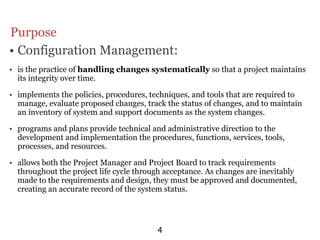
• Configuration Management:
• is the practice of handling changes systematically so that a project maintains
  its integrity over time.

• implements the policies, procedures, techniques, and tools that are required to
  manage, evaluate proposed changes, track the status of changes, and to maintain
  an inventory of system and support documents as the system changes.

• programs and plans provide technical and administrative direction to the
  development and implementation the procedures, functions, services, tools,
  processes, and resources.

• allows both the Project Manager and Project Board to track requirements
  throughout the project life cycle through acceptance. As changes are inevitably
  made to the requirements and design, they must be approved and documented,
  creating an accurate record of the system status.


                                         4
THE B
                             AS   ICS
Purpose


      Systems to allow you to
    track and find items easily


                5
History


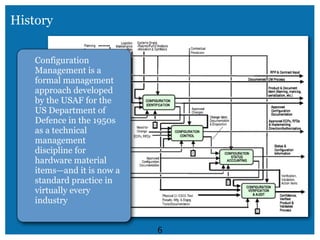
    Configuration
    Management is a
    formal management
    approach developed
    by the USAF for the
    US Department of
    Defence in the 1950s
    as a technical
    management
    discipline for
    hardware material
    items—and it is now a
    standard practice in
    virtually every
    industry


                            6
Procedure - Managing the configuration

• Configuration Management consists of five
  basic functions:
  –Planning:
  –Identification:
  –Control:
  –Status accounting:
  –Verification:

                      7
Managing the configuration
• Configuration Management Plan will
  contain:
 – An Explanation of the purpose of configuration management
 – A description of (or reference to) the method being used
 – Reference to any configuration management systems or tools
   being used
 – How and where the product will be stored
 – What filing and retrieval security there will be
 – How the products and the various versions of these will be
   identified
 – Where responsibilities for configuration management lie.

                                 8
Managing the configuration
• Configuration identification, each product requires a unique
  identifier, as a minimum, the coding scheme should identify:
  – The product in which the product is created
  – Type of product, for example, document, hardware
  – Product title
  – Latest version number


                                  9
Configuration management method (1)
• may be manual or automated, and should cover the following
  functions:
   – Identification of individual sub-products of the final product
   – Identification of those products that are required in order to
     produce other products
   – Establishing a unique coding system for each product
   – Identification of the ‘owner’ of a product
   – Identifying of whom creation or amendment of a version of a
     product has be delegated
   – Recording, monitoring and reporting the current status of each
     product as it progresses through its own life cycle
   – Filing all documentation produced during the development life of
     the product
Configuration management method (2)
• cover the following functions (continuation from previous slide):
   – Retention of all master copies (within the configuration library)
   – Provision of procedures to ensure the safety and security aspects
     of products
   – Distribution of copies of all product and recording of holders of
     copies
   – Maintenance of record of relationship between products - so that
     no product is changed without being able to check for possible
     impact on related products
   – Providing administrative support for change to all products
   – Establishment of baselines
   – Performance of configuration audits
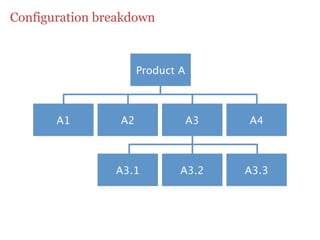
Configuration breakdown


                      Product A


       A1        A2               A3   A4


                A3.1          A3.2     A3.3
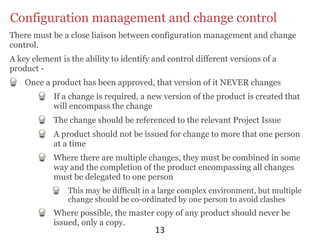
Configuration management and change control
There must be a close liaison between configuration management and change
control.
A key element is the ability to identify and control different versions of a
product -
    Once a product has been approved, that version of it NEVER changes
            If a change is required, a new version of the product is created that
            will encompass the change
            The change should be referenced to the relevant Project Issue
            A product should not be issued for change to more that one person
            at a time
            Where there are multiple changes, they must be combined in some
            way and the completion of the product encompassing all changes
            must be delegated to one person
                This may be difficult in a large complex environment, but multiple
                change should be co-ordinated by one person to avoid clashes
            Where possible, the master copy of any product should never be
            issued, only a copy.
                                      13
TASK


     Review your own
‘configuration management’
         systems

57086 16 configuration_management

  • 1.
    16 57086 Contract and ProjectManagement David Sowden, The University of Hull
  • 2.
    16 57086 Contract and ProjectManagement Configuration Management David Sowden, The University of Hull
  • 3.
    Overview • Configuration Management – Purpose – History – Procedure – Managing the configuration – Configuration management method – Configuration management and change control 3
  • 4.
    Purpose • Configuration Management: •is the practice of handling changes systematically so that a project maintains its integrity over time. • implements the policies, procedures, techniques, and tools that are required to manage, evaluate proposed changes, track the status of changes, and to maintain an inventory of system and support documents as the system changes. • programs and plans provide technical and administrative direction to the development and implementation the procedures, functions, services, tools, processes, and resources. • allows both the Project Manager and Project Board to track requirements throughout the project life cycle through acceptance. As changes are inevitably made to the requirements and design, they must be approved and documented, creating an accurate record of the system status. 4
  • 5.
    THE B AS ICS Purpose Systems to allow you to track and find items easily 5
  • 6.
    History Configuration Management is a formal management approach developed by the USAF for the US Department of Defence in the 1950s as a technical management discipline for hardware material items—and it is now a standard practice in virtually every industry 6
  • 7.
    Procedure - Managingthe configuration • Configuration Management consists of five basic functions: –Planning: –Identification: –Control: –Status accounting: –Verification: 7
  • 8.
    Managing the configuration •Configuration Management Plan will contain: – An Explanation of the purpose of configuration management – A description of (or reference to) the method being used – Reference to any configuration management systems or tools being used – How and where the product will be stored – What filing and retrieval security there will be – How the products and the various versions of these will be identified – Where responsibilities for configuration management lie. 8
  • 9.
    Managing the configuration •Configuration identification, each product requires a unique identifier, as a minimum, the coding scheme should identify: – The product in which the product is created – Type of product, for example, document, hardware – Product title – Latest version number 9
  • 10.
    Configuration management method(1) • may be manual or automated, and should cover the following functions: – Identification of individual sub-products of the final product – Identification of those products that are required in order to produce other products – Establishing a unique coding system for each product – Identification of the ‘owner’ of a product – Identifying of whom creation or amendment of a version of a product has be delegated – Recording, monitoring and reporting the current status of each product as it progresses through its own life cycle – Filing all documentation produced during the development life of the product
  • 11.
    Configuration management method(2) • cover the following functions (continuation from previous slide): – Retention of all master copies (within the configuration library) – Provision of procedures to ensure the safety and security aspects of products – Distribution of copies of all product and recording of holders of copies – Maintenance of record of relationship between products - so that no product is changed without being able to check for possible impact on related products – Providing administrative support for change to all products – Establishment of baselines – Performance of configuration audits
  • 12.
    Configuration breakdown Product A A1 A2 A3 A4 A3.1 A3.2 A3.3
  • 13.
    Configuration management andchange control There must be a close liaison between configuration management and change control. A key element is the ability to identify and control different versions of a product - Once a product has been approved, that version of it NEVER changes If a change is required, a new version of the product is created that will encompass the change The change should be referenced to the relevant Project Issue A product should not be issued for change to more that one person at a time Where there are multiple changes, they must be combined in some way and the completion of the product encompassing all changes must be delegated to one person This may be difficult in a large complex environment, but multiple change should be co-ordinated by one person to avoid clashes Where possible, the master copy of any product should never be issued, only a copy. 13
  • 14.
    TASK Review your own ‘configuration management’ systems