Software Change Management
HELLO!
I am Abhinav Sabharwal
You can find me at skyabhinav@gmail.com
Why Is Software Difficult to Build?
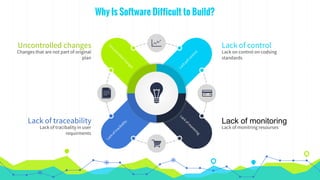
Lack on control on codsing
standards
Lack of control
Lack of monitring resourses
Lack of monitoring
Changes that are not part of original
plan
Uncontrolled changes
Lack of tracibality in user
requirments
Lack of traceability
Why Is Software Difficult to Build?
Conflicts in Team Software Development
◉Simultaneous updates – how to
prevent one person from undoing the
changes of another
◉Shared and common code – how to
notify everyone who needs to know
about a change
◉Versions – how to make changes to all
affected versions when needed
Software Configuration Management Basics
◉Identification – identifying software
configuration items in a baseline
◉Control – controlling the release of a product
and changes to it throughout its lifecycle
◉Status Accounting – recording and reporting of
the status of components and changes
◉Auditing and Reviewing – Validating the
completeness of a product and that SCM
procedures are being followed
SCM Definitions
◉Baseline – One or more software configuration
items that have been formally reviewed and
agreed upon and serve as a basis for further
development
◉Software Configuration Item – A collection of
software elements treated as a unit for the
purposes of SCM
◉Configuration – A collection of all the elements
of a baseline and a description of how they fit
together
SCM Definitions
◉Configuration Control Board – Group with the
responsibility for reviewing and approving
changes to baselines
◉Software – All of the code, specifications, plans,
descriptions, processes, and documents
associated with a software development effort
◉Version – A specific instance of a baseline or
configuration item
Examples of Configuration Items
◉Product concept specification
◉Software project plans
◉Software requirements specifications
◉Software design descriptions
◉Source code
◉Database descriptions
◉SCM procedures
◉Software release processes
◉Software test documents
◉User documentation
◉Maintenance documentation
Version Control
◉Allows different projects to use the same source
files at the same time
◉Isolates work that is not ready to be shared by
the rest of the project
◉Isolates work that should never be shared
◉Allows software engineers to continue
development along a branch even when a line of
development is frozen
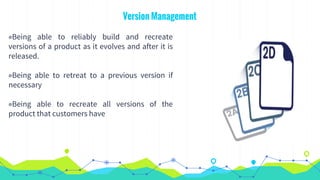
Version Management
◉Being able to reliably build and recreate
versions of a product as it evolves and after it is
released.
◉Being able to retreat to a previous version if
necessary
◉Being able to recreate all versions of the
product that customers have
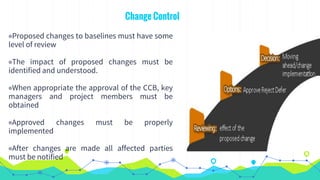
Change Control
◉Proposed changes to baselines must have some
level of review
◉The impact of proposed changes must be
identified and understood.
◉When appropriate the approval of the CCB, key
managers and project members must be
obtained
◉Approved changes must be properly
implemented
◉After changes are made all affected parties
must be notified
Baseline Management
◉What baselines are required to be defined and
managed?
◉Typically aligned with major milestones
◉Applies to documents as well as code
◉How is the current software configuration
defined?
◉A snapshot of everything the product has
produced at some point in time
Baseline Management
◉What metrics should be used to assess changes
to a baseline?
◉Complexity
◉Average module size
◉Number of modules changed
◉Number of bugs fixed and verified
◉Code coverage
Baseline Management
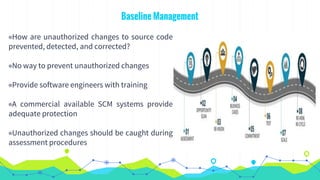
◉How are unauthorized changes to source code
prevented, detected, and corrected?
◉No way to prevent unauthorized changes
◉Provide software engineers with training
◉A commercial available SCM systems provide
adequate protection
◉Unauthorized changes should be caught during
assessment procedures
Baseline Management
◉What tools, resources, and training are required
to perform baseline management?
◉A fully featured SCM tool
◉On large projects a separate SCM group may be
needed
◉SCM training is required for all involved in the
process
Baseline Management
◉What tools, resources, and training are required
to perform baseline management?
◉A fully featured SCM tool
◉On large projects a separate SCM group may be
needed
◉SCM training is required for all involved in the
process
Workspace Management
◉Software engineers need a consistent and
reproducible workspace area (a sandbox) in
which they can develop and debug their code
◉They need to be able to share project files while
shielding the project from the instability of their
evolving code
◉SCM tools should provide such a capability
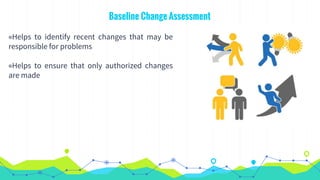
Baseline Change Assessment
◉Helps to identify recent changes that may be
responsible for problems
◉Helps to ensure that only authorized changes
are made
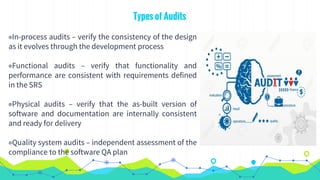
Types of Audits
◉In-process audits – verify the consistency of the design
as it evolves through the development process
◉Functional audits – verify that functionality and
performance are consistent with requirements defined
in the SRS
◉Physical audits – verify that the as-built version of
software and documentation are internally consistent
and ready for delivery
◉Quality system audits – independent assessment of the
compliance to the software QA plan
Configuration Status Accounting Requirements
◉Identifying the types of information that project
managers need
◉Identifying the degree of control needed by project
management
◉Identifying the reports required and the different
audiences for each report
◉Identifying the information required to produce each
report
SCM Summary
◉Change is inevitable
◉Defined procedures are required to manage change
without preventing change
◉Software presents many challenges from a control,
management, and tracking perspective
◉Knowing what you have and how you got there is
very important
◉Being able to recreate exactly what is delivered to
customers is essential
THANKS!
Any questions?
You can find me at
skyabhinav@gmail.com

Change Management

  • 1.
  • 2.
    HELLO! I am AbhinavSabharwal You can find me at skyabhinav@gmail.com
  • 3.
    Why Is SoftwareDifficult to Build?
  • 4.
    Lack on controlon codsing standards Lack of control Lack of monitring resourses Lack of monitoring Changes that are not part of original plan Uncontrolled changes Lack of tracibality in user requirments Lack of traceability Why Is Software Difficult to Build?
  • 5.
    Conflicts in TeamSoftware Development ◉Simultaneous updates – how to prevent one person from undoing the changes of another ◉Shared and common code – how to notify everyone who needs to know about a change ◉Versions – how to make changes to all affected versions when needed
  • 6.
    Software Configuration ManagementBasics ◉Identification – identifying software configuration items in a baseline ◉Control – controlling the release of a product and changes to it throughout its lifecycle ◉Status Accounting – recording and reporting of the status of components and changes ◉Auditing and Reviewing – Validating the completeness of a product and that SCM procedures are being followed
  • 7.
    SCM Definitions ◉Baseline –One or more software configuration items that have been formally reviewed and agreed upon and serve as a basis for further development ◉Software Configuration Item – A collection of software elements treated as a unit for the purposes of SCM ◉Configuration – A collection of all the elements of a baseline and a description of how they fit together
  • 8.
    SCM Definitions ◉Configuration ControlBoard – Group with the responsibility for reviewing and approving changes to baselines ◉Software – All of the code, specifications, plans, descriptions, processes, and documents associated with a software development effort ◉Version – A specific instance of a baseline or configuration item
  • 9.
    Examples of ConfigurationItems ◉Product concept specification ◉Software project plans ◉Software requirements specifications ◉Software design descriptions ◉Source code ◉Database descriptions ◉SCM procedures ◉Software release processes ◉Software test documents ◉User documentation ◉Maintenance documentation
  • 10.
    Version Control ◉Allows differentprojects to use the same source files at the same time ◉Isolates work that is not ready to be shared by the rest of the project ◉Isolates work that should never be shared ◉Allows software engineers to continue development along a branch even when a line of development is frozen
  • 11.
    Version Management ◉Being ableto reliably build and recreate versions of a product as it evolves and after it is released. ◉Being able to retreat to a previous version if necessary ◉Being able to recreate all versions of the product that customers have
  • 12.
    Change Control ◉Proposed changesto baselines must have some level of review ◉The impact of proposed changes must be identified and understood. ◉When appropriate the approval of the CCB, key managers and project members must be obtained ◉Approved changes must be properly implemented ◉After changes are made all affected parties must be notified
  • 13.
    Baseline Management ◉What baselinesare required to be defined and managed? ◉Typically aligned with major milestones ◉Applies to documents as well as code ◉How is the current software configuration defined? ◉A snapshot of everything the product has produced at some point in time
  • 14.
    Baseline Management ◉What metricsshould be used to assess changes to a baseline? ◉Complexity ◉Average module size ◉Number of modules changed ◉Number of bugs fixed and verified ◉Code coverage
  • 15.
    Baseline Management ◉How areunauthorized changes to source code prevented, detected, and corrected? ◉No way to prevent unauthorized changes ◉Provide software engineers with training ◉A commercial available SCM systems provide adequate protection ◉Unauthorized changes should be caught during assessment procedures
  • 16.
    Baseline Management ◉What tools,resources, and training are required to perform baseline management? ◉A fully featured SCM tool ◉On large projects a separate SCM group may be needed ◉SCM training is required for all involved in the process
  • 17.
    Baseline Management ◉What tools,resources, and training are required to perform baseline management? ◉A fully featured SCM tool ◉On large projects a separate SCM group may be needed ◉SCM training is required for all involved in the process
  • 18.
    Workspace Management ◉Software engineersneed a consistent and reproducible workspace area (a sandbox) in which they can develop and debug their code ◉They need to be able to share project files while shielding the project from the instability of their evolving code ◉SCM tools should provide such a capability
  • 19.
    Baseline Change Assessment ◉Helpsto identify recent changes that may be responsible for problems ◉Helps to ensure that only authorized changes are made
  • 20.
    Types of Audits ◉In-processaudits – verify the consistency of the design as it evolves through the development process ◉Functional audits – verify that functionality and performance are consistent with requirements defined in the SRS ◉Physical audits – verify that the as-built version of software and documentation are internally consistent and ready for delivery ◉Quality system audits – independent assessment of the compliance to the software QA plan
  • 21.
    Configuration Status AccountingRequirements ◉Identifying the types of information that project managers need ◉Identifying the degree of control needed by project management ◉Identifying the reports required and the different audiences for each report ◉Identifying the information required to produce each report
  • 22.
    SCM Summary ◉Change isinevitable ◉Defined procedures are required to manage change without preventing change ◉Software presents many challenges from a control, management, and tracking perspective ◉Knowing what you have and how you got there is very important ◉Being able to recreate exactly what is delivered to customers is essential
  • 23.
    THANKS! Any questions? You canfind me at skyabhinav@gmail.com