Chapter 8
Strategies Software
Configuration Management
Software Configuration Management (SCM)
Software Configuration Management is defined as a process to systematically
manage, organize, and control the changes in the documents, codes, and other
entities during the Software Development Life Cycle. It is abbreviated as the
SCM process in software engineering. The primary goal is to increase
productivity with minimal mistakes.
The items that comprise all information produced as part of the software process
are collectively called a Software Configuration.
Need Of Configuration management
The primary reasons for Implementing Software Configuration Management
System are:
● There are multiple people working on software which is continually updating
● It may be a case where multiple version, branches, authors are involved in a
software project, and the team is geographically distributed and works
concurrently
● Changes in user requirement, policy, budget, schedule need to be
accommodated.
● Software should able to run on various machines and Operating Systems
● Helps to develop coordination among stakeholders
● SCM process is also beneficial to control the costs involved in making
changes to a system
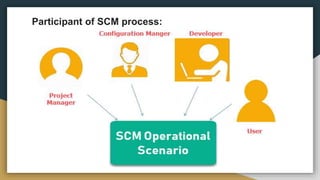
Participant of SCM process:
1. Configuration Manager
● Configuration Manager is the head who is Responsible for identifying
configuration items.
● CM ensures team follows the SCM process
● He/She needs to approve or reject change requests
2. Developer
● The developer needs to change the code as per standard
development activities or change requests. He is responsible for
maintaining configuration of code.
● The developer should check the changes and resolves conflicts
3. Auditor
● The auditor is responsible for SCM audits and reviews.
● Need to ensure the consistency and completeness of release.
4. Project Manager:
● Ensure that the product is developed within a certain time frame
● Monitors the progress of development and recognizes issues in the SCM
process
● Generate reports about the status of the software system
● Make sure that processes and policies are followed for creating, changing,
and testing
5. User:The end user should understand the key SCM terms to ensure he has the
latest version of the software
Features of SCM
Concurrency Management: When two or more tasks are happening at same time it
is known as concurrent operation. If we talk concurrency in context to SCM it means
that the same file being edited by multiple persons at the same time. If concurrency
is not managed properly with SCM tools then it may lead to very severe problems.
Version Control: The second important feature provided by SCM tools is version
control. SCM tool uses archiving method or saves every change made to file so that
it is possible for use to roll back to previous version in case of any problems.
Configuration Management: A configuration management facility keeps track of
series of configurations representing specific project milestones or production
realeases.
Steps of SCM
1.Configuration Identification:
Configuration identification is a method of determining the scope of the software
system. With the help of this step, you can manage or control something even if
you don't know what it is. It is a description that contains the CSCI type (Computer
Software Configuration Item), a project identifier and version information.
Example:
Instead of naming a File login.php its should be named login_v1.2.php where v1.2
stands for the version number of the file
Instead of naming folder "Code" it should be named "Code_D" where D represents
code should be backed up daily.
2. Baseline:
A baseline is a formally accepted version of a software configuration item.
It is designated and fixed at a specific time while conducting the SCM
process. It can only be changed through formal change control procedures.
3. Change Control:
Change control is a procedural method which ensures quality and
consistency when changes are made in the configuration object. In this
step, the change request is submitted to software configuration manager.
4. Configuration Status Accounting:
Configuration status accounting tracks each release during the SCM
process. This stage involves tracking what each version has and the
changes that lead to this version.
5. Configuration Audits and Reviews:
Software Configuration audits verify that all the software product satisfies
the baseline needs. It ensures that what is built is what is delivered.

Software configuration management

  • 1.
  • 2.
    Software Configuration Management(SCM) Software Configuration Management is defined as a process to systematically manage, organize, and control the changes in the documents, codes, and other entities during the Software Development Life Cycle. It is abbreviated as the SCM process in software engineering. The primary goal is to increase productivity with minimal mistakes. The items that comprise all information produced as part of the software process are collectively called a Software Configuration.
  • 3.
    Need Of Configurationmanagement The primary reasons for Implementing Software Configuration Management System are: ● There are multiple people working on software which is continually updating ● It may be a case where multiple version, branches, authors are involved in a software project, and the team is geographically distributed and works concurrently ● Changes in user requirement, policy, budget, schedule need to be accommodated. ● Software should able to run on various machines and Operating Systems ● Helps to develop coordination among stakeholders ● SCM process is also beneficial to control the costs involved in making changes to a system
  • 4.
  • 5.
    1. Configuration Manager ●Configuration Manager is the head who is Responsible for identifying configuration items. ● CM ensures team follows the SCM process ● He/She needs to approve or reject change requests 2. Developer ● The developer needs to change the code as per standard development activities or change requests. He is responsible for maintaining configuration of code. ● The developer should check the changes and resolves conflicts
  • 6.
    3. Auditor ● Theauditor is responsible for SCM audits and reviews. ● Need to ensure the consistency and completeness of release. 4. Project Manager: ● Ensure that the product is developed within a certain time frame ● Monitors the progress of development and recognizes issues in the SCM process ● Generate reports about the status of the software system ● Make sure that processes and policies are followed for creating, changing, and testing 5. User:The end user should understand the key SCM terms to ensure he has the latest version of the software
  • 7.
    Features of SCM ConcurrencyManagement: When two or more tasks are happening at same time it is known as concurrent operation. If we talk concurrency in context to SCM it means that the same file being edited by multiple persons at the same time. If concurrency is not managed properly with SCM tools then it may lead to very severe problems. Version Control: The second important feature provided by SCM tools is version control. SCM tool uses archiving method or saves every change made to file so that it is possible for use to roll back to previous version in case of any problems. Configuration Management: A configuration management facility keeps track of series of configurations representing specific project milestones or production realeases.
  • 8.
    Steps of SCM 1.ConfigurationIdentification: Configuration identification is a method of determining the scope of the software system. With the help of this step, you can manage or control something even if you don't know what it is. It is a description that contains the CSCI type (Computer Software Configuration Item), a project identifier and version information. Example: Instead of naming a File login.php its should be named login_v1.2.php where v1.2 stands for the version number of the file Instead of naming folder "Code" it should be named "Code_D" where D represents code should be backed up daily.
  • 9.
    2. Baseline: A baselineis a formally accepted version of a software configuration item. It is designated and fixed at a specific time while conducting the SCM process. It can only be changed through formal change control procedures. 3. Change Control: Change control is a procedural method which ensures quality and consistency when changes are made in the configuration object. In this step, the change request is submitted to software configuration manager.
  • 10.
    4. Configuration StatusAccounting: Configuration status accounting tracks each release during the SCM process. This stage involves tracking what each version has and the changes that lead to this version. 5. Configuration Audits and Reviews: Software Configuration audits verify that all the software product satisfies the baseline needs. It ensures that what is built is what is delivered.