The Mwalimu Nyerere Memorial 
Academy (MNMA) 
Introduction to Records Management 
for TCHRM /SST 05111 
By, Mr. Sanchawa, Denis H 
Assistant Lecturer-Social Studies 
9/24/2014 1
Introduction 
• Records management offers tangible benefits to 
organisations, from economic good practice in 
reducing storage costs of documents, to enabling 
administrative, financial and legal requirements 
to be met. 
• Poor management of record system makes the 
performance of duties more difficult, costs 
organisations time, money and other resources 
and e.t.c 
9/24/2014 Mr. SANCHAWA, Denis H 2
Introduction (ctd) 
• Thus, in this lecture we are going to see the 
concepts of record, document, record 
management, record life cycle , the benefits of 
records management, the principles for 
effective records management and other 
areas which deem to be necessary 
9/24/2014 Mr. SANCHAWA, Denis H 3
What are records? 
• Records are official documents that should be 
stored for later use 
• Records and Archives management Act,2002 
defines records as recorded information 
regardless of form or medium created, received 
and maintained by institution or individual in the 
pursuance of its legal obligations or in the 
transaction of its business and providing evidence 
of the performance of those obligations 
9/24/2014 Mr. SANCHAWA, Denis H 4
What are records? 
• Thus, records are information kept in various 
forms such as paper or computer disk needed for 
carrying out the activities of the organization. 
The captured information can be in form of :- 
• Paper (e.g. Files, reports, maps, print outs 
invoices etc) 
• Microfilm 
• Compact disk 
• Tapes and etc 
9/24/2014 Mr. SANCHAWA, Denis H 5
What are records? 
• Records are information that have been 
documented by an organization in the course 
of its business and maintained in pursuance of 
certain obligations. 
• Records are document created, received, 
maintained and used by an organization or an 
individual in transaction of business which it 
provides evidence. 
9/24/2014 Mr. SANCHAWA, Denis H 6
What are records? 
Healy, S (1997) sees records as documented 
information consist of books, papers, maps, 
photographs or other forms regardless of 
physical characteristics made or received by 
any public or private institution in connection 
to functions, policies, procedures, operations 
and activities of an organization 
9/24/2014 Mr. SANCHAWA, Denis H 7
Forms of records may INCLUDE? 
• Paper reports, directives, forms, 
correspondence 
• Phone call notes 
• Photographs, videotapes, posters 
• Maps and drawings 
• Databases 
• E-mail 
• Microfilms and etc 
9/24/2014 Mr. SANCHAWA, Denis H 8
What is NOT a record? 
• Material that does not meet the statutory 
definition of the record include but not limited 
to (Samson, 2012) :- 
i. Technical reference material 
ii. Catalogs , trade journals, manual 
iii. Extra copies 
iv. Black forms 
v. Some electronic information 
9/24/2014 Mr. SANCHAWA, Denis H 9
Why records? 
To ensure continuity in administration 
To ensure tax-payer’s interest is protected at all 
times 
For providing evidence in case of disputes 
For planning & scheduling organisation activities 
For historical value 
To make available needed facts, figures, 
correspondence etc. 
9/24/2014 Mr. SANCHAWA, Denis H 10
Why records? 
• Documentation of workforce performance 
• Provide evidence about past actions and 
decisions 
• For accountability and transference purpose 
9/24/2014 Mr. SANCHAWA, Denis H 11
Criteria in creating records 
• Is it necessary? 
• What constitutes adequate 
documentation? 
• Is it desirable to have it in a consistent 
format? 
• What is its future life ? 
• What is the best way to store and 
retrieve it? 
9/24/2014 Mr. SANCHAWA, Denis H 12
What are the characteristics of 
records? 
• Records are evidence of actions and transactions 
• Records should support accountability, which is 
tightly connected to evidence but which allows 
accountability to be traced; 
• Records are related to processes, i.e. 
“information that is generated by and linked to 
work processes” [Thomassen, 2001, p 374]; 
• Records must be preserved, some for very short 
time and some permanently. 
9/24/2014 Mr. SANCHAWA, Denis H 13
Other characteristics of records 
• Authenticity : proven to be purport to be created 
and sent by the Person implied to have 
sent/created them 
• Integrity : Must remain complete and unaltered 
over time 
• Usability : Can be located, retrieved, presented 
and interpreted 
• Reliability: contents can be trusted as a full and 
accurate representation of the transaction to 
which they attest 
9/24/2014 Mr. SANCHAWA, Denis H 14
Records contain information and 
date from which ? 
• Decisions are made 
• Plans are developed 
• Policies are made 
• Objectives are realized 
• Obligations are discharged 
• Questions can be answered 
• Historical evidence can be taken 
• Investigations can be handled and etc 
9/24/2014 Mr. SANCHAWA, Denis H 15
What are the categories of records ? 
• Records can be categorized in a number of 
different ways:- Commonly recognized 
categories include: (Standard Australian, 1996) 
• Administrative Records : procedures 
documentation, forms and correspondence ; 
examples are staff manuals, rosters, logging of 
property maintenance jobs, travel bookings 
9/24/2014 Mr. SANCHAWA, Denis H 16
What are the categories of records? 
• Accounting records : reports, forms and 
related correspondence. Examples are 
invoices, bank account reports, customer 
billing reports 
• Project reports: correspondence , notes , 
product development documentation e.t.c 
related to a specific project 
9/24/2014 Mr. SANCHAWA, Denis H 17
What are the categories of records? 
• Case files: client records, personnel records, 
insurance, contacts and lawsuit files 
9/24/2014 Mr. SANCHAWA, Denis H 18
Meaning of a document 
• A document is any piece of written information in 
any form, produced or received by an 
organisation or person. It can include databases, 
website, email messages, word and excel files, 
letters, and memos. 
• Recorded information, which can be treated as a 
unit (URT, 2011) 
• Structured unit of recorded information either 
published or unpublished, in hard copy or 
electronic form and managed as discrete units in 
information systems( Standard Australian, 1996) 
9/24/2014 Mr. SANCHAWA, Denis H 19
A document and a record 
• When document s are kept as future evidence 
they become official records. 
• In other words, all records start off as documents, 
but not all documents will ultimately become 
records. 
• A FILE : An organized physical assembly (usually 
within a folder) or documents grouped together 
because they relate to the same subject, activity 
or transaction (URT, 2011) 
9/24/2014 Mr. SANCHAWA, Denis H 20
What is records management? 
• Records management is the systematic control of 
an organisation's records (both paper and 
electronic), throughout their life cycle, in order to 
meet operational business needs, statutory and 
fiscal requirements, and community expectations 
• A field of management responsible for the 
efficient and systematic control of the receipt, 
maintenance , use and disposition of records 
(GoT, 2011) 
9/24/2014 Mr. SANCHAWA, Denis H 21
What is records management? 
• Record management refers to administrative 
management concerned with systematic 
planning, controlling, creating, maintenance, 
efficient and economic use and disposal of 
records throughout the entire life cycle of 
records of an organization (Samson, 2012) 
9/24/2014 Mr. SANCHAWA, Denis H 22
What is records management ? 
Activities involved in controlling the life cycle of a 
record, beginning with its creation and ending 
with ultimate disposition 
Leads to prevention of creation of unnecessary 
documentation 
Early identification of papers lasting value and 
systematic planning of retirement procedures 
9/24/2014 Mr. SANCHAWA, Denis H 23
Why is records management 
necessary? 
• RM ensures information can be accessed easily, 
can be destroyed routinely when no longer 
needed, 
• RM enables organisations not only to function on 
a day to day basis, but also to fulfil its legal and 
financial requirements 
• Through effective record management for 
example, organization can be held accountable 
for its actions or in actions . 
9/24/2014 Mr. SANCHAWA, Denis H 24
Why records management ? 
For essentially planning, organizing and 
coordinating of certain functions relating to 
information gathering, information processing, 
communicating and records keeping 
Key to efficient administration 
9/24/2014 Mr. SANCHAWA, Denis H 25
The benefits of effective records 
management 
Systematic management of records allows 
organisations to: 
• know what records they have, and locate them 
easily 
• increase efficiency and effectiveness 
• make savings in administration costs, both in staff 
time and storage 
• support decision making 
• be accountable 
9/24/2014 Mr. SANCHAWA, Denis H 26
Benefits of effective records 
management 
• achieve organisation objectives and targets 
• provide continuity in the event of a disaster 
• meet legislative and regulatory requirements, 
particularly protect the interests of 
employees, clients and stakeholders 
9/24/2014 Mr. SANCHAWA, Denis H 27
Legal and regulatory frameworks for 
RM in Tanzania 
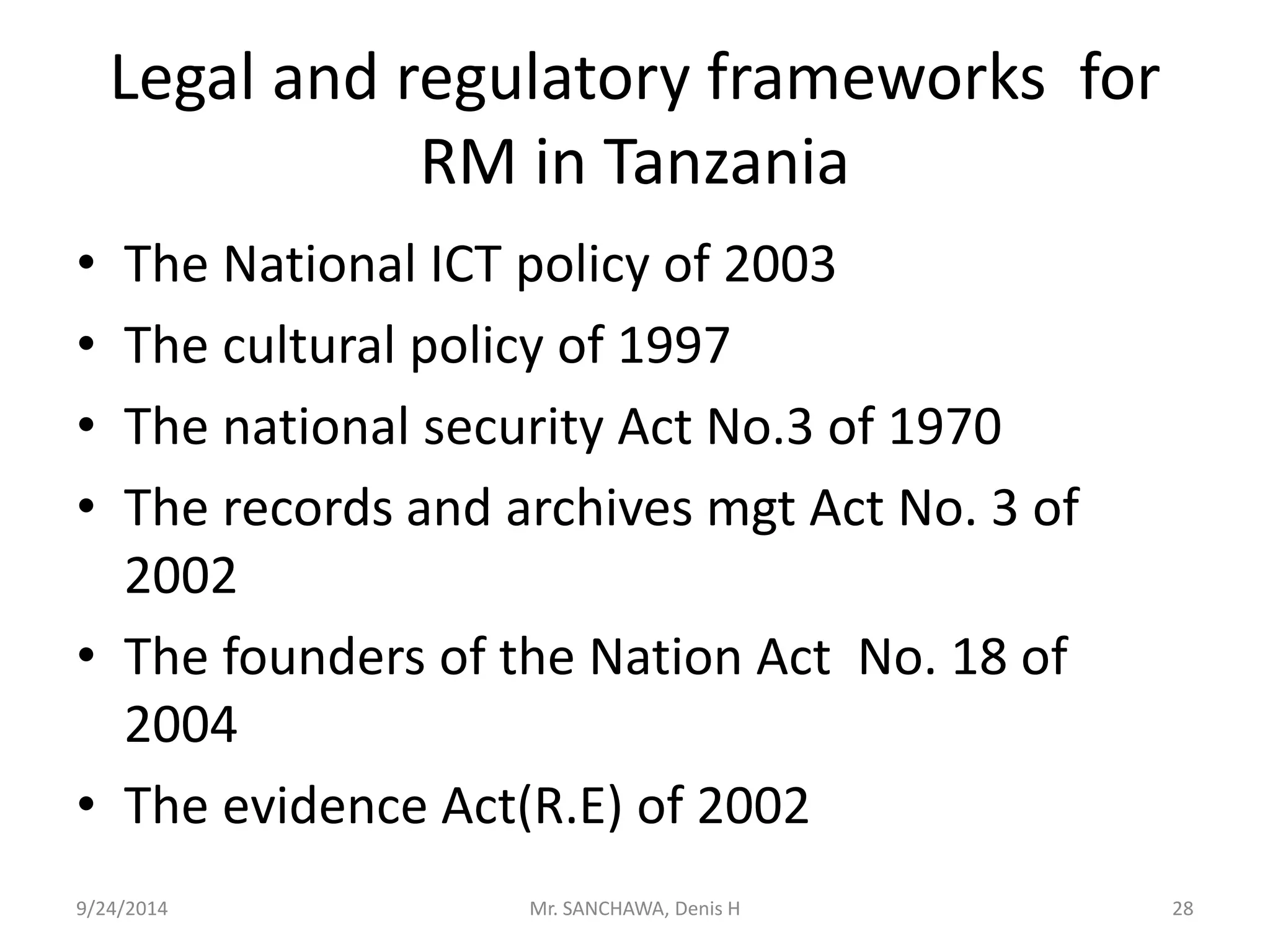
• The National ICT policy of 2003 
• The cultural policy of 1997 
• The national security Act No.3 of 1970 
• The records and archives mgt Act No. 3 of 
2002 
• The founders of the Nation Act No. 18 of 
2004 
• The evidence Act(R.E) of 2002 
9/24/2014 Mr. SANCHAWA, Denis H 28
Summary of the benefits of record mgt 
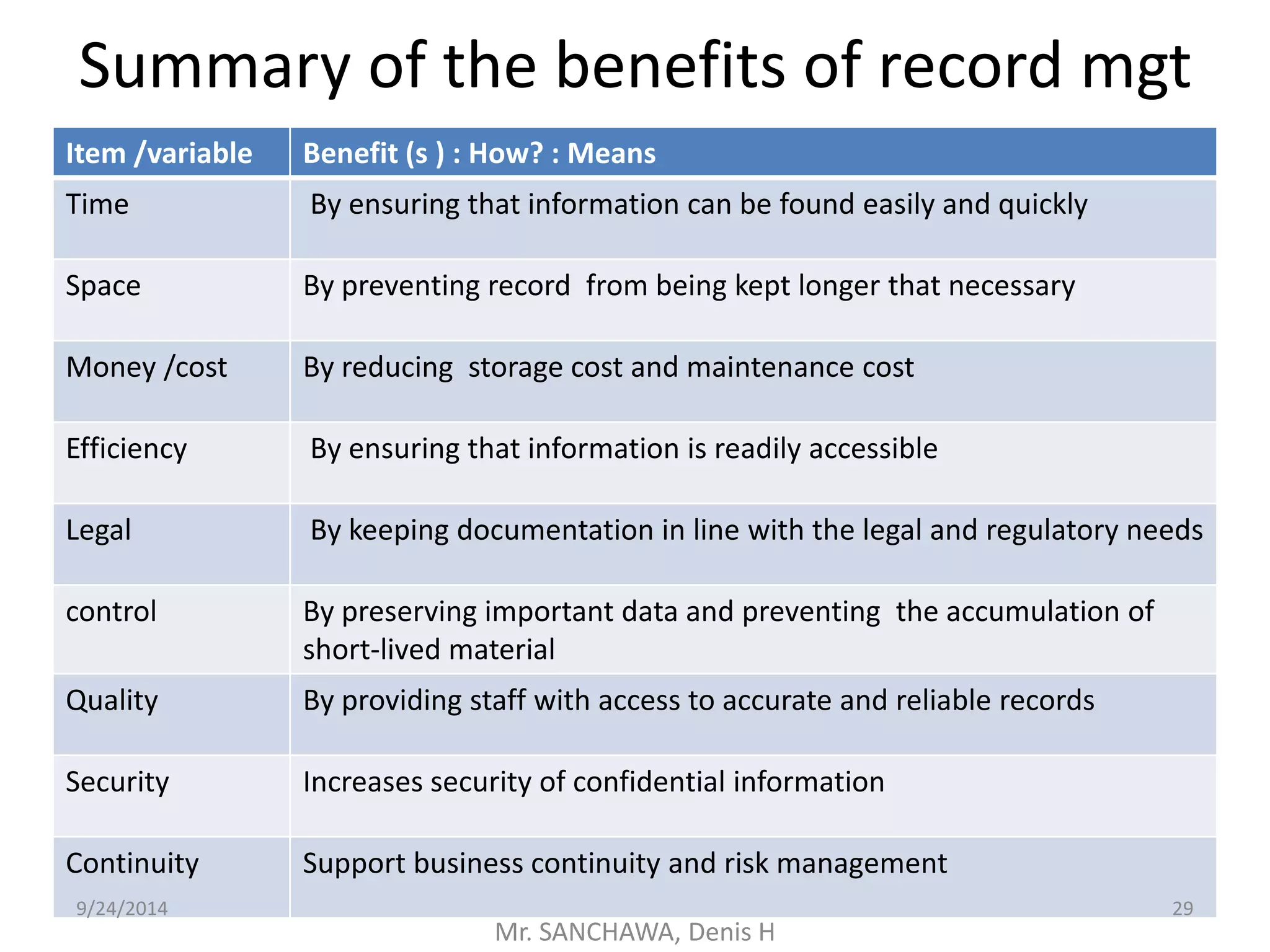
Item /variable Benefit (s ) : How? : Means 
Time By ensuring that information can be found easily and quickly 
Space By preventing record from being kept longer that necessary 
Money /cost By reducing storage cost and maintenance cost 
Efficiency By ensuring that information is readily accessible 
Legal By keeping documentation in line with the legal and regulatory needs 
control By preserving important data and preventing the accumulation of 
short-lived material 
Quality By providing staff with access to accurate and reliable records 
Security Increases security of confidential information 
Continuity Support business continuity and risk management 
9/24/2014 29 
Mr. SANCHAWA, Denis H
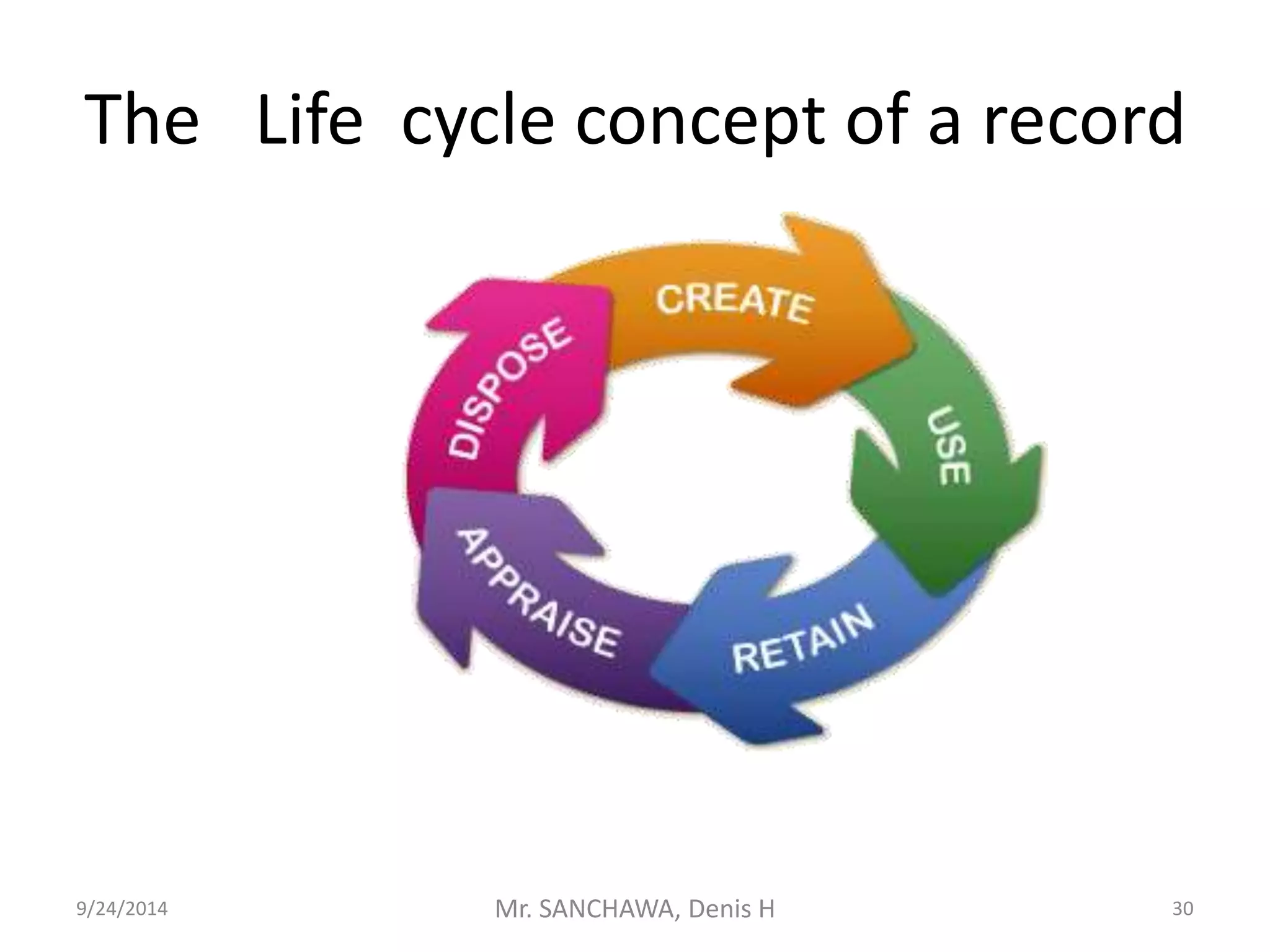
The Life cycle concept of a record 
9/24/2014 Mr. SANCHAWA, Denis H 30
What is the life cycle of a record? 
• The record life cycle is a concept based on the 
idea that records may be regarded as having a 
life similar to that of living organism. 
• Refers to the life cycle of records from their 
creation to their destruction or permanent 
retention(GoT,2011) 
• Thus, the concept goes into stages as 
described in this presentation 
9/24/2014 Mr. SANCHAWA, Denis H 31
The life cycle of records 
• Current: Initially records are current or active 
while they are used to carry out day-to-day work. 
• Semi-current: Next records become semi-current 
or semi-active, when they only need to be 
referred to occasionally or have to be retained for 
legal or regulatory reasons. 
• Inactive: Finally records become inactive, and a 
decision has to be made whether to discard them 
or, in a few cases, keep them permanently 
because they have historical value. 
9/24/2014 Mr. SANCHAWA, Denis H 32
The importance of the life cycle 
concept of records (Mhina, 2012) 
• Helps the record managers to have clear 
understanding of managing records from their 
creation stage to disposition 
• helps record managers to make prior decision 
whether to create a record or not by making 
judgement of the value of a record 
• Helps the record liason to understand in advance 
in what media the record could be created 
• Helps the record managers to apply records 
retention scheduling of records at the right time 
9/24/2014 Mr. SANCHAWA, Denis H 33
Key elements for records management 
• Records management involves controlling records 
throughout their life cycle. Thus , the activities 
involved in records management can be described 
into the following key elements or items 
9/24/2014 Mr. SANCHAWA, Denis H 34
Records creation 
• Each department must create records that are 
accurate and complete, so that it is possible to 
establish what has been done and why. 
• The quality of the records must also be 
sufficient to allow staff to carry out their work 
efficiently, demonstrate compliance with legal 
and regulatory requirements, and ensure 
accountability and transparency expectations 
are met. 
9/24/2014 Mr. SANCHAWA, Denis H 35
Information audit 
• Information audit is helpful in order to 
establish what information (both paper and 
electronic) is held by a department and where 
it is held; and to clarify who is responsible for 
keeping the definitive versions of documents 
and who is simply holding copies. 
9/24/2014 Mr. SANCHAWA, Denis H 36
Classification 
• All records (e.g. paper files, electronic 
documents, emails) should be arranged 
systematically, so that they can be retrieved 
easily and quickly. 
• The main areas of work carried out by a 
department should be identified, and then a 
paper filing structure and electronic directory 
tree developed into which all the documents 
can be logically placed 
9/24/2014 Mr. SANCHAWA, Denis H 37
Storage 
• Records that are consulted frequently should 
be kept close-at-hand within the immediate 
office space, while semi-current material can 
be housed in separate store rooms or stored 
off-site 
9/24/2014 Mr. SANCHAWA, Denis H 38
Security 
• Paper records containing confidential 
information must be stored in locked cabinets 
or drawers when not in use, and access only 
granted to authorized staff. 
• In the case of sensitive electronic data, access 
should be controlled through the use of log-ins, 
passwords and read-only settings, and 
computers should not be left unattended 
when logged-on. 
9/24/2014 Mr. SANCHAWA, Denis H 39
Tracking 
• In departments where several people need to 
consult the same documents, it may helpful to 
track the movement of files to ensure they can 
always be found. 
• For example, a form can be used to record the 
name of the person retrieving a file, as well as 
its reference, title and the date of retrieval; 
9/24/2014 Mr. SANCHAWA, Denis H 40
Vital records 
• It is essential to store all critical business data 
on a network drive, so that it will be protected 
by appropriate back up and disaster recovery 
procedures. Vital records that are only 
available in paper format should be 
duplicated, and the originals and copies stored 
in separate locations. 
9/24/2014 Mr. SANCHAWA, Denis H 41
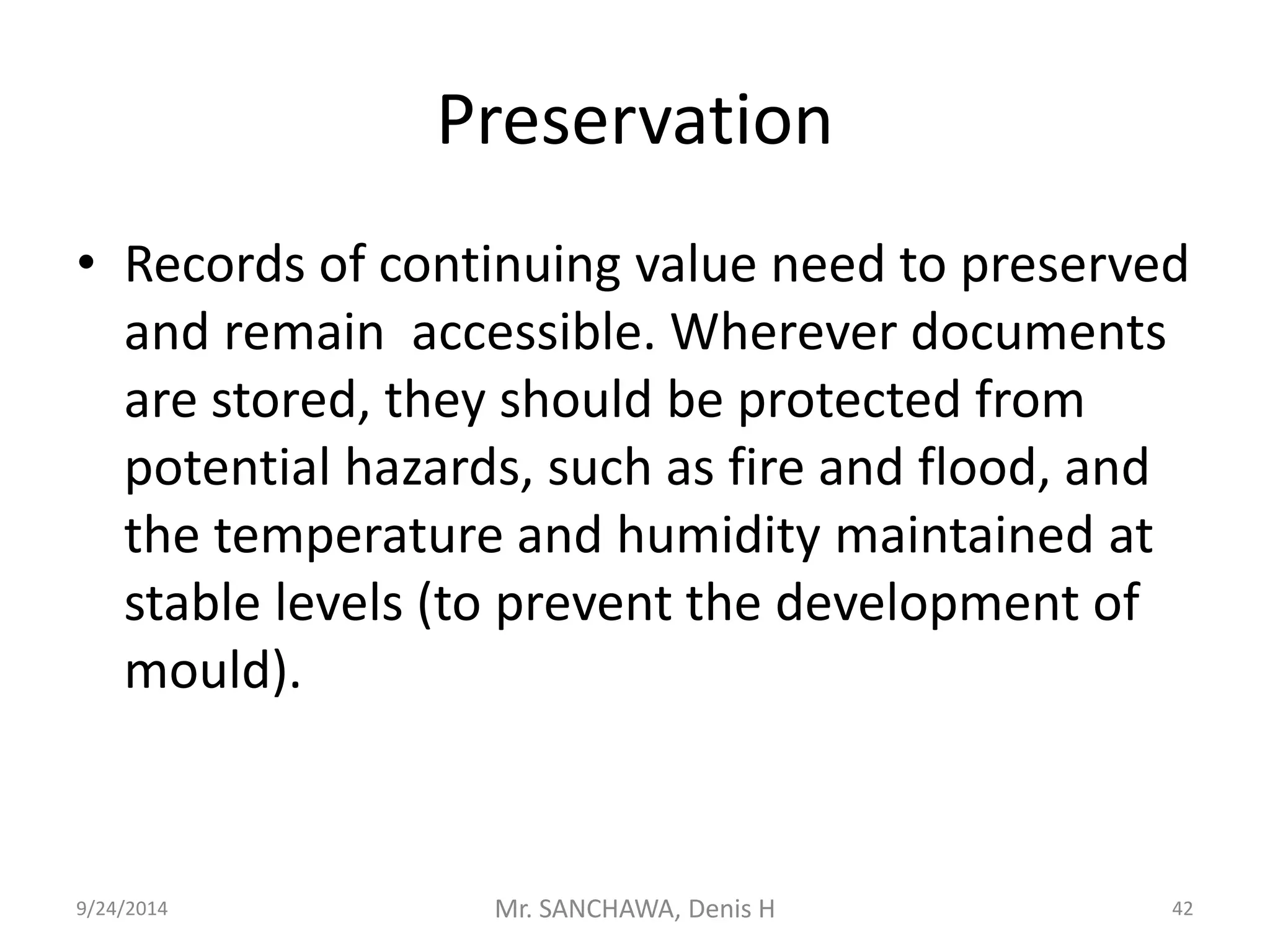
Preservation 
• Records of continuing value need to preserved 
and remain accessible. Wherever documents 
are stored, they should be protected from 
potential hazards, such as fire and flood, and 
the temperature and humidity maintained at 
stable levels (to prevent the development of 
mould). 
9/24/2014 Mr. SANCHAWA, Denis H 42
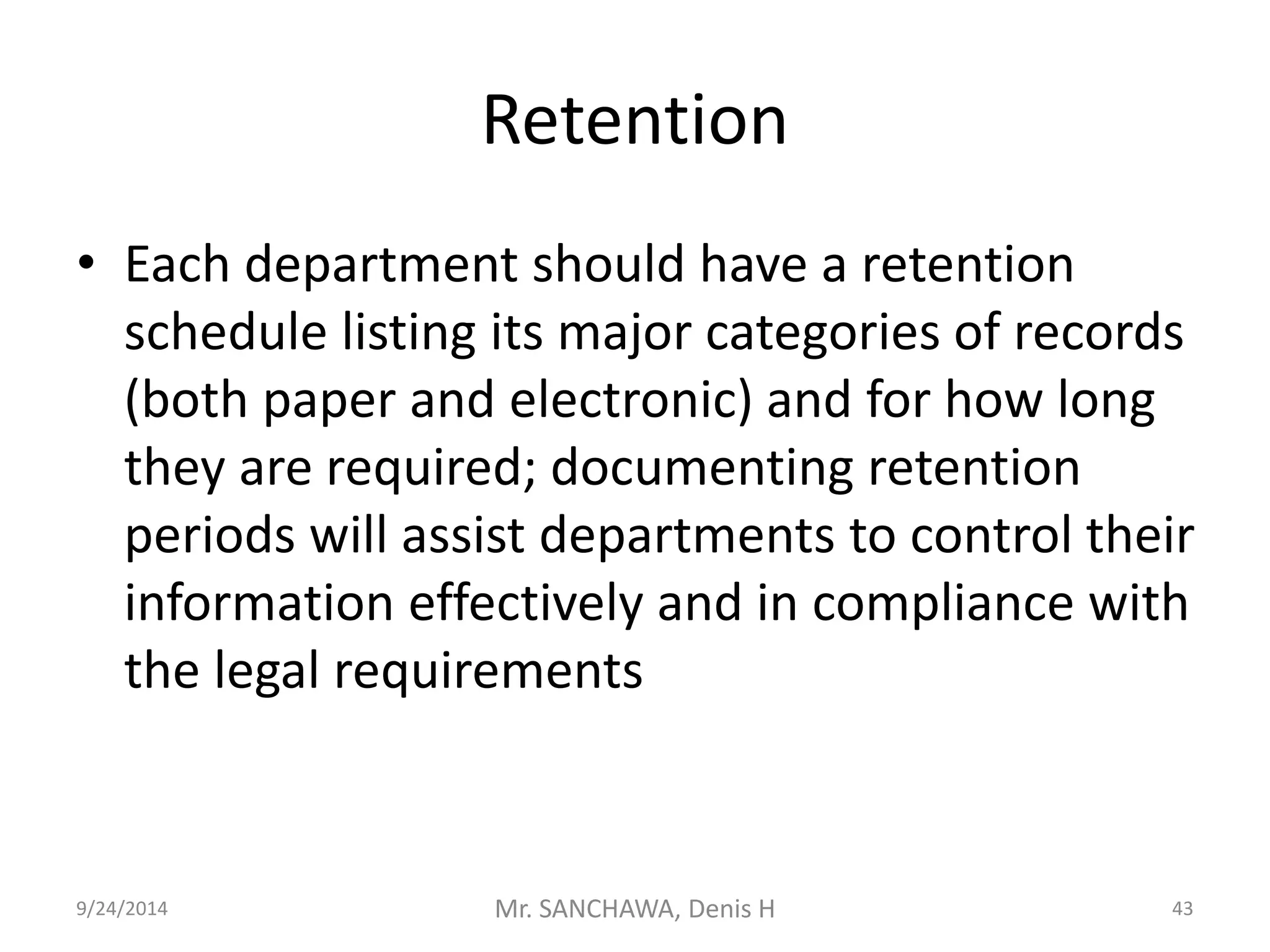
Retention 
• Each department should have a retention 
schedule listing its major categories of records 
(both paper and electronic) and for how long 
they are required; documenting retention 
periods will assist departments to control their 
information effectively and in compliance with 
the legal requirements 
9/24/2014 Mr. SANCHAWA, Denis H 43
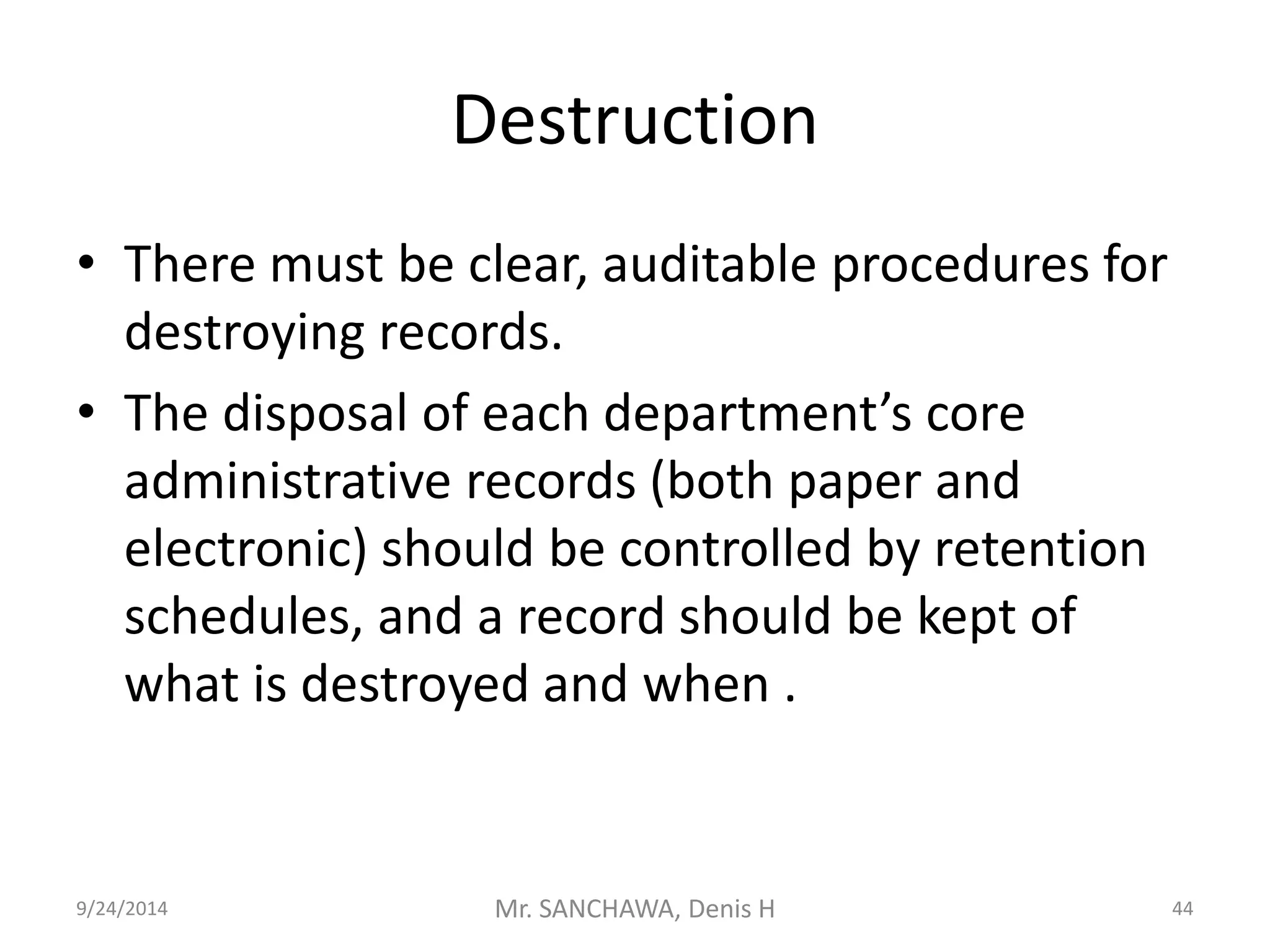
Destruction 
• There must be clear, auditable procedures for 
destroying records. 
• The disposal of each department’s core 
administrative records (both paper and 
electronic) should be controlled by retention 
schedules, and a record should be kept of 
what is destroyed and when . 
9/24/2014 Mr. SANCHAWA, Denis H 44
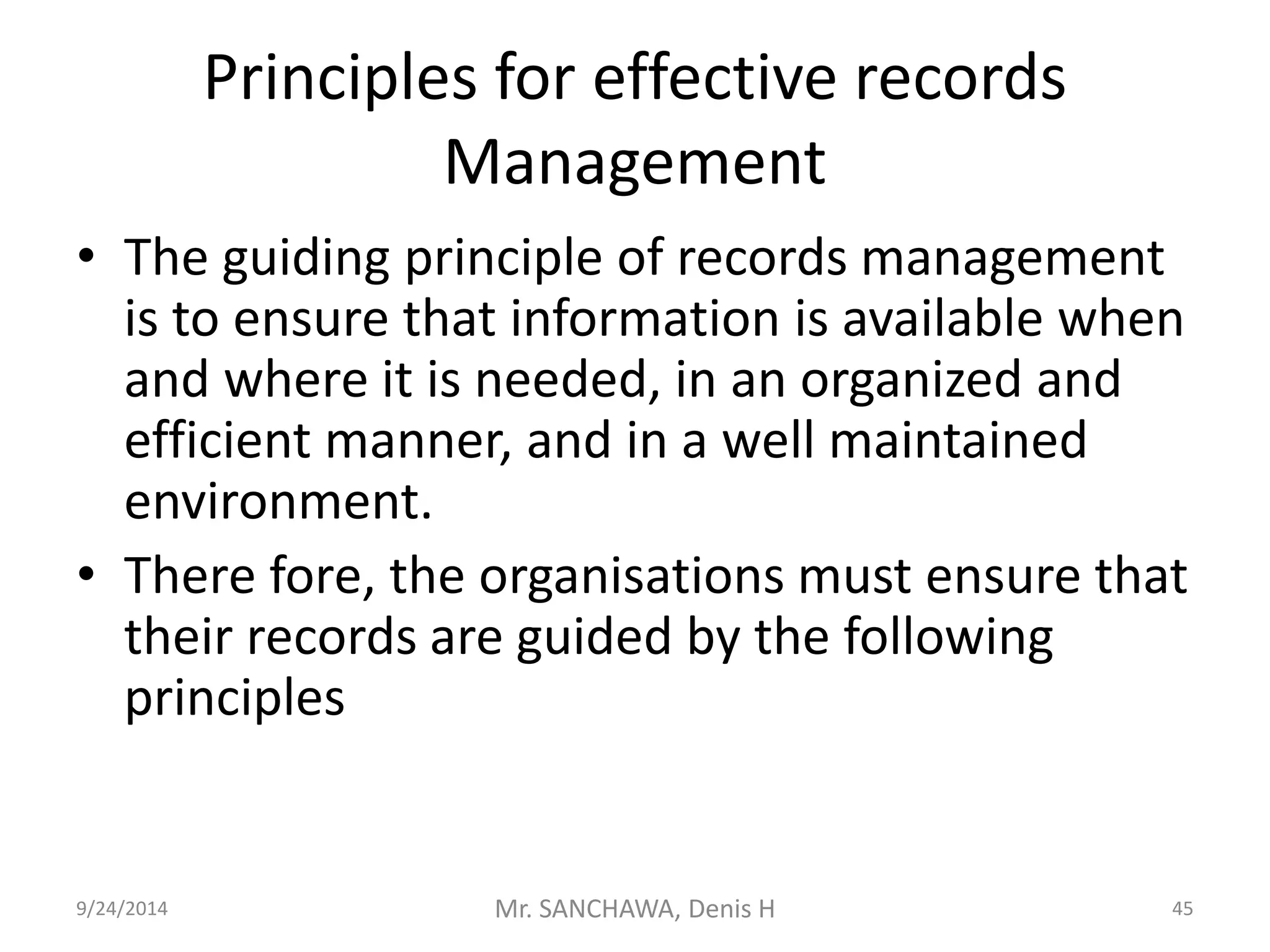
Principles for effective records 
Management 
• The guiding principle of records management 
is to ensure that information is available when 
and where it is needed, in an organized and 
efficient manner, and in a well maintained 
environment. 
• There fore, the organisations must ensure that 
their records are guided by the following 
principles 
9/24/2014 Mr. SANCHAWA, Denis H 45
Principles for effective records 
management 
Appraisal: Review at appropriate stages, starting 
from last action on current file 
Weeding: There should be constant weeding and 
review of records so that the cost of maintenance 
of records kept to minimum 
Accessibility: Should provide an easily accessible 
store house of information relevant to the 
changing needs of the organisation 
Control: There should be control on growth of 
record since its creation tile final disposal stage 
9/24/2014 Mr. SANCHAWA, Denis H 46
Principles for effective records 
management 
Speed & Retrieval: Records should be kept in such 
a way that they should be capable of being 
retrieved quickly 
Economy: Economy should be observed by 
ensuring that records occupy minimum space, 
cost of equipment's for storing records is low, cost 
of retrieving information is low 
Retention Schedule: Should provide a uniform & 
systematic schedule for retention & disposal of 
records 
9/24/2014 Mr. SANCHAWA, Denis H 47
References 
• http://www.authorstream.com/Presentation/ran 
dhawakiran23-1131597-records/ accessed on 
19/09/2014 at 16:35 Pm 
• http://www.authorstream.com/Presentation/sad 
ada2008-1541785-records-management-adada 
on 20/09/2014 at 20:30 Pm 
• http://www.nas.gov.uk/recordKeeping/recordsM 
anagement.asp accessed on 17/09/2014 at 10:05 
am 
• GoT(2011), The National records and archives 
mgt policy: Dar es Salaam Government printers 
9/24/2014 Mr. SANCHAWA, Denis H 48

Lecture two records

  • 1.
    The Mwalimu NyerereMemorial Academy (MNMA) Introduction to Records Management for TCHRM /SST 05111 By, Mr. Sanchawa, Denis H Assistant Lecturer-Social Studies 9/24/2014 1
  • 2.
    Introduction • Recordsmanagement offers tangible benefits to organisations, from economic good practice in reducing storage costs of documents, to enabling administrative, financial and legal requirements to be met. • Poor management of record system makes the performance of duties more difficult, costs organisations time, money and other resources and e.t.c 9/24/2014 Mr. SANCHAWA, Denis H 2
  • 3.
    Introduction (ctd) •Thus, in this lecture we are going to see the concepts of record, document, record management, record life cycle , the benefits of records management, the principles for effective records management and other areas which deem to be necessary 9/24/2014 Mr. SANCHAWA, Denis H 3
  • 4.
    What are records? • Records are official documents that should be stored for later use • Records and Archives management Act,2002 defines records as recorded information regardless of form or medium created, received and maintained by institution or individual in the pursuance of its legal obligations or in the transaction of its business and providing evidence of the performance of those obligations 9/24/2014 Mr. SANCHAWA, Denis H 4
  • 5.
    What are records? • Thus, records are information kept in various forms such as paper or computer disk needed for carrying out the activities of the organization. The captured information can be in form of :- • Paper (e.g. Files, reports, maps, print outs invoices etc) • Microfilm • Compact disk • Tapes and etc 9/24/2014 Mr. SANCHAWA, Denis H 5
  • 6.
    What are records? • Records are information that have been documented by an organization in the course of its business and maintained in pursuance of certain obligations. • Records are document created, received, maintained and used by an organization or an individual in transaction of business which it provides evidence. 9/24/2014 Mr. SANCHAWA, Denis H 6
  • 7.
    What are records? Healy, S (1997) sees records as documented information consist of books, papers, maps, photographs or other forms regardless of physical characteristics made or received by any public or private institution in connection to functions, policies, procedures, operations and activities of an organization 9/24/2014 Mr. SANCHAWA, Denis H 7
  • 8.
    Forms of recordsmay INCLUDE? • Paper reports, directives, forms, correspondence • Phone call notes • Photographs, videotapes, posters • Maps and drawings • Databases • E-mail • Microfilms and etc 9/24/2014 Mr. SANCHAWA, Denis H 8
  • 9.
    What is NOTa record? • Material that does not meet the statutory definition of the record include but not limited to (Samson, 2012) :- i. Technical reference material ii. Catalogs , trade journals, manual iii. Extra copies iv. Black forms v. Some electronic information 9/24/2014 Mr. SANCHAWA, Denis H 9
  • 10.
    Why records? Toensure continuity in administration To ensure tax-payer’s interest is protected at all times For providing evidence in case of disputes For planning & scheduling organisation activities For historical value To make available needed facts, figures, correspondence etc. 9/24/2014 Mr. SANCHAWA, Denis H 10
  • 11.
    Why records? •Documentation of workforce performance • Provide evidence about past actions and decisions • For accountability and transference purpose 9/24/2014 Mr. SANCHAWA, Denis H 11
  • 12.
    Criteria in creatingrecords • Is it necessary? • What constitutes adequate documentation? • Is it desirable to have it in a consistent format? • What is its future life ? • What is the best way to store and retrieve it? 9/24/2014 Mr. SANCHAWA, Denis H 12
  • 13.
    What are thecharacteristics of records? • Records are evidence of actions and transactions • Records should support accountability, which is tightly connected to evidence but which allows accountability to be traced; • Records are related to processes, i.e. “information that is generated by and linked to work processes” [Thomassen, 2001, p 374]; • Records must be preserved, some for very short time and some permanently. 9/24/2014 Mr. SANCHAWA, Denis H 13
  • 14.
    Other characteristics ofrecords • Authenticity : proven to be purport to be created and sent by the Person implied to have sent/created them • Integrity : Must remain complete and unaltered over time • Usability : Can be located, retrieved, presented and interpreted • Reliability: contents can be trusted as a full and accurate representation of the transaction to which they attest 9/24/2014 Mr. SANCHAWA, Denis H 14
  • 15.
    Records contain informationand date from which ? • Decisions are made • Plans are developed • Policies are made • Objectives are realized • Obligations are discharged • Questions can be answered • Historical evidence can be taken • Investigations can be handled and etc 9/24/2014 Mr. SANCHAWA, Denis H 15
  • 16.
    What are thecategories of records ? • Records can be categorized in a number of different ways:- Commonly recognized categories include: (Standard Australian, 1996) • Administrative Records : procedures documentation, forms and correspondence ; examples are staff manuals, rosters, logging of property maintenance jobs, travel bookings 9/24/2014 Mr. SANCHAWA, Denis H 16
  • 17.
    What are thecategories of records? • Accounting records : reports, forms and related correspondence. Examples are invoices, bank account reports, customer billing reports • Project reports: correspondence , notes , product development documentation e.t.c related to a specific project 9/24/2014 Mr. SANCHAWA, Denis H 17
  • 18.
    What are thecategories of records? • Case files: client records, personnel records, insurance, contacts and lawsuit files 9/24/2014 Mr. SANCHAWA, Denis H 18
  • 19.
    Meaning of adocument • A document is any piece of written information in any form, produced or received by an organisation or person. It can include databases, website, email messages, word and excel files, letters, and memos. • Recorded information, which can be treated as a unit (URT, 2011) • Structured unit of recorded information either published or unpublished, in hard copy or electronic form and managed as discrete units in information systems( Standard Australian, 1996) 9/24/2014 Mr. SANCHAWA, Denis H 19
  • 20.
    A document anda record • When document s are kept as future evidence they become official records. • In other words, all records start off as documents, but not all documents will ultimately become records. • A FILE : An organized physical assembly (usually within a folder) or documents grouped together because they relate to the same subject, activity or transaction (URT, 2011) 9/24/2014 Mr. SANCHAWA, Denis H 20
  • 21.
    What is recordsmanagement? • Records management is the systematic control of an organisation's records (both paper and electronic), throughout their life cycle, in order to meet operational business needs, statutory and fiscal requirements, and community expectations • A field of management responsible for the efficient and systematic control of the receipt, maintenance , use and disposition of records (GoT, 2011) 9/24/2014 Mr. SANCHAWA, Denis H 21
  • 22.
    What is recordsmanagement? • Record management refers to administrative management concerned with systematic planning, controlling, creating, maintenance, efficient and economic use and disposal of records throughout the entire life cycle of records of an organization (Samson, 2012) 9/24/2014 Mr. SANCHAWA, Denis H 22
  • 23.
    What is recordsmanagement ? Activities involved in controlling the life cycle of a record, beginning with its creation and ending with ultimate disposition Leads to prevention of creation of unnecessary documentation Early identification of papers lasting value and systematic planning of retirement procedures 9/24/2014 Mr. SANCHAWA, Denis H 23
  • 24.
    Why is recordsmanagement necessary? • RM ensures information can be accessed easily, can be destroyed routinely when no longer needed, • RM enables organisations not only to function on a day to day basis, but also to fulfil its legal and financial requirements • Through effective record management for example, organization can be held accountable for its actions or in actions . 9/24/2014 Mr. SANCHAWA, Denis H 24
  • 25.
    Why records management? For essentially planning, organizing and coordinating of certain functions relating to information gathering, information processing, communicating and records keeping Key to efficient administration 9/24/2014 Mr. SANCHAWA, Denis H 25
  • 26.
    The benefits ofeffective records management Systematic management of records allows organisations to: • know what records they have, and locate them easily • increase efficiency and effectiveness • make savings in administration costs, both in staff time and storage • support decision making • be accountable 9/24/2014 Mr. SANCHAWA, Denis H 26
  • 27.
    Benefits of effectiverecords management • achieve organisation objectives and targets • provide continuity in the event of a disaster • meet legislative and regulatory requirements, particularly protect the interests of employees, clients and stakeholders 9/24/2014 Mr. SANCHAWA, Denis H 27
  • 28.
    Legal and regulatoryframeworks for RM in Tanzania • The National ICT policy of 2003 • The cultural policy of 1997 • The national security Act No.3 of 1970 • The records and archives mgt Act No. 3 of 2002 • The founders of the Nation Act No. 18 of 2004 • The evidence Act(R.E) of 2002 9/24/2014 Mr. SANCHAWA, Denis H 28
  • 29.
    Summary of thebenefits of record mgt Item /variable Benefit (s ) : How? : Means Time By ensuring that information can be found easily and quickly Space By preventing record from being kept longer that necessary Money /cost By reducing storage cost and maintenance cost Efficiency By ensuring that information is readily accessible Legal By keeping documentation in line with the legal and regulatory needs control By preserving important data and preventing the accumulation of short-lived material Quality By providing staff with access to accurate and reliable records Security Increases security of confidential information Continuity Support business continuity and risk management 9/24/2014 29 Mr. SANCHAWA, Denis H
  • 30.
    The Life cycleconcept of a record 9/24/2014 Mr. SANCHAWA, Denis H 30
  • 31.
    What is thelife cycle of a record? • The record life cycle is a concept based on the idea that records may be regarded as having a life similar to that of living organism. • Refers to the life cycle of records from their creation to their destruction or permanent retention(GoT,2011) • Thus, the concept goes into stages as described in this presentation 9/24/2014 Mr. SANCHAWA, Denis H 31
  • 32.
    The life cycleof records • Current: Initially records are current or active while they are used to carry out day-to-day work. • Semi-current: Next records become semi-current or semi-active, when they only need to be referred to occasionally or have to be retained for legal or regulatory reasons. • Inactive: Finally records become inactive, and a decision has to be made whether to discard them or, in a few cases, keep them permanently because they have historical value. 9/24/2014 Mr. SANCHAWA, Denis H 32
  • 33.
    The importance ofthe life cycle concept of records (Mhina, 2012) • Helps the record managers to have clear understanding of managing records from their creation stage to disposition • helps record managers to make prior decision whether to create a record or not by making judgement of the value of a record • Helps the record liason to understand in advance in what media the record could be created • Helps the record managers to apply records retention scheduling of records at the right time 9/24/2014 Mr. SANCHAWA, Denis H 33
  • 34.
    Key elements forrecords management • Records management involves controlling records throughout their life cycle. Thus , the activities involved in records management can be described into the following key elements or items 9/24/2014 Mr. SANCHAWA, Denis H 34
  • 35.
    Records creation •Each department must create records that are accurate and complete, so that it is possible to establish what has been done and why. • The quality of the records must also be sufficient to allow staff to carry out their work efficiently, demonstrate compliance with legal and regulatory requirements, and ensure accountability and transparency expectations are met. 9/24/2014 Mr. SANCHAWA, Denis H 35
  • 36.
    Information audit •Information audit is helpful in order to establish what information (both paper and electronic) is held by a department and where it is held; and to clarify who is responsible for keeping the definitive versions of documents and who is simply holding copies. 9/24/2014 Mr. SANCHAWA, Denis H 36
  • 37.
    Classification • Allrecords (e.g. paper files, electronic documents, emails) should be arranged systematically, so that they can be retrieved easily and quickly. • The main areas of work carried out by a department should be identified, and then a paper filing structure and electronic directory tree developed into which all the documents can be logically placed 9/24/2014 Mr. SANCHAWA, Denis H 37
  • 38.
    Storage • Recordsthat are consulted frequently should be kept close-at-hand within the immediate office space, while semi-current material can be housed in separate store rooms or stored off-site 9/24/2014 Mr. SANCHAWA, Denis H 38
  • 39.
    Security • Paperrecords containing confidential information must be stored in locked cabinets or drawers when not in use, and access only granted to authorized staff. • In the case of sensitive electronic data, access should be controlled through the use of log-ins, passwords and read-only settings, and computers should not be left unattended when logged-on. 9/24/2014 Mr. SANCHAWA, Denis H 39
  • 40.
    Tracking • Indepartments where several people need to consult the same documents, it may helpful to track the movement of files to ensure they can always be found. • For example, a form can be used to record the name of the person retrieving a file, as well as its reference, title and the date of retrieval; 9/24/2014 Mr. SANCHAWA, Denis H 40
  • 41.
    Vital records •It is essential to store all critical business data on a network drive, so that it will be protected by appropriate back up and disaster recovery procedures. Vital records that are only available in paper format should be duplicated, and the originals and copies stored in separate locations. 9/24/2014 Mr. SANCHAWA, Denis H 41
  • 42.
    Preservation • Recordsof continuing value need to preserved and remain accessible. Wherever documents are stored, they should be protected from potential hazards, such as fire and flood, and the temperature and humidity maintained at stable levels (to prevent the development of mould). 9/24/2014 Mr. SANCHAWA, Denis H 42
  • 43.
    Retention • Eachdepartment should have a retention schedule listing its major categories of records (both paper and electronic) and for how long they are required; documenting retention periods will assist departments to control their information effectively and in compliance with the legal requirements 9/24/2014 Mr. SANCHAWA, Denis H 43
  • 44.
    Destruction • Theremust be clear, auditable procedures for destroying records. • The disposal of each department’s core administrative records (both paper and electronic) should be controlled by retention schedules, and a record should be kept of what is destroyed and when . 9/24/2014 Mr. SANCHAWA, Denis H 44
  • 45.
    Principles for effectiverecords Management • The guiding principle of records management is to ensure that information is available when and where it is needed, in an organized and efficient manner, and in a well maintained environment. • There fore, the organisations must ensure that their records are guided by the following principles 9/24/2014 Mr. SANCHAWA, Denis H 45
  • 46.
    Principles for effectiverecords management Appraisal: Review at appropriate stages, starting from last action on current file Weeding: There should be constant weeding and review of records so that the cost of maintenance of records kept to minimum Accessibility: Should provide an easily accessible store house of information relevant to the changing needs of the organisation Control: There should be control on growth of record since its creation tile final disposal stage 9/24/2014 Mr. SANCHAWA, Denis H 46
  • 47.
    Principles for effectiverecords management Speed & Retrieval: Records should be kept in such a way that they should be capable of being retrieved quickly Economy: Economy should be observed by ensuring that records occupy minimum space, cost of equipment's for storing records is low, cost of retrieving information is low Retention Schedule: Should provide a uniform & systematic schedule for retention & disposal of records 9/24/2014 Mr. SANCHAWA, Denis H 47
  • 48.
    References • http://www.authorstream.com/Presentation/ran dhawakiran23-1131597-records/ accessed on 19/09/2014 at 16:35 Pm • http://www.authorstream.com/Presentation/sad ada2008-1541785-records-management-adada on 20/09/2014 at 20:30 Pm • http://www.nas.gov.uk/recordKeeping/recordsM anagement.asp accessed on 17/09/2014 at 10:05 am • GoT(2011), The National records and archives mgt policy: Dar es Salaam Government printers 9/24/2014 Mr. SANCHAWA, Denis H 48