Neuromuscular
transmission
Red: Important
Black: In Male & Female slides
Blue: In male slides
Pink: In female slides
Gray: Notes & extra information
5
Editing file
physiology439@gmail.com
Objectives
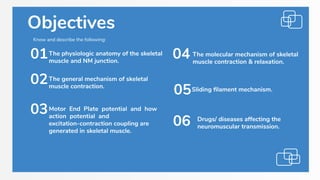
The general mechanism of skeletal
muscle contraction.
02
The physiologic anatomy of the skeletal
muscle and NM junction.
01
Motor End Plate potential and how
action potential and
excitation-contraction coupling are
generated in skeletal muscle.
03
The molecular mechanism of skeletal
muscle contraction & relaxation.
04
Sliding filament mechanism.
05
Drugs/ diseases affecting the
neuromuscular transmission.
06
Know and describe the following:
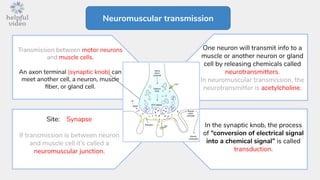
Transmission between motor neurons
and muscle cells.
An axon terminal (synaptic knob) can
meet another cell, a neuron, muscle
fiber, or gland cell.
One neuron will transmit info to a
muscle or another neuron or gland
cell by releasing chemicals called
neurotransmitters.
In neuromuscular transmission, the
neurotransmitter is acetylcholine.
Neuromuscular transmission
Site: Synapse
If transmission is between neuron
and muscle cell it’s called a
neuromuscular junction.
In the synaptic knob, the process
of “conversion of electrical signal
into a chemical signal” is called
transduction.
Neuromuscular Junction (NMJ)
In the case of neuron to neuron transmission
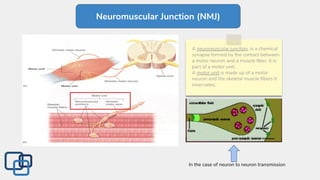
A neuromuscular junction, is a chemical
synapse formed by the contact between
a motor neuron and a muscle fiber. It is
part of a motor unit.
A motor unit is made up of a motor
neuron and the skeletal muscle fibers it
innervates.
Physiologic Anatomy of the
Neuromuscular Junction
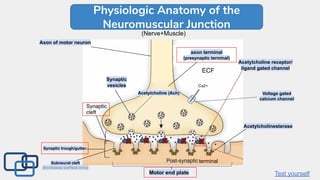
(Presynaptic terminal)
terminal
Motor end plate
Synaptic trough/gutter
Subneural cleft
(Increases surface area)
Synaptic
vesicles
Acetylcholine (Ach)
Acetylcholinesterase
Acetylcholine receptor/
ligand gated channel
Ca2+
Voltage gated
calcium channel
Axon of motor neuron
ECF
axon terminal
(presynaptic terminal)
(Nerve+Muscle)
Test yourself
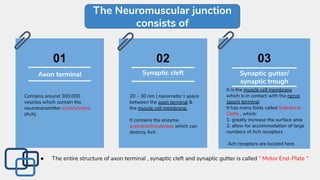
02
Synaptic cleft
03
Synaptic gutter/
synaptic trough
01
Axon terminal
The Neuromuscular junction
consists of
Contains around 300,000
vesicles which contain the
neurotransmitter acetylcholine
(Ach).
It is the muscle cell membrane
which is in contact with the nerve
(axon) terminal.
It has many folds called Subneural
Clefts , which:
1: greatly increase the surface area
2: allow for accommodation of large
numbers of Ach receptors .
Ach receptors are located here .
20 – 30 nm ( nanometer ) space
between the axon terminal &
the muscle cell membrane.
It contains the enzyme
acetylcholinesterase which can
destroy Ach .
● The entire structure of axon terminal , synaptic cleft and synaptic gutter is called “ Motor End-Plate ”
Acetylcholine
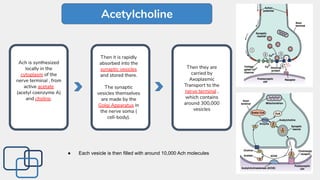
Ach is synthesized
locally in the
cytoplasm of the
nerve terminal , from
active acetate
(acetyl coenzyme A)
and choline.
Then it is rapidly
absorbed into the
synaptic vesicles
and stored there.
The synaptic
vesicles themselves
are made by the
Golgi Apparatus in
the nerve soma (
cell-body).
Then they are
carried by
Axoplasmic
Transport to the
nerve terminal ,
which contains
around 300,000
vesicles
● Each vesicle is then filled with around 10,000 Ach molecules
01
02
Get a modern
PowerPoint
Presentation
Add Text
03
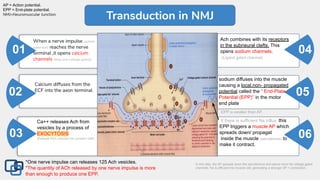
Transduction in NMJ
04
05
06
When a nerve impulse (action
potential) reaches the nerve
terminal ,it opens calcium
channels (they are voltage gated)
Calcium diffuses from the
ECF into the axon terminal.
Ca++ releases Ach from
vesicles by a process of
EXOCYTOSIS
(Release from vesicles into synaptic cleft)
Ach combines with its receptors
in the subneural clefts. This
opens sodium channels.
(Ligand gated channel)
sodium diffuses into the muscle
causing a local,non- propagated
potential called the “ End-Plate
Potential (EPP)” in the motor
end plate
If there is sufficient Na influx, this
EPP triggers a muscle AP which
spreads down/ propagat
inside the muscle (sarcolemma) to
make it contract.
In this step, the AP spreads down the sarcolemma and opens more Na voltage gated
channels. Na is diffused into muscle cell, generating a stronger AP = contraction.
AP = Action potential.
EPP = End-plate potential.
NMJ=Neuromuscular Junction.
EPP is weaker than AP.
*One nerve impulse can releases 125 Ach vesicles.
*The quantity of ACh released by one nerve impulse is more
than enough to produce one EPP.
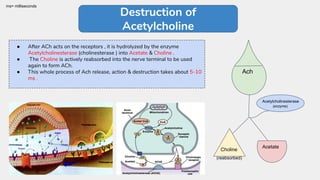
Destruction of
Acetylcholine
● After ACh acts on the receptors , it is hydrolyzed by the enzyme
Acetylcholinesterase (cholinesterase ) into Acetate & Choline .
● The Choline is actively reabsorbed into the nerve terminal to be used
again to form ACh.
● This whole process of Ach release, action & destruction takes about 5-10
ms .
Ach
Acetylcholinesterase
Acetate
Choline
(reabsorbed)
(enzyme)
ms= milliseconds
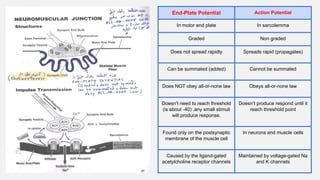
End-Plate Potential Action Potential
In motor end plate In sarcolemma
Graded Non graded
Does not spread rapidly Spreads rapid (propagates)
Can be summated (added) Cannot be summated
Does NOT obey all-or-none law Obeys all-or-none law
Doesn’t need to reach threshold
(is about -40) .any small stimuli
will produce response.
Doesn’t produce respond until it
reach threshold point
Found only on the postsynaptic
membrane of the muscle cell
In neurons and muscle cells
Caused by the ligand-gated
acetylcholine receptor channels
Maintained by voltage-gated Na
and K channels
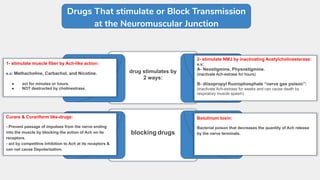
2- stimulate NMJ by inactivating Acetylcholinesterase:
e.x:
A- Neostigmine, Physostigmine.
(inactivate Ach-estrase for hours)
B- diisopropyl fluorophosphate “nerve gas poison”:
(inactivate Ach-estrase for weeks and can cause death by
respiratory muscle spasm)
Curare & Curariform like-drugs:
- Prevent passage of impulses from the nerve ending
into the muscle by blocking the action of Ach on its
receptors.
- act by competitive inhibition to Ach at its receptors &
can not cause Depolarization.
Botulinum toxin:
Bacterial poison that decreases the quantity of Ach release
by the nerve terminals.
drug stimulates by
2 ways:
blocking drugs
1- stimulate muscle fiber by Ach-like action:
e.x: Methacholine, Carbachol, and Nicotine.
● act for minutes or hours.
● NOT destructed by cholinestrase.
Drugs That stimulate or Block Transmission
at the Neuromuscular Junction
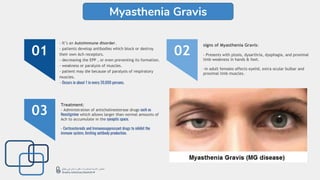
- It’s an Autoimmune disorder.
- patients develop antibodies which block or destroy
their own Ach receptors.
- decreasing the EPP , or even preventing its formation.
- weakness or paralysis of muscles.
- patient may die because of paralysis of respiratory
muscles.
- Occurs in about 1 in every 20,000 persons.
01
signs of Myasthenia Gravis:
- Presents with ptosis, dysarthria, dysphagia, and proximal
limb weakness in hands & feet.
-in adult females affects eyelid, extra ocular bulbar and
proximal limb muscles.
02
Treatment:
- Administration of anticholinesterase drugs such as
Neostigmine which allows larger than normal amounts of
Ach to accumulate in the synaptic space.
- Corticosteroids and Immunosuppressant drugs to inhibit the
immune system, limiting antibody production.
03
Myasthenia Gravis
‫ﺑﯾطﻠﻊ‬ ‫ﻟﻠﻲ‬ ‫ﻣﻧﺎن‬ ‫دﻛﺗورة‬ ‫ﻟﻣﺣﺎﺿرات‬ ‫اﻷدوﯾﺔ‬ ‫ﻣﻠﺧص‬
Shatha Aldhohair,Med439 ♥
S
U
M
M
A
R
Y
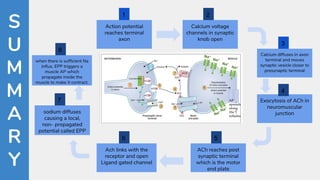
Action potential
reaches terminal
axon
when there is sufficient Na
influx, EPP triggers a
muscle AP which
propagate inside the
muscle to make it contract.
sodium diffuses
causing a local,
non- propagated
potential called EPP
Ach links with the
receptor and open
Ligand gated channel
Calcium voltage
channels in synaptic
knob open
Calcium diffuses in axon
terminal and moves
synaptic vesicle closer to
presynaptic terminal
Exocytosis of ACh in
neuromuscular
junction
ACh reaches post
synaptic terminal
which is the motor
end plate
1 2
3
4
5
6
7
8
Q1: mention two features of EPP and two
features of AP ?
Q2: what does NMJ means and what is the
site?
SAQ
answer
key
:
1)
slide
10
2)
NMJ
is
transmission
is
between
neuron
and
muscle
cell
site:
synaps
SAQ
MCQs
key
answer
:
1)
D
2)
B
3)
A
4)
C
5)
A
6)
D
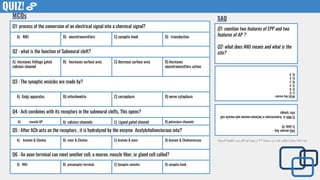
Q1: process of the conversion of an electrical signal into a chemical signal?
A) NMJ B) neurotransmitters C) synaptic knob D) transduction
Q2 : what is the function of Subneural cleft?
A) Increases Voltage gated
calcium channel
B) Increases surface area C) decrease surface area D) Increases
neurotransmitters action
Q3 : The synaptic vesicles are made by?
A) Golgi apparatus B) mitochondria C) sarcoplasm D) nerve cytoplasm
Q4 : Ach combines with its receptors in the subneural clefts, This opens?
A) muscle AP B) calcium channels C) Ligand gated channel D) potassium channels
MCQs
QUIZ!
Q5 : After ACh acts on the receptors , it is hydrolyzed by the enzyme Acetylcholinesterase into?
A) Acetate & Choline B) ester & Choline C) Acetate & ester D) Acetate & Cholinesterase
Q6 : An axon terminal can meet another cell, a neuron, muscle fiber, or gland cell called?
A) NMJ B) presynaptic terminal C) Synaptic vesicles D) synaptic knob
‫اﻟﺳﺎﺑﻌﺔ‬ ‫اﻟطﺑﻌﺔ‬ ،‫ﻟﻠﺗدرﯾب‬ ‫ﻟﮭﺎ‬ ‫ارﺟﻌوا‬ ٥٣ ‫ﺻﻔﺣﺔ‬ ‫ﻣن‬ ‫ﻟﯾﻧدا‬ ‫ﺑﻛﺗﺎب‬ ‫ﻣﻣﺗﺎزة‬ ‫أﺳﺋﻠﺔ‬ ‫ﻓﯾﮫ‬
Abdulrahman Alswat Haya Alanazi
▷ Mishal Althuanyan
▷ Basel Fakeeha
▷ Mohammad Beyari
▷ Abdulaziz Alsuhaim
▷ Mohammad Alsalman
▷ Abdulrahman Addweesh
▷ Morshed Alharbi
▷ Ahmad Alkhayatt
▷ Abdulaziz Alguligah
▷ Omar Alhalabi
TEAM MEMBERS
▷ Sumo Alzeer
▷ Noura Alshathri
▷ Renad Alhomaidi
▷ Yasmin Alqarni
▷ Lama Alahmadi
▷ Alaa Alsulmi
▷ Farah Albakr
▷ Hind Almotywea
▷ Sarah Alqahtani
▷ Duaa Alhumoudi
Question bank
TEAM LEADERS
THANK
YOU
REVIEWED BY
Meshal Alhamed Ghada Alothman

5. Neuromuscular transmission .pdf

  • 1.
    Neuromuscular transmission Red: Important Black: InMale & Female slides Blue: In male slides Pink: In female slides Gray: Notes & extra information 5 Editing file physiology439@gmail.com
  • 2.
    Objectives The general mechanismof skeletal muscle contraction. 02 The physiologic anatomy of the skeletal muscle and NM junction. 01 Motor End Plate potential and how action potential and excitation-contraction coupling are generated in skeletal muscle. 03 The molecular mechanism of skeletal muscle contraction & relaxation. 04 Sliding filament mechanism. 05 Drugs/ diseases affecting the neuromuscular transmission. 06 Know and describe the following:
  • 3.
    Transmission between motorneurons and muscle cells. An axon terminal (synaptic knob) can meet another cell, a neuron, muscle fiber, or gland cell. One neuron will transmit info to a muscle or another neuron or gland cell by releasing chemicals called neurotransmitters. In neuromuscular transmission, the neurotransmitter is acetylcholine. Neuromuscular transmission Site: Synapse If transmission is between neuron and muscle cell it’s called a neuromuscular junction. In the synaptic knob, the process of “conversion of electrical signal into a chemical signal” is called transduction.
  • 4.
    Neuromuscular Junction (NMJ) Inthe case of neuron to neuron transmission A neuromuscular junction, is a chemical synapse formed by the contact between a motor neuron and a muscle fiber. It is part of a motor unit. A motor unit is made up of a motor neuron and the skeletal muscle fibers it innervates.
  • 5.
    Physiologic Anatomy ofthe Neuromuscular Junction (Presynaptic terminal) terminal Motor end plate Synaptic trough/gutter Subneural cleft (Increases surface area) Synaptic vesicles Acetylcholine (Ach) Acetylcholinesterase Acetylcholine receptor/ ligand gated channel Ca2+ Voltage gated calcium channel Axon of motor neuron ECF axon terminal (presynaptic terminal) (Nerve+Muscle) Test yourself
  • 6.
    02 Synaptic cleft 03 Synaptic gutter/ synaptictrough 01 Axon terminal The Neuromuscular junction consists of Contains around 300,000 vesicles which contain the neurotransmitter acetylcholine (Ach). It is the muscle cell membrane which is in contact with the nerve (axon) terminal. It has many folds called Subneural Clefts , which: 1: greatly increase the surface area 2: allow for accommodation of large numbers of Ach receptors . Ach receptors are located here . 20 – 30 nm ( nanometer ) space between the axon terminal & the muscle cell membrane. It contains the enzyme acetylcholinesterase which can destroy Ach . ● The entire structure of axon terminal , synaptic cleft and synaptic gutter is called “ Motor End-Plate ”
  • 7.
    Acetylcholine Ach is synthesized locallyin the cytoplasm of the nerve terminal , from active acetate (acetyl coenzyme A) and choline. Then it is rapidly absorbed into the synaptic vesicles and stored there. The synaptic vesicles themselves are made by the Golgi Apparatus in the nerve soma ( cell-body). Then they are carried by Axoplasmic Transport to the nerve terminal , which contains around 300,000 vesicles ● Each vesicle is then filled with around 10,000 Ach molecules
  • 8.
    01 02 Get a modern PowerPoint Presentation AddText 03 Transduction in NMJ 04 05 06 When a nerve impulse (action potential) reaches the nerve terminal ,it opens calcium channels (they are voltage gated) Calcium diffuses from the ECF into the axon terminal. Ca++ releases Ach from vesicles by a process of EXOCYTOSIS (Release from vesicles into synaptic cleft) Ach combines with its receptors in the subneural clefts. This opens sodium channels. (Ligand gated channel) sodium diffuses into the muscle causing a local,non- propagated potential called the “ End-Plate Potential (EPP)” in the motor end plate If there is sufficient Na influx, this EPP triggers a muscle AP which spreads down/ propagat inside the muscle (sarcolemma) to make it contract. In this step, the AP spreads down the sarcolemma and opens more Na voltage gated channels. Na is diffused into muscle cell, generating a stronger AP = contraction. AP = Action potential. EPP = End-plate potential. NMJ=Neuromuscular Junction. EPP is weaker than AP. *One nerve impulse can releases 125 Ach vesicles. *The quantity of ACh released by one nerve impulse is more than enough to produce one EPP.
  • 9.
    Destruction of Acetylcholine ● AfterACh acts on the receptors , it is hydrolyzed by the enzyme Acetylcholinesterase (cholinesterase ) into Acetate & Choline . ● The Choline is actively reabsorbed into the nerve terminal to be used again to form ACh. ● This whole process of Ach release, action & destruction takes about 5-10 ms . Ach Acetylcholinesterase Acetate Choline (reabsorbed) (enzyme) ms= milliseconds
  • 10.
    End-Plate Potential ActionPotential In motor end plate In sarcolemma Graded Non graded Does not spread rapidly Spreads rapid (propagates) Can be summated (added) Cannot be summated Does NOT obey all-or-none law Obeys all-or-none law Doesn’t need to reach threshold (is about -40) .any small stimuli will produce response. Doesn’t produce respond until it reach threshold point Found only on the postsynaptic membrane of the muscle cell In neurons and muscle cells Caused by the ligand-gated acetylcholine receptor channels Maintained by voltage-gated Na and K channels
  • 11.
    2- stimulate NMJby inactivating Acetylcholinesterase: e.x: A- Neostigmine, Physostigmine. (inactivate Ach-estrase for hours) B- diisopropyl fluorophosphate “nerve gas poison”: (inactivate Ach-estrase for weeks and can cause death by respiratory muscle spasm) Curare & Curariform like-drugs: - Prevent passage of impulses from the nerve ending into the muscle by blocking the action of Ach on its receptors. - act by competitive inhibition to Ach at its receptors & can not cause Depolarization. Botulinum toxin: Bacterial poison that decreases the quantity of Ach release by the nerve terminals. drug stimulates by 2 ways: blocking drugs 1- stimulate muscle fiber by Ach-like action: e.x: Methacholine, Carbachol, and Nicotine. ● act for minutes or hours. ● NOT destructed by cholinestrase. Drugs That stimulate or Block Transmission at the Neuromuscular Junction
  • 12.
    - It’s anAutoimmune disorder. - patients develop antibodies which block or destroy their own Ach receptors. - decreasing the EPP , or even preventing its formation. - weakness or paralysis of muscles. - patient may die because of paralysis of respiratory muscles. - Occurs in about 1 in every 20,000 persons. 01 signs of Myasthenia Gravis: - Presents with ptosis, dysarthria, dysphagia, and proximal limb weakness in hands & feet. -in adult females affects eyelid, extra ocular bulbar and proximal limb muscles. 02 Treatment: - Administration of anticholinesterase drugs such as Neostigmine which allows larger than normal amounts of Ach to accumulate in the synaptic space. - Corticosteroids and Immunosuppressant drugs to inhibit the immune system, limiting antibody production. 03 Myasthenia Gravis ‫ﺑﯾطﻠﻊ‬ ‫ﻟﻠﻲ‬ ‫ﻣﻧﺎن‬ ‫دﻛﺗورة‬ ‫ﻟﻣﺣﺎﺿرات‬ ‫اﻷدوﯾﺔ‬ ‫ﻣﻠﺧص‬ Shatha Aldhohair,Med439 ♥
  • 13.
    S U M M A R Y Action potential reaches terminal axon whenthere is sufficient Na influx, EPP triggers a muscle AP which propagate inside the muscle to make it contract. sodium diffuses causing a local, non- propagated potential called EPP Ach links with the receptor and open Ligand gated channel Calcium voltage channels in synaptic knob open Calcium diffuses in axon terminal and moves synaptic vesicle closer to presynaptic terminal Exocytosis of ACh in neuromuscular junction ACh reaches post synaptic terminal which is the motor end plate 1 2 3 4 5 6 7 8
  • 14.
    Q1: mention twofeatures of EPP and two features of AP ? Q2: what does NMJ means and what is the site? SAQ answer key : 1) slide 10 2) NMJ is transmission is between neuron and muscle cell site: synaps SAQ MCQs key answer : 1) D 2) B 3) A 4) C 5) A 6) D Q1: process of the conversion of an electrical signal into a chemical signal? A) NMJ B) neurotransmitters C) synaptic knob D) transduction Q2 : what is the function of Subneural cleft? A) Increases Voltage gated calcium channel B) Increases surface area C) decrease surface area D) Increases neurotransmitters action Q3 : The synaptic vesicles are made by? A) Golgi apparatus B) mitochondria C) sarcoplasm D) nerve cytoplasm Q4 : Ach combines with its receptors in the subneural clefts, This opens? A) muscle AP B) calcium channels C) Ligand gated channel D) potassium channels MCQs QUIZ! Q5 : After ACh acts on the receptors , it is hydrolyzed by the enzyme Acetylcholinesterase into? A) Acetate & Choline B) ester & Choline C) Acetate & ester D) Acetate & Cholinesterase Q6 : An axon terminal can meet another cell, a neuron, muscle fiber, or gland cell called? A) NMJ B) presynaptic terminal C) Synaptic vesicles D) synaptic knob ‫اﻟﺳﺎﺑﻌﺔ‬ ‫اﻟطﺑﻌﺔ‬ ،‫ﻟﻠﺗدرﯾب‬ ‫ﻟﮭﺎ‬ ‫ارﺟﻌوا‬ ٥٣ ‫ﺻﻔﺣﺔ‬ ‫ﻣن‬ ‫ﻟﯾﻧدا‬ ‫ﺑﻛﺗﺎب‬ ‫ﻣﻣﺗﺎزة‬ ‫أﺳﺋﻠﺔ‬ ‫ﻓﯾﮫ‬
  • 15.
    Abdulrahman Alswat HayaAlanazi ▷ Mishal Althuanyan ▷ Basel Fakeeha ▷ Mohammad Beyari ▷ Abdulaziz Alsuhaim ▷ Mohammad Alsalman ▷ Abdulrahman Addweesh ▷ Morshed Alharbi ▷ Ahmad Alkhayatt ▷ Abdulaziz Alguligah ▷ Omar Alhalabi TEAM MEMBERS ▷ Sumo Alzeer ▷ Noura Alshathri ▷ Renad Alhomaidi ▷ Yasmin Alqarni ▷ Lama Alahmadi ▷ Alaa Alsulmi ▷ Farah Albakr ▷ Hind Almotywea ▷ Sarah Alqahtani ▷ Duaa Alhumoudi Question bank TEAM LEADERS THANK YOU REVIEWED BY Meshal Alhamed Ghada Alothman