KVM/ARM: The Design and
Implementation of the Linux ARM
Hypervisor
Fall 2014
Presented By: Probir Roy
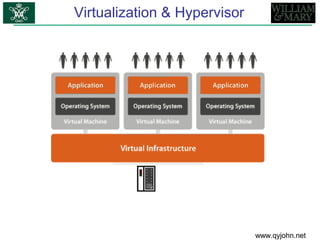
Virtualization & Hypervisor
www.qyjohn.net
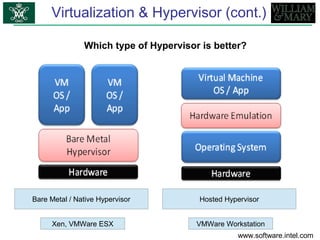
Virtualization & Hypervisor (cont.)
www.software.intel.com
Xen, VMWare ESX
Bare Metal / Native Hypervisor
VMWare Workstation
Hosted Hypervisor
Which type of Hypervisor is better?
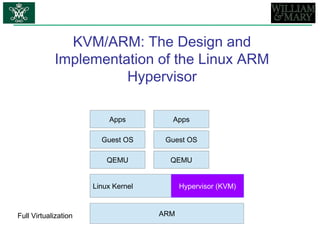
KVM/ARM: The Design and
Implementation of the Linux ARM
Hypervisor
ARM
Linux Kernel Hypervisor (KVM)
QEMU
Guest OS
Apps
QEMU
Guest OS
Apps
QEMU
Guest OS
Apps
QEMU
Guest OS
Apps
Full Virtualization
Prior ARMV7
Cannot Emulate
Trap & EmulateNot Classically Virtualizable
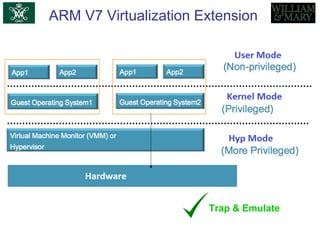
ARM V7 Virtualization Extension
Trap & Emulate
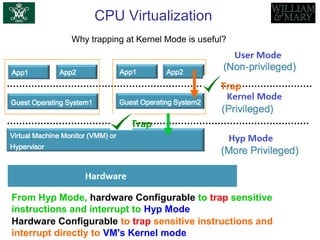
CPU Virtualization
From Hyp Mode, hardware Configurable to trap sensitive
instructions and interrupt to Hyp Mode
Hardware Configurable to trap sensitive instructions and
interrupt directly to VM's Kernel mode
Trap
Trap
Why trapping at Kernel Mode is useful?
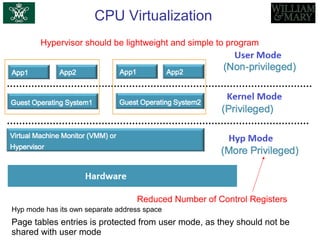
CPU Virtualization
Hypervisor should be lightweight and simple to program
Reduced Number of Control Registers
Page tables entries is protected from user mode, as they should not be
shared with user mode
Hyp mode has its own separate address space
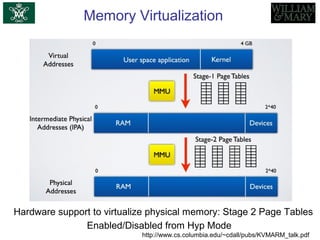
Memory Virtualization
http://www.cs.columbia.edu/~cdall/pubs/KVMARM_talk.pdf
Hardware support to virtualize physical memory: Stage 2 Page Tables
Enabled/Disabled from Hyp Mode
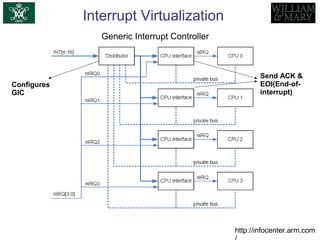
Interrupt Virtualization
Generic Interrupt Controller
http://infocenter.arm.com
Configures
GIC
Send ACK &
EOI(End-of-
interrupt)
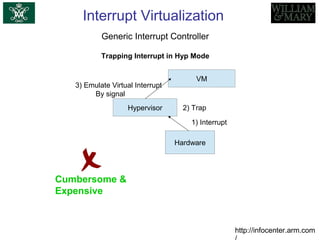
Interrupt Virtualization
Generic Interrupt Controller
http://infocenter.arm.com
Cumbersome &
Expensive
Trapping Interrupt in Hyp Mode
Hardware
Hypervisor
1) Interrupt
2) Trap
VM
3) Emulate Virtual Interrupt
By signal
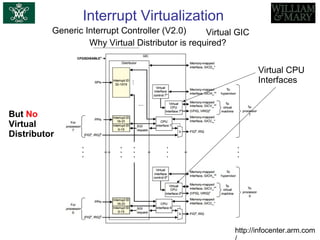
Interrupt Virtualization
Generic Interrupt Controller (V2.0)
http://infocenter.arm.com
Virtual GIC
Virtual CPU
Interfaces
But No
Virtual
Distributor
Why Virtual Distributor is required?
Interrupt Virtualization
Generic Interrupt Controller (V2.0)
http://infocenter.arm.com
Virtual GIC
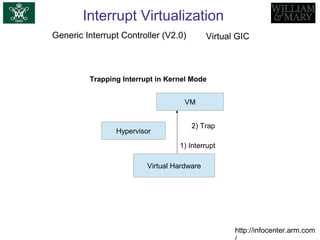
Trapping Interrupt in Kernel Mode
Virtual Hardware
Hypervisor
1) Interrupt
2) Trap
VM
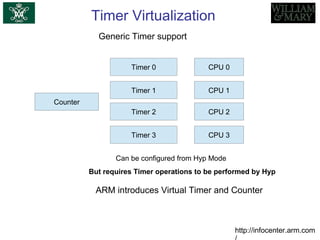
Timer Virtualization
Generic Timer support
http://infocenter.arm.com
ARM introduces Virtual Timer and Counter
But requires Timer operations to be performed by Hyp
CPU 0
Counter
Timer 0
CPU 1Timer 1
CPU 2Timer 2
CPU 3Timer 3
Can be configured from Hyp Mode
Timer Virtualization
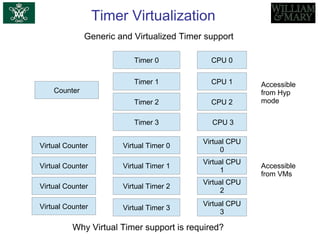
Generic and Virtualized Timer support
CPU 0
Counter
Timer 0
Virtual CPU
0
Virtual Timer 0
CPU 1Timer 1
Virtual CPU
1
Virtual Timer 1
CPU 2Timer 2
Virtual CPU
2
Virtual Timer 2
CPU 3Timer 3
Virtual CPU
3
Virtual Timer 3
Virtual Counter
Virtual Counter
Virtual Counter
Virtual Counter
Accessible
from Hyp
mode
Accessible
from VMs
Why Virtual Timer support is required?
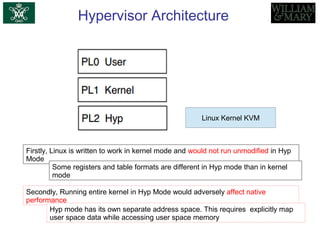
Hypervisor Architecture
Linux Kernel KVM
Firstly, Linux is written to work in kernel mode and would not run unmodified in Hyp
Mode
Secondly, Running entire kernel in Hyp Mode would adversely affect native
performance
Hyp mode has its own separate address space. This requires explicitly map
user space data while accessing user space memory
Some registers and table formats are different in Hyp mode than in kernel
mode
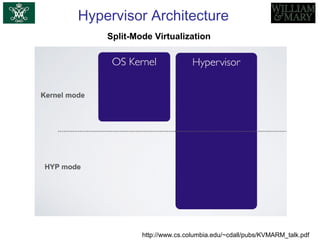
Hypervisor Architecture
Split-Mode Virtualization
Linux Kernel KVM
http://www.cs.columbia.edu/~cdall/pubs/KVMARM_talk.pdf
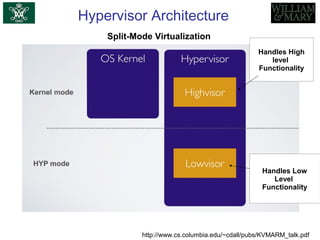
Hypervisor Architecture
Split-Mode Virtualization
Handles High
level
Functionality
Handles Low
Level
Functionality
http://www.cs.columbia.edu/~cdall/pubs/KVMARM_talk.pdf
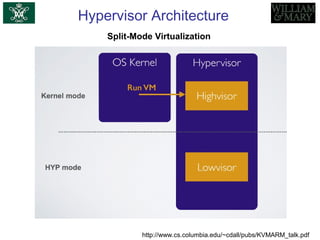
Hypervisor Architecture
Split-Mode Virtualization
http://www.cs.columbia.edu/~cdall/pubs/KVMARM_talk.pdf
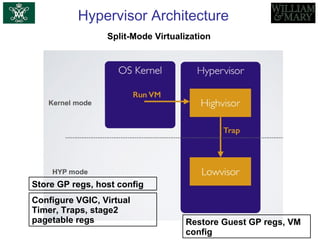
Hypervisor Architecture
Split-Mode Virtualization
Store GP regs, host config
Configure VGIC, Virtual
Timer, Traps, stage2
pagetable regs Restore Guest GP regs, VM
config
Hypervisor Architecture
Split-Mode Virtualization
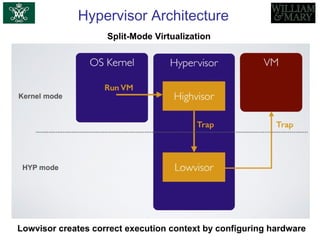
Lowvisor creates correct execution context by configuring hardware
Hypervisor Architecture
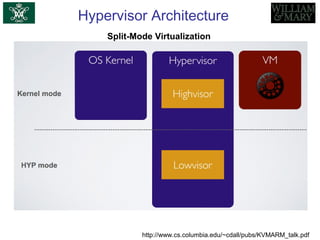
Split-Mode Virtualization
http://www.cs.columbia.edu/~cdall/pubs/KVMARM_talk.pdf
Hypervisor Architecture
Split-Mode Virtualization
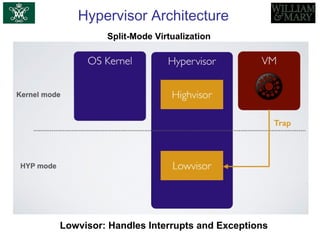
Lowvisor: Handles Interrupts and Exceptions
Hypervisor Architecture
Split-Mode Virtualization
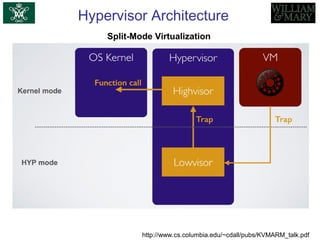
http://www.cs.columbia.edu/~cdall/pubs/KVMARM_talk.pdf
Hypervisor Architecture
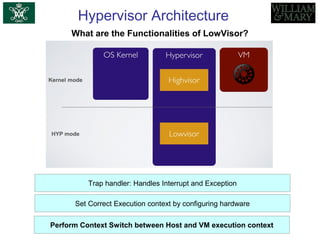
What are the Functionalities of LowVisor?
Trap handler: Handles Interrupt and Exception
Set Correct Execution context by configuring hardware
Perform Context Switch between Host and VM execution context
Hypervisor Architecture
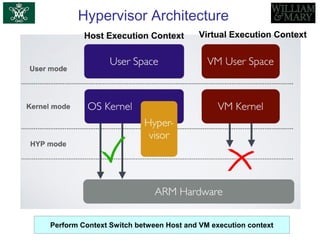
Perform Context Switch between Host and VM execution context
Host Execution Context Virtual Execution Context
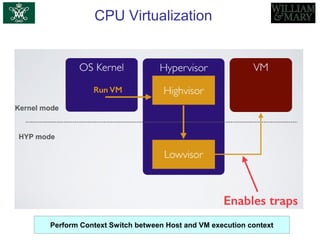
CPU Virtualization
Perform Context Switch between Host and VM execution context
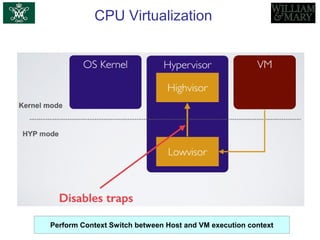
CPU Virtualization
Perform Context Switch between Host and VM execution context
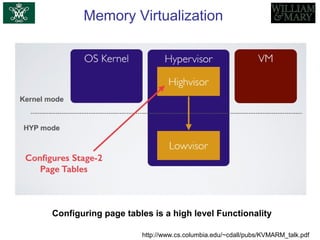
Memory Virtualization
Configuring page tables is a high level Functionality
http://www.cs.columbia.edu/~cdall/pubs/KVMARM_talk.pdf
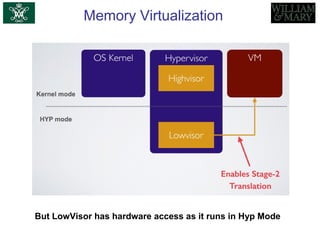
Memory Virtualization
But LowVisor has hardware access as it runs in Hyp Mode
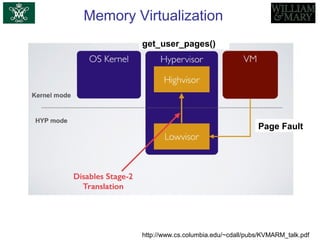
Memory Virtualization
Page Fault
get_user_pages()
http://www.cs.columbia.edu/~cdall/pubs/KVMARM_talk.pdf
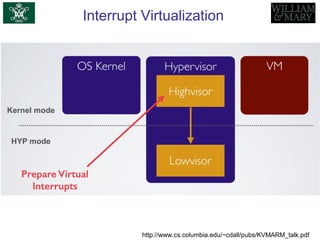
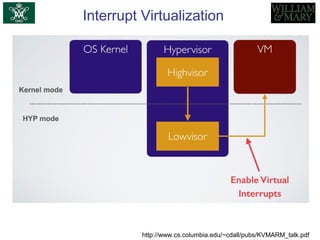
Interrupt Virtualization
http://www.cs.columbia.edu/~cdall/pubs/KVMARM_talk.pdf
Interrupt Virtualization
http://www.cs.columbia.edu/~cdall/pubs/KVMARM_talk.pdf
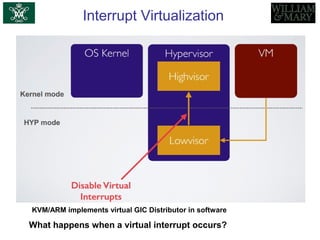
Interrupt Virtualization
KVM/ARM implements virtual GIC Distributor in software
What happens when a virtual interrupt occurs?
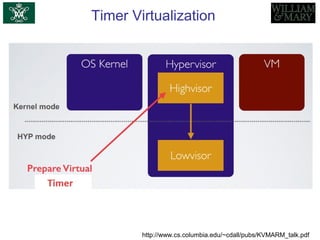
Timer Virtualization
http://www.cs.columbia.edu/~cdall/pubs/KVMARM_talk.pdf
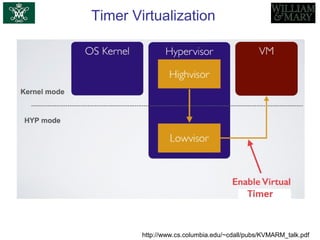
Timer Virtualization
http://www.cs.columbia.edu/~cdall/pubs/KVMARM_talk.pdf
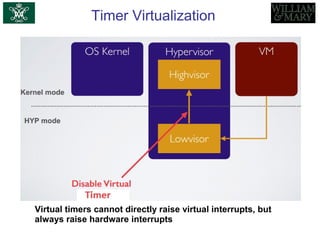
Timer Virtualization
Virtual timers cannot directly raise virtual interrupts, but
always raise hardware interrupts
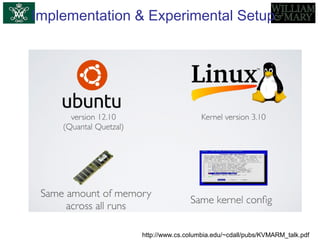
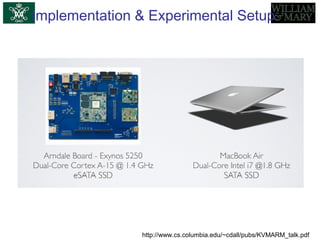
Implementation & Experimental Setup
http://www.cs.columbia.edu/~cdall/pubs/KVMARM_talk.pdf
Implementation & Experimental Setup
http://www.cs.columbia.edu/~cdall/pubs/KVMARM_talk.pdf
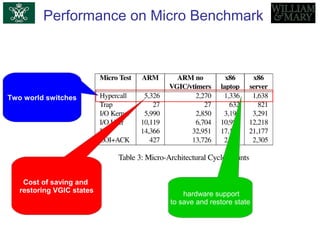
Performance on Micro Benchmark
Two world switches
Cost of saving and
restoring VGIC states hardware support
to save and restore state
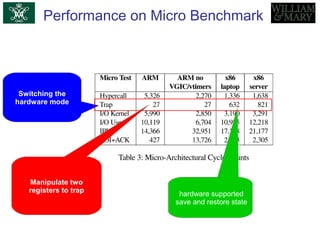
Performance on Micro Benchmark
Switching the
hardware mode
Manipulate two
registers to trap hardware supported
save and restore state
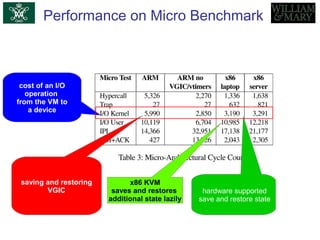
Performance on Micro Benchmark
cost of an I/O
operation
from the VM to
a device
saving and restoring
VGIC hardware supported
save and restore state
x86 KVM
saves and restores
additional state lazily
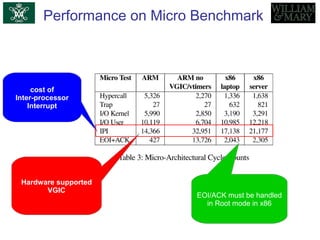
Performance on Micro Benchmark
cost of
Inter-processor
Interrupt
Hardware supported
VGIC
EOI/ACK must be handled
in Root mode in x86
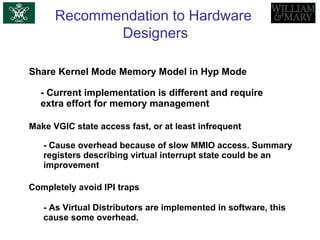
Recommendation to Hardware
Designers
Share Kernel Mode Memory Model in Hyp Mode
- Current implementation is different and require
extra effort for memory management
Make VGIC state access fast, or at least infrequent
- Cause overhead because of slow MMIO access. Summary
registers describing virtual interrupt state could be an
improvement
Completely avoid IPI traps
- As Virtual Distributors are implemented in software, this
cause some overhead.
Summary
KVM/ARM was the first system to run unmodified
guests on hardware
Facilitated by split-mode virtualization
Comparison with KVM
Questions?

5 kvm arm

Editor's Notes

  • #2 A little background about myself.
  • #3 A little background about myself.
  • #4 A little background about myself.
  • #5 A little background about myself.
  • #6 A little background about myself.
  • #7 A little background about myself.
  • #8 A little background about myself.
  • #9 A little background about myself.
  • #10 A little background about myself.
  • #11 A little background about myself.
  • #12 A little background about myself.
  • #13 A little background about myself.
  • #14 A little background about myself.
  • #15 A little background about myself.
  • #16 A little background about myself.
  • #17 A little background about myself.
  • #18 A little background about myself.
  • #19 A little background about myself.
  • #20 A little background about myself.
  • #21 A little background about myself.
  • #22 A little background about myself.
  • #23 A little background about myself.
  • #24 A little background about myself.
  • #25 A little background about myself.
  • #26 A little background about myself.
  • #27 A little background about myself.
  • #28 A little background about myself.
  • #29 A little background about myself.
  • #30 A little background about myself.
  • #31 A little background about myself.
  • #32 A little background about myself.
  • #33 A little background about myself.
  • #34 A little background about myself.
  • #35 A little background about myself.
  • #36 A little background about myself.
  • #37 A little background about myself.
  • #38 A little background about myself.
  • #39 A little background about myself.
  • #40 A little background about myself.
  • #41 A little background about myself.
  • #42 A little background about myself.
  • #43 A little background about myself.
  • #44 A little background about myself.
  • #45 A little background about myself.
  • #46 A little background about myself.
  • #47 A little background about myself.