Enzyme Kinetics - Inhibition
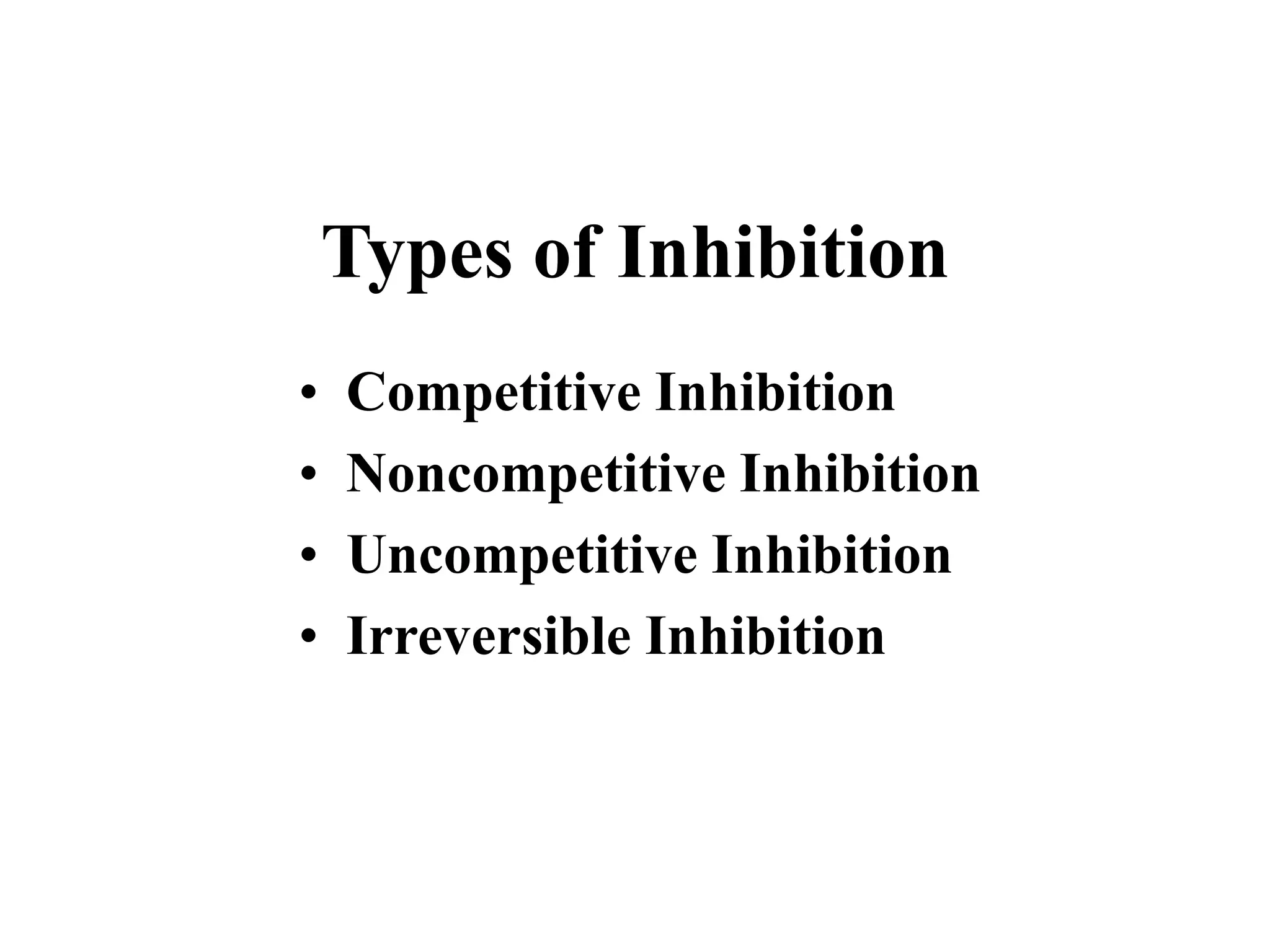
Types of Inhibition
• Competitive Inhibition
• Noncompetitive Inhibition
• Uncompetitive Inhibition
• Irreversible Inhibition
S
I
Enzyme
Competitive Inhibition
In competitive inhibition,
the inhibitor competes
with the substrate for the
same binding site
Competitive Inhibition
- Reaction Mechanism
In competitive inhibition, the
inhibitor binds only to the
free enzyme, not to the ES
complex
E + S ES E + P
EI
+
I
General Michaelis-Menten Equation
This form of the Michaelis-Menten equation
can be used to understand how each type of
inhibitor affects the reaction rate curve
v =
[S]
Km,app + [S]
Vmax,app
In competitive inhibition, only the apparent Km
is affected (Km,app> Km),
The Vmax remains unchanged by the presence
of the inhibitor.
Competitive inhibitors alter the
apparent Km, not the Vmax
.
Vmax
Vmax
2
Km Km,app
[Substrate]
Reaction
Rate
- Inhibitor
+ Inhibitor
Vmax,app = Vmax
Km,app > Km
The Lineweaver-Burk plot is
diagnostic for competitive inhibition
Slope =
Km,app
Vmax
1
Vmax
-1
Km,app
1
[S]
Increasing [I]
1
v
v
=
1
Vmax
Km,app
Vmax
1
+
[S]
1
.
Vmax
Vmax
2
Km Km,app
[Substrate]
Reaction
Rate
- Inhibitor
+ Inhibitor
Inhibitor
competes with
substrate,
decreasing its
apparent affinity:
Km,app > Km
Formation of EI
complex shifts reaction
to the left: Km,app > Km
Km,app > Km
Vmax,app = Vmax
Formation of EI
complex shifts reaction
to the left: Km,app > Km
Relating the Michaelis-Menten equation, the v vs. [S]
plot, and the physical picture of competitive inhibition
Example - Competitive Inhibition
Sulfanilamide is a competitive
inhibitor of p-aminobenzoic
acid. Sulfanilamides (also
known as sulfa drugs,
discovered in the 1930s)
were the first effective
systemic antibacterial
agents.
Because we do not make folic
acid, sulfanilamides do not
affect human cells.
COOH
NH2
p-aminobenzoic acid
folic acid
SO2NH2
NH2
sulfanilamide
Practical case: Methanol poisoning
A wealthy visitor is taken to
the emergency room, where
he is diagnosed with
methanol poisoning. You
are contacted by a 3rd year
medical student and asked
what to do? How would you
suggest treating this
patient?
Methanol (CH3OH) is metabolized to
formaldehyde and formic acid by alcohol
dehydrogenase. You advisethe third year
student to get the patient very drunk.
Since ethanol (CH3CH2OH) competes with
methanol for the same binding site on
alcohol dehydrogenase, it slows the
metabolism of methanol, allowing the toxic
metabolites to be disposed of before they
build up to dangerous levels. By the way,
the patient was very grateful and decided
to leave all their worldly possessions to the
hospital. Unfortunately, after being
released from the hospital, he went to the
casinos and lost everything he had.
.
S
I
I
S
S
I
I
S
Enzyme
Enzyme
Enzyme
Enzyme
Noncompetitive Inhibition
the inhibitor
does not
interfere with
substrate
binding (and
vice versa)
E + S ES E + P
EI
+
I
ESI
+
I
S
+
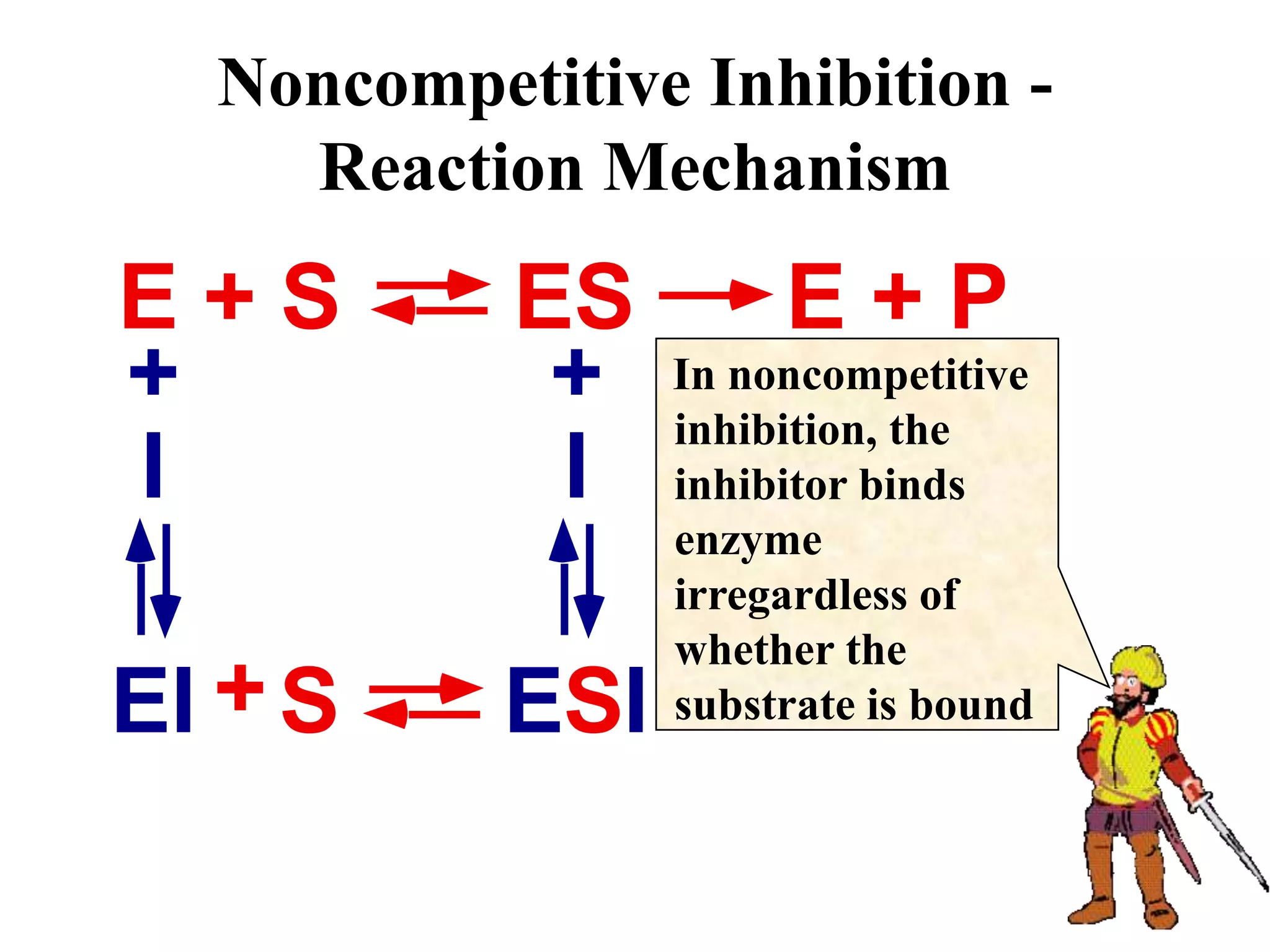
Noncompetitive Inhibition -
Reaction Mechanism
In noncompetitive
inhibition, the
inhibitor binds
enzyme
irregardless of
whether the
substrate is bound
Noncompetitive inhibitors decrease
the Vmax,app, but don’t affect the Km
Vmax,app < Vmax
Km,app = Km
The inhibitor binds
equally well to free
enzyme and the ES
complex, so it doesn’t
alter apparent affinity
of the enzyme for the
substrate
Why does Km,app = Km for
noncompetitive inhibition?
E + S ES E + P
EI
+
I
ESI
+
I
S
+
The Lineweaver-Burk plot is diagnostic
for noncompetitive inhibition
v
=
1
Vmax,app
Km
Vmax,app
1
+
[S]
1
Slope =
Vmax,app
Km
1
Vmax,app
-1
Km
1
[S]
Increasing [I]
1
v
Formation of EI
complex shifts reaction
to the left: Km,app > Km
Km,app > Km
Vmax,app = Vmax
.
S
I
I
S
S
I
I
S
Enzyme
Enzyme
Enzyme
Enzyme
.
Vmax
Vmax
2
1
2
1
Vmax,app
Km Km,app
[Substrate]
Reaction
Rate
- Inhibitor
+ Inhibitor
Vmax,app
Inhibitor doesn’t interfere
with substrate binding,
Km,app = Km
Even at high
substrate levels,
inhibitor still binds,
[E]t < [ES]
Vmax,app < Vmax
Vmax,app < Vmax
Km,app = Km
Relating the Michaelis-Menten equation, the v vs. [S] plot,
and the physical picture of noncompetitive inhibition
Noncompetitive inhibitors
decrease the apparent Vmax, but
do not alter the Km of the
reaction
Example of noncompetitive inhibition:
fructose 1,6-bisphosphatase inhibition by AMP
Fructose 1,6-bisphosphatase is a key regulatory
enzyme in the gluconeogenesis pathway. High
amounts of AMP signal that ATP levels are low and
gluconeogenesis should be shut down while
glycolysis is turned on.
High AMP levels inhibit fructose 1,6-bisphosphatase
(shutting down gluconeogenesis) and activate
phosphofructokinase (turning on glycolysis).
Regulation of fructose 1,6-bisphosphatase and
phosphofructokinase by AMP prevents a futile cycle
in which glucose is simultaneously synthesized and
broken down.
Uncompetitive Inhibition
In uncompetitive
inhibition, the
inhibitor binds
only to the ES
complex
.
S
I
S
Enzyme Enzyme
I
Enzyme
S
Enzyme
I
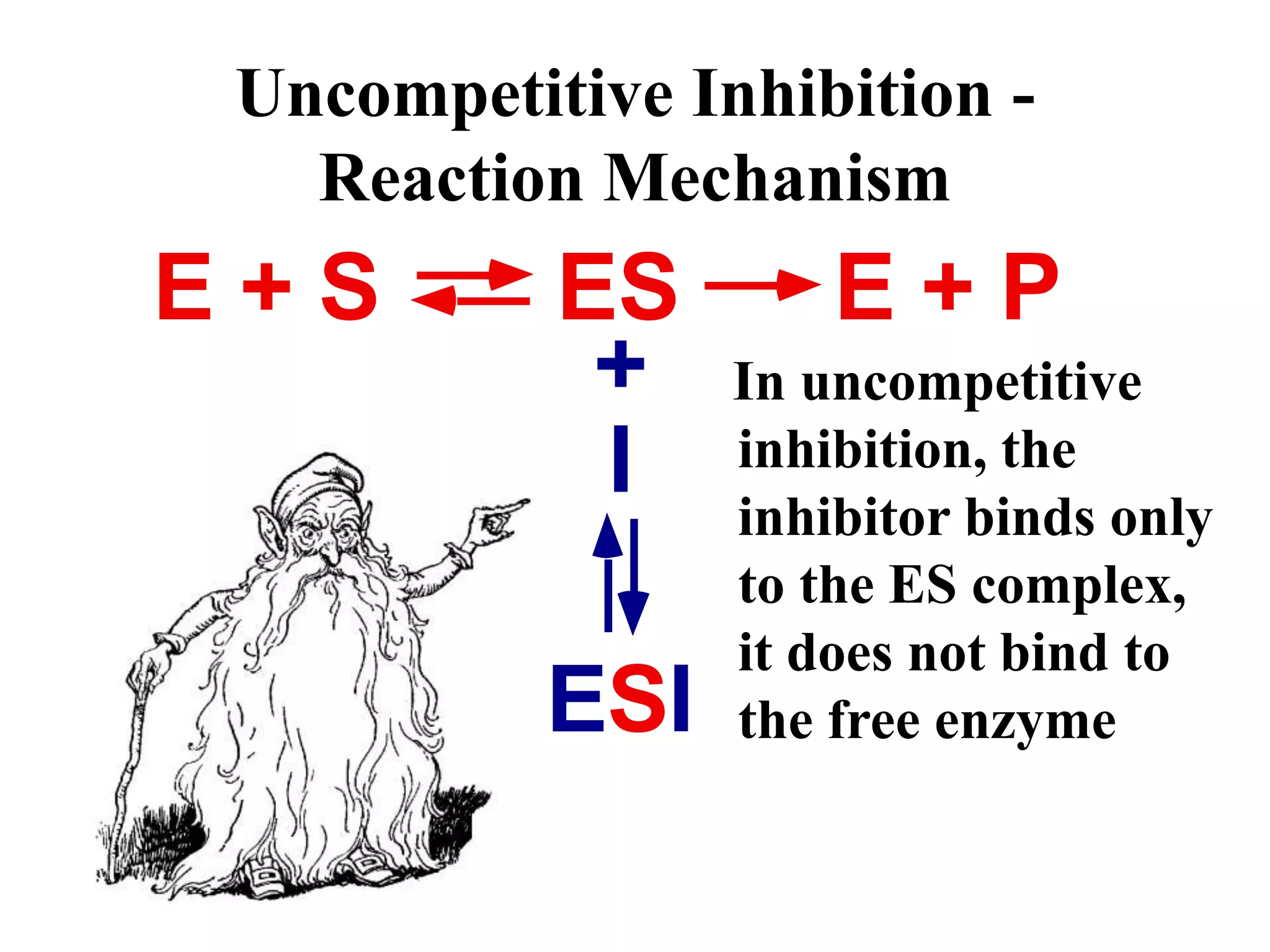
Uncompetitive Inhibition -
Reaction Mechanism
In uncompetitive
inhibition, the
inhibitor binds only
to the ES complex,
it does not bind to
the free enzyme
E + S ES E + P
ESI
+
I
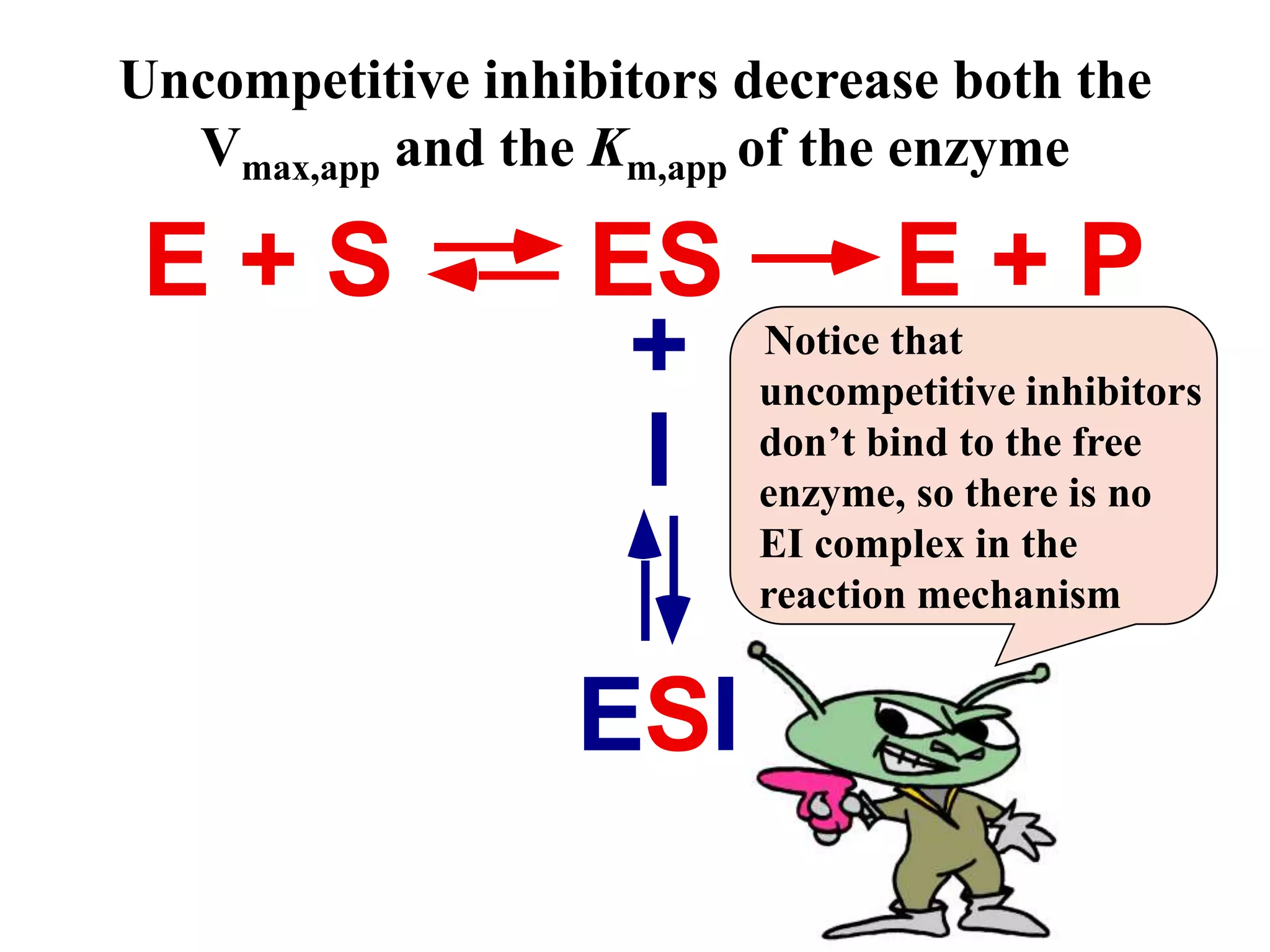
Uncompetitive inhibitors decrease
both the Vmax,app and the Km,app
Vmax,app < Vmax
Km,app < Km
Notice that at low substrate
concentrations,
uncompetitive inhibitors
have little effect on the
reaction rate because the
lower Km,app of the enzyme
offsets the decreased Vmax,app
Uncompetitive inhibitors decrease both the
Vmax,app and the Km,app of the enzyme
E + S ES E + P
ESI
+
I
Notice that
uncompetitive inhibitors
don’t bind to the free
enzyme, so there is no
EI complex in the
reaction mechanism
The Lineweaver-Burk plot is
diagnostic for uncompetitive inhibition
v
=
1
Vmax,app
Km,app
Vmax,app
1
+
[S]
1
=
Vmax
Km
Vmax,app
1
+
[S]
1
1
Vmax,app
-1
Km,app
1
[S]
Increasing [I]
1
v
Slope =
Vmax
Km
.
Vmax
Vmax
2
1
2
1
Vmax,app
Km
Km,app
[Substrate]
Reaction
Rate
- Inhibitor
+ Inhibitor
Vmax,app
Formation of EI
complex shifts reaction
to the left: Km,app > Km
.
S
I
S
Enzyme Enzyme
I
Enzyme
S
Enzyme
I
Even at high
substrate levels,
inhibitor binds,
[E]t < [ES]
Vmax,app < Vmax
Inhibitor
increases
the amount of
enzyme bound
to substrate
Km,app < Km
Vmax,app < Vmax
Km,app< Km
Relating the Michaelis-Menten equation, the v vs. [S]
plot, and the physical picture of uncompetitive inhibition
Uncompetitive inhibitors
decrease the apparent Km of the
enzyme and decrease the Vmax of
the reaction
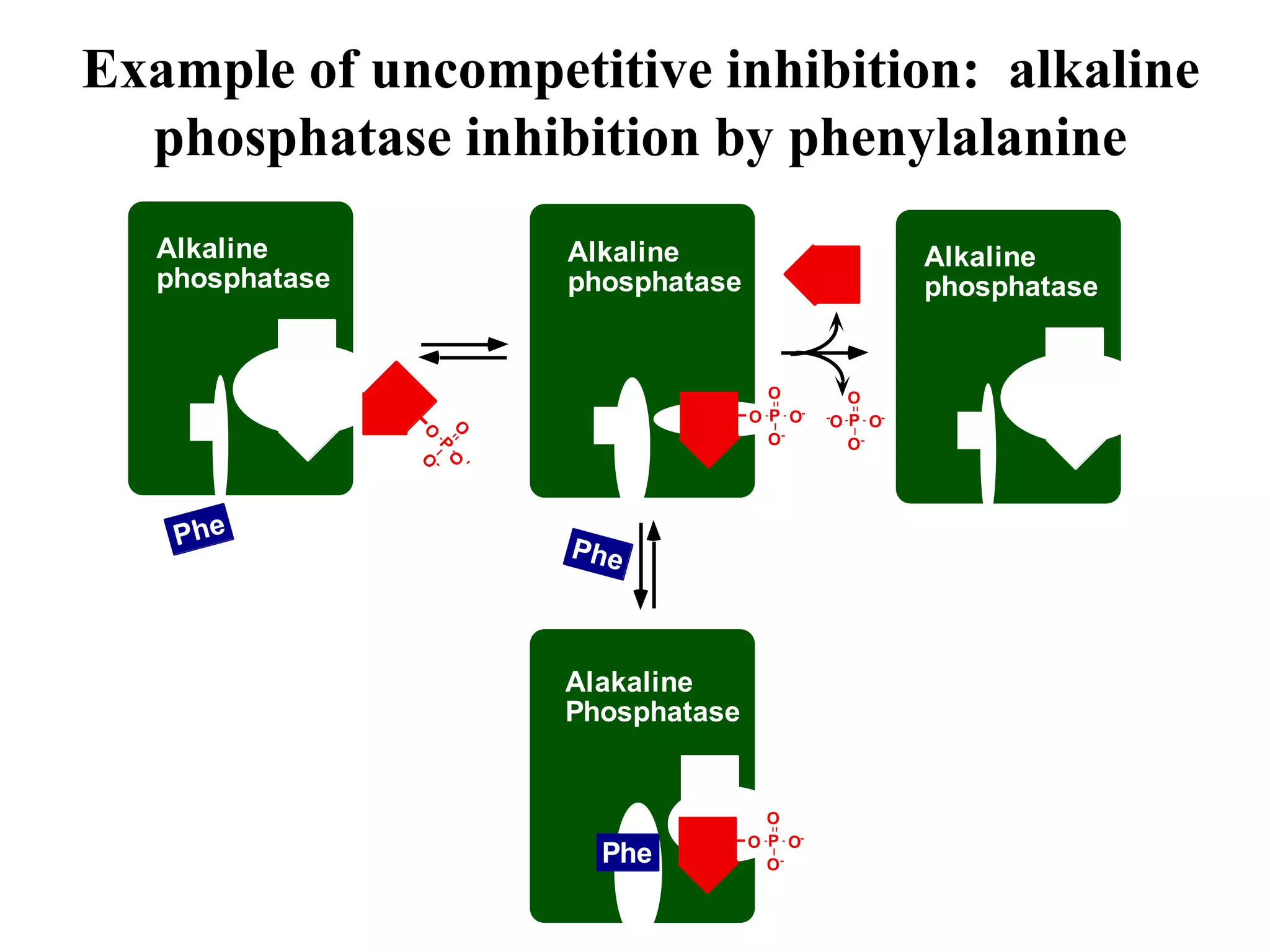
Example of uncompetitive inhibition: alkaline
phosphatase inhibition by phenylalanine
.
Alkaline
phosphatase
O P
O-
O
-
O
Alkaline
phosphatase
Phe
Alakaline
Phosphatase
Phe
Phe
O
P
O -
O
-
O
O P
O-
O
-
O
P
O-
O
-
O
-
O
Alkaline
phosphatase
At alkaline pH, alkaline phosphatase catalyzes
the release of inorganic phosphate from
phosphate esters. It is found in a number of
tissues, including liver, bile ducts, intestine,
bone, kidney, placenta, and leukocytes.
Alkaline phosphatase plays a role in the
deposition of hydroxyapetite in osteoid cells
during bone formation. The function of
alkaline phosphatase in other tissues is not
known. Serum alkaline phosphatase levels are
important diagnostic markers for bone and
liver disease.
Irreversible Inhibition
In irreversible
inhibition, the
inhibitor binds to the
enzyme irreversibly
through formation of
a covalent bond with
the enzyme ,
permanently
inactivating the
enzyme
Enzyme
S
O I
Irreversible Inhibition - Reaction
Mechanism
In irreversible inhibition,
the inhibitor permanently
inactivates the enzyme.
The net effect is to remove
enzyme from the reaction.
Vmax decreases
No effect on Km
E + S ES E + P
EI
+
I
The Michaelis-Menten plot for an irreversible
inhibitor looks like noncompetitive inhibition
Vmax,app < Vmax
Km,app = Km
.
Vmax
Vmax
2
1
2
1
Vmax,app
Km
Km,app
[Substrate]
Reaction
Rate
- Inhibitor
+ Inhibitor
Vmax,app
Irreversible inhibition is distinguished from
noncompetitive inhibition by plotting Vmax vs [E]t
Enzyme is
inactivated
until all of the
irreversible
inhibitor is
used up
Irreversible inhibitors decrease
Vmax,app, but leave the apparent
Km unchanged. Irreversible
inhibitors differ from other types
of inhibitors because they
covalently modify the enzyme.
This results in the permanent
inhibition of the enzyme activity.
Examples of Irreversible Inhibitors
• diisopropylphosphofluoridate
– prototype for the nerve gas sarin
– permanently inactivates serine proteases by
forming a covalent bond with the active site
serine
Penicillin is a suicide inhibitor
Glycopeptide transpeptidase catalyzes the formation of cross-links between D-
amino acids in the cell walls of bacteria. This enzyme also catalyzes the
reverse reaction, the hydrolysis of peptide bonds. During the course of
hydrolyzing the strained peptide bond in penicillin, the enzyme activates the
inhibitor (penicillin), which then covalently modifies an active site serine in
the enzyme. In effect, the enzyme “commits suicide” by hydrolyzing the
strained peptide bond in penicillin.
glycopeptide
transpeptidase
OH
Ser O
glycopeptide
transpeptidase
Ser
N
S CH3
CH3
COO-
H
H
C
C
O
H
N
C
O
H
H
R
N
S
CH3
COO-
H
H
C
C
O
H
N
C
O
H
Strained
peptide bond
Penicillin
CH3
R
Suicide inhibitors work by
“tricking” the enzyme into
activating the inhibitor, which
then forms a covalent bond with
the enzyme, leading to its
permanent inactivation.
Summary-Enzyme Inhibition
• Competitive Inhibitor
– Binds to substrate binding site
– Competes with substrate
– The affinity of the substrate appears to be decreased
when inhibitor is present (Km,app >Km)
• Noncompetitive inhibitor
– Binds to allosteric site
– Does not compete with the substrate for binding to
the enzyme
– The maximum velocity appears to be decreased in
the presence of the inhibitor (Vmax,app <Vmax)
• Uncompetitive Inhibitor
– Binds to the enzyme only after the substrate has
bound
– The affinity of the substrate appears to be increased
and the maximum velocity appears to be decreased
when inhibitor is present (Km,app <Km,
Vmax,app <Vmax),
• Irreversible Inhibitor
– Covalently modifies and permanently inactivates the
enzyme

5 enzyme kinetics-inhibition.ppt

  • 1.
  • 2.
    Types of Inhibition •Competitive Inhibition • Noncompetitive Inhibition • Uncompetitive Inhibition • Irreversible Inhibition
  • 3.
    S I Enzyme Competitive Inhibition In competitiveinhibition, the inhibitor competes with the substrate for the same binding site
  • 4.
    Competitive Inhibition - ReactionMechanism In competitive inhibition, the inhibitor binds only to the free enzyme, not to the ES complex E + S ES E + P EI + I
  • 5.
    General Michaelis-Menten Equation Thisform of the Michaelis-Menten equation can be used to understand how each type of inhibitor affects the reaction rate curve v = [S] Km,app + [S] Vmax,app
  • 6.
    In competitive inhibition,only the apparent Km is affected (Km,app> Km), The Vmax remains unchanged by the presence of the inhibitor.
  • 7.
    Competitive inhibitors alterthe apparent Km, not the Vmax . Vmax Vmax 2 Km Km,app [Substrate] Reaction Rate - Inhibitor + Inhibitor Vmax,app = Vmax Km,app > Km
  • 8.
    The Lineweaver-Burk plotis diagnostic for competitive inhibition Slope = Km,app Vmax 1 Vmax -1 Km,app 1 [S] Increasing [I] 1 v v = 1 Vmax Km,app Vmax 1 + [S] 1
  • 9.
    . Vmax Vmax 2 Km Km,app [Substrate] Reaction Rate - Inhibitor +Inhibitor Inhibitor competes with substrate, decreasing its apparent affinity: Km,app > Km Formation of EI complex shifts reaction to the left: Km,app > Km Km,app > Km Vmax,app = Vmax Formation of EI complex shifts reaction to the left: Km,app > Km Relating the Michaelis-Menten equation, the v vs. [S] plot, and the physical picture of competitive inhibition
  • 10.
    Example - CompetitiveInhibition Sulfanilamide is a competitive inhibitor of p-aminobenzoic acid. Sulfanilamides (also known as sulfa drugs, discovered in the 1930s) were the first effective systemic antibacterial agents. Because we do not make folic acid, sulfanilamides do not affect human cells. COOH NH2 p-aminobenzoic acid folic acid SO2NH2 NH2 sulfanilamide
  • 11.
    Practical case: Methanolpoisoning A wealthy visitor is taken to the emergency room, where he is diagnosed with methanol poisoning. You are contacted by a 3rd year medical student and asked what to do? How would you suggest treating this patient?
  • 12.
    Methanol (CH3OH) ismetabolized to formaldehyde and formic acid by alcohol dehydrogenase. You advisethe third year student to get the patient very drunk. Since ethanol (CH3CH2OH) competes with methanol for the same binding site on alcohol dehydrogenase, it slows the metabolism of methanol, allowing the toxic metabolites to be disposed of before they build up to dangerous levels. By the way, the patient was very grateful and decided to leave all their worldly possessions to the hospital. Unfortunately, after being released from the hospital, he went to the casinos and lost everything he had.
  • 13.
  • 14.
    E + SES E + P EI + I ESI + I S + Noncompetitive Inhibition - Reaction Mechanism In noncompetitive inhibition, the inhibitor binds enzyme irregardless of whether the substrate is bound
  • 15.
    Noncompetitive inhibitors decrease theVmax,app, but don’t affect the Km Vmax,app < Vmax Km,app = Km
  • 16.
    The inhibitor binds equallywell to free enzyme and the ES complex, so it doesn’t alter apparent affinity of the enzyme for the substrate Why does Km,app = Km for noncompetitive inhibition? E + S ES E + P EI + I ESI + I S +
  • 17.
    The Lineweaver-Burk plotis diagnostic for noncompetitive inhibition v = 1 Vmax,app Km Vmax,app 1 + [S] 1 Slope = Vmax,app Km 1 Vmax,app -1 Km 1 [S] Increasing [I] 1 v
  • 18.
    Formation of EI complexshifts reaction to the left: Km,app > Km Km,app > Km Vmax,app = Vmax . S I I S S I I S Enzyme Enzyme Enzyme Enzyme . Vmax Vmax 2 1 2 1 Vmax,app Km Km,app [Substrate] Reaction Rate - Inhibitor + Inhibitor Vmax,app Inhibitor doesn’t interfere with substrate binding, Km,app = Km Even at high substrate levels, inhibitor still binds, [E]t < [ES] Vmax,app < Vmax Vmax,app < Vmax Km,app = Km Relating the Michaelis-Menten equation, the v vs. [S] plot, and the physical picture of noncompetitive inhibition
  • 19.
    Noncompetitive inhibitors decrease theapparent Vmax, but do not alter the Km of the reaction
  • 20.
    Example of noncompetitiveinhibition: fructose 1,6-bisphosphatase inhibition by AMP
  • 21.
    Fructose 1,6-bisphosphatase isa key regulatory enzyme in the gluconeogenesis pathway. High amounts of AMP signal that ATP levels are low and gluconeogenesis should be shut down while glycolysis is turned on. High AMP levels inhibit fructose 1,6-bisphosphatase (shutting down gluconeogenesis) and activate phosphofructokinase (turning on glycolysis). Regulation of fructose 1,6-bisphosphatase and phosphofructokinase by AMP prevents a futile cycle in which glucose is simultaneously synthesized and broken down.
  • 22.
    Uncompetitive Inhibition In uncompetitive inhibition,the inhibitor binds only to the ES complex . S I S Enzyme Enzyme I Enzyme S Enzyme I
  • 23.
    Uncompetitive Inhibition - ReactionMechanism In uncompetitive inhibition, the inhibitor binds only to the ES complex, it does not bind to the free enzyme E + S ES E + P ESI + I
  • 24.
    Uncompetitive inhibitors decrease boththe Vmax,app and the Km,app Vmax,app < Vmax Km,app < Km Notice that at low substrate concentrations, uncompetitive inhibitors have little effect on the reaction rate because the lower Km,app of the enzyme offsets the decreased Vmax,app
  • 25.
    Uncompetitive inhibitors decreaseboth the Vmax,app and the Km,app of the enzyme E + S ES E + P ESI + I Notice that uncompetitive inhibitors don’t bind to the free enzyme, so there is no EI complex in the reaction mechanism
  • 26.
    The Lineweaver-Burk plotis diagnostic for uncompetitive inhibition v = 1 Vmax,app Km,app Vmax,app 1 + [S] 1 = Vmax Km Vmax,app 1 + [S] 1 1 Vmax,app -1 Km,app 1 [S] Increasing [I] 1 v Slope = Vmax Km
  • 27.
    . Vmax Vmax 2 1 2 1 Vmax,app Km Km,app [Substrate] Reaction Rate - Inhibitor + Inhibitor Vmax,app Formationof EI complex shifts reaction to the left: Km,app > Km . S I S Enzyme Enzyme I Enzyme S Enzyme I Even at high substrate levels, inhibitor binds, [E]t < [ES] Vmax,app < Vmax Inhibitor increases the amount of enzyme bound to substrate Km,app < Km Vmax,app < Vmax Km,app< Km Relating the Michaelis-Menten equation, the v vs. [S] plot, and the physical picture of uncompetitive inhibition
  • 28.
    Uncompetitive inhibitors decrease theapparent Km of the enzyme and decrease the Vmax of the reaction
  • 29.
    Example of uncompetitiveinhibition: alkaline phosphatase inhibition by phenylalanine . Alkaline phosphatase O P O- O - O Alkaline phosphatase Phe Alakaline Phosphatase Phe Phe O P O - O - O O P O- O - O P O- O - O - O Alkaline phosphatase
  • 30.
    At alkaline pH,alkaline phosphatase catalyzes the release of inorganic phosphate from phosphate esters. It is found in a number of tissues, including liver, bile ducts, intestine, bone, kidney, placenta, and leukocytes. Alkaline phosphatase plays a role in the deposition of hydroxyapetite in osteoid cells during bone formation. The function of alkaline phosphatase in other tissues is not known. Serum alkaline phosphatase levels are important diagnostic markers for bone and liver disease.
  • 31.
    Irreversible Inhibition In irreversible inhibition,the inhibitor binds to the enzyme irreversibly through formation of a covalent bond with the enzyme , permanently inactivating the enzyme Enzyme S O I
  • 32.
    Irreversible Inhibition -Reaction Mechanism In irreversible inhibition, the inhibitor permanently inactivates the enzyme. The net effect is to remove enzyme from the reaction. Vmax decreases No effect on Km E + S ES E + P EI + I
  • 33.
    The Michaelis-Menten plotfor an irreversible inhibitor looks like noncompetitive inhibition Vmax,app < Vmax Km,app = Km . Vmax Vmax 2 1 2 1 Vmax,app Km Km,app [Substrate] Reaction Rate - Inhibitor + Inhibitor Vmax,app
  • 34.
    Irreversible inhibition isdistinguished from noncompetitive inhibition by plotting Vmax vs [E]t Enzyme is inactivated until all of the irreversible inhibitor is used up
  • 35.
    Irreversible inhibitors decrease Vmax,app,but leave the apparent Km unchanged. Irreversible inhibitors differ from other types of inhibitors because they covalently modify the enzyme. This results in the permanent inhibition of the enzyme activity.
  • 36.
    Examples of IrreversibleInhibitors • diisopropylphosphofluoridate – prototype for the nerve gas sarin – permanently inactivates serine proteases by forming a covalent bond with the active site serine
  • 37.
    Penicillin is asuicide inhibitor Glycopeptide transpeptidase catalyzes the formation of cross-links between D- amino acids in the cell walls of bacteria. This enzyme also catalyzes the reverse reaction, the hydrolysis of peptide bonds. During the course of hydrolyzing the strained peptide bond in penicillin, the enzyme activates the inhibitor (penicillin), which then covalently modifies an active site serine in the enzyme. In effect, the enzyme “commits suicide” by hydrolyzing the strained peptide bond in penicillin. glycopeptide transpeptidase OH Ser O glycopeptide transpeptidase Ser N S CH3 CH3 COO- H H C C O H N C O H H R N S CH3 COO- H H C C O H N C O H Strained peptide bond Penicillin CH3 R
  • 38.
    Suicide inhibitors workby “tricking” the enzyme into activating the inhibitor, which then forms a covalent bond with the enzyme, leading to its permanent inactivation.
  • 39.
    Summary-Enzyme Inhibition • CompetitiveInhibitor – Binds to substrate binding site – Competes with substrate – The affinity of the substrate appears to be decreased when inhibitor is present (Km,app >Km) • Noncompetitive inhibitor – Binds to allosteric site – Does not compete with the substrate for binding to the enzyme – The maximum velocity appears to be decreased in the presence of the inhibitor (Vmax,app <Vmax)
  • 40.
    • Uncompetitive Inhibitor –Binds to the enzyme only after the substrate has bound – The affinity of the substrate appears to be increased and the maximum velocity appears to be decreased when inhibitor is present (Km,app <Km, Vmax,app <Vmax), • Irreversible Inhibitor – Covalently modifies and permanently inactivates the enzyme