QUANTITY & COST
ESTIMATION
CIVILE-318
CH-(2+1)
Department of Civil Engineering
Lecturer Engr. Meer Hamza Khan
Specific Objectives of course:
 To enhance the ability of students to learn the
various principles of computations related
to quantity surveying.
 To enhance skill of students in preparing detail
estimates and bill of quantities for various civil
engineering projects.
 To familiarize students with tender and contract
documents.
Course Learning Outcomes (CLOs):
Upon successful completion of the course, the
student will be able to:
S.No CLO’s
Learning
Domain
Taxonomy
Level
PLO
Theory
1
APPLY concept and
skills for quantity
take-off for different
civil engineering
works.
Cognitive 3 1
2
CARRY OUT rate
analysis, productivity
and pricing.
Cognitive 3 2
3
DISCUSS concepts
related to cost of
construction projects
Cognitive 2 11
Course Learning Outcomes (CLOs):
Upon successful completion of the course, the
student will be able to:
S.No CLO’s
Learning
Domain
Taxonomy
Level
PLO
Practical
1
PERFORM and
PRACTISE the
experiments related
to the subject.
Psychomotor
3 9
2
FORMULATE and
ORGANIZE
experimental data
Affective
4 10
3
PARTICIPATE in lab
activities and
COMPLY with the
instructions
Affective
2 10
1.Quantity Takeoff
Review of basic take-off mathematics and measurement
Units., Takeoff Rules and
Measurement Accuracy, Organization of take-off, Quantity
take-off and Pricing of Labor,
Material and Equipment for; Site work, Concrete, Masonry,
Carpentry, and Finishes Works.
Estimating Procedures and Considerations for Concrete
Retaining Wall, Piles, Steel Truss,
Road, Sewer and Water Mains Pipe Works, Maintaining of
Measurement Books
COURSE OUTLINE
2. Development of Estimates, Pricing and Related
Aspects
Types and methods of estimates (conceptual estimates,
preliminary, detailed estimates)
Rate analysis, Labor productivity, Cost analysis of
construction materials
Estimate Setup, Overhead, Profit, Sources of Estimating
Errors, Escalation, Contingency, Life-Cycle Costing and
Analysis, Concept of Cost Code
Use of different types of indices for conceptual estimates
COURSE OUTLINE
3. Construction Project Aspects Related to
Bidding
Specifications and their types for various items of
construction projects, Preparation of Civil
Engineering tender/bid proposal documents
evaluation methods of proposals and bids,
Preparation of documents for bid submissions,
General practice in government departments for
schedule of rates and specifications.
COURSE OUTLINE
COURSE OUTLINE
 Practical Work:
Following design exercises may be taken up for the course.
1. Use of spreadsheets for rate analysis, bid preparation etc.
2. Use of Quantity take-off software.
Recommended Books:
Marks Kalin, Robert S. Weygant, Harold J. Rosen & John R. Regenar,
Construction
Specifications Writing: Principles and Procedures, 2010, Wiley.
2. Stephen J. Peterson, Construction Estimating Using Excel, Prentice
Hall
3. Standard Form of Bidding Documents by Pakistan Engineering Council
4. Jimmie Hinze, Construction Contracts, 3rd Edition, 2010, McGraw-Hill
COST ESTIMATION
 A cost estimate is the predicted expenditure of a
project which is generally prepared before the
project to be taken up.
 It is prepared in different types, based on the
requirement of project.
 It can be prepared in detailed manner by taking
all items of works into consideration and
sometimes it can also be prepared approximately
without going into much details.
Quantity Surveyor
 He the person who is responsible on estimating
the quantities from the design drawings, and
measurement of the quantities in the site during
the project implementation, and preparing the
current and final payments.
Required Skills
 Ability to understand the drawings details, design
drawings.
 Excellent knowledge of the calculation of the
areas and volumes, knowledge of fees of workers
/technicians/rules and laws of the contracts,
 In addition to the knowledge of related financial
issues/ taxes, banks transactions, insurances and
its implication.
 Knowledge of the productivity of the workers and
technicians.
Quantity take-offs (QTO) are a detailed measurement
of materials and labor needed to complete a
construction project. They are developed by an
estimator during the pre-construction phase.
Accuracy and completeness are critical factors in all
cost estimates. An accurate and complete estimate
establishes accountability and credibility of the cost
engineer, therefore, providing greater confidence in
the cost estimate. The quantity of material in a project
can be accurately determined from the drawings.
Quantity surveys (take off)
The estimator must review each sheet of the drawings,
calculate the quantity of material and record the
amount and unit of measure. Each estimator must
develop a system of quantity takeoff that ensures that
a quantity is not omitted or calculated twice.
A well- organized check-list of work will help reduce
the chances of omitting an item. The estimator must,
also, add an appropriate percentage of waste for those
items where waste is likely to occur during
construction. The material quantity takeoff is extremely
important for cost estimating because it often
establishes the quantity and unit of measure for the
costs of labor and contractor’s equipment.
Quantity surveys (take off)
In general we can describe quantity take off as:
 Description and preparation of the bill of quantities
and its items required for the tender.
 Preparation of the site material, material types,
and material distribution.
 Description and preparing of the cost estimate of
item listed in BOQ.
 Preparation of the list of the site needs (technician
/ workers)
 Preparation of the due payment statements
(contractor payments during the construction)
Technical specification or
organization of take off
 Earth works
 Concrete works
 Masonry works
 Plastering
 Tiling
 Metal work
 Carpentry work
 Painting works
 Glazing
 Plumbing works
 Electrical works
Types of construction Engineering
Projects :
 Building construction
 Roads Construction
 Water Systems
 Sewerage and Storm water systems
Types of Cost Estimates
1) Preliminary Cost Estimate:
 Preliminary cost estimate is also called as abstract cost
estimate or budget estimate.
 Preliminary estimates are prepared with reference to cost
of similar type projects in a practical manner. In this
estimate, approximate cost of each important item of work
is displayed individually to know the necessity and utility
of each item of work. The items of work include cost of
lands, cost of roads, electrification, water supply costs,
cost of each buildings etc.
 By this estimate, the competent sanctioning authority can
decide the financial position and policy for administration
section.
2) Plinth Area Cost Estimate
 Plinth area cost estimate is prepared on the basis of
plinth area of a building which is the area covered
by external dimensions of building at the floor level
and plinth area rate of building which is the cost of
similar building with specifications in that locality.
 Plinth area estimate is obtained by multiplying plinth
area of building with plinth area rate.
 Open areas, courtyards etc. are should not be
included in plinth area. If building is multi storied,
plinth area estimate is prepared separately for each
floor level.
Types of Cost Estimates
3) Cube Rate Cost Estimate
 Cube rate cost estimate of a building is obtained by
multiplying plinth area with the height of building.
Height of building should be considered from floor
level to the top of the roof level. It is more suitable
for multi storied buildings.
 This method of estimation is same as plinth area
method. The rate per cubic meter is taken into
consideration based on the costs of similar type of
buildings situated in that location. Foundation, plinth
and parapet above the roof level are not considered
in this type of estimate.
Types of Cost Estimates
4) Approximate Quantity Method Cost Estimate
 In approximate quantity method of cost estimate,
The total wall length of structure is measured and
then this length is multiplied by rate per running
meter or feet which gives the cost of building. Rate
per running meter or feet is calculated separately
for foundation and superstructure.
 In case of foundation, rate per running meter is
decided by considering quantities such as
excavation cost, brick work cost up to plinth. While
in case of superstructure quantities like brickwork
for wall, wood works, floor finishing etc. are
considered for deciding rate per running meter.
Types of Cost Estimates
5) Detailed Cost Estimate
 Detailed cost estimate is prepared when competent
administrative authority approved the preliminary
estimates. This is very accurate type of estimate.
Quantities of items of work are measured and the cost of
each item of work is calculated separately.
 The rates of different items are provided according to the
current workable rates and total estimated cost is
calculated. 3 to 5 % of estimated cost is added to this for
contingencies as miscellaneous expenditure.
Types of Cost Estimates
The detailed Estimated should consist following
details and documents.
 Report
 General Specifications
 Detailed Specifications
 Drawings/plans – layout plans, elevation,
sectional views, detailed drawings etc.
 Designs and calculations – In case of buildings
design of foundations, beams, slab etc.
 Schedule of rates
Types of Cost Estimates
6) Revised Cost Estimate
 Revised cost estimate is a detailed estimate
and it is prepared when the original sanctioned
estimate value is exceeded by 5% or more.
 The increase may be due to sudden increase
in cost of materials, cost of transportation etc.
The reason behind the revision of estimate
should be mentioned on the last page of
revised estimate.
Types of Cost Estimates
7) Supplementary Cost Estimate
 Supplementary cost estimate is a detailed
estimate and it is prepared freshly when there
is a requirement of additional works during the
progress of original work. The estimate sheet
should consists of cost of original estimate as
well as the total cost of work including
supplementary cost of work for which sanction
is required.
Types of Cost Estimates
8) Annual Repair Cost Estimate
 Annual repair cost estimate is also called as
annual maintenance estimate which is prepared
to know the maintenance costs of building which
will keep the structure in safe condition. White
washing, painting, minor repairs etc. are taken
into consideration while preparing annual repair
estimate for a building.
Types of Cost Estimates
Method of measurements
1- Conventional measurement
 Depends on experience, and type of project.
 Doesn't govern by theories or engineering basics.
 Not considered as scientific method.
 Doesn't subtract the opening as windows or doors
from the block, plastering, painting works and
computing whole wall.
2- Engineering measurement
 It is basically by calculating all the works finished
after subtracting all opening.
Preparation of engineering
measurements
 measurement sheet
length width heigth Remarks
Total Quantity
Dimension
SN Description Number
Preparation of engineering
measurements
 measurement sheet for Bill
project name _________________
contractor name ____________
engineer name _______________
Total amount
SN Description Quantity unit Unit rate
 Concrete works measures in Cu-m or Cu-ft or
may be Sq-m or Sq-ft in engineering
measurement.
 All openings more than 0.1sq-m or 1.07 sq-ft
are deducted.
Measurement of works / concrete
works
Measurement of works / concrete works
Item unit Method of measurement
Blinding concrete,
benching, and
slabs concrete with
fixed thickness
Sq-m/sq-ft = length * width (the thickness
should be specified in the
drawings and specifications)
Footings, columns,
ground beams,
stairs, and
canopies,
cu-m/cu-ft = length*width*thickness
-Ground beams are measured
from its connection with
columns
- concrete include the stairs ,
steps, stair slabs, walls
supporting the stairs.
Concrete
decoration works
as curves.
No. The dimensions must be
specified in the drawings.
Measurement of works / block works
Item unit Method of measurement
Block works cu-m or cu-ft = length* width* thickness (the
thickness should be specified in
the drawings and specifications)
- subtracting all openings more
than 0.1 sq-m or 1.07 sq-ft.
Measurement of works / brick works
Item unit Method of measurement
Brick works cu-m or cu-ft
sq-m or sq-ft
= length*width*thickness/
length*width*(the thickness
should be specified in the
drawings and specifications)
- subtracting all openings more
than 0.1 cu-m or 3.528 cu-ft.
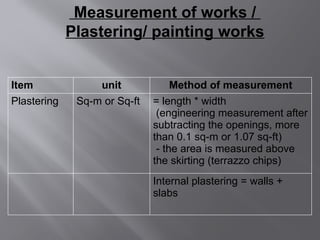
Measurement of works /
Plastering/ painting works
Item unit Method of measurement
Plastering Sq-m or Sq-ft = length * width
(engineering measurement after
subtracting the openings, more
than 0.1 sq-m or 1.07 sq-ft)
- the area is measured above
the skirting (terrazzo chips)
Internal plastering = walls +
slabs
Measurement of works / tilling works
Item unit Method of measurement
Terrazzo,
marble,
ceramic
Sq-m or sq-ft = length * width
(engineering measurement)
Measurement of works / Doors and
Windows
Item unit Method of measurement
Doors and
Windows
No. The exact dimensions should be
specified in the design
drawings.
Sometimes carpentry works
measured in m2
or m length
according to the item described
in BOQ.
Measurement of works / electrical &
sanitary works
Item unit Method of measurement
Electrical
and sanitary
pieces /
accessories
No. The dimensions should be
specified clearly in the design
drawings as the sockets, lamps,
fluorescent lighting,…etc
(W.C. , washing basins, sinks,
manholes, pumps…etc)
piping R-M or R-F The dimension and details should
be specified in the drawings, as
(cables, pipes, ..etc)
Works with
special
detail
Lumps sum All details should be specified in
the drawings, as gas network etc.
Bill of Quantities
 The results in the quantities book, are recorded
in the BOQ table.
 It is preferable to add 5-10% percentage on the
quantities for contingency to avoid any errors
or any.
Total amount
Sr.
No.
Description Quantity unit
Unit
rate
Code
No.
Summary table
No. Item Total amount
(RS)
1 EXCAVATION & EARTH WORKS
2 CONCRETE WORKS
3 BLOCK WORK
4 CARPENTRY
5 METAL WORK
6 FINISHING WORKS
7 PLUMBING WORKS
8 ELECTRICAL WORKS
9 MISCELLANEOUS

Cost Estimation for civil engineering .pptx

  • 1.
    QUANTITY & COST ESTIMATION CIVILE-318 CH-(2+1) Departmentof Civil Engineering Lecturer Engr. Meer Hamza Khan
  • 2.
    Specific Objectives ofcourse:  To enhance the ability of students to learn the various principles of computations related to quantity surveying.  To enhance skill of students in preparing detail estimates and bill of quantities for various civil engineering projects.  To familiarize students with tender and contract documents.
  • 3.
    Course Learning Outcomes(CLOs): Upon successful completion of the course, the student will be able to: S.No CLO’s Learning Domain Taxonomy Level PLO Theory 1 APPLY concept and skills for quantity take-off for different civil engineering works. Cognitive 3 1 2 CARRY OUT rate analysis, productivity and pricing. Cognitive 3 2 3 DISCUSS concepts related to cost of construction projects Cognitive 2 11
  • 4.
    Course Learning Outcomes(CLOs): Upon successful completion of the course, the student will be able to: S.No CLO’s Learning Domain Taxonomy Level PLO Practical 1 PERFORM and PRACTISE the experiments related to the subject. Psychomotor 3 9 2 FORMULATE and ORGANIZE experimental data Affective 4 10 3 PARTICIPATE in lab activities and COMPLY with the instructions Affective 2 10
  • 5.
    1.Quantity Takeoff Review ofbasic take-off mathematics and measurement Units., Takeoff Rules and Measurement Accuracy, Organization of take-off, Quantity take-off and Pricing of Labor, Material and Equipment for; Site work, Concrete, Masonry, Carpentry, and Finishes Works. Estimating Procedures and Considerations for Concrete Retaining Wall, Piles, Steel Truss, Road, Sewer and Water Mains Pipe Works, Maintaining of Measurement Books COURSE OUTLINE
  • 6.
    2. Development ofEstimates, Pricing and Related Aspects Types and methods of estimates (conceptual estimates, preliminary, detailed estimates) Rate analysis, Labor productivity, Cost analysis of construction materials Estimate Setup, Overhead, Profit, Sources of Estimating Errors, Escalation, Contingency, Life-Cycle Costing and Analysis, Concept of Cost Code Use of different types of indices for conceptual estimates COURSE OUTLINE
  • 7.
    3. Construction ProjectAspects Related to Bidding Specifications and their types for various items of construction projects, Preparation of Civil Engineering tender/bid proposal documents evaluation methods of proposals and bids, Preparation of documents for bid submissions, General practice in government departments for schedule of rates and specifications. COURSE OUTLINE
  • 8.
    COURSE OUTLINE  PracticalWork: Following design exercises may be taken up for the course. 1. Use of spreadsheets for rate analysis, bid preparation etc. 2. Use of Quantity take-off software. Recommended Books: Marks Kalin, Robert S. Weygant, Harold J. Rosen & John R. Regenar, Construction Specifications Writing: Principles and Procedures, 2010, Wiley. 2. Stephen J. Peterson, Construction Estimating Using Excel, Prentice Hall 3. Standard Form of Bidding Documents by Pakistan Engineering Council 4. Jimmie Hinze, Construction Contracts, 3rd Edition, 2010, McGraw-Hill
  • 9.
    COST ESTIMATION  Acost estimate is the predicted expenditure of a project which is generally prepared before the project to be taken up.  It is prepared in different types, based on the requirement of project.  It can be prepared in detailed manner by taking all items of works into consideration and sometimes it can also be prepared approximately without going into much details.
  • 10.
    Quantity Surveyor  Hethe person who is responsible on estimating the quantities from the design drawings, and measurement of the quantities in the site during the project implementation, and preparing the current and final payments.
  • 11.
    Required Skills  Abilityto understand the drawings details, design drawings.  Excellent knowledge of the calculation of the areas and volumes, knowledge of fees of workers /technicians/rules and laws of the contracts,  In addition to the knowledge of related financial issues/ taxes, banks transactions, insurances and its implication.  Knowledge of the productivity of the workers and technicians.
  • 12.
    Quantity take-offs (QTO)are a detailed measurement of materials and labor needed to complete a construction project. They are developed by an estimator during the pre-construction phase. Accuracy and completeness are critical factors in all cost estimates. An accurate and complete estimate establishes accountability and credibility of the cost engineer, therefore, providing greater confidence in the cost estimate. The quantity of material in a project can be accurately determined from the drawings. Quantity surveys (take off)
  • 13.
    Quantity surveys (takeoff) The estimator must review each sheet of the drawings, calculate the quantity of material and record the amount and unit of measure. Each estimator must develop a system of quantity takeoff that ensures that a quantity is not omitted or calculated twice. A well- organized check-list of work will help reduce the chances of omitting an item. The estimator must, also, add an appropriate percentage of waste for those items where waste is likely to occur during construction. The material quantity takeoff is extremely important for cost estimating because it often establishes the quantity and unit of measure for the costs of labor and contractor’s equipment.
  • 14.
    Quantity surveys (takeoff) In general we can describe quantity take off as:  Description and preparation of the bill of quantities and its items required for the tender.  Preparation of the site material, material types, and material distribution.  Description and preparing of the cost estimate of item listed in BOQ.  Preparation of the list of the site needs (technician / workers)  Preparation of the due payment statements (contractor payments during the construction)
  • 15.
    Technical specification or organizationof take off  Earth works  Concrete works  Masonry works  Plastering  Tiling  Metal work  Carpentry work  Painting works  Glazing  Plumbing works  Electrical works
  • 16.
    Types of constructionEngineering Projects :  Building construction  Roads Construction  Water Systems  Sewerage and Storm water systems
  • 17.
    Types of CostEstimates 1) Preliminary Cost Estimate:  Preliminary cost estimate is also called as abstract cost estimate or budget estimate.  Preliminary estimates are prepared with reference to cost of similar type projects in a practical manner. In this estimate, approximate cost of each important item of work is displayed individually to know the necessity and utility of each item of work. The items of work include cost of lands, cost of roads, electrification, water supply costs, cost of each buildings etc.  By this estimate, the competent sanctioning authority can decide the financial position and policy for administration section.
  • 18.
    2) Plinth AreaCost Estimate  Plinth area cost estimate is prepared on the basis of plinth area of a building which is the area covered by external dimensions of building at the floor level and plinth area rate of building which is the cost of similar building with specifications in that locality.  Plinth area estimate is obtained by multiplying plinth area of building with plinth area rate.  Open areas, courtyards etc. are should not be included in plinth area. If building is multi storied, plinth area estimate is prepared separately for each floor level. Types of Cost Estimates
  • 19.
    3) Cube RateCost Estimate  Cube rate cost estimate of a building is obtained by multiplying plinth area with the height of building. Height of building should be considered from floor level to the top of the roof level. It is more suitable for multi storied buildings.  This method of estimation is same as plinth area method. The rate per cubic meter is taken into consideration based on the costs of similar type of buildings situated in that location. Foundation, plinth and parapet above the roof level are not considered in this type of estimate. Types of Cost Estimates
  • 20.
    4) Approximate QuantityMethod Cost Estimate  In approximate quantity method of cost estimate, The total wall length of structure is measured and then this length is multiplied by rate per running meter or feet which gives the cost of building. Rate per running meter or feet is calculated separately for foundation and superstructure.  In case of foundation, rate per running meter is decided by considering quantities such as excavation cost, brick work cost up to plinth. While in case of superstructure quantities like brickwork for wall, wood works, floor finishing etc. are considered for deciding rate per running meter. Types of Cost Estimates
  • 21.
    5) Detailed CostEstimate  Detailed cost estimate is prepared when competent administrative authority approved the preliminary estimates. This is very accurate type of estimate. Quantities of items of work are measured and the cost of each item of work is calculated separately.  The rates of different items are provided according to the current workable rates and total estimated cost is calculated. 3 to 5 % of estimated cost is added to this for contingencies as miscellaneous expenditure. Types of Cost Estimates
  • 22.
    The detailed Estimatedshould consist following details and documents.  Report  General Specifications  Detailed Specifications  Drawings/plans – layout plans, elevation, sectional views, detailed drawings etc.  Designs and calculations – In case of buildings design of foundations, beams, slab etc.  Schedule of rates Types of Cost Estimates
  • 23.
    6) Revised CostEstimate  Revised cost estimate is a detailed estimate and it is prepared when the original sanctioned estimate value is exceeded by 5% or more.  The increase may be due to sudden increase in cost of materials, cost of transportation etc. The reason behind the revision of estimate should be mentioned on the last page of revised estimate. Types of Cost Estimates
  • 24.
    7) Supplementary CostEstimate  Supplementary cost estimate is a detailed estimate and it is prepared freshly when there is a requirement of additional works during the progress of original work. The estimate sheet should consists of cost of original estimate as well as the total cost of work including supplementary cost of work for which sanction is required. Types of Cost Estimates
  • 25.
    8) Annual RepairCost Estimate  Annual repair cost estimate is also called as annual maintenance estimate which is prepared to know the maintenance costs of building which will keep the structure in safe condition. White washing, painting, minor repairs etc. are taken into consideration while preparing annual repair estimate for a building. Types of Cost Estimates
  • 26.
    Method of measurements 1-Conventional measurement  Depends on experience, and type of project.  Doesn't govern by theories or engineering basics.  Not considered as scientific method.  Doesn't subtract the opening as windows or doors from the block, plastering, painting works and computing whole wall. 2- Engineering measurement  It is basically by calculating all the works finished after subtracting all opening.
  • 27.
    Preparation of engineering measurements measurement sheet length width heigth Remarks Total Quantity Dimension SN Description Number
  • 28.
    Preparation of engineering measurements measurement sheet for Bill project name _________________ contractor name ____________ engineer name _______________ Total amount SN Description Quantity unit Unit rate
  • 29.
     Concrete worksmeasures in Cu-m or Cu-ft or may be Sq-m or Sq-ft in engineering measurement.  All openings more than 0.1sq-m or 1.07 sq-ft are deducted. Measurement of works / concrete works
  • 30.
    Measurement of works/ concrete works Item unit Method of measurement Blinding concrete, benching, and slabs concrete with fixed thickness Sq-m/sq-ft = length * width (the thickness should be specified in the drawings and specifications) Footings, columns, ground beams, stairs, and canopies, cu-m/cu-ft = length*width*thickness -Ground beams are measured from its connection with columns - concrete include the stairs , steps, stair slabs, walls supporting the stairs. Concrete decoration works as curves. No. The dimensions must be specified in the drawings.
  • 31.
    Measurement of works/ block works Item unit Method of measurement Block works cu-m or cu-ft = length* width* thickness (the thickness should be specified in the drawings and specifications) - subtracting all openings more than 0.1 sq-m or 1.07 sq-ft.
  • 32.
    Measurement of works/ brick works Item unit Method of measurement Brick works cu-m or cu-ft sq-m or sq-ft = length*width*thickness/ length*width*(the thickness should be specified in the drawings and specifications) - subtracting all openings more than 0.1 cu-m or 3.528 cu-ft.
  • 33.
    Measurement of works/ Plastering/ painting works Item unit Method of measurement Plastering Sq-m or Sq-ft = length * width (engineering measurement after subtracting the openings, more than 0.1 sq-m or 1.07 sq-ft) - the area is measured above the skirting (terrazzo chips) Internal plastering = walls + slabs
  • 34.
    Measurement of works/ tilling works Item unit Method of measurement Terrazzo, marble, ceramic Sq-m or sq-ft = length * width (engineering measurement)
  • 35.
    Measurement of works/ Doors and Windows Item unit Method of measurement Doors and Windows No. The exact dimensions should be specified in the design drawings. Sometimes carpentry works measured in m2 or m length according to the item described in BOQ.
  • 36.
    Measurement of works/ electrical & sanitary works Item unit Method of measurement Electrical and sanitary pieces / accessories No. The dimensions should be specified clearly in the design drawings as the sockets, lamps, fluorescent lighting,…etc (W.C. , washing basins, sinks, manholes, pumps…etc) piping R-M or R-F The dimension and details should be specified in the drawings, as (cables, pipes, ..etc) Works with special detail Lumps sum All details should be specified in the drawings, as gas network etc.
  • 37.
    Bill of Quantities The results in the quantities book, are recorded in the BOQ table.  It is preferable to add 5-10% percentage on the quantities for contingency to avoid any errors or any. Total amount Sr. No. Description Quantity unit Unit rate Code No.
  • 38.
    Summary table No. ItemTotal amount (RS) 1 EXCAVATION & EARTH WORKS 2 CONCRETE WORKS 3 BLOCK WORK 4 CARPENTRY 5 METAL WORK 6 FINISHING WORKS 7 PLUMBING WORKS 8 ELECTRICAL WORKS 9 MISCELLANEOUS