


The WHY-The WHAT and The HOW?


Author: Jihad Daniel
WHY Do Cost Management?
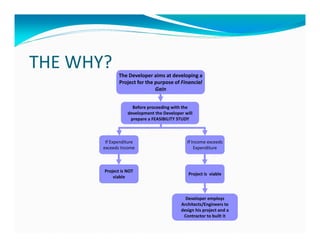
THE WHY?      The Developer aims at developing a
              Project for the purpose of Financial
                              Gain


                    Before proceeding with the
                  development the Developer will
                   prepare a FEASIBILITY STUDY


        If Expenditure                       If Income exceeds
       exceeds Income                            Expenditure


       Project is NOT
                                              Project is viable
           viable


                                            Developer employs
                                          Architects/Engineers to
                                          design his project and a
                                           Contractor to built it
THE WHY?
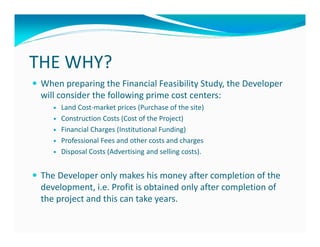
 When preparing the Financial Feasibility Study, the Developer
 will consider the following prime cost centers:
      Land Cost-market prices (Purchase of the site)
      Construction Costs (Cost of the Project)
      Financial Charges (Institutional Funding)
      Professional Fees and other costs and charges
      Disposal Costs (Advertising and selling costs).


 The Developer only makes his money after completion of the
 development, i.e. Profit is obtained only after completion of
 the project and this can take years.
THE WHY?
 It is essential to identify the Cost of Construction at the
 Feasibility Stage and to ensure that the cost of
 construction does not substantially vary during the
 Design Stage-Tender-and on completion of the
 Construction Stage (Final Account).
Example Feasibility Study
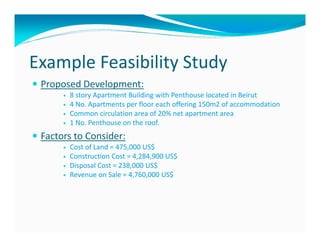
 Proposed Development:
       8 story Apartment Building with Penthouse located in Beirut
       4 No. Apartments per floor each offering 150m2 of accommodation
       Common circulation area of 20% net apartment area
       1 No. Penthouse on the roof.
 Factors to Consider:
       Cost of Land = 475,000 US$
       Construction Cost = 4,284,900 US$
       Disposal Cost = 238,000 US$
       Revenue on Sale = 4,760,000 US$
Example Feasibility Study
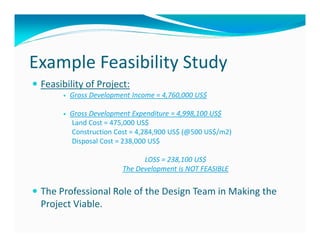
 Feasibility of Project:
        Gross Development Income = 4,760,000 US$

        Gross Development Expenditure = 4,998,100 US$
        Land Cost = 475,000 US$
        Construction Cost = 4,284,900 US$ (@500 US$/m2)
        Disposal Cost = 238,000 US$

                             LOSS = 238,100 US$
                       The Development is NOT FEASIBLE


 The Professional Role of the Design Team in Making the
 Project Viable.
WHAT Do We Do to Satisfy the
         WHY?
THE WHAT?
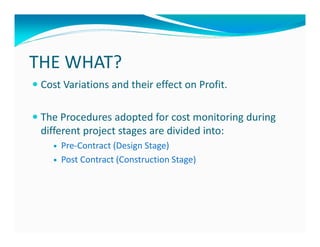
 Cost Variations and their effect on Profit.

 The Procedures adopted for cost monitoring during
 different project stages are divided into:
     Pre-Contract (Design Stage)
     Post Contract (Construction Stage)
THE WHAT?
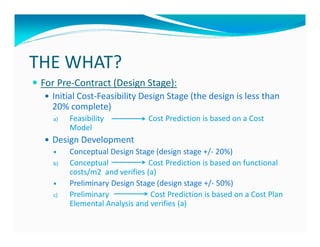
 For Pre-Contract (Design Stage):
   Initial Cost-Feasibility Design Stage (the design is less than
   20% complete)
   a)   Feasibility           Cost Prediction is based on a Cost
        Model
   Design Development
        Conceptual Design Stage (design stage +/- 20%)
   b)   Conceptual             Cost Prediction is based on functional
        costs/m2 and verifies (a)
        Preliminary Design Stage (design stage +/- 50%)
   c)   Preliminary            Cost Prediction is based on a Cost Plan
        Elemental Analysis and verifies (a)
THE WHAT?
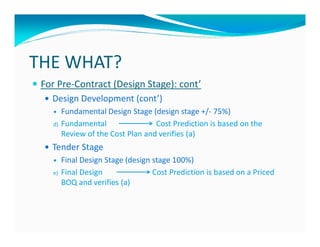
 For Pre-Contract (Design Stage): cont’
   Design Development (cont’)
        Fundamental Design Stage (design stage +/- 75%)
   d)   Fundamental                Cost Prediction is based on the
        Review of the Cost Plan and verifies (a)
   Tender Stage
        Final Design Stage (design stage 100%)
   e)   Final Design               Cost Prediction is based on a Priced
        BOQ and verifies (a)
THE WHAT?
 For Post-Contract (Construction Stage):
 Contract Forms provide administrative procedures to
 monitor and limit cost variations/claims arising between
 the Tender Cost and Final Accounts Costs.
HOW We Do WHAT We Do?
THE HOW?
 During the Feasibility Design Stage (Design less than 20%
 complete) a COST MODEL is used.
        A Cost Model is data extracted from a similar previous completed
        project
        Differences from the Cost Model and Proposed Project are isolated
        Historical cost data is updated to present day costs BASE DATE
        accounting for the differences
        The Cost Model’s modified costs are equated to cost/m2 and then
        applied to the built-up floor area of the Proposed Project.

      The Above Procedures provide an Indicative Cost based on cost/m2.
THE HOW?
 During the Conceptual Design Stage (Design +/- 20%
 complete).
          Assumptions made at the Feasibility Stage Estimate are verified
          Elements should be quantified, if possible
          The estimated total cost should be similar to that already
          reported. But if there are differences, these should be discussed
          with the Designer/Developer.

        The Above Procedures provide an Indicative Cost based on cost/m2
          but with more certainty.
THE HOW?
 During the Preliminary Design Stage (Design +/- 50%
 complete).
       Design advances to approximate quantification priced at composite
       unit rates
       A Cost Plan is prepared
       The estimated total cost should be similar to that already reported.
       But if there are differences, these should be discussed with the
       Designer/Developer.
THE HOW?
 During the Fundamental Design Stage (Design +/- 75%
 complete).
       An updated Cost Plan incorporating additional details is prepared
       The estimated total cost should be similar to that already reported.
       But if there are differences, these should be discussed with the
       Designer/Developer.
 During the Final Design Stage (Design 100% complete).
       A BOQ is priced using market prices in an attempt to predict tender
       results (Fair Priced Estimate)
       The estimated total cost should be similar to that already reported.
       But if there are differences, these should be discussed with the
       Designer/Developer.
THE HOW?
 Tender Results-Contractor’s Prices
       In the event the Tender results differ from the Tender Predications
       (Priced BOQ), differences should be discussed with the Designer and
       the Developer.
 Keeping a Cost Data Base
       A Data Base of Building Costs is maintained for the purposes of
       preparing those estimates required by the various design stages.
       In addition to the Data Base, continuous attention must be made to
       the various economic conditions arising during extended
       development and construction programmes and the effect of these
       conditions on prices.
COMMENTS & QUESTIONS!?

J.S. Daniel paper for presentation cost management

  • 1.
    The WHY-The WHATand The HOW? Author: Jihad Daniel
  • 2.
    WHY Do CostManagement?
  • 3.
    THE WHY? The Developer aims at developing a Project for the purpose of Financial Gain Before proceeding with the development the Developer will prepare a FEASIBILITY STUDY If Expenditure If Income exceeds exceeds Income Expenditure Project is NOT Project is viable viable Developer employs Architects/Engineers to design his project and a Contractor to built it
  • 4.
    THE WHY? Whenpreparing the Financial Feasibility Study, the Developer will consider the following prime cost centers: Land Cost-market prices (Purchase of the site) Construction Costs (Cost of the Project) Financial Charges (Institutional Funding) Professional Fees and other costs and charges Disposal Costs (Advertising and selling costs). The Developer only makes his money after completion of the development, i.e. Profit is obtained only after completion of the project and this can take years.
  • 5.
    THE WHY? Itis essential to identify the Cost of Construction at the Feasibility Stage and to ensure that the cost of construction does not substantially vary during the Design Stage-Tender-and on completion of the Construction Stage (Final Account).
  • 6.
  • 7.
    Example Feasibility Study Proposed Development: 8 story Apartment Building with Penthouse located in Beirut 4 No. Apartments per floor each offering 150m2 of accommodation Common circulation area of 20% net apartment area 1 No. Penthouse on the roof. Factors to Consider: Cost of Land = 475,000 US$ Construction Cost = 4,284,900 US$ Disposal Cost = 238,000 US$ Revenue on Sale = 4,760,000 US$
  • 8.
    Example Feasibility Study Feasibility of Project: Gross Development Income = 4,760,000 US$ Gross Development Expenditure = 4,998,100 US$ Land Cost = 475,000 US$ Construction Cost = 4,284,900 US$ (@500 US$/m2) Disposal Cost = 238,000 US$ LOSS = 238,100 US$ The Development is NOT FEASIBLE The Professional Role of the Design Team in Making the Project Viable.
  • 9.
    WHAT Do WeDo to Satisfy the WHY?
  • 10.
    THE WHAT? CostVariations and their effect on Profit. The Procedures adopted for cost monitoring during different project stages are divided into: Pre-Contract (Design Stage) Post Contract (Construction Stage)
  • 11.
    THE WHAT? ForPre-Contract (Design Stage): Initial Cost-Feasibility Design Stage (the design is less than 20% complete) a) Feasibility Cost Prediction is based on a Cost Model Design Development Conceptual Design Stage (design stage +/- 20%) b) Conceptual Cost Prediction is based on functional costs/m2 and verifies (a) Preliminary Design Stage (design stage +/- 50%) c) Preliminary Cost Prediction is based on a Cost Plan Elemental Analysis and verifies (a)
  • 12.
    THE WHAT? ForPre-Contract (Design Stage): cont’ Design Development (cont’) Fundamental Design Stage (design stage +/- 75%) d) Fundamental Cost Prediction is based on the Review of the Cost Plan and verifies (a) Tender Stage Final Design Stage (design stage 100%) e) Final Design Cost Prediction is based on a Priced BOQ and verifies (a)
  • 13.
    THE WHAT? ForPost-Contract (Construction Stage): Contract Forms provide administrative procedures to monitor and limit cost variations/claims arising between the Tender Cost and Final Accounts Costs.
  • 14.
    HOW We DoWHAT We Do?
  • 15.
    THE HOW? Duringthe Feasibility Design Stage (Design less than 20% complete) a COST MODEL is used. A Cost Model is data extracted from a similar previous completed project Differences from the Cost Model and Proposed Project are isolated Historical cost data is updated to present day costs BASE DATE accounting for the differences The Cost Model’s modified costs are equated to cost/m2 and then applied to the built-up floor area of the Proposed Project. The Above Procedures provide an Indicative Cost based on cost/m2.
  • 16.
    THE HOW? Duringthe Conceptual Design Stage (Design +/- 20% complete). Assumptions made at the Feasibility Stage Estimate are verified Elements should be quantified, if possible The estimated total cost should be similar to that already reported. But if there are differences, these should be discussed with the Designer/Developer. The Above Procedures provide an Indicative Cost based on cost/m2 but with more certainty.
  • 17.
    THE HOW? Duringthe Preliminary Design Stage (Design +/- 50% complete). Design advances to approximate quantification priced at composite unit rates A Cost Plan is prepared The estimated total cost should be similar to that already reported. But if there are differences, these should be discussed with the Designer/Developer.
  • 18.
    THE HOW? Duringthe Fundamental Design Stage (Design +/- 75% complete). An updated Cost Plan incorporating additional details is prepared The estimated total cost should be similar to that already reported. But if there are differences, these should be discussed with the Designer/Developer. During the Final Design Stage (Design 100% complete). A BOQ is priced using market prices in an attempt to predict tender results (Fair Priced Estimate) The estimated total cost should be similar to that already reported. But if there are differences, these should be discussed with the Designer/Developer.
  • 19.
    THE HOW? TenderResults-Contractor’s Prices In the event the Tender results differ from the Tender Predications (Priced BOQ), differences should be discussed with the Designer and the Developer. Keeping a Cost Data Base A Data Base of Building Costs is maintained for the purposes of preparing those estimates required by the various design stages. In addition to the Data Base, continuous attention must be made to the various economic conditions arising during extended development and construction programmes and the effect of these conditions on prices.
  • 20.