STEP 6
Education Psychology
Learning Behaviours
-Behaviorist
- Cognitivist
-Humanist
- Social theorist
Behaviour Modifications
- Behaviour problems
- Behaviour Management
Memory – Forgetting
Learning Behaviours
• Behaviorist Theory
– Pavlov, Watson, Thorndike, Skinner
• Cognitive Theory
– Kohler, Gagne, Bruner, Ausubel, Piaget
• Humanistic Theory
– Maslow, Carl Rogers
• Social Theory
– Bandura
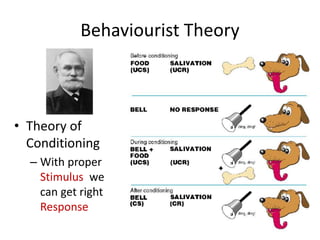
Behaviourist Theory
• Theory of
Conditioning
– With proper
Stimulus we
can get right
Response
Cognitive Theory
Bruner’s Discovery
Learning
• takes place in problem
solving situations where
the learner uses his/her
own past experience
and existing knowledge
to discover facts and
relationships.
• encourages active engagement
• promotes motivation
• promotes responsibility,
independence
• the development of creativity
and problem solving skills.
Humanistic Theory
• Maslow
– Hierarchy of
Needs
• Our actions
are motivated
by our needs.
Social theory
• Bandura
– Modeling Theory
• Attention
– have to pay attention.
• Retention
– must be able to retain –
remember.
• Reproduction
– have the ability to reproduce
the behavior.
• Motivation
– some reason for learning and
imitating.
Bobo experiment
Video – Challenging Behaviour
• https://www.youtube.com/watch?v=8eCfnrGu
5xo
Behaviour Problems
• Any concrete action of pupils that is
disruptive or disturbing to others;
• Hinders the smooth implementation of
teaching;
• Disturbs other pupils’ learning process.
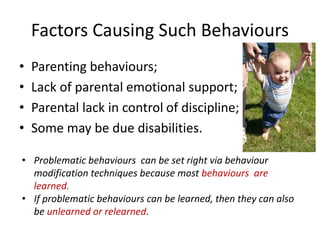
Factors Causing Such Behaviours
• Parenting behaviours;
• Lack of parental emotional support;
• Parental lack in control of discipline;
• Some may be due disabilities.
• Problematic behaviours can be set right via behaviour
modification techniques because most behaviours are
learned.
• If problematic behaviours can be learned, then they can also
be unlearned or relearned.
TYPES OF PROBLEMATIC BEHAVIOUR
DISRUPTIVE DESTRUCTIVE
OVER-DEPENDENCE
The child is
uncooperative
and prevents
himself and
other children
in class from
learning.
The child who lacks
self control and has
low self-esteem
consistently exhibits
misbehavior such as
hitting, biting and
destroying things.
Child who holds
on desperately to
others to give
them direction
and security; not
willing to let go.
Issues in the Classroom
• Attention seeking
• ‘Showing off’
• Child is bored easily
• Classroom environment not
challenging enough
• Change in situation at home
making the child insecure
• Arrival of a new sibling
• Hyperactivity
• ???
• Low self-esteem
• No mastery of skills
• Lack of social & emotional
skills to work / play with
others
• Resentful
• With-drawn and shows
insecurity
Managing Problems
How can you manage children who are
1. Disruptive?
2. Destructive?
3. Over dependent?
Select two examples and discuss how you will handle the
situation and resolve them.
4. How can you provide activities so that preschoolers
remember what they learn / what they are taught
Suggest two examples.
Behaviour Modification
https://www.youtube.com/watch?v=xv1Q6DTXo
L8
Memory – How Our Brain Works
• Atkinson & Shiffrin’s Memory
Process
• All inputs through our senses >
short term memory > goes into
long term memory to recall later
(repeat many times to remember
and store properly)
Forget - Remember
How can you provide activities so that
preschoolers remember what they learn / what
they are taught
Suggest two examples.

4share 06 step 6

  • 1.
    STEP 6 Education Psychology LearningBehaviours -Behaviorist - Cognitivist -Humanist - Social theorist Behaviour Modifications - Behaviour problems - Behaviour Management Memory – Forgetting
  • 2.
    Learning Behaviours • BehavioristTheory – Pavlov, Watson, Thorndike, Skinner • Cognitive Theory – Kohler, Gagne, Bruner, Ausubel, Piaget • Humanistic Theory – Maslow, Carl Rogers • Social Theory – Bandura
  • 3.
    Behaviourist Theory • Theoryof Conditioning – With proper Stimulus we can get right Response
  • 4.
    Cognitive Theory Bruner’s Discovery Learning •takes place in problem solving situations where the learner uses his/her own past experience and existing knowledge to discover facts and relationships. • encourages active engagement • promotes motivation • promotes responsibility, independence • the development of creativity and problem solving skills.
  • 5.
    Humanistic Theory • Maslow –Hierarchy of Needs • Our actions are motivated by our needs.
  • 6.
    Social theory • Bandura –Modeling Theory • Attention – have to pay attention. • Retention – must be able to retain – remember. • Reproduction – have the ability to reproduce the behavior. • Motivation – some reason for learning and imitating. Bobo experiment
  • 7.
    Video – ChallengingBehaviour • https://www.youtube.com/watch?v=8eCfnrGu 5xo
  • 8.
    Behaviour Problems • Anyconcrete action of pupils that is disruptive or disturbing to others; • Hinders the smooth implementation of teaching; • Disturbs other pupils’ learning process.
  • 9.
    Factors Causing SuchBehaviours • Parenting behaviours; • Lack of parental emotional support; • Parental lack in control of discipline; • Some may be due disabilities. • Problematic behaviours can be set right via behaviour modification techniques because most behaviours are learned. • If problematic behaviours can be learned, then they can also be unlearned or relearned.
  • 10.
    TYPES OF PROBLEMATICBEHAVIOUR DISRUPTIVE DESTRUCTIVE OVER-DEPENDENCE The child is uncooperative and prevents himself and other children in class from learning. The child who lacks self control and has low self-esteem consistently exhibits misbehavior such as hitting, biting and destroying things. Child who holds on desperately to others to give them direction and security; not willing to let go.
  • 11.
    Issues in theClassroom • Attention seeking • ‘Showing off’ • Child is bored easily • Classroom environment not challenging enough • Change in situation at home making the child insecure • Arrival of a new sibling • Hyperactivity • ??? • Low self-esteem • No mastery of skills • Lack of social & emotional skills to work / play with others • Resentful • With-drawn and shows insecurity
  • 12.
    Managing Problems How canyou manage children who are 1. Disruptive? 2. Destructive? 3. Over dependent? Select two examples and discuss how you will handle the situation and resolve them. 4. How can you provide activities so that preschoolers remember what they learn / what they are taught Suggest two examples.
  • 13.
  • 14.
    Memory – HowOur Brain Works • Atkinson & Shiffrin’s Memory Process • All inputs through our senses > short term memory > goes into long term memory to recall later (repeat many times to remember and store properly)
  • 15.
    Forget - Remember Howcan you provide activities so that preschoolers remember what they learn / what they are taught Suggest two examples.