P a ge | 1
Title: Design and Simulation of OFDM-Based Communication System in MATLAB
Abstract:
This project presents the design and simulation of an Orthogonal Frequency Division
Multiplexing (OFDM) communication system using MATLAB. OFDM is a key modulation
technique used in modern wireless communication systems such as LTE, Wi-Fi, and 5G. In this
simulation, digital data is modulated using BPSK, processed through IFFT for transmission, and
then demodulated using FFT at the receiver side. The effect of Additive White Gaussian Noise
(AWGN) on the system is analyzed by plotting the Bit Error Rate (BER) against different Signal-
to-Noise Ratio (SNR) values.
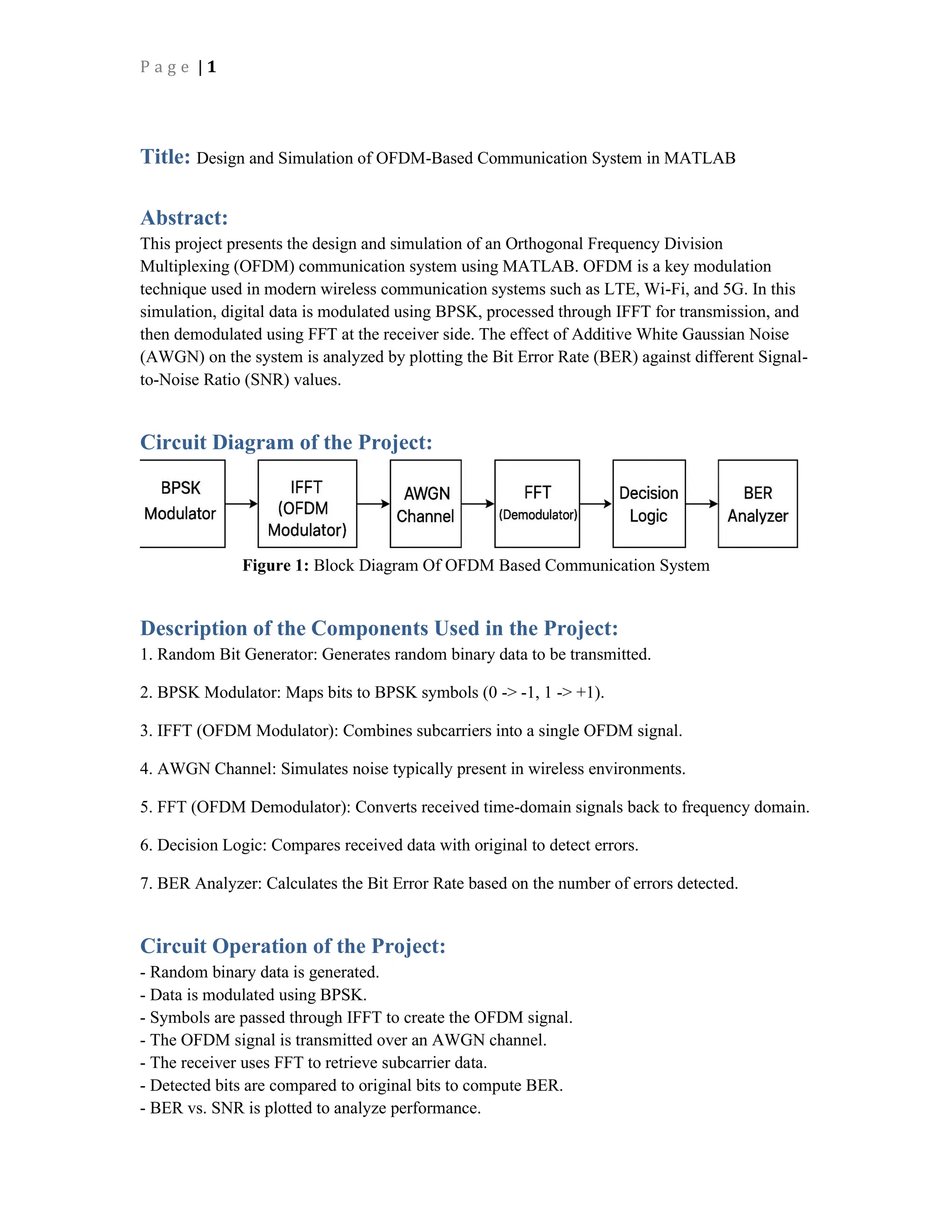
Circuit Diagram of the Project:
Figure 1: Block Diagram Of OFDM Based Communication System
Description of the Components Used in the Project:
1. Random Bit Generator: Generates random binary data to be transmitted.
2. BPSK Modulator: Maps bits to BPSK symbols (0 -> -1, 1 -> +1).
3. IFFT (OFDM Modulator): Combines subcarriers into a single OFDM signal.
4. AWGN Channel: Simulates noise typically present in wireless environments.
5. FFT (OFDM Demodulator): Converts received time-domain signals back to frequency domain.
6. Decision Logic: Compares received data with original to detect errors.
7. BER Analyzer: Calculates the Bit Error Rate based on the number of errors detected.
Circuit Operation of the Project:
- Random binary data is generated.
- Data is modulated using BPSK.
- Symbols are passed through IFFT to create the OFDM signal.
- The OFDM signal is transmitted over an AWGN channel.
- The receiver uses FFT to retrieve subcarrier data.
- Detected bits are compared to original bits to compute BER.
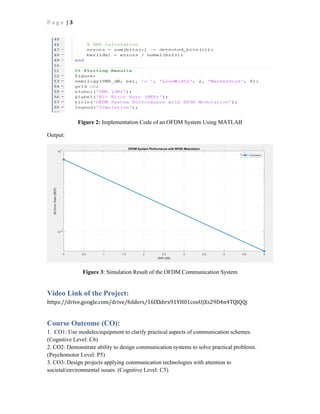
- BER vs. SNR is plotted to analyze performance.
2.
P a ge | 2
Application of the Project:
- LTE and 5G baseband communication modeling.
- Wi-Fi physical layer simulation.
- Educational tool to understand OFDM.
- Research platform for testing error correction techniques.
Cost Calculation:
This is a simulation-based project, so there is no hardware cost.
Picture of the Project:
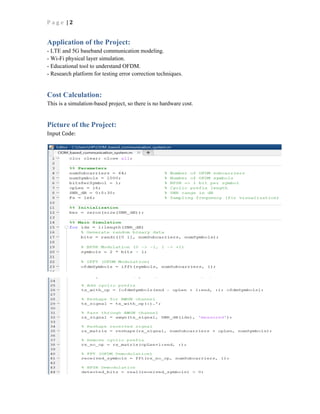
Input Code:
3.
P a ge | 3
Figure 2: Implementation Code of an OFDM System Using MATLAB
Output:
Figure 3: Simulation Result of the OFDM Communication System
Video Link of the Project:
https://drive.google.com/drive/folders/16IXkhrx91YH01cooUjXs29D4n4TQlQQj
Course Outcome (CO):
1. CO1: Use modules/equipment to clarify practical aspects of communication schemes.
(Cognitive Level: C6)
2. CO2: Demonstrate ability to design communication systems to solve practical problems.
(Psychomotor Level: P5)
3. CO3: Design projects applying communication technologies with attention to
societal/environmental issues. (Cognitive Level: C5)
4.
P a ge | 4
Program Outcome (PO):
PO(c): Ability to design systems and components for engineering problems considering social,
environmental, and ethical contexts.
PO(e): Ability to identify, formulate, analyze, and solve engineering problems through the
application of modern tools and techniques.
PO(i): Ability to engage in independent and lifelong learning.
Discussion:
The OFDM simulation project effectively demonstrates the practical implementation of a key
modern modulation technique used in wireless communications. Through MATLAB, students
can visualize the process of multiplexing subcarriers, observe the effects of noise, and understand
the critical relationship between BER and SNR. The project reflects the core principles of digital
communications and provides a foundation for more advanced studies such as channel coding,
synchronization, and MIMO systems. Moreover, the simulation-based approach makes it cost-
effective and ideal for academic exploration. By integrating theoretical concepts with practical
simulation, this project bridges the gap between classroom learning and real-world
communication system design.