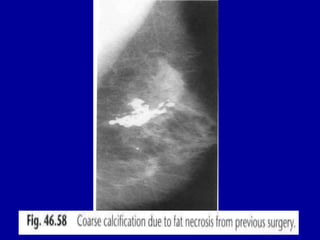
46THE BREAST
DAVID SUTTON
DAVID SUTTON PICTURES
DR. Muhammad Bin Zulfiqar
PGR-FCPS III SIMS/SHL
• Fig. 46.1 Correct positioning
for mediolateral oblique view.
a = Nipple in profile. b =
Pectoralis muscle visible down
to level of the nipple. c =
Inframammary fold visible. d =
Glandular tissue evenly
compressed and adequately
penetrated.
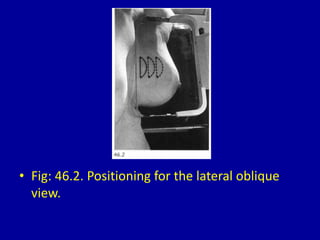
• Fig: 46.2. Positioning for the lateral oblique
view.
• Fig: 46.3. Positioning for the Craniocaudal
view.
• Fig: 46.4. Positioning for a localized
compression view
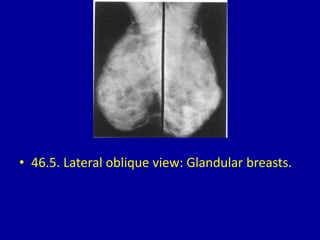
• 46.5. Lateral oblique view: Glandular breasts.
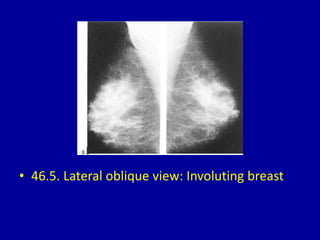
• 46.5. Lateral oblique view: Involuting breast
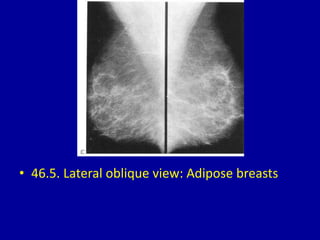
• 46.5. Lateral oblique view: Adipose breasts
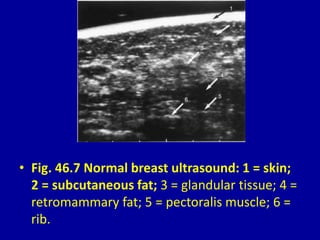
• Fig. 46.7 Normal breast ultrasound: 1 = skin;
2 = subcutaneous fat; 3 = glandular tissue; 4 =
retromammary fat; 5 = pectoralis muscle; 6 =
rib.
• Fig. 46.8 (A). A typical fibroadenoma with
homogeneous internal echoes with an ovoid shape
and circumscribed margins. There is posterior
acoustic enhancement.
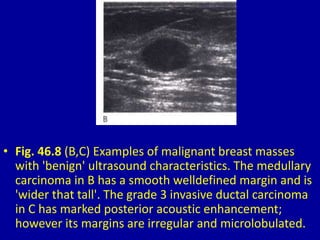
• Fig. 46.8 (B,C) Examples of malignant breast masses
with 'benign' ultrasound characteristics. The medullary
carcinoma in B has a smooth welldefined margin and is
'wider that tall'. The grade 3 invasive ductal carcinoma
in C has marked posterior acoustic enhancement;
however its margins are irregular and microlobulated.
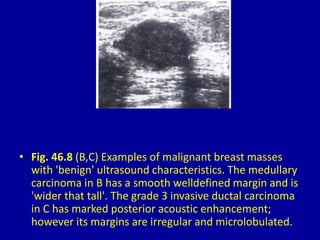
• Fig. 46.8 (B,C) Examples of malignant breast masses
with 'benign' ultrasound characteristics. The medullary
carcinoma in B has a smooth welldefined margin and is
'wider that tall'. The grade 3 invasive ductal carcinoma
in C has marked posterior acoustic enhancement;
however its margins are irregular and microlobulated.
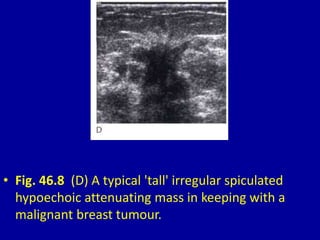
• Fig. 46.8 (D) A typical 'tall' irregular spiculated
hypoechoic attenuating mass in keeping with a
malignant breast tumour.
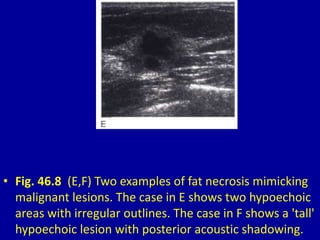
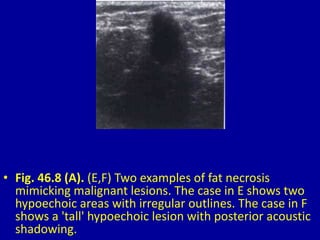
• Fig. 46.8 (E,F) Two examples of fat necrosis mimicking
malignant lesions. The case in E shows two hypoechoic
areas with irregular outlines. The case in F shows a 'tall'
hypoechoic lesion with posterior acoustic shadowing.
• Fig. 46.8 (A). (E,F) Two examples of fat necrosis
mimicking malignant lesions. The case in E shows two
hypoechoic areas with irregular outlines. The case in F
shows a 'tall' hypoechoic lesion with posterior acoustic
shadowing.
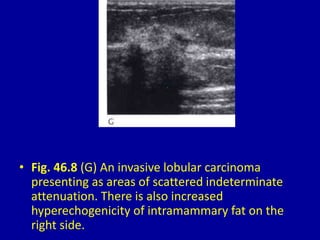
• Fig. 46.8 (G) An invasive lobular carcinoma
presenting as areas of scattered indeterminate
attenuation. There is also increased
hyperechogenicity of intramammary fat on the
right side.
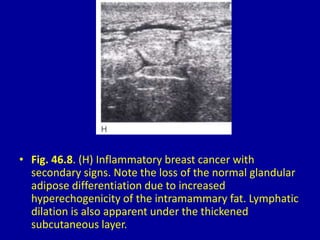
• Fig. 46.8. (H) Inflammatory breast cancer with
secondary signs. Note the loss of the normal glandular
adipose differentiation due to increased
hyperechogenicity of the intramammary fat. Lymphatic
dilation is also apparent under the thickened
subcutaneous layer.
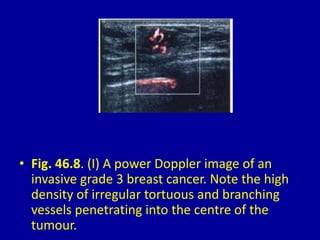
• Fig. 46.8. (I) A power Doppler image of an
invasive grade 3 breast cancer. Note the high
density of irregular tortuous and branching
vessels penetrating into the centre of the
tumour.
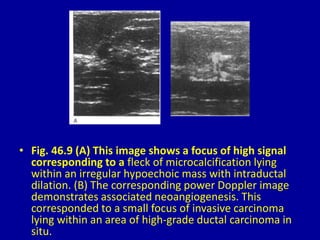
• Fig. 46.9 (A) This image shows a focus of high signal
corresponding to a fleck of microcalcification lying
within an irregular hypoechoic mass with intraductal
dilation. (B) The corresponding power Doppler image
demonstrates associated neoangiogenesis. This
corresponded to a small focus of invasive carcinoma
lying within an area of high-grade ductal carcinoma in
situ.
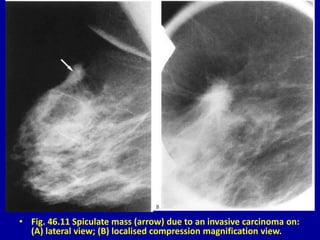
• Fig. 46.11 Spiculate mass (arrow) due to an invasive carcinoma on:
(A) lateral view; (B) localised compression magnification view.
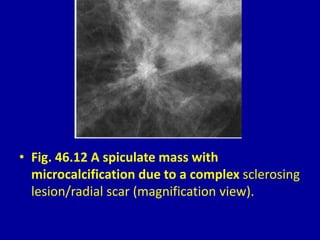
• Fig. 46.12 A spiculate mass with
microcalcification due to a complex sclerosing
lesion/radial scar (magnification view).
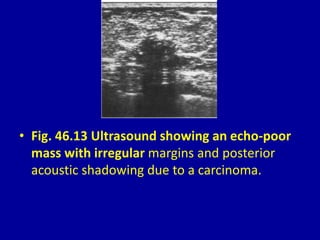
• Fig. 46.13 Ultrasound showing an echo-poor
mass with irregular margins and posterior
acoustic shadowing due to a carcinoma.
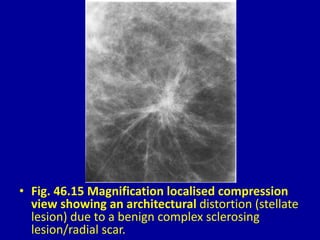
• Fig. 46.15 Magnification localised compression
view showing an architectural distortion (stellate
lesion) due to a benign complex sclerosing
lesion/radial scar.
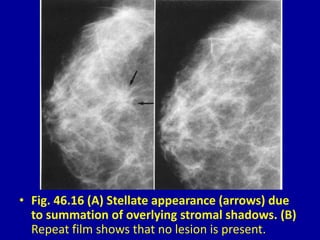
• Fig. 46.16 (A) Stellate appearance (arrows) due
to summation of overlying stromal shadows. (B)
Repeat film shows that no lesion is present.
• Fig. 46.17 Stellate opacity due to a surgical
• scar.
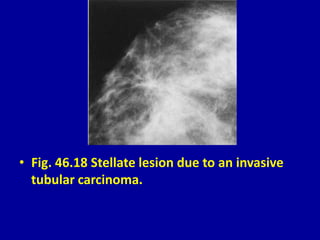
• Fig. 46.18 Stellate lesion due to an invasive
tubular carcinoma.
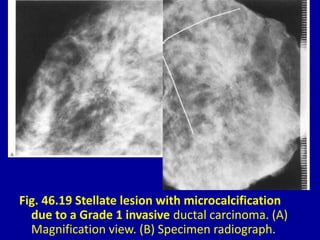
Fig. 46.19 Stellate lesion with microcalcification
due to a Grade 1 invasive ductal carcinoma. (A)
Magnification view. (B) Specimen radiograph.
• Fig. 46.21 A small soft-tissue density with
irregular margins due to a carcinoma is
present just anterior to the left pectoralis
muscle (arrow).
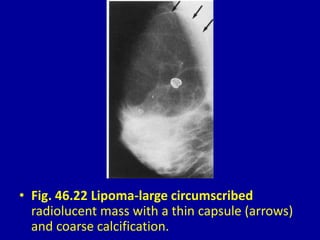
• Fig. 46.22 Lipoma-large circumscribed
radiolucent mass with a thin capsule (arrows)
and coarse calcification.
• Fig. 46.23 Oil cyst. A round radiolucent lesion
is present at the site of a previous surgical
excision; clinically a firm lump was present.
• Fig. 46.24 Adenolipoma. A large circumscribed
mixed density mass is present (arrows). Clinically
only a soft swelling was present.
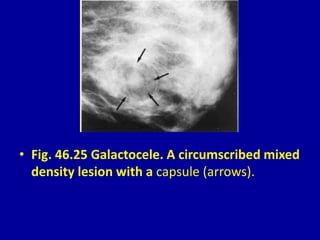
• Fig. 46.25 Galactocele. A circumscribed mixed
density lesion with a capsule (arrows).
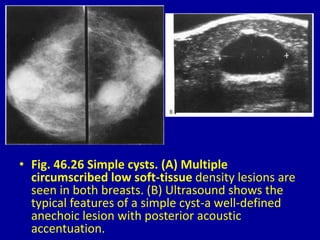
• Fig. 46.26 Simple cysts. (A) Multiple
circumscribed low soft-tissue density lesions are
seen in both breasts. (B) Ultrasound shows the
typical features of a simple cyst-a well-defined
anechoic lesion with posterior acoustic
accentuation.
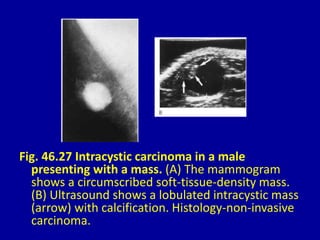
Fig. 46.27 Intracystic carcinoma in a male
presenting with a mass. (A) The mammogram
shows a circumscribed soft-tissue-density mass.
(B) Ultrasound shows a lobulated intracystic mass
(arrow) with calcification. Histology-non-invasive
carcinoma.
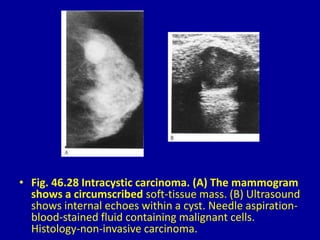
• Fig. 46.28 Intracystic carcinoma. (A) The mammogram
shows a circumscribed soft-tissue mass. (B) Ultrasound
shows internal echoes within a cyst. Needle aspiration-
blood-stained fluid containing malignant cells.
Histology-non-invasive carcinoma.
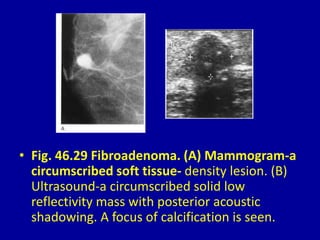
• Fig. 46.29 Fibroadenoma. (A) Mammogram-a
circumscribed soft tissue- density lesion. (B)
Ultrasound-a circumscribed solid low
reflectivity mass with posterior acoustic
shadowing. A focus of calcification is seen.
• Fig. 46.30 Fibroadenomas. (A) First screening
mammogram. (B) Second round screening
mammogram. Two circumscribed lobulated
masses are present. The superior lesion shows
progressive coarse calcification.
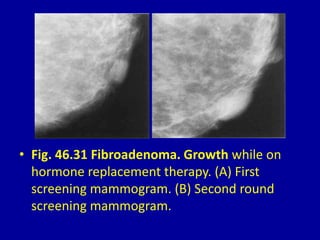
• Fig. 46.31 Fibroadenoma. Growth while on
hormone replacement therapy. (A) First
screening mammogram. (B) Second round
screening mammogram.
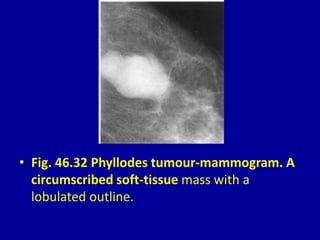
• Fig. 46.32 Phyllodes tumour-mammogram. A
circumscribed soft-tissue mass with a
lobulated outline.
• Fig. 46.33 Mutinous
carcinoma and invasive
ductal carcinoma. (A)
Mammogram shows a
poorly defined spiculate
mass: (1) due to invasive
ductal carcinoma and a
circumscribed soft-tissue
mass; (2) due to a
mucinous carcinoma. (B)
Ultrasound shows a
typical low reflectivity
mass: (1) due to invasive
ductal carcinoma, and a
circumscribed mass with
posterior acoustic
accentuation due to the
mutinous carcinoma (2).
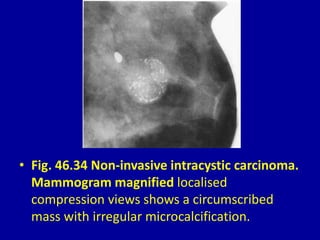
• Fig. 46.34 Non-invasive intracystic carcinoma.
Mammogram magnified localised
compression views shows a circumscribed
mass with irregular microcalcification.
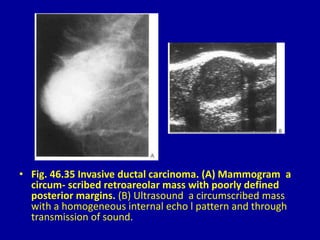
• Fig. 46.35 Invasive ductal carcinoma. (A) Mammogram a
circum- scribed retroareolar mass with poorly defined
posterior margins. (B) Ultrasound a circumscribed mass
with a homogeneous internal echo l pattern and through
transmission of sound.
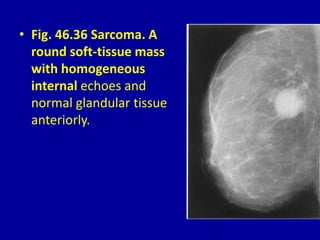
• Fig. 46.36 Sarcoma. A
round soft-tissue mass
with homogeneous
internal echoes and
normal glandular tissue
anteriorly.
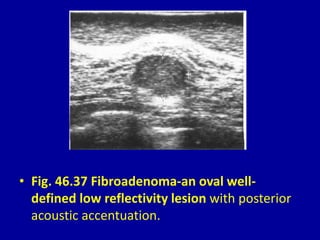
• Fig. 46.37 Fibroadenoma-an oval well-
defined low reflectivity lesion with posterior
acoustic accentuation.
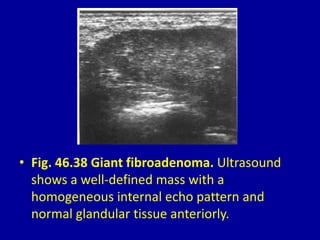
• Fig. 46.38 Giant fibroadenoma. Ultrasound
shows a well-defined mass with a
homogeneous internal echo pattern and
normal glandular tissue anteriorly.
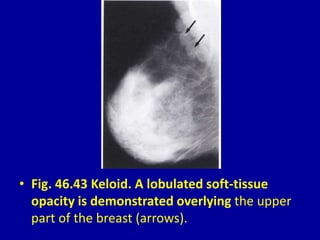
• Fig. 46.43 Keloid. A lobulated soft-tissue
opacity is demonstrated overlying the upper
part of the breast (arrows).
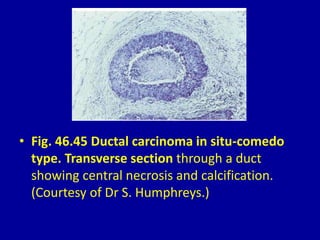
• Fig. 46.45 Ductal carcinoma in situ-comedo
type. Transverse section through a duct
showing central necrosis and calcification.
(Courtesy of Dr S. Humphreys.)
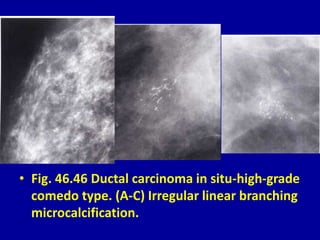
• Fig. 46.46 Ductal carcinoma in situ-high-grade
comedo type. (A-C) Irregular linear branching
microcalcification.
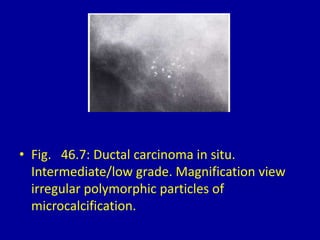
• Fig. 46.7: Ductal carcinoma in situ.
Intermediate/low grade. Magnification view
irregular polymorphic particles of
microcalcification.
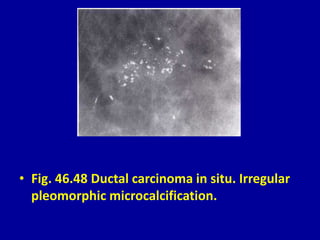
• Fig. 46.48 Ductal carcinoma in situ. Irregular
pleomorphic microcalcification.
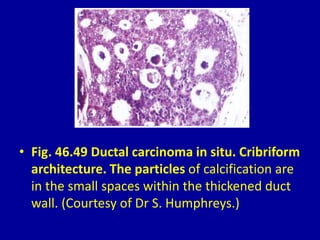
• Fig. 46.49 Ductal carcinoma in situ. Cribriform
architecture. The particles of calcification are
in the small spaces within the thickened duct
wall. (Courtesy of Dr S. Humphreys.)
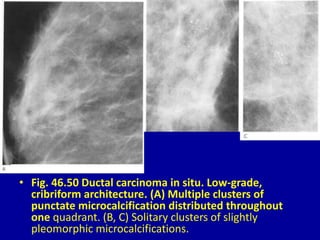
• Fig. 46.50 Ductal carcinoma in situ. Low-grade,
cribriform architecture. (A) Multiple clusters of
punctate microcalcification distributed throughout
one quadrant. (B, C) Solitary clusters of slightly
pleomorphic microcalcifications.
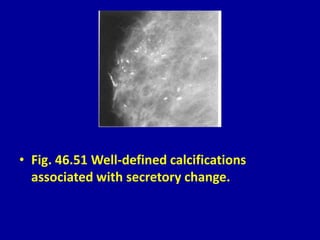
• Fig. 46.51 Well-defined calcifications
associated with secretory change.
• Fig. 46.52 Lobular calcifications. (A) Adenosis.
(B) Sclerosing adenosis. (C) Microcystic
change.
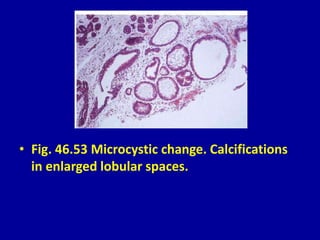
• Fig. 46.53 Microcystic change. Calcifications
in enlarged lobular spaces.
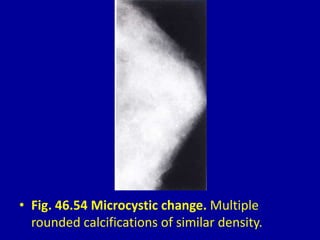
• Fig. 46.54 Microcystic change. Multiple
rounded calcifications of similar density.
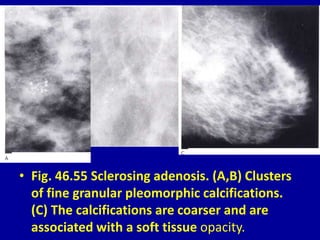
• Fig. 46.55 Sclerosing adenosis. (A,B) Clusters
of fine granular pleomorphic calcifications.
(C) The calcifications are coarser and are
associated with a soft tissue opacity.
• Fig. 46.56 Milk of calcium in benign cystic
change. On the craniocaudal view the
calcifications appear as round 'smudge' shadows
(A). On the lateral view the calcifications show a
straight upper border, the 'tea cup‘ sign (B).
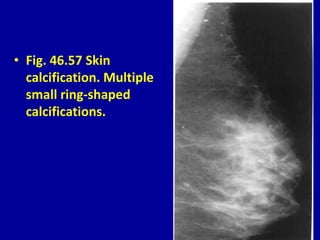
• Fig. 46.57 Skin
calcification. Multiple
small ring-shaped
calcifications.
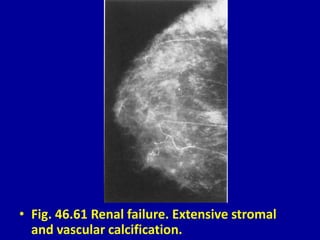
• Fig. 46.61 Renal failure. Extensive stromal
and vascular calcification.
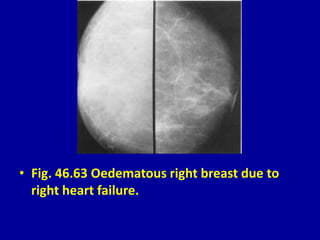
• Fig. 46.63 Oedematous right breast due to
right heart failure.
• Fig. 46.64 Ultrasound of a 48-year-old woman
with a palpable left breast mass. The
mammogram did not demonstrate a mass.
Ultrasound shows a solid mass. FNAC - malignant
cells. Final diagnosis - invasive breast carcinoma.
• Fig. 46.65 Localised compression magnification
view of a 56-year-old woman with a palpable left
subareolar mass. The standard views showed no
subareolar abnormality. The localised
compression view, however, shows a spiculate
mass (arrows) due to an invasive carcinoma.
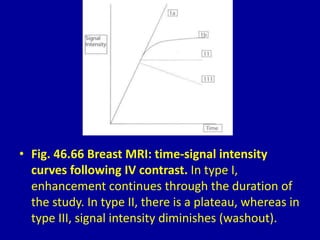
• Fig. 46.66 Breast MRI: time-signal intensity
curves following IV contrast. In type I,
enhancement continues through the duration of
the study. In type II, there is a plateau, whereas in
type III, signal intensity diminishes (washout).
• Fig. 46.67 Sagittal T 1 -weighted gradient-echo images with
fat saturation pre (A) and post (B) intravenous gadolinium-
DTPA. Two malignant masses are demonstrated. Note typical
heterogeneous and rim enhancement of the larger mass and
clear demonstration of involvement of the prepectoral fascia,
pectoralis major muscle and skin by the inferior mass.
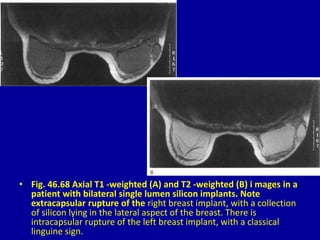
• Fig. 46.68 Axial T1 -weighted (A) and T2 -weighted (B) i mages in a
patient with bilateral single lumen silicon implants. Note
extracapsular rupture of the right breast implant, with a collection
of silicon lying in the lateral aspect of the breast. There is
intracapsular rupture of the left breast implant, with a classical
linguine sign.
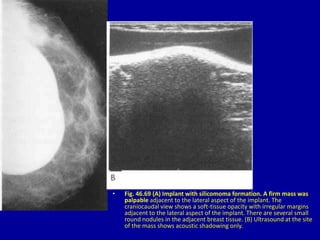
• Fig. 46.69 (A) Implant with silicomoma formation. A firm mass was
palpable adjacent to the lateral aspect of the implant. The
craniocaudal view shows a soft-tissue opacity with irregular margins
adjacent to the lateral aspect of the implant. There are several small
round nodules in the adjacent breast tissue. (B) Ultrasound at the site
of the mass shows acoustic shadowing only.
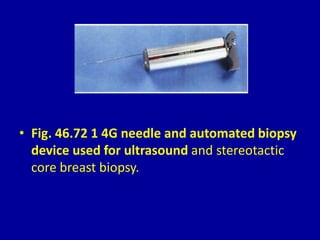
• Fig. 46.72 1 4G needle and automated biopsy
device used for ultrasound and stereotactic
core breast biopsy.
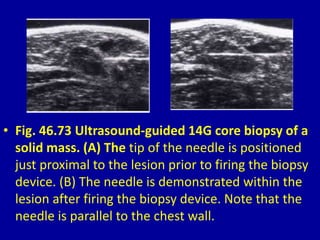
• Fig. 46.73 Ultrasound-guided 14G core biopsy of a
solid mass. (A) The tip of the needle is positioned
just proximal to the lesion prior to firing the biopsy
device. (B) The needle is demonstrated within the
lesion after firing the biopsy device. Note that the
needle is parallel to the chest wall.
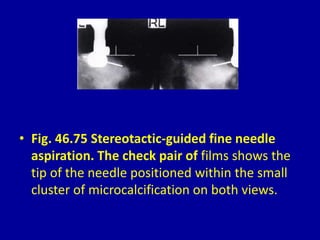
• Fig. 46.75 Stereotactic-guided fine needle
aspiration. The check pair of films shows the
tip of the needle positioned within the small
cluster of microcalcification on both views.
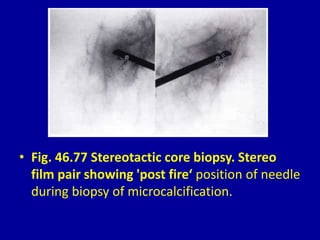
• Fig. 46.77 Stereotactic core biopsy. Stereo
film pair showing 'post fire‘ position of needle
during biopsy of microcalcification.
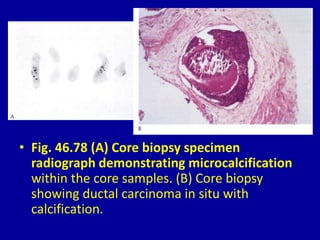
• Fig. 46.78 (A) Core biopsy specimen
radiograph demonstrating microcalcification
within the core samples. (B) Core biopsy
showing ductal carcinoma in situ with
calcification.
• Fig. 46.79 Vacuum-assisted core biopsy. (A)
Probe showing biopsy port with holes leading to
vacuum-producing apparatus. (B) Biopsy probe
and driver unit.
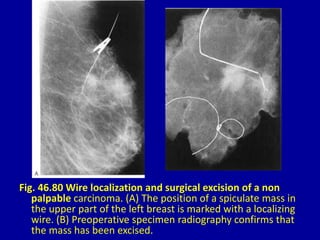
Fig. 46.80 Wire localization and surgical excision of a non
palpable carcinoma. (A) The position of a spiculate mass in
the upper part of the left breast is marked with a localizing
wire. (B) Preoperative specimen radiography confirms that
the mass has been excised.
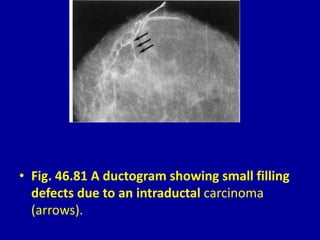
• Fig. 46.81 A ductogram showing small filling
defects due to an intraductal carcinoma
(arrows).
46 DAVID SUTTON PICTURES THE BREAST

46 DAVID SUTTON PICTURES THE BREAST

  • 1.
  • 2.
    DAVID SUTTON PICTURES DR.Muhammad Bin Zulfiqar PGR-FCPS III SIMS/SHL
  • 3.
    • Fig. 46.1Correct positioning for mediolateral oblique view. a = Nipple in profile. b = Pectoralis muscle visible down to level of the nipple. c = Inframammary fold visible. d = Glandular tissue evenly compressed and adequately penetrated.
  • 4.
    • Fig: 46.2.Positioning for the lateral oblique view.
  • 5.
    • Fig: 46.3.Positioning for the Craniocaudal view.
  • 6.
    • Fig: 46.4.Positioning for a localized compression view
  • 7.
    • 46.5. Lateraloblique view: Glandular breasts.
  • 8.
    • 46.5. Lateraloblique view: Involuting breast
  • 9.
    • 46.5. Lateraloblique view: Adipose breasts
  • 11.
    • Fig. 46.7Normal breast ultrasound: 1 = skin; 2 = subcutaneous fat; 3 = glandular tissue; 4 = retromammary fat; 5 = pectoralis muscle; 6 = rib.
  • 12.
    • Fig. 46.8(A). A typical fibroadenoma with homogeneous internal echoes with an ovoid shape and circumscribed margins. There is posterior acoustic enhancement.
  • 13.
    • Fig. 46.8(B,C) Examples of malignant breast masses with 'benign' ultrasound characteristics. The medullary carcinoma in B has a smooth welldefined margin and is 'wider that tall'. The grade 3 invasive ductal carcinoma in C has marked posterior acoustic enhancement; however its margins are irregular and microlobulated.
  • 14.
    • Fig. 46.8(B,C) Examples of malignant breast masses with 'benign' ultrasound characteristics. The medullary carcinoma in B has a smooth welldefined margin and is 'wider that tall'. The grade 3 invasive ductal carcinoma in C has marked posterior acoustic enhancement; however its margins are irregular and microlobulated.
  • 15.
    • Fig. 46.8(D) A typical 'tall' irregular spiculated hypoechoic attenuating mass in keeping with a malignant breast tumour.
  • 16.
    • Fig. 46.8(E,F) Two examples of fat necrosis mimicking malignant lesions. The case in E shows two hypoechoic areas with irregular outlines. The case in F shows a 'tall' hypoechoic lesion with posterior acoustic shadowing.
  • 17.
    • Fig. 46.8(A). (E,F) Two examples of fat necrosis mimicking malignant lesions. The case in E shows two hypoechoic areas with irregular outlines. The case in F shows a 'tall' hypoechoic lesion with posterior acoustic shadowing.
  • 18.
    • Fig. 46.8(G) An invasive lobular carcinoma presenting as areas of scattered indeterminate attenuation. There is also increased hyperechogenicity of intramammary fat on the right side.
  • 19.
    • Fig. 46.8.(H) Inflammatory breast cancer with secondary signs. Note the loss of the normal glandular adipose differentiation due to increased hyperechogenicity of the intramammary fat. Lymphatic dilation is also apparent under the thickened subcutaneous layer.
  • 20.
    • Fig. 46.8.(I) A power Doppler image of an invasive grade 3 breast cancer. Note the high density of irregular tortuous and branching vessels penetrating into the centre of the tumour.
  • 21.
    • Fig. 46.9(A) This image shows a focus of high signal corresponding to a fleck of microcalcification lying within an irregular hypoechoic mass with intraductal dilation. (B) The corresponding power Doppler image demonstrates associated neoangiogenesis. This corresponded to a small focus of invasive carcinoma lying within an area of high-grade ductal carcinoma in situ.
  • 23.
    • Fig. 46.11Spiculate mass (arrow) due to an invasive carcinoma on: (A) lateral view; (B) localised compression magnification view.
  • 24.
    • Fig. 46.12A spiculate mass with microcalcification due to a complex sclerosing lesion/radial scar (magnification view).
  • 25.
    • Fig. 46.13Ultrasound showing an echo-poor mass with irregular margins and posterior acoustic shadowing due to a carcinoma.
  • 27.
    • Fig. 46.15Magnification localised compression view showing an architectural distortion (stellate lesion) due to a benign complex sclerosing lesion/radial scar.
  • 28.
    • Fig. 46.16(A) Stellate appearance (arrows) due to summation of overlying stromal shadows. (B) Repeat film shows that no lesion is present.
  • 29.
    • Fig. 46.17Stellate opacity due to a surgical • scar.
  • 30.
    • Fig. 46.18Stellate lesion due to an invasive tubular carcinoma.
  • 31.
    Fig. 46.19 Stellatelesion with microcalcification due to a Grade 1 invasive ductal carcinoma. (A) Magnification view. (B) Specimen radiograph.
  • 33.
    • Fig. 46.21A small soft-tissue density with irregular margins due to a carcinoma is present just anterior to the left pectoralis muscle (arrow).
  • 34.
    • Fig. 46.22Lipoma-large circumscribed radiolucent mass with a thin capsule (arrows) and coarse calcification.
  • 35.
    • Fig. 46.23Oil cyst. A round radiolucent lesion is present at the site of a previous surgical excision; clinically a firm lump was present.
  • 36.
    • Fig. 46.24Adenolipoma. A large circumscribed mixed density mass is present (arrows). Clinically only a soft swelling was present.
  • 37.
    • Fig. 46.25Galactocele. A circumscribed mixed density lesion with a capsule (arrows).
  • 38.
    • Fig. 46.26Simple cysts. (A) Multiple circumscribed low soft-tissue density lesions are seen in both breasts. (B) Ultrasound shows the typical features of a simple cyst-a well-defined anechoic lesion with posterior acoustic accentuation.
  • 39.
    Fig. 46.27 Intracysticcarcinoma in a male presenting with a mass. (A) The mammogram shows a circumscribed soft-tissue-density mass. (B) Ultrasound shows a lobulated intracystic mass (arrow) with calcification. Histology-non-invasive carcinoma.
  • 40.
    • Fig. 46.28Intracystic carcinoma. (A) The mammogram shows a circumscribed soft-tissue mass. (B) Ultrasound shows internal echoes within a cyst. Needle aspiration- blood-stained fluid containing malignant cells. Histology-non-invasive carcinoma.
  • 41.
    • Fig. 46.29Fibroadenoma. (A) Mammogram-a circumscribed soft tissue- density lesion. (B) Ultrasound-a circumscribed solid low reflectivity mass with posterior acoustic shadowing. A focus of calcification is seen.
  • 42.
    • Fig. 46.30Fibroadenomas. (A) First screening mammogram. (B) Second round screening mammogram. Two circumscribed lobulated masses are present. The superior lesion shows progressive coarse calcification.
  • 43.
    • Fig. 46.31Fibroadenoma. Growth while on hormone replacement therapy. (A) First screening mammogram. (B) Second round screening mammogram.
  • 44.
    • Fig. 46.32Phyllodes tumour-mammogram. A circumscribed soft-tissue mass with a lobulated outline.
  • 45.
    • Fig. 46.33Mutinous carcinoma and invasive ductal carcinoma. (A) Mammogram shows a poorly defined spiculate mass: (1) due to invasive ductal carcinoma and a circumscribed soft-tissue mass; (2) due to a mucinous carcinoma. (B) Ultrasound shows a typical low reflectivity mass: (1) due to invasive ductal carcinoma, and a circumscribed mass with posterior acoustic accentuation due to the mutinous carcinoma (2).
  • 46.
    • Fig. 46.34Non-invasive intracystic carcinoma. Mammogram magnified localised compression views shows a circumscribed mass with irregular microcalcification.
  • 47.
    • Fig. 46.35Invasive ductal carcinoma. (A) Mammogram a circum- scribed retroareolar mass with poorly defined posterior margins. (B) Ultrasound a circumscribed mass with a homogeneous internal echo l pattern and through transmission of sound.
  • 48.
    • Fig. 46.36Sarcoma. A round soft-tissue mass with homogeneous internal echoes and normal glandular tissue anteriorly.
  • 49.
    • Fig. 46.37Fibroadenoma-an oval well- defined low reflectivity lesion with posterior acoustic accentuation.
  • 50.
    • Fig. 46.38Giant fibroadenoma. Ultrasound shows a well-defined mass with a homogeneous internal echo pattern and normal glandular tissue anteriorly.
  • 55.
    • Fig. 46.43Keloid. A lobulated soft-tissue opacity is demonstrated overlying the upper part of the breast (arrows).
  • 57.
    • Fig. 46.45Ductal carcinoma in situ-comedo type. Transverse section through a duct showing central necrosis and calcification. (Courtesy of Dr S. Humphreys.)
  • 58.
    • Fig. 46.46Ductal carcinoma in situ-high-grade comedo type. (A-C) Irregular linear branching microcalcification.
  • 59.
    • Fig. 46.7:Ductal carcinoma in situ. Intermediate/low grade. Magnification view irregular polymorphic particles of microcalcification.
  • 60.
    • Fig. 46.48Ductal carcinoma in situ. Irregular pleomorphic microcalcification.
  • 61.
    • Fig. 46.49Ductal carcinoma in situ. Cribriform architecture. The particles of calcification are in the small spaces within the thickened duct wall. (Courtesy of Dr S. Humphreys.)
  • 62.
    • Fig. 46.50Ductal carcinoma in situ. Low-grade, cribriform architecture. (A) Multiple clusters of punctate microcalcification distributed throughout one quadrant. (B, C) Solitary clusters of slightly pleomorphic microcalcifications.
  • 63.
    • Fig. 46.51Well-defined calcifications associated with secretory change.
  • 64.
    • Fig. 46.52Lobular calcifications. (A) Adenosis. (B) Sclerosing adenosis. (C) Microcystic change.
  • 65.
    • Fig. 46.53Microcystic change. Calcifications in enlarged lobular spaces.
  • 66.
    • Fig. 46.54Microcystic change. Multiple rounded calcifications of similar density.
  • 67.
    • Fig. 46.55Sclerosing adenosis. (A,B) Clusters of fine granular pleomorphic calcifications. (C) The calcifications are coarser and are associated with a soft tissue opacity.
  • 68.
    • Fig. 46.56Milk of calcium in benign cystic change. On the craniocaudal view the calcifications appear as round 'smudge' shadows (A). On the lateral view the calcifications show a straight upper border, the 'tea cup‘ sign (B).
  • 69.
    • Fig. 46.57Skin calcification. Multiple small ring-shaped calcifications.
  • 73.
    • Fig. 46.61Renal failure. Extensive stromal and vascular calcification.
  • 75.
    • Fig. 46.63Oedematous right breast due to right heart failure.
  • 76.
    • Fig. 46.64Ultrasound of a 48-year-old woman with a palpable left breast mass. The mammogram did not demonstrate a mass. Ultrasound shows a solid mass. FNAC - malignant cells. Final diagnosis - invasive breast carcinoma.
  • 77.
    • Fig. 46.65Localised compression magnification view of a 56-year-old woman with a palpable left subareolar mass. The standard views showed no subareolar abnormality. The localised compression view, however, shows a spiculate mass (arrows) due to an invasive carcinoma.
  • 78.
    • Fig. 46.66Breast MRI: time-signal intensity curves following IV contrast. In type I, enhancement continues through the duration of the study. In type II, there is a plateau, whereas in type III, signal intensity diminishes (washout).
  • 79.
    • Fig. 46.67Sagittal T 1 -weighted gradient-echo images with fat saturation pre (A) and post (B) intravenous gadolinium- DTPA. Two malignant masses are demonstrated. Note typical heterogeneous and rim enhancement of the larger mass and clear demonstration of involvement of the prepectoral fascia, pectoralis major muscle and skin by the inferior mass.
  • 80.
    • Fig. 46.68Axial T1 -weighted (A) and T2 -weighted (B) i mages in a patient with bilateral single lumen silicon implants. Note extracapsular rupture of the right breast implant, with a collection of silicon lying in the lateral aspect of the breast. There is intracapsular rupture of the left breast implant, with a classical linguine sign.
  • 81.
    • Fig. 46.69(A) Implant with silicomoma formation. A firm mass was palpable adjacent to the lateral aspect of the implant. The craniocaudal view shows a soft-tissue opacity with irregular margins adjacent to the lateral aspect of the implant. There are several small round nodules in the adjacent breast tissue. (B) Ultrasound at the site of the mass shows acoustic shadowing only.
  • 84.
    • Fig. 46.721 4G needle and automated biopsy device used for ultrasound and stereotactic core breast biopsy.
  • 85.
    • Fig. 46.73Ultrasound-guided 14G core biopsy of a solid mass. (A) The tip of the needle is positioned just proximal to the lesion prior to firing the biopsy device. (B) The needle is demonstrated within the lesion after firing the biopsy device. Note that the needle is parallel to the chest wall.
  • 87.
    • Fig. 46.75Stereotactic-guided fine needle aspiration. The check pair of films shows the tip of the needle positioned within the small cluster of microcalcification on both views.
  • 89.
    • Fig. 46.77Stereotactic core biopsy. Stereo film pair showing 'post fire‘ position of needle during biopsy of microcalcification.
  • 90.
    • Fig. 46.78(A) Core biopsy specimen radiograph demonstrating microcalcification within the core samples. (B) Core biopsy showing ductal carcinoma in situ with calcification.
  • 91.
    • Fig. 46.79Vacuum-assisted core biopsy. (A) Probe showing biopsy port with holes leading to vacuum-producing apparatus. (B) Biopsy probe and driver unit.
  • 92.
    Fig. 46.80 Wirelocalization and surgical excision of a non palpable carcinoma. (A) The position of a spiculate mass in the upper part of the left breast is marked with a localizing wire. (B) Preoperative specimen radiography confirms that the mass has been excised.
  • 93.
    • Fig. 46.81A ductogram showing small filling defects due to an intraductal carcinoma (arrows).