Presented by: Group ll
Principles,
Tools, and
Techniques in
Creating a
Business
At the end of this module, you are expected to:
1. Identify the different tools or techniques in business.
2. Compare and contrast the tools or techniques in business
through a graphic organizer/concept map/flowchart.
3. Analyze the LGUs response to pandemic by using one of the
tool or techniques in business.
What I Need To Know
This module is designed to help you understand
the importance of the different business strategies
and how these strategies helps the business or
company survive the competition.
“fighting multinationals was very tough. At first,
everyone thought I was crazy. They told me how will
I survive this? True enough, it’s by the grace of God
that I’m still here in the toothpaste industry after 20
years. God is good.”
- Cecilio K. Pedro of Lamoiyan Corporation
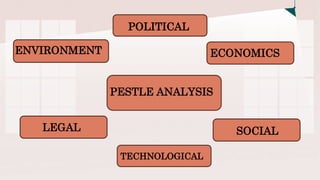
PESTLE ANALYSIS
ECONOMICS
SOCIAL
TECHNOLOGICAL
POLITICAL
LEGAL
ENVIRONMENT
l. What is PESTLE?
• A PESTLE analysis studies the key external factors
(Political, Economic, Social, Technological, Legal
and Environmental) that influence an organization.
It can be used in a range of different scenarios, and
can guide people professionals and senior managers
in strategic decision making.
• The PESTLE is used to gauge the external factors
that could have an impact on the profitability of the
company or organization
PESTLE analysis factors below:
1. Political factors
Political factors involves the ways and
extent to which a government intervenes in
economies or industries. A government can
impact an economy through its political
stability and the status of its relations with
other nation.
Here are the several examples of Political factors:
• Trade barriers
- Trade barriers are regulations that governments put in
place to protect domestic businesses from international
competition. Governments may impose tariffs on imports or
provide subsidies to help boost support and sales for
domestic businesses.
• Tax policies
-Businesses must follows numerous tax regulations, such as
obtaining an Employer identification Number.
Governments may also establish policies that increase or
decrease the tax corporation pay.
• Political stability
- The political stability of a government can affect
businesses in that country. For example, if there are
protests and strikes against government actions,
businesses may see a temporary lull in consumer
support.
- A country’s relationships with other nations
can directly impact a business’ ability to export
and import goods and services.
• International relations
2. Economics
– Economic factors can directly
impact businesses operations and
profits. Economic and political
factors may overlap, such as
monetary policies that governments
establish.
Economics factors typically
include:
• Economic growth
• Interest rates
• Employment rates
• Foreign exchange rates
• Supply and Demand
• Cost of raw materials
• Inflation rates
• Consumer spending power
3. Social factors
– Also known as socio-cultural factors,
social factors involve the demographics,
beliefs, attitudes, and traditions of a
region’s inhabitants. These factors help
businesses understand the profiles and
motivations of their potential customers.
4. Technological factors
– Technological factors represent how
businesses and industries utilize
technology to produce and sell products
and services or run operations. Businesses
that stay updated on technological
advancements can use them to develop
and improve their strategies and processes
Beyond advancement, technological factors
may also include consumer’s access to the
following:
• Technology
• Technological infrastructure
• Emerging technologies
• Automation
• Research
5. Legal factors
– Legal factors are the laws of the country in
which a business resides. These laws may
overlap with other factors particularly political
factors, and can impact how businesses in that
country operate. As a result, businesses must
stay updated on legislation changes to ensure
adherence to local and national laws.
Examples of Legal factors:
1. Health and Safety – require businesses to follow
practices that ensure the health and safety of employees
and customers.
2. Equal opportunities – equal opportunity laws prohibit
discrimination during the hiring process or in the
workplace.
3. International trade – may regulate what businesses can
import from and export to other countries.
4. Advertising standards – how businesses advertise their
products or services, such as requirements that these ads
must contain truth or evidence to support claim.
Examples of Legal factors:
5. Consumer rights – this may include protecting your
costumer’s information and their safety while on business
property.
6. Product labelling – As a business owner, it’s important to
understand that one of the core things your customer
require is transparency. This law requires you to label your
products accurately and correctly.
7. Product safety – This law requires that your products are
safe to use. It’s advisable to run a quality test before
launching a product.
6. Environmental factors
Environmental factors involve the impact that
changes in the natural environment can have
on businesses. This includes factors such as:
• Weather
• Scarcity of raw materials
• Pollution
• Climate Change
• Waste disposal
• Agriculture
• Sustainability practices
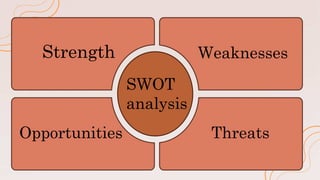
Strength Weaknesses
Opportunities Threats
SWOT
analysis
ll. What is SWOT analysis?
• A SWOT analysis is a framework used to
evaluate a company’s competitive
position and to develop strategic
planning.
• Usually preferrred by small businesses,
easier to determine the prons and cons
of a project or initiative.
Elements:
1. Internal factors – are the strength and
weaknesses of the company. It includes the
resources and capabilities within the
organization.
Strength – are the characteristics that give the
business it’s competitive advantage.
Weaknesses – are characteristic that a company
needs to overcome in order to improve its
performance.
Examples of internal factors include:
• Company culture
• Company image
• Operational efficiency
• Brand awareness
• Market share
• Financial resources
• Key staff
• Organizational structure
2. External Factors – External factors include
opportunities and threats to the company.
These are factors that the company may be able
influence or at least anticipate but not fully
control.
Opportunities – are elements that the company sees
in the external environment that it could pursue in
the future to generate value.
Threats – are elements in the external environment
that could prevent the company from achieving its
goa or its mission or creating value.
Changes in the external environment may
be due to:
• Social changes
• Customers
• Competitors
• Economic environment
• Government regulation
• Suppliers
• Partners
• Market trends
lll. Porters 5 forces competitive position
analysis
Porter’s Five Forces Analysis is an
important tool for understanding the forces
that shape competition within an industry.
It is also useful for helping you to adjust
your strategy to suit your competitive
environment, and to improve your potential
profit.
1. Competitive rivalry – Competitive Rivalry
evaluates the number of existing players and
how established they are in the industry. In
industries with cutthroat competition,
companies often lower prices and invest in
expensive marketing campaigns to increase
market share. That means suppliers and buyers
can quickly move towards your competitors.
Conversely, businesses in less competitive
sectors enjoy more comfortable profit margins.
2. Supplier Power – Suppliers provide the
essential ingredients for a business’s operations.
How much influence does a supplier wield over a
company’s profits? When only a few suppliers can
provide a product, they can dictate terms and
pressure businesses to accept higher prices. Even
if terms are unfavorable, some get pressured to
take them because of the costs of moving to
another supplier.
3. Buyer Power – Buyer Power refers to the
influence customers wield over a business. If an
industry has strong buyer power, consumers can
demand lower prices, higher quality or improved
service, affecting a company’s profitability.
4. Threat of Substitute – refers to the likelihood
that customers might switch to a different
product or service. When substitution threats
are high, businesses are vulnerable to sudden
shifts in consumer preferences.
5. Threat of New Entry – Your position can
be affected by potential rivals’ ability to
enter your market. If it takes little money
and effort to enter your market and compete
effectively, or if you have little protection for
your key technologies, then rivals can
quickly enter your market and weaken your
position.
THANK YOU FOR
PAKIKINIG, HANGGANG
SA MULI NATING
PAGKIKITA, PAALAM!

GROUP-2-APdfgdfgdfgdfgdfgdffgffgPLIED.pptx

  • 1.
    Presented by: Groupll Principles, Tools, and Techniques in Creating a Business
  • 2.
    At the endof this module, you are expected to: 1. Identify the different tools or techniques in business. 2. Compare and contrast the tools or techniques in business through a graphic organizer/concept map/flowchart. 3. Analyze the LGUs response to pandemic by using one of the tool or techniques in business. What I Need To Know This module is designed to help you understand the importance of the different business strategies and how these strategies helps the business or company survive the competition.
  • 3.
    “fighting multinationals wasvery tough. At first, everyone thought I was crazy. They told me how will I survive this? True enough, it’s by the grace of God that I’m still here in the toothpaste industry after 20 years. God is good.” - Cecilio K. Pedro of Lamoiyan Corporation
  • 4.
  • 5.
    l. What isPESTLE? • A PESTLE analysis studies the key external factors (Political, Economic, Social, Technological, Legal and Environmental) that influence an organization. It can be used in a range of different scenarios, and can guide people professionals and senior managers in strategic decision making. • The PESTLE is used to gauge the external factors that could have an impact on the profitability of the company or organization
  • 6.
    PESTLE analysis factorsbelow: 1. Political factors Political factors involves the ways and extent to which a government intervenes in economies or industries. A government can impact an economy through its political stability and the status of its relations with other nation.
  • 7.
    Here are theseveral examples of Political factors: • Trade barriers - Trade barriers are regulations that governments put in place to protect domestic businesses from international competition. Governments may impose tariffs on imports or provide subsidies to help boost support and sales for domestic businesses. • Tax policies -Businesses must follows numerous tax regulations, such as obtaining an Employer identification Number. Governments may also establish policies that increase or decrease the tax corporation pay.
  • 8.
    • Political stability -The political stability of a government can affect businesses in that country. For example, if there are protests and strikes against government actions, businesses may see a temporary lull in consumer support. - A country’s relationships with other nations can directly impact a business’ ability to export and import goods and services. • International relations
  • 9.
    2. Economics – Economicfactors can directly impact businesses operations and profits. Economic and political factors may overlap, such as monetary policies that governments establish.
  • 10.
    Economics factors typically include: •Economic growth • Interest rates • Employment rates • Foreign exchange rates • Supply and Demand • Cost of raw materials • Inflation rates • Consumer spending power
  • 11.
    3. Social factors –Also known as socio-cultural factors, social factors involve the demographics, beliefs, attitudes, and traditions of a region’s inhabitants. These factors help businesses understand the profiles and motivations of their potential customers.
  • 12.
    4. Technological factors –Technological factors represent how businesses and industries utilize technology to produce and sell products and services or run operations. Businesses that stay updated on technological advancements can use them to develop and improve their strategies and processes
  • 13.
    Beyond advancement, technologicalfactors may also include consumer’s access to the following: • Technology • Technological infrastructure • Emerging technologies • Automation • Research
  • 14.
    5. Legal factors –Legal factors are the laws of the country in which a business resides. These laws may overlap with other factors particularly political factors, and can impact how businesses in that country operate. As a result, businesses must stay updated on legislation changes to ensure adherence to local and national laws.
  • 15.
    Examples of Legalfactors: 1. Health and Safety – require businesses to follow practices that ensure the health and safety of employees and customers. 2. Equal opportunities – equal opportunity laws prohibit discrimination during the hiring process or in the workplace. 3. International trade – may regulate what businesses can import from and export to other countries. 4. Advertising standards – how businesses advertise their products or services, such as requirements that these ads must contain truth or evidence to support claim.
  • 16.
    Examples of Legalfactors: 5. Consumer rights – this may include protecting your costumer’s information and their safety while on business property. 6. Product labelling – As a business owner, it’s important to understand that one of the core things your customer require is transparency. This law requires you to label your products accurately and correctly. 7. Product safety – This law requires that your products are safe to use. It’s advisable to run a quality test before launching a product.
  • 17.
    6. Environmental factors Environmentalfactors involve the impact that changes in the natural environment can have on businesses. This includes factors such as: • Weather • Scarcity of raw materials • Pollution • Climate Change • Waste disposal • Agriculture • Sustainability practices
  • 18.
  • 19.
    ll. What isSWOT analysis? • A SWOT analysis is a framework used to evaluate a company’s competitive position and to develop strategic planning. • Usually preferrred by small businesses, easier to determine the prons and cons of a project or initiative.
  • 20.
    Elements: 1. Internal factors– are the strength and weaknesses of the company. It includes the resources and capabilities within the organization. Strength – are the characteristics that give the business it’s competitive advantage. Weaknesses – are characteristic that a company needs to overcome in order to improve its performance.
  • 21.
    Examples of internalfactors include: • Company culture • Company image • Operational efficiency • Brand awareness • Market share • Financial resources • Key staff • Organizational structure
  • 22.
    2. External Factors– External factors include opportunities and threats to the company. These are factors that the company may be able influence or at least anticipate but not fully control. Opportunities – are elements that the company sees in the external environment that it could pursue in the future to generate value. Threats – are elements in the external environment that could prevent the company from achieving its goa or its mission or creating value.
  • 23.
    Changes in theexternal environment may be due to: • Social changes • Customers • Competitors • Economic environment • Government regulation • Suppliers • Partners • Market trends
  • 24.
    lll. Porters 5forces competitive position analysis Porter’s Five Forces Analysis is an important tool for understanding the forces that shape competition within an industry. It is also useful for helping you to adjust your strategy to suit your competitive environment, and to improve your potential profit.
  • 25.
    1. Competitive rivalry– Competitive Rivalry evaluates the number of existing players and how established they are in the industry. In industries with cutthroat competition, companies often lower prices and invest in expensive marketing campaigns to increase market share. That means suppliers and buyers can quickly move towards your competitors. Conversely, businesses in less competitive sectors enjoy more comfortable profit margins.
  • 26.
    2. Supplier Power– Suppliers provide the essential ingredients for a business’s operations. How much influence does a supplier wield over a company’s profits? When only a few suppliers can provide a product, they can dictate terms and pressure businesses to accept higher prices. Even if terms are unfavorable, some get pressured to take them because of the costs of moving to another supplier.
  • 27.
    3. Buyer Power– Buyer Power refers to the influence customers wield over a business. If an industry has strong buyer power, consumers can demand lower prices, higher quality or improved service, affecting a company’s profitability. 4. Threat of Substitute – refers to the likelihood that customers might switch to a different product or service. When substitution threats are high, businesses are vulnerable to sudden shifts in consumer preferences.
  • 28.
    5. Threat ofNew Entry – Your position can be affected by potential rivals’ ability to enter your market. If it takes little money and effort to enter your market and compete effectively, or if you have little protection for your key technologies, then rivals can quickly enter your market and weaken your position.
  • 29.
    THANK YOU FOR PAKIKINIG,HANGGANG SA MULI NATING PAGKIKITA, PAALAM!