DISASTER
READINESS AND
RISK REDUCTION
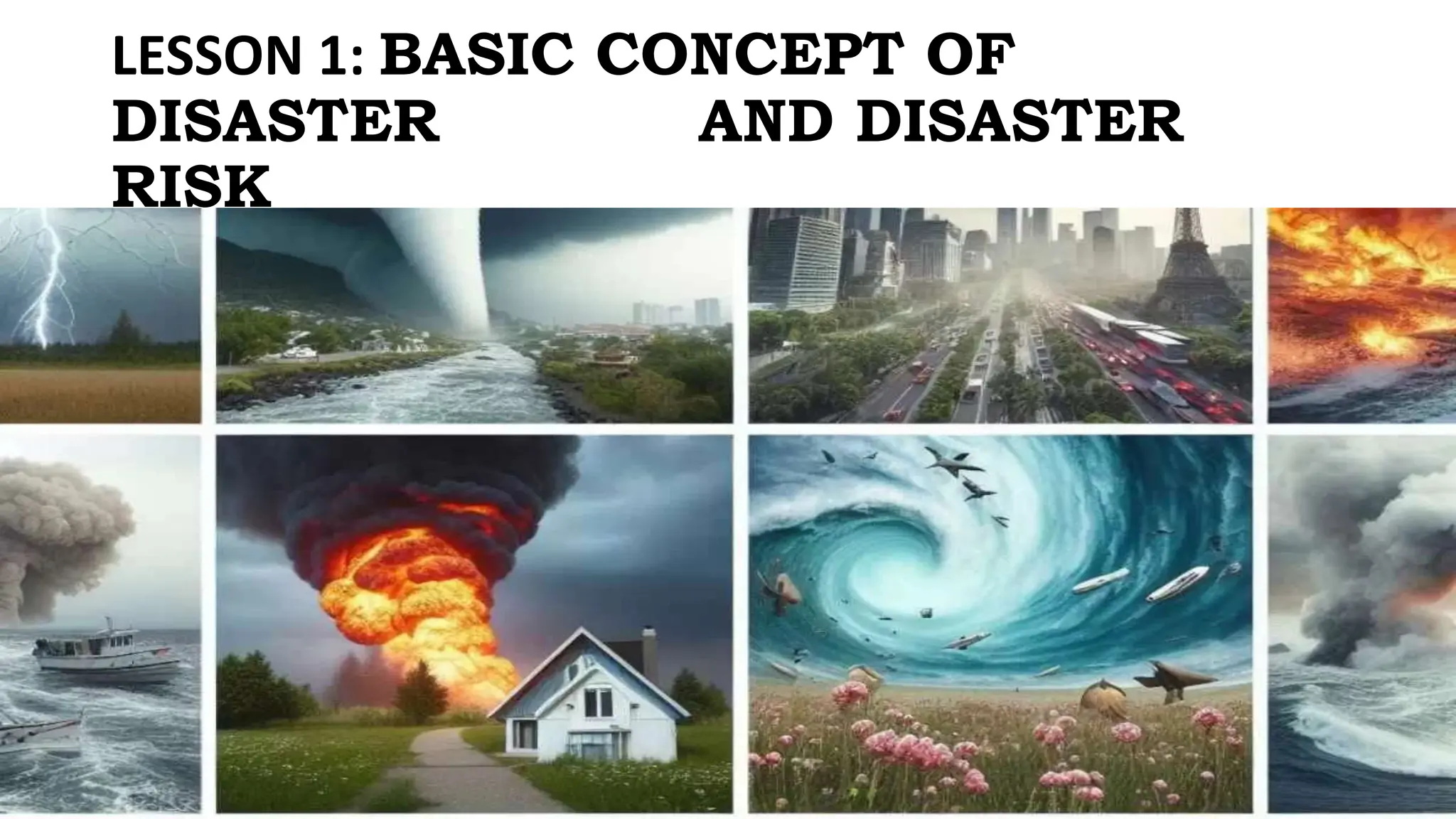
LESSON 1: BASIC CONCEPT OF
DISASTER AND DISASTER
RISK
WILDFIRE
FLOOD
EARTHQUAKE
VOLCANO ERUPTION
TYPHOON
VIRUSES / COVID 19
WHAT IS DISASTER ?
Is any natural or man-made event circumstances that
cannot be handled by community.
Disaster causes widespread economic,
environmental, and even structural and human
damages of losses.
It is a sudden, calamitous occurrence that causes
great harm, injury, destruction, and devastation to life
and properties.
WHEN IS AN EVENT A DISASTER?
At least 20% of the population are affected & in need of
emergency assistance or those dwelling units have been
destroyed.
A great number or at least 40% of the means of livelihood
such as bancas, fishing boats, vehicles and the like are
destroyed.
Major roads and bridges are destroyed and impassable for
at least a week, thus disrupting the flow of transport and
commerce.
WHEN IS AN EVENT A DISASTER?
Widespread destruction of fishponds, crops, poultry
and livestock, and other agricultural products, and
Epidemics
WHEN IS AN EVENT A DISASTER?
Covid-19 Pandemic is considered a worldwide
disaster that greatly affect economic mobility, serious
global public health safety concerns, political crisis,
and education modalities or simply this pandemic
changes the way we live nowadays.
Types of Disaster
1. Natural Disaster
2. Man-made Disaster
Natural Disaster
events that results from natural processes of the
Earth
The destruction is the result of the uncontrolled
forces of nature.
Example of Natural Disaster
volcanic eruptions,
Tectonic and volcanic earthquakes,
epidemics, and pandemics,
other geologic, atmospheric, and biologic process
Man-made Disaster
event caused directly and principally by one or more
identifiable deliberate or negligent human actions.
Man-made disasters are human intention to cause
devastation to a community.
Example of Man-made Disaster
air crash, train accidents, building collapse, warfare
(conventional, chemical, biological or nuclear)
WAR / BOMBING
TRASH SLIDE
What is a hazard?
Is a dangerous phenomenon, substance, human
activity or condition that may cause loss of life, injury
or other health impacts, property damage, loss of
livelihood & services, social & economic disruption or
environmental damage.
What is a hazard?
A hazard is a source or condition that has the
potential to cause harm to humans in the form of
injury or illness, property damage, environmental
damage, or a combination of these.
Example of hazard.
Lightning during storm
Types of hazard?
A. A natural hazard occurs when an extreme natural event
is destructive to human life and property.
This event could interfere with activities in a minor way
such as when strong winds blow trees down, or this event
could completely disrupt activities like a large earthquake
damaging your home, business or school.
These natural events have been happening for thousands
of years (a long time before we were even around!), but
they only become hazards when humans are affected in
some way.
Types of hazard?
B. Human-made induced hazards are caused by
human activities. Unlike natural hazards, human-made
hazards can often be prevented.
What is Disaster Risk?
The term disaster risk refers to the potential (not
actual and realized) disaster losses, in lives, health
status, livelihoods, assets, and services which could
occur in a community or society over some specified
future time period.
What is Disaster Risk?
The term disaster risk refers to the potential (not
actual and realized) disaster losses, in lives, health
status, livelihoods, assets, and services which could
occur in a community or society over some specified
future time period.
When we say potential disaster losses?
A product of possible damage caused by the hazard
The combination of the probability of an event and its
negative consequences.

DISASTER READINFHDFHFHFGHGFHESS AND.pptx

  • 1.
  • 2.
    LESSON 1: BASICCONCEPT OF DISASTER AND DISASTER RISK
  • 4.
  • 5.
  • 6.
  • 7.
  • 8.
  • 9.
  • 10.
    WHAT IS DISASTER? Is any natural or man-made event circumstances that cannot be handled by community. Disaster causes widespread economic, environmental, and even structural and human damages of losses. It is a sudden, calamitous occurrence that causes great harm, injury, destruction, and devastation to life and properties.
  • 11.
    WHEN IS ANEVENT A DISASTER? At least 20% of the population are affected & in need of emergency assistance or those dwelling units have been destroyed. A great number or at least 40% of the means of livelihood such as bancas, fishing boats, vehicles and the like are destroyed. Major roads and bridges are destroyed and impassable for at least a week, thus disrupting the flow of transport and commerce.
  • 12.
    WHEN IS ANEVENT A DISASTER? Widespread destruction of fishponds, crops, poultry and livestock, and other agricultural products, and Epidemics
  • 13.
    WHEN IS ANEVENT A DISASTER? Covid-19 Pandemic is considered a worldwide disaster that greatly affect economic mobility, serious global public health safety concerns, political crisis, and education modalities or simply this pandemic changes the way we live nowadays.
  • 14.
    Types of Disaster 1.Natural Disaster 2. Man-made Disaster
  • 15.
    Natural Disaster events thatresults from natural processes of the Earth The destruction is the result of the uncontrolled forces of nature.
  • 16.
    Example of NaturalDisaster volcanic eruptions, Tectonic and volcanic earthquakes, epidemics, and pandemics, other geologic, atmospheric, and biologic process
  • 18.
    Man-made Disaster event causeddirectly and principally by one or more identifiable deliberate or negligent human actions. Man-made disasters are human intention to cause devastation to a community.
  • 19.
    Example of Man-madeDisaster air crash, train accidents, building collapse, warfare (conventional, chemical, biological or nuclear)
  • 20.
  • 21.
  • 22.
    What is ahazard? Is a dangerous phenomenon, substance, human activity or condition that may cause loss of life, injury or other health impacts, property damage, loss of livelihood & services, social & economic disruption or environmental damage.
  • 23.
    What is ahazard? A hazard is a source or condition that has the potential to cause harm to humans in the form of injury or illness, property damage, environmental damage, or a combination of these. Example of hazard. Lightning during storm
  • 24.
    Types of hazard? A.A natural hazard occurs when an extreme natural event is destructive to human life and property. This event could interfere with activities in a minor way such as when strong winds blow trees down, or this event could completely disrupt activities like a large earthquake damaging your home, business or school. These natural events have been happening for thousands of years (a long time before we were even around!), but they only become hazards when humans are affected in some way.
  • 25.
    Types of hazard? B.Human-made induced hazards are caused by human activities. Unlike natural hazards, human-made hazards can often be prevented.
  • 26.
    What is DisasterRisk? The term disaster risk refers to the potential (not actual and realized) disaster losses, in lives, health status, livelihoods, assets, and services which could occur in a community or society over some specified future time period.
  • 27.
    What is DisasterRisk? The term disaster risk refers to the potential (not actual and realized) disaster losses, in lives, health status, livelihoods, assets, and services which could occur in a community or society over some specified future time period.
  • 28.
    When we saypotential disaster losses? A product of possible damage caused by the hazard The combination of the probability of an event and its negative consequences.