Construction of Bridges
Information prepared by Raymond Wong
Division of Building Science and Technology,
City University of Hong Kong
January 2012
e-mail of Raymond Wong
bswmwong@cityu.edu.hk
Materials suitable for the Construction of
Long-span Bridges
1. Stone – in arch masonry
2. Steel – in girder or box-section constructed in steel
plates and standard sections
3. Steel – truss constructed of standard sections
4. Reinforced Concrete – in arch or spanned forms
5. Tensioned RC – in various forms
6. Precast – mainly in box-section girder
Common Bridge Forms
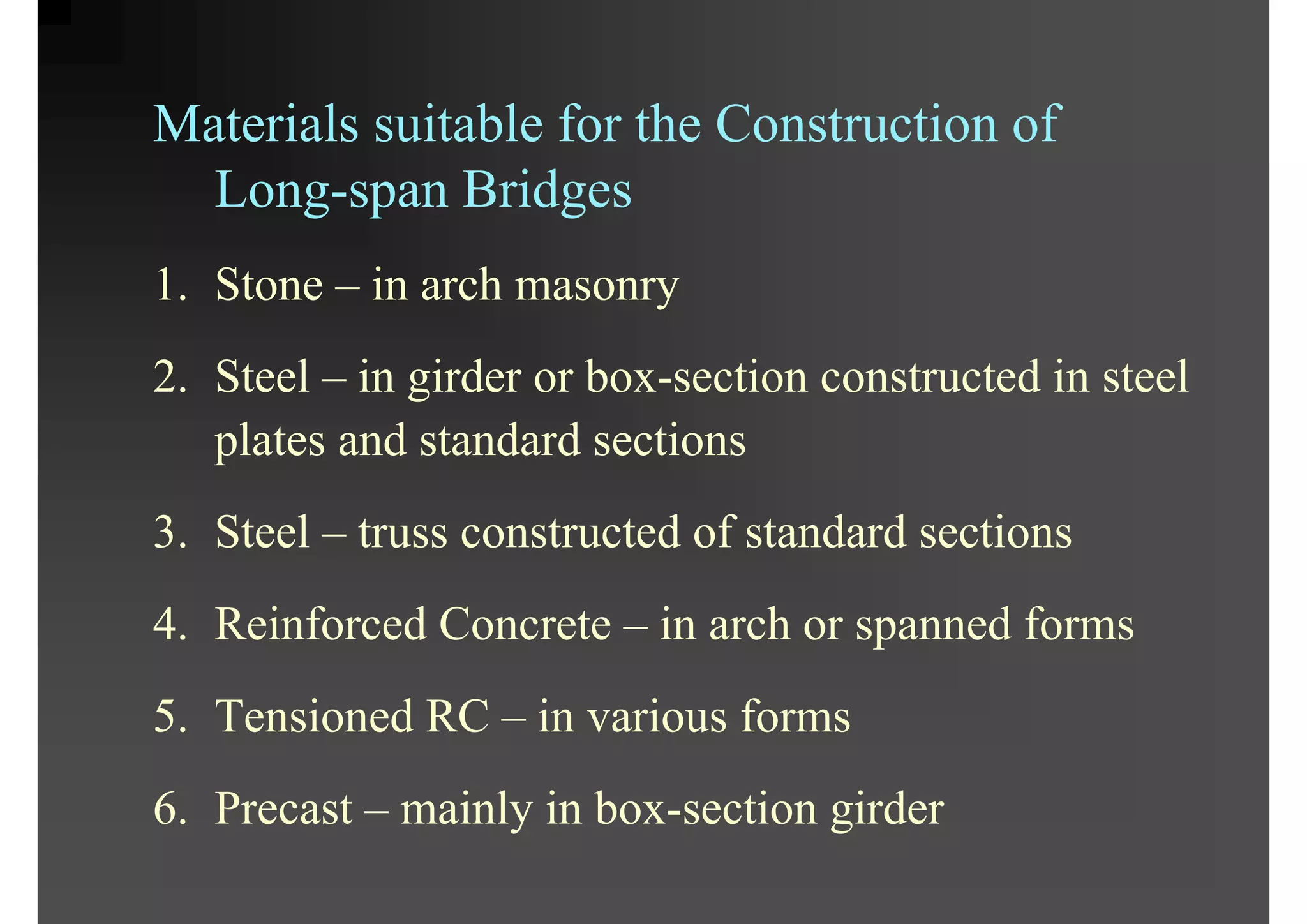
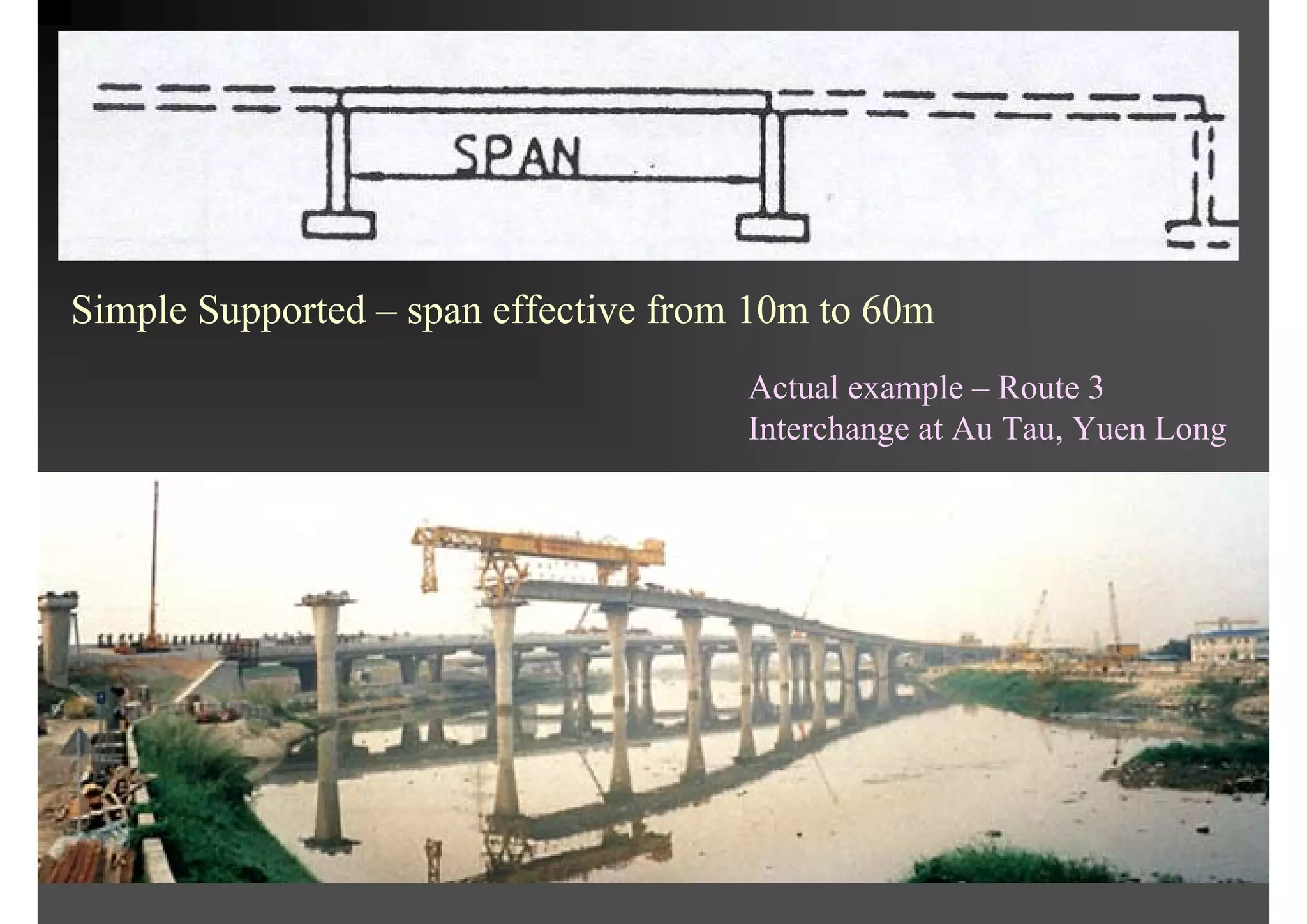
Simple Supported – span effective from 10m to 60m
Actual example – Route 3
Interchange at Au Tau, Yuen Long
Continuous Span – from 10m to 100m
Actual example – construction of a span of continual section
of elevated highway bridge at Route 3, Kwai Chung
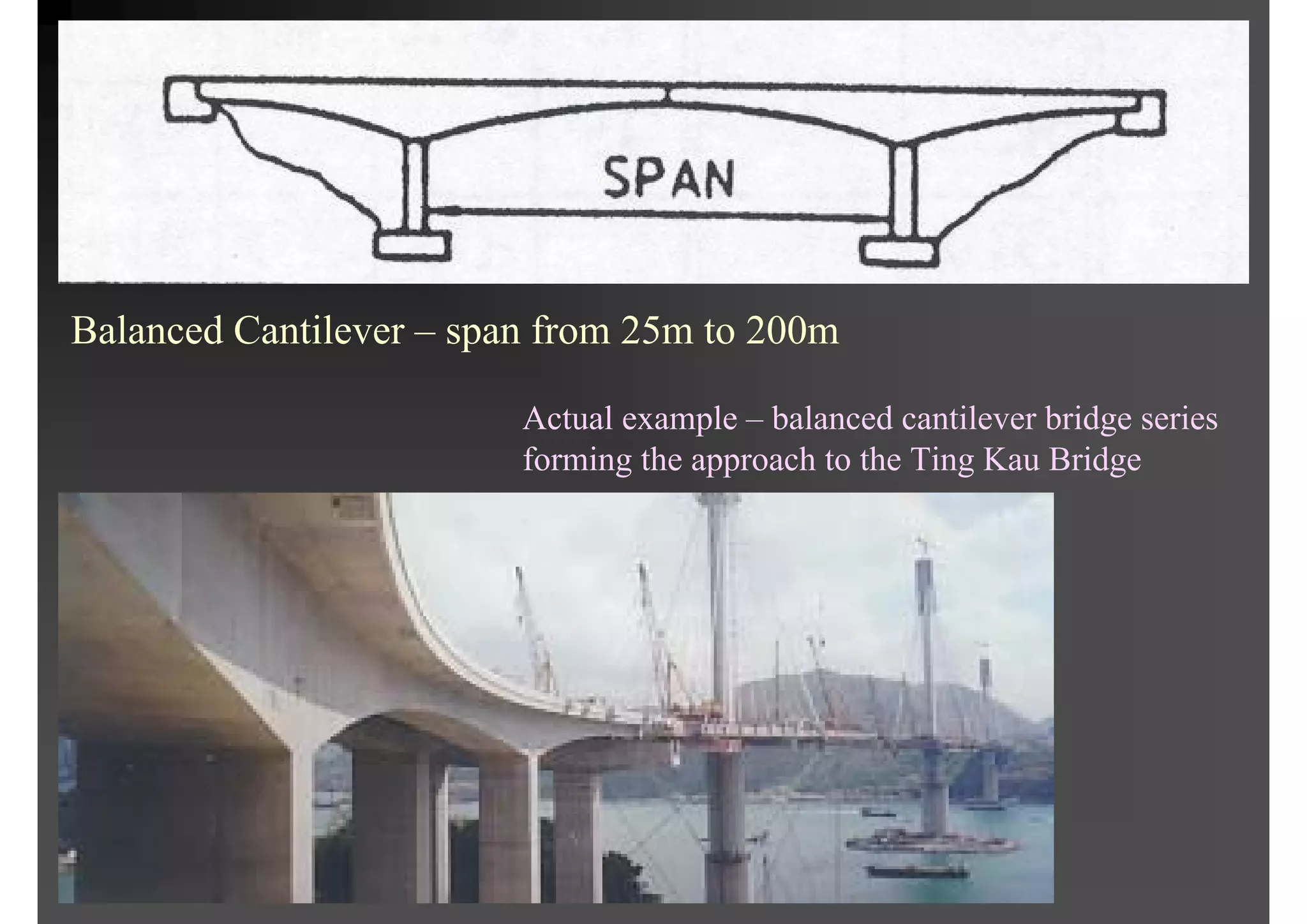
Balanced Cantilever – span from 25m to 200m
Actual example – balanced cantilever bridge series
forming the approach to the Ting Kau Bridge
Balanced cantilever bridge
for viaduct of West Rail at
Au Tau Interchange
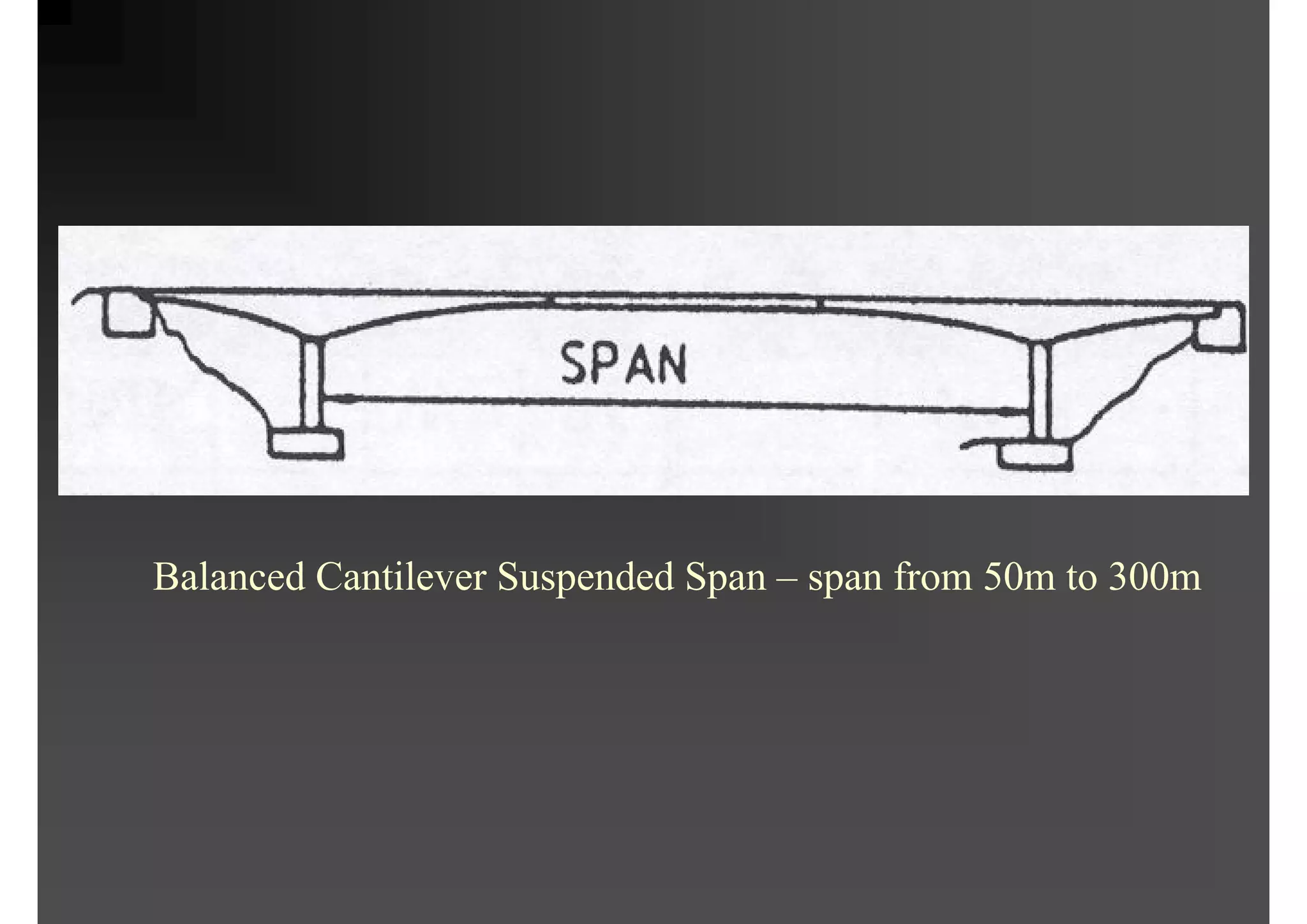
Balanced Cantilever Suspended Span – span from 50m to 300m
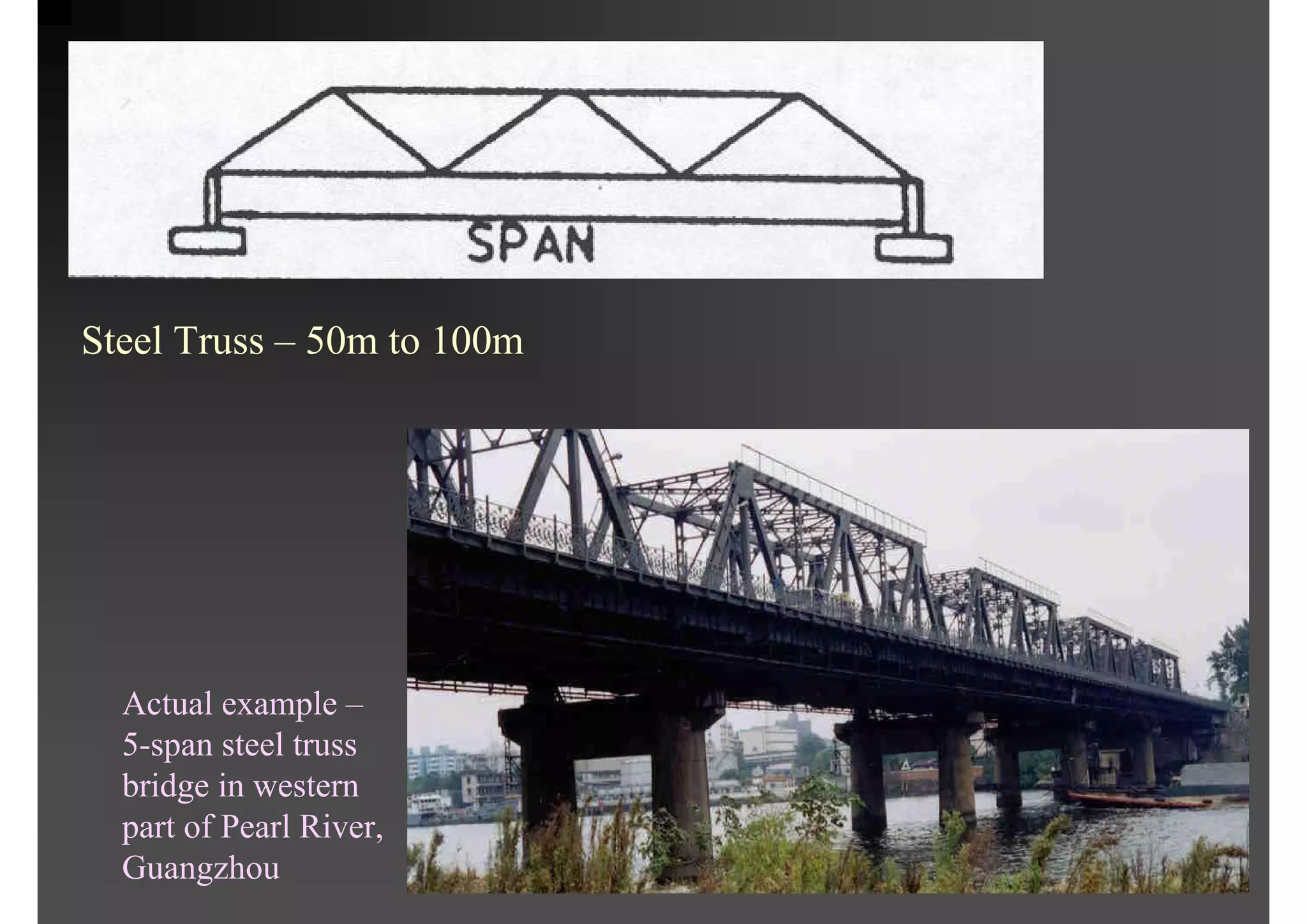
Steel Truss – 50m to 100m
Actual example –
5-span steel truss
bridge in western
part of Pearl River,
Guangzhou
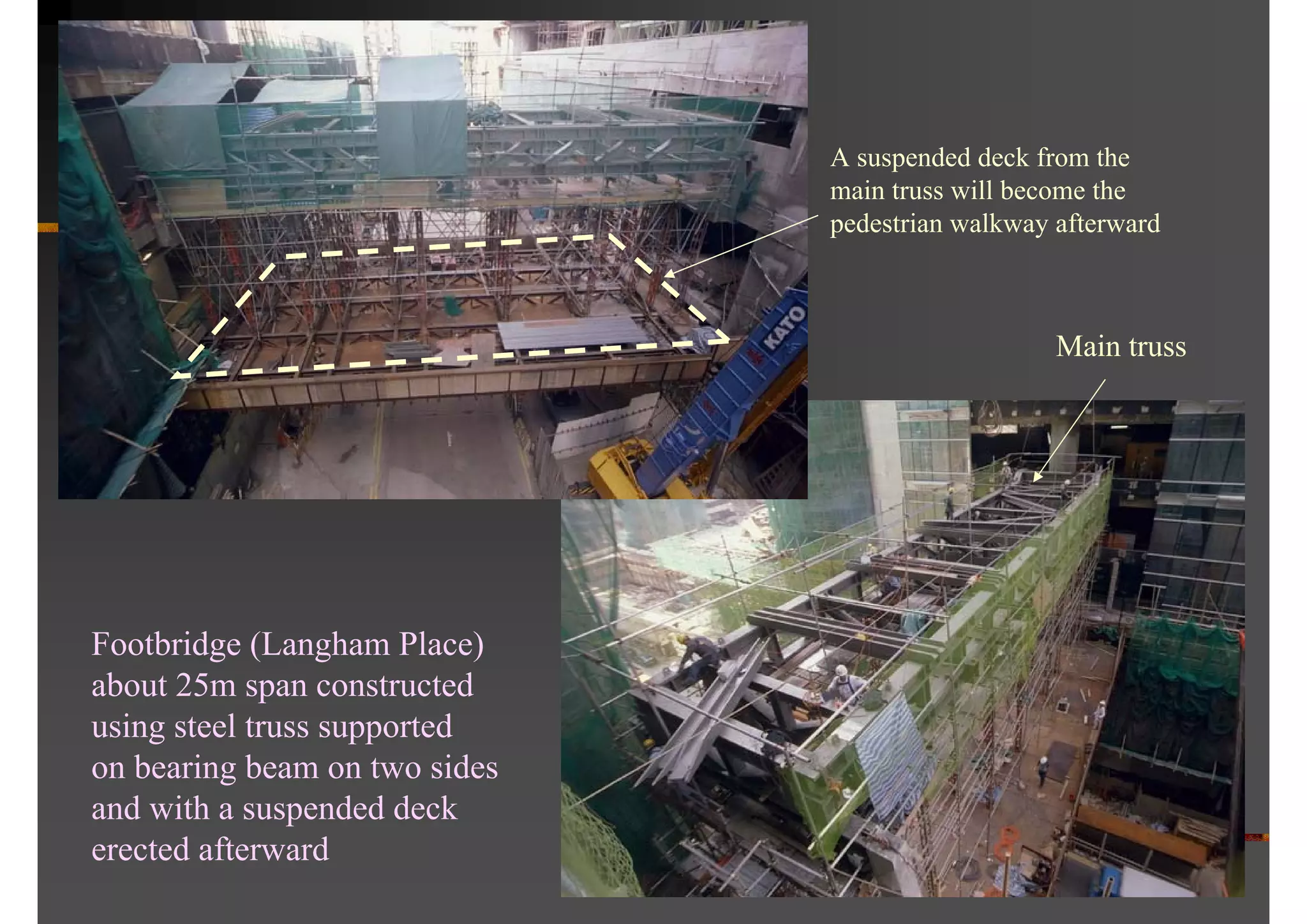
Footbridge (Langham Place)
about 25m span constructed
using steel truss supported
on bearing beam on two sides
and with a suspended deck
erected afterward
Main truss
A suspended deck from the
main truss will become the
pedestrian walkway afterward
Stone arch
– from 15m to 50m
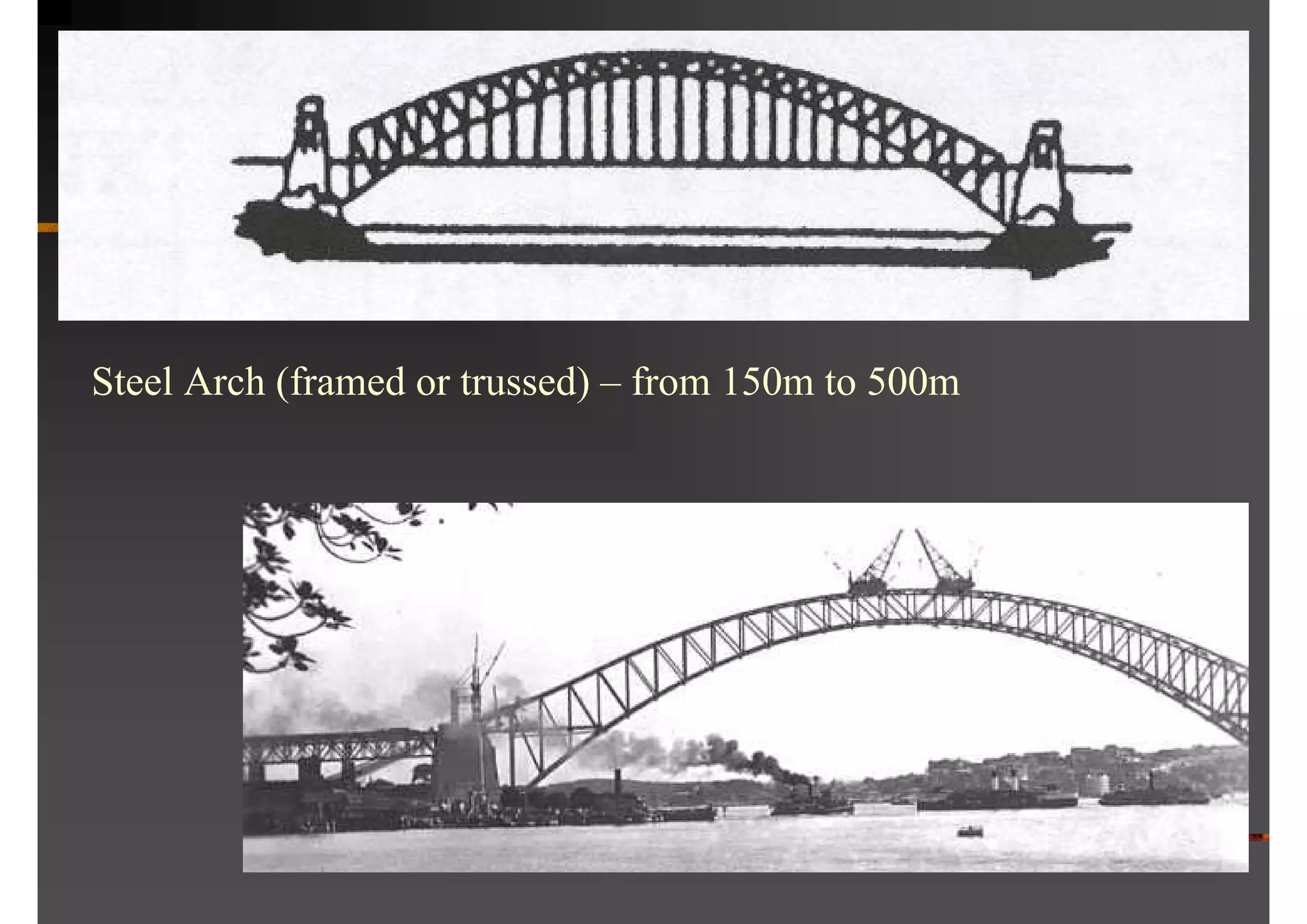
Steel Arch (framed or trussed) – from 150m to 500m
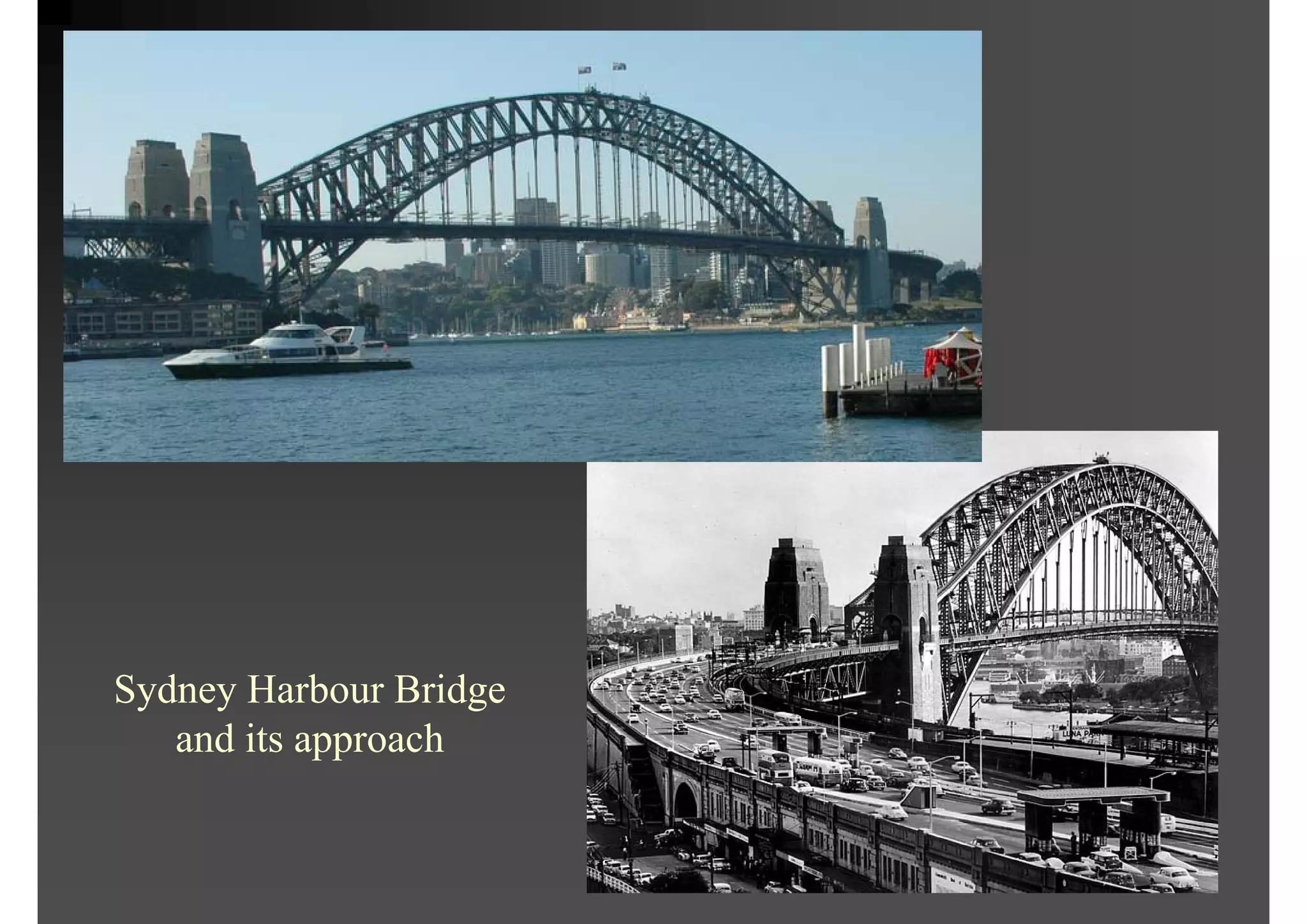
Sydney Harbour Bridge
and its approach
Close up view of the
bridge trusses
Close up of the bridge at
the tower support
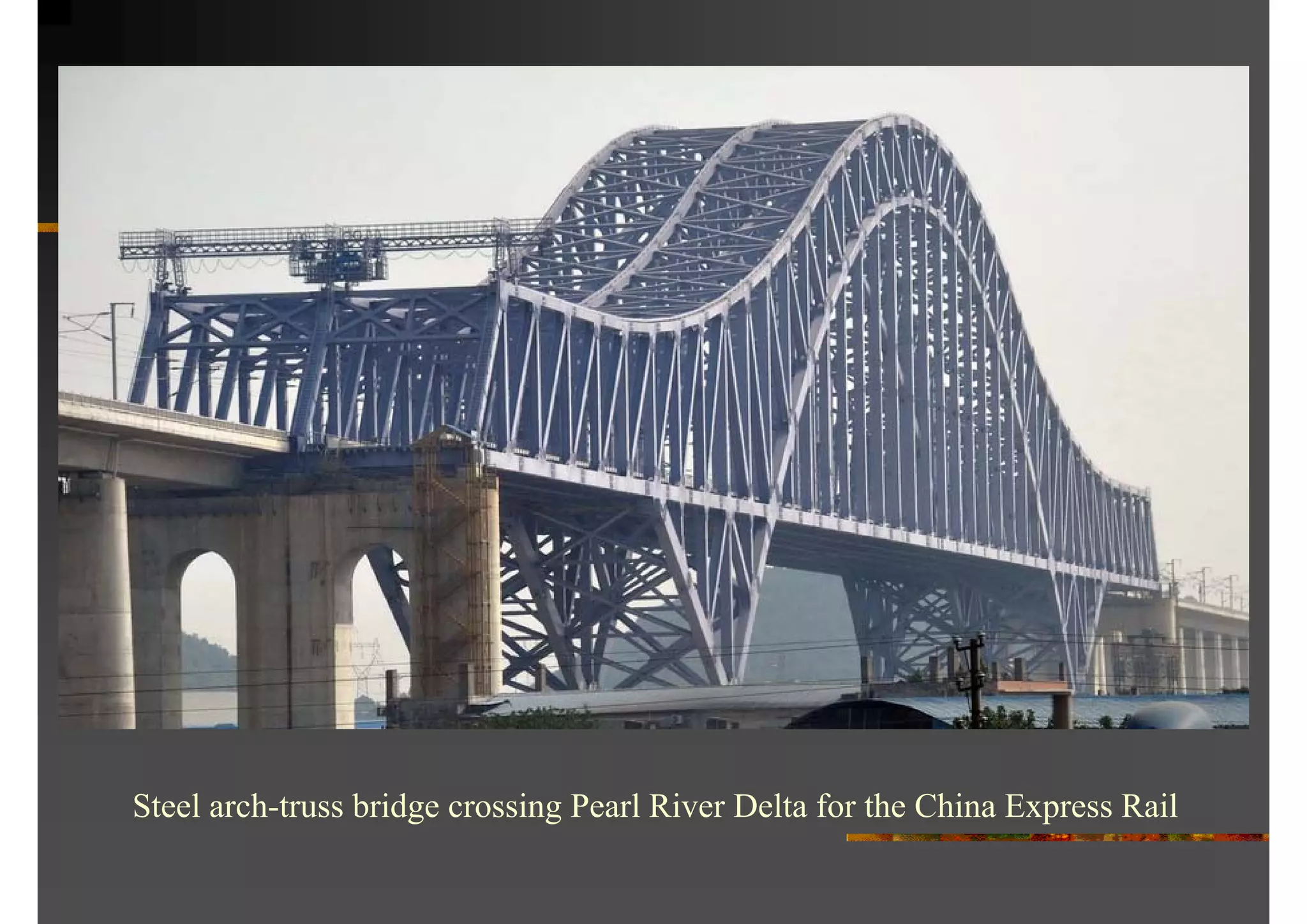
Steel arch-truss bridge crossing Pearl River Delta for the China Express Rail
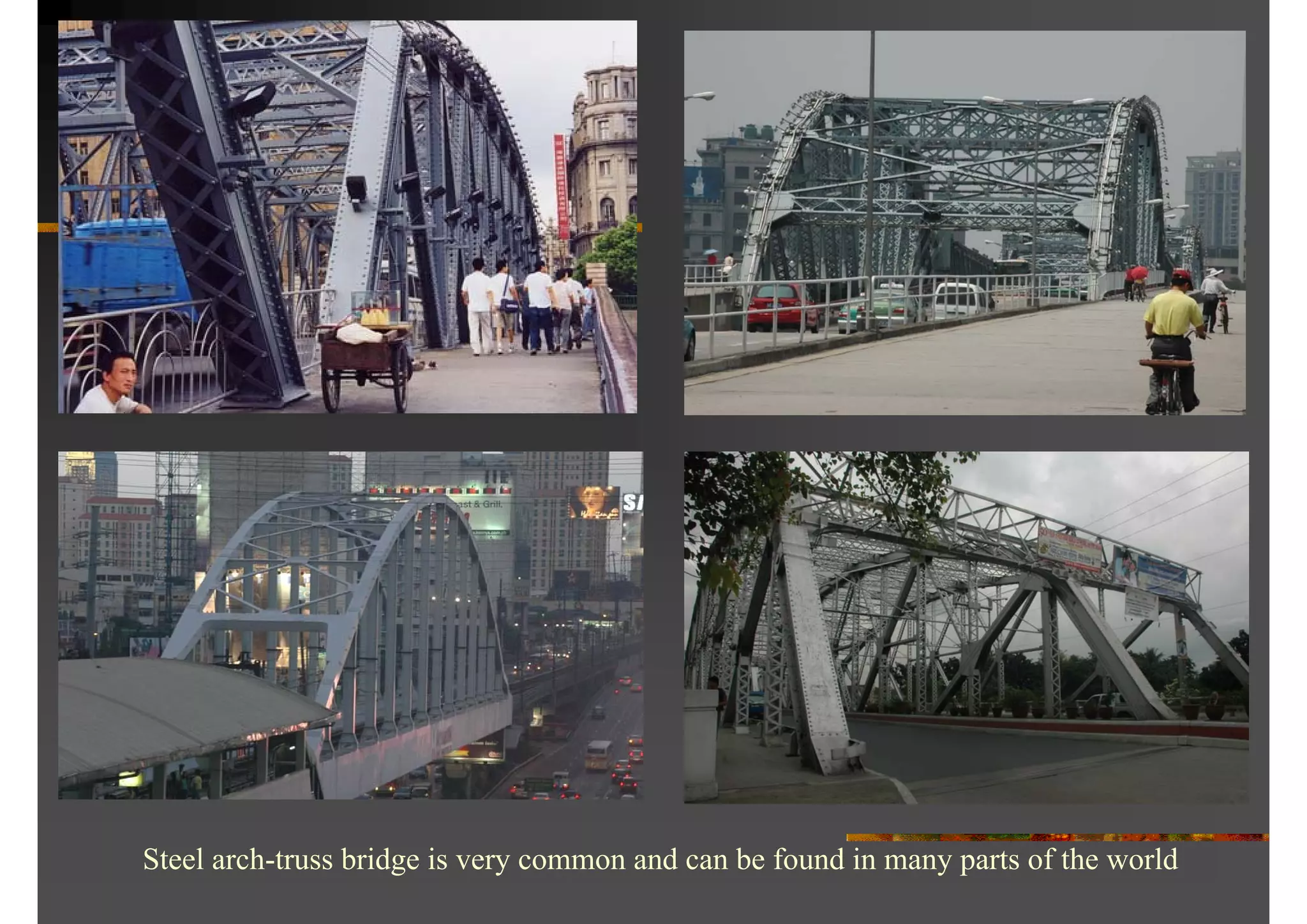
Steel arch-truss bridge is very common and can be found in many parts of the world
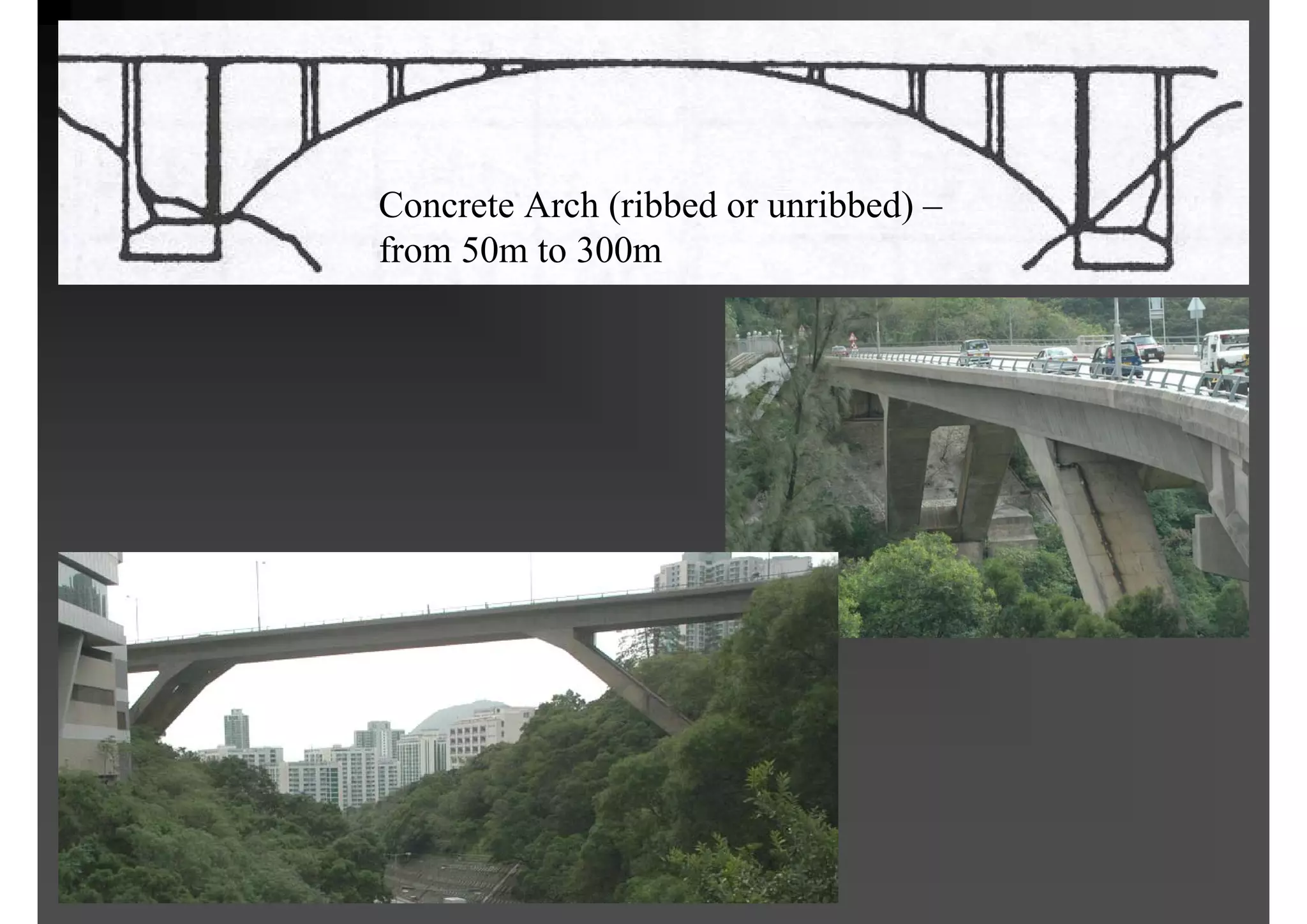
Concrete Arch (ribbed or unribbed) –
from 50m to 300m
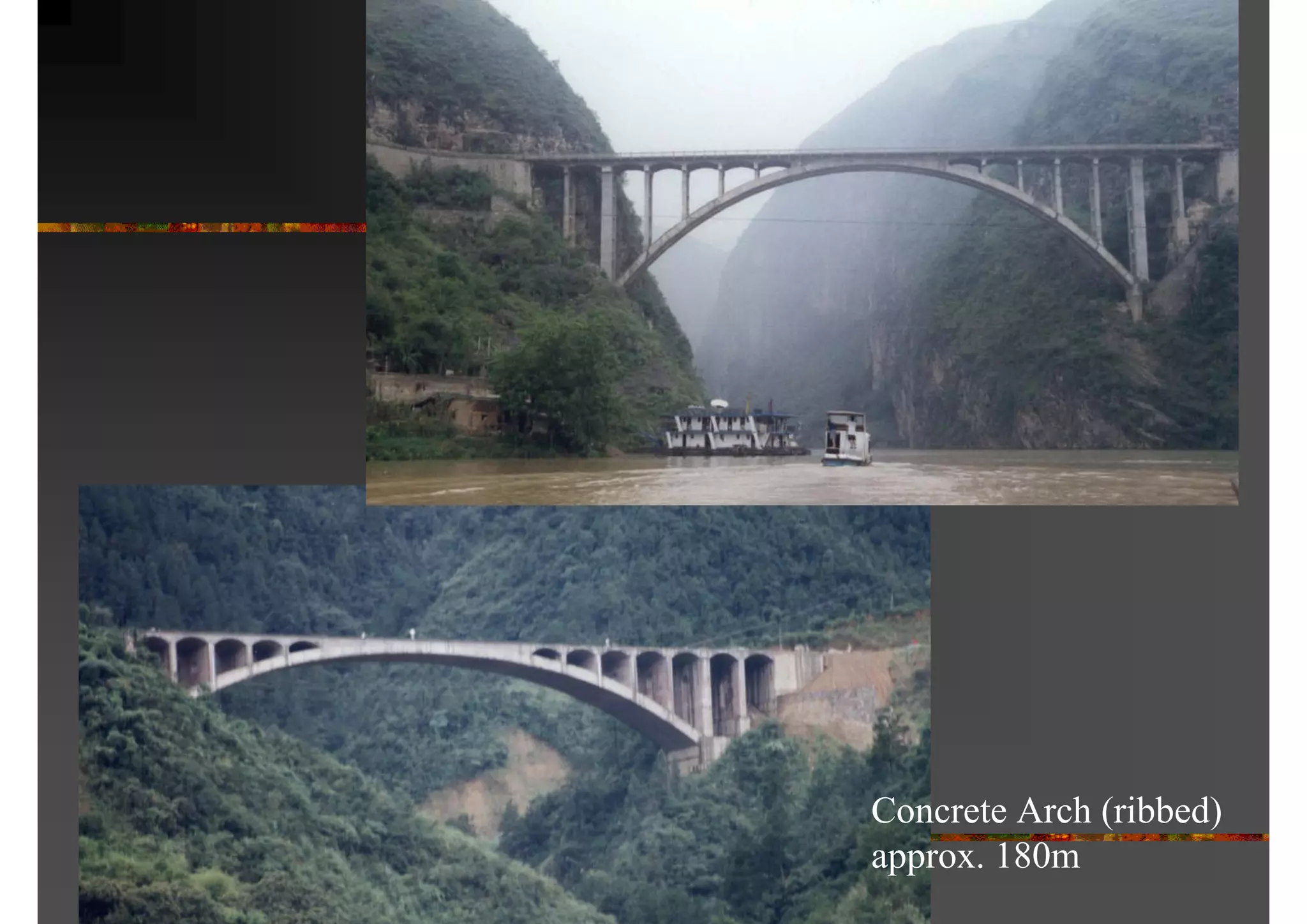
Concrete Arch (ribbed)
approx. 180m
Steel Arch – from
100m to 500m
The actual example – LuPoa Bridge, Shanghai (550m main span)
Cable suspension – from 400m to 1500m
The 1377m
span Tsing
Ma Bridge
Bridge anchor
Golden Gate
Bridge in
San
Francisco
Bridge anchor
Rainbow Bridge in Tokyo
Cable stayed (multi-spanned) – from 50 to 500m per span
The 3-span cable-stayed
Ting Kau Bridge
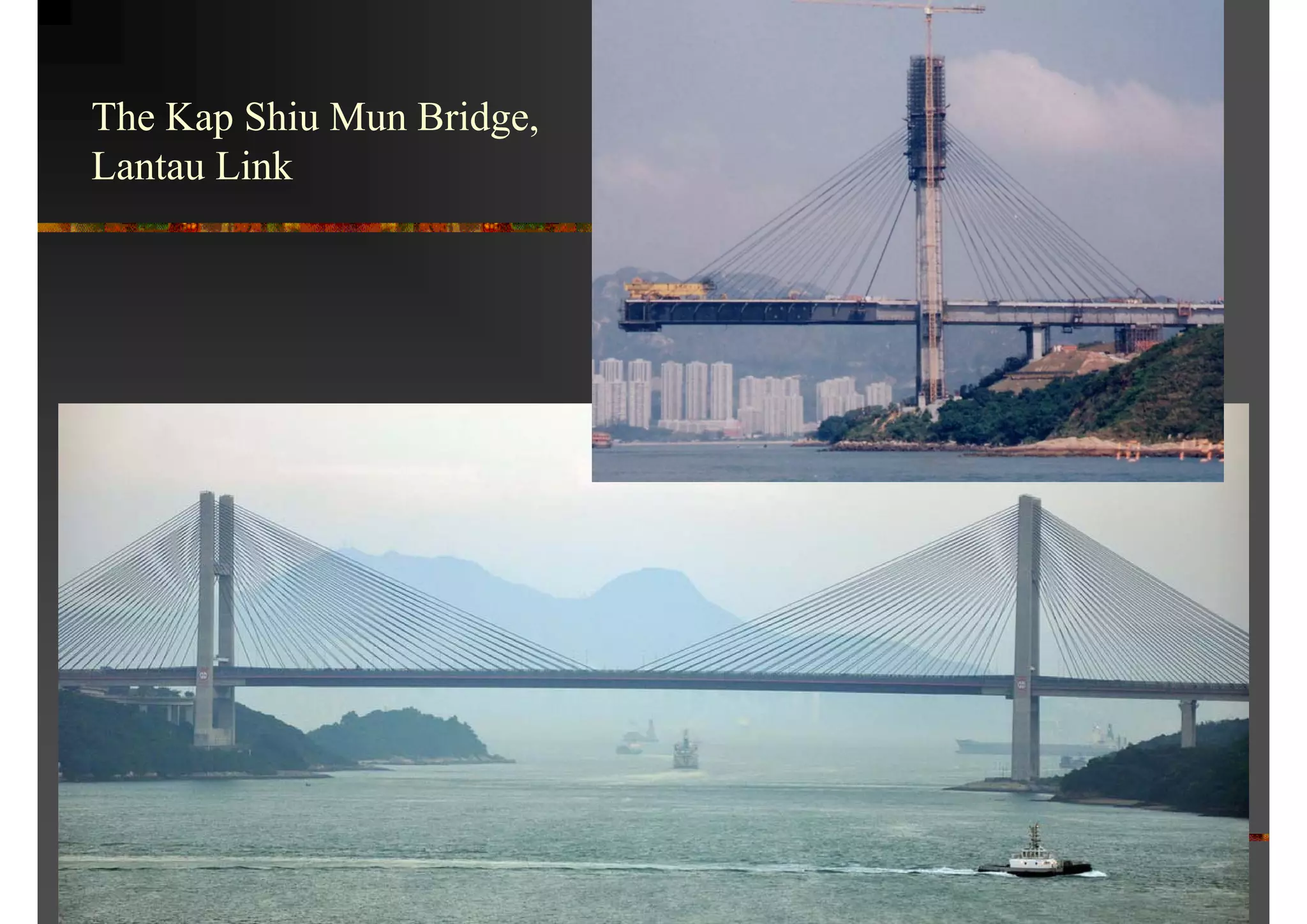
The Kap Shiu Mun Bridge,
Lantau Link
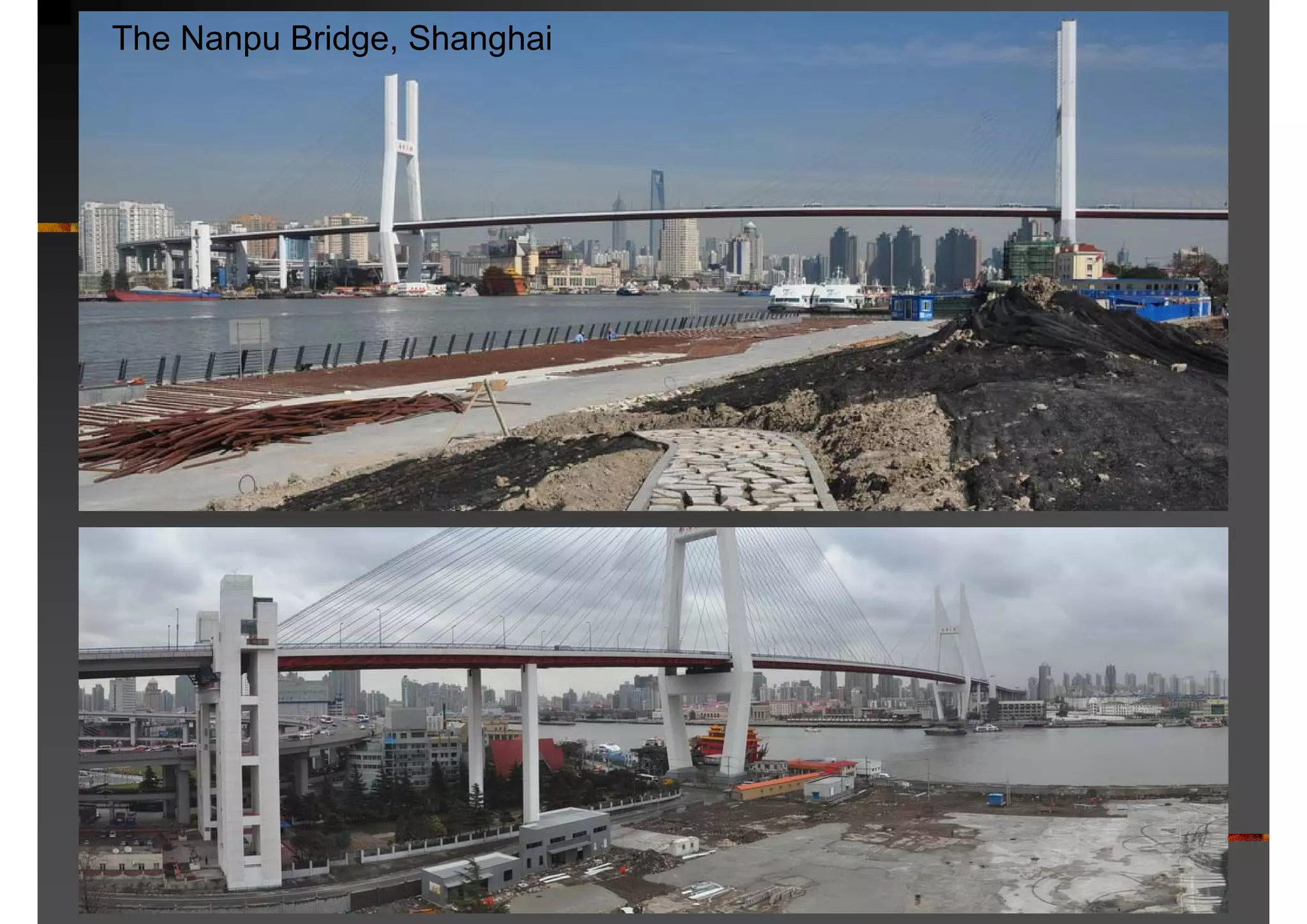
The Nanpu Bridge, Shanghai
Nanpu Bridge and
the approach bridge,
Shanghai
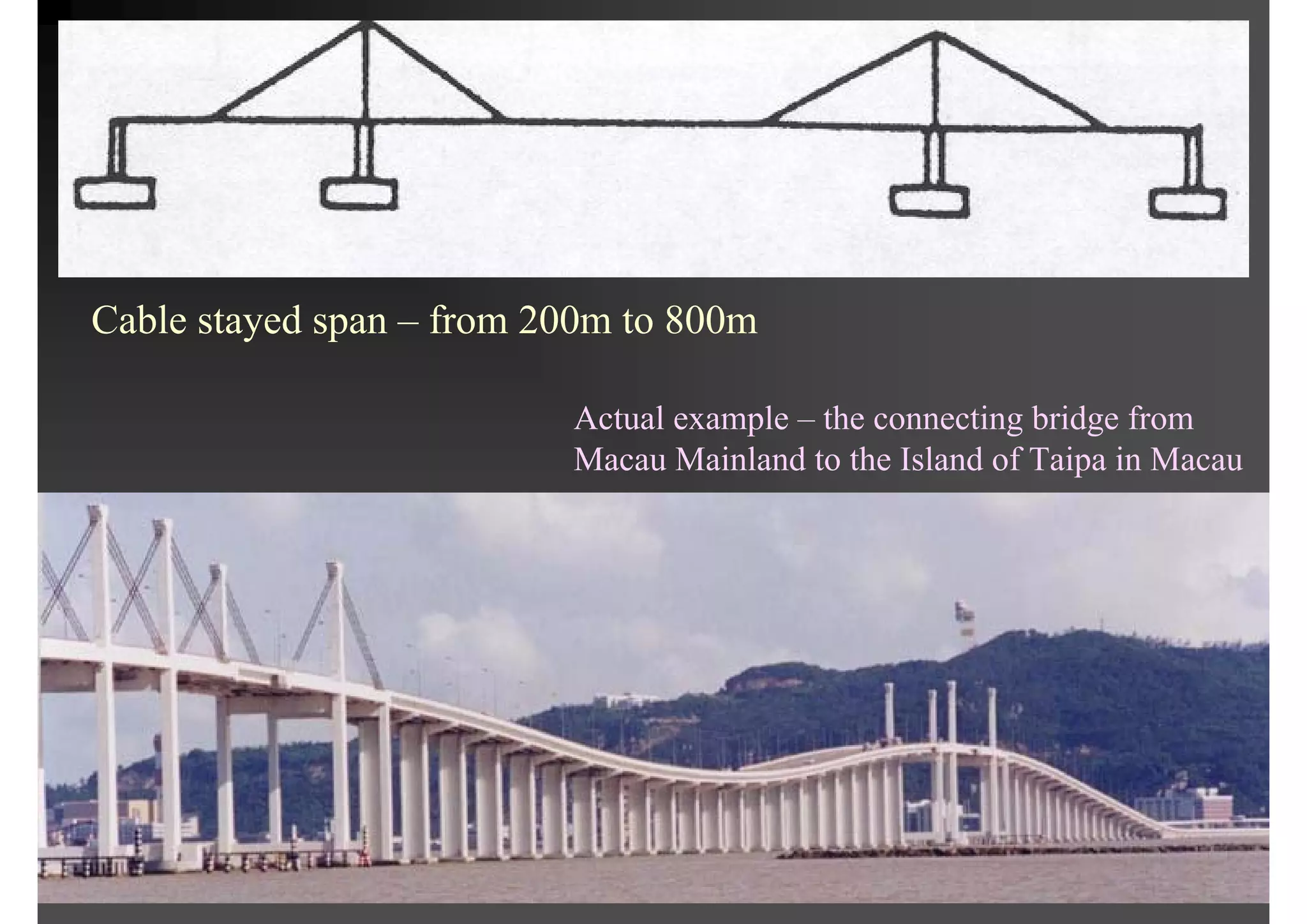
Cable stayed span – from 200m to 800m
Actual example – the connecting bridge from
Macau Mainland to the Island of Taipa in Macau
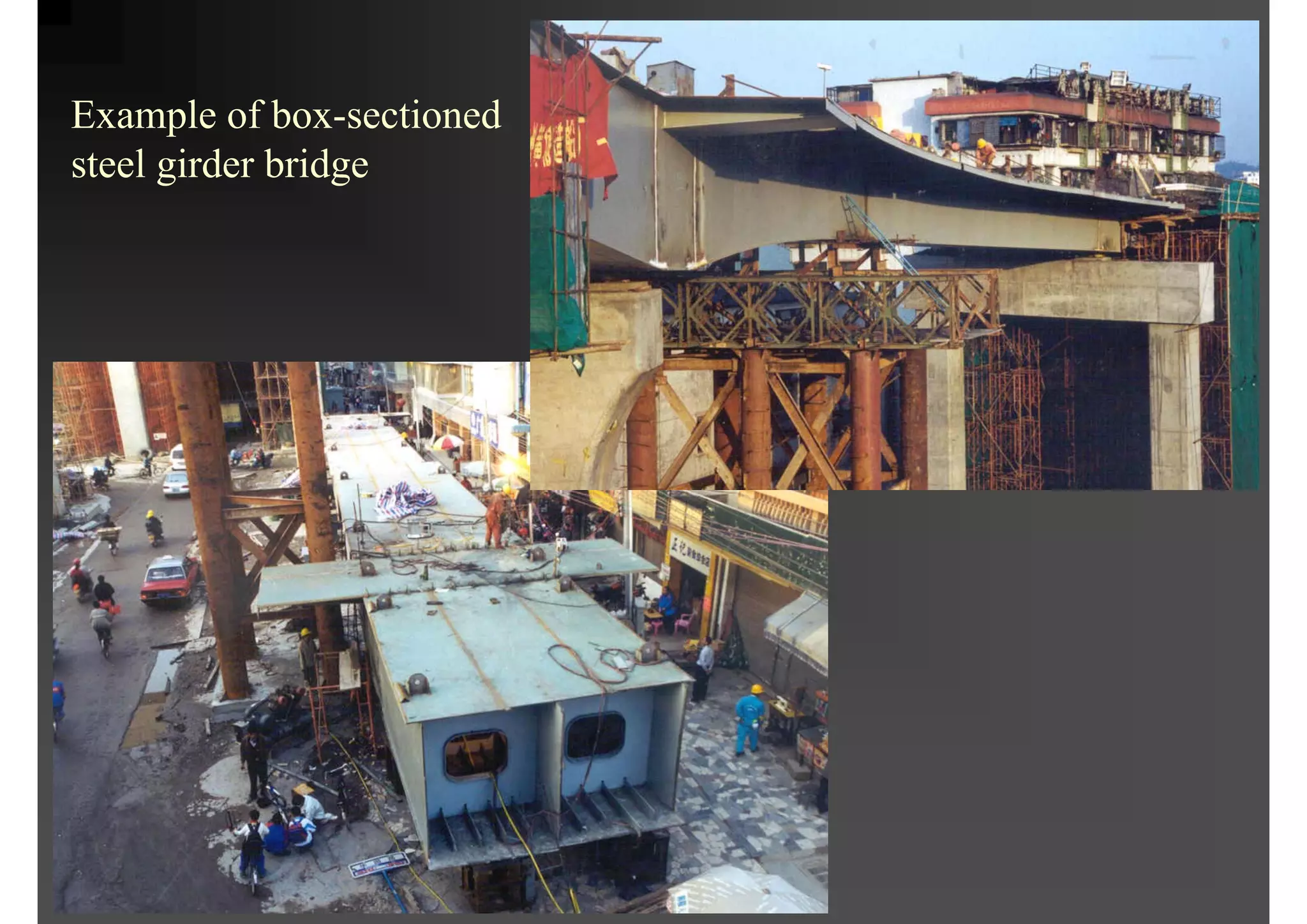
Example of box-sectioned
steel girder bridge
A traffic interchange using large amount steel section
deck for elevated bridges ( Rainbow Bridge, Toyko)
Structural Elements for Typical Bridges
1. Foundation
foundation is required to support the bridge towers, portal
frames or piers
Usual foundation methods such as H-pile, pipe-pile, bore-
pile or precast concrete pile can be used for such purpose.
2. Bridge Tower
This is the vertical supporting structure only for cable
suspension or cable-stayed bridges. The tower is usually
construction in high-strength concrete using in-situ method.
Mechanical climb form is most efficient for casting the
bridge tower. In some cases, the tower can be constructed in
a structural frame type.
The foundation of
the bridge tower of
Ting Kau Bridge
on Tsing Yi side
The foundation for the
Bridge Tower of Tsing Ma
Bridge on the Tsing Yi side
Foundation of bridges may
need to be carried out in very
difficult location such as
along an un-accessible slope
Structural Elements for Typical Bridges
3. Pier is the vertical supporting structure for usual spanned
bridges. Pier is more suitable for bridge with maximum
width of deck up to about 8m (2 traffic lanes). Usually
bridge pier is constructed using in-situ method with large
panel formwork.
4. Portal frame
A portal usually consists on two piers on each side with
cross beam in between to support the deck. In this case the
width of deck can be up to 20m (6 traffic lanes).
In some situations the height of a portal frame can be up to
50m from ground. Climb form can be used in this high-
headroom cases.
The erection of a complicated falsework system to support
the portal construction is usually involved.
Forming the foundation for piers of elevated highway bridges
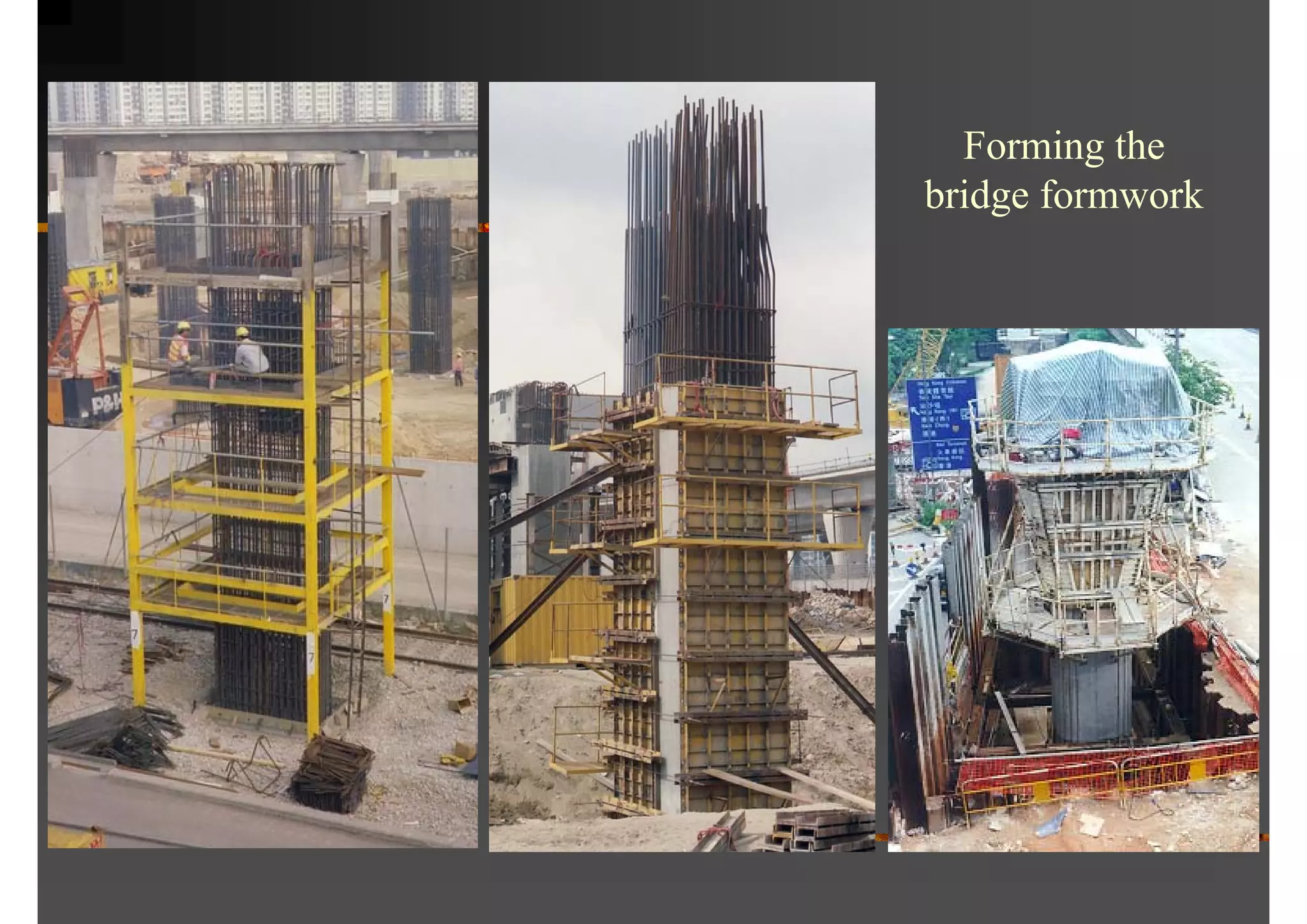
Forming the
bridge formwork
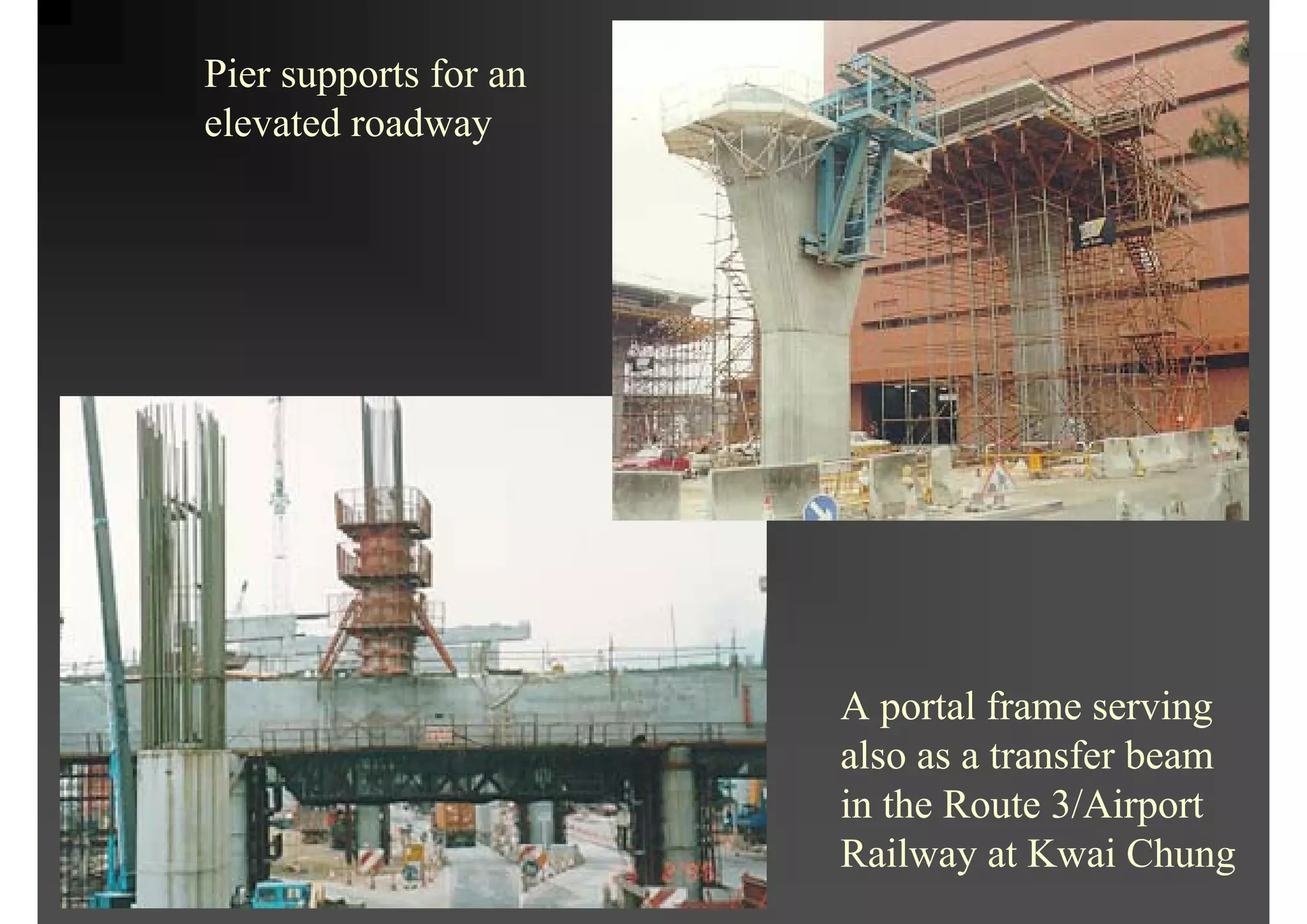
Pier supports for an
elevated roadway
A portal frame serving
also as a transfer beam
in the Route 3/Airport
Railway at Kwai Chung
Falsework for the
construction a
portal frame
Single piers to support the bridge deck
Portal frame to support wider
deck for multi-lane traffic
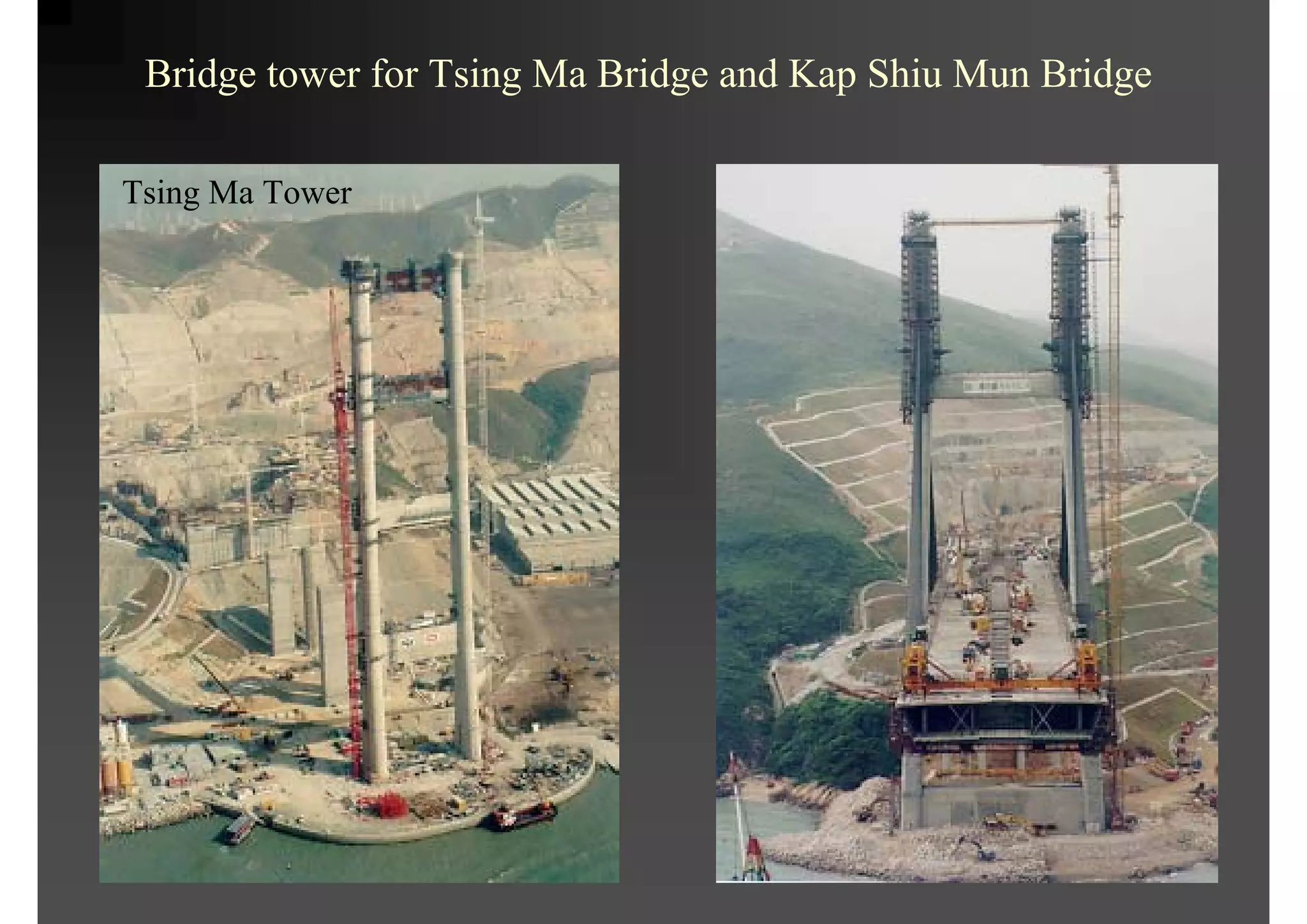
Bridge tower for Tsing Ma Bridge and Kap Shiu Mun Bridge
Tsing Ma Tower
Bridge tower for Stonecutter Bridge
Bridge tower & side span/approach bridge of Stonecutter Bridge
Structural Elements for Typical Bridges
5. Bridge deck – the horizontal part of a bridge that support
pedestrian or traffic activities. The construction methods for
the deck is shown in the following slides.
6. Bridge anchor – required only for suspension or cable-stay
bridges to resist the pull from the suspension cable or
counter-span of the bridge. Bridge anchor can be of gravity
type using great mass for the counter-balancing, or using
ground anchors for the same purpose.
7. Suspension cable – for suspension and cable-stayed bridges
for the hanging, support or counter-balancing of the bridge
deck
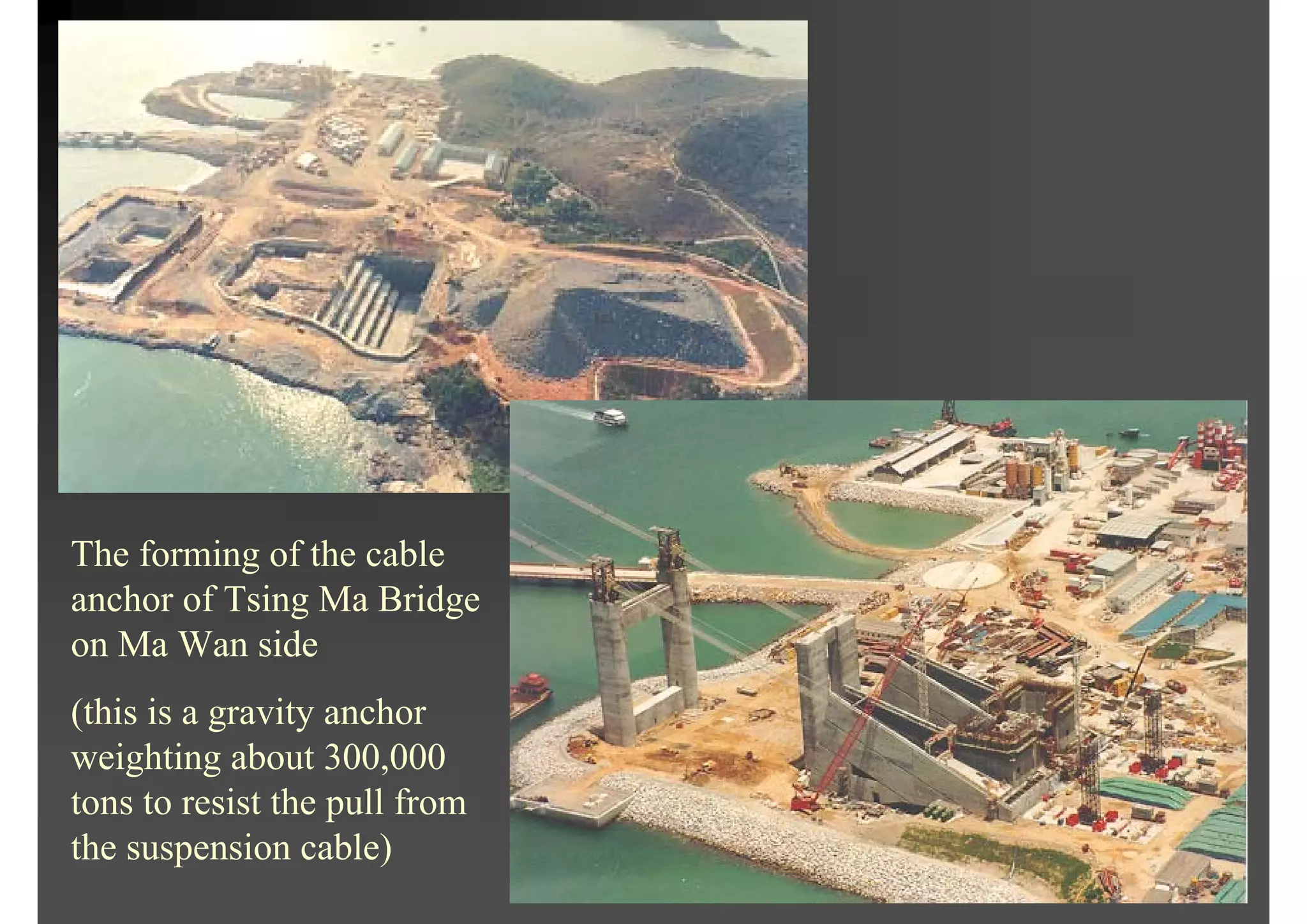
The forming of the cable
anchor of Tsing Ma Bridge
on Ma Wan side
(this is a gravity anchor
weighting about 300,000
tons to resist the pull from
the suspension cable)
The forming of the cable
anchor of Tsing Ma
Bridge on Tsing Yi side
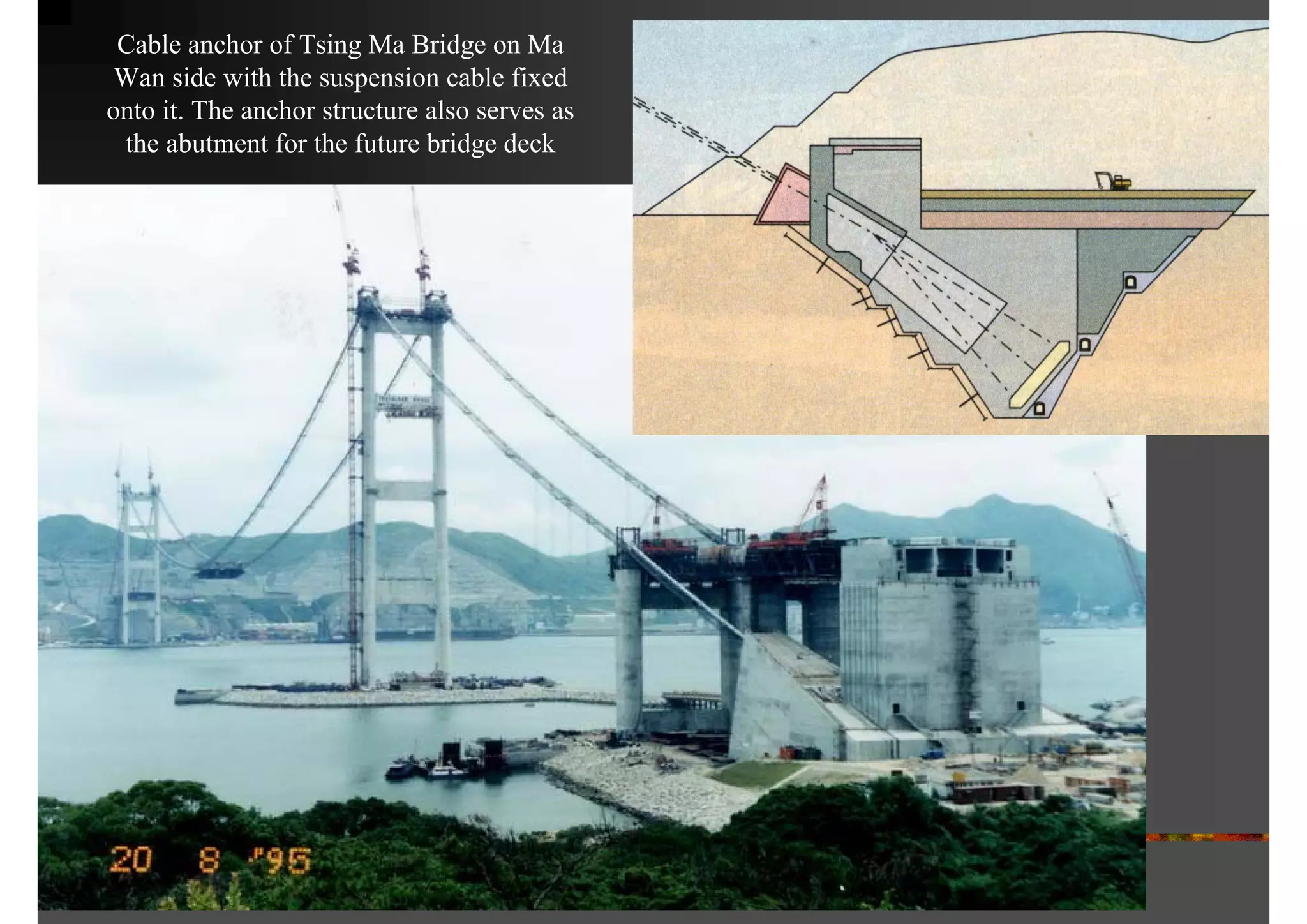
Cable anchor of Tsing Ma Bridge on Ma
Wan side with the suspension cable fixed
onto it. The anchor structure also serves as
the abutment for the future bridge deck
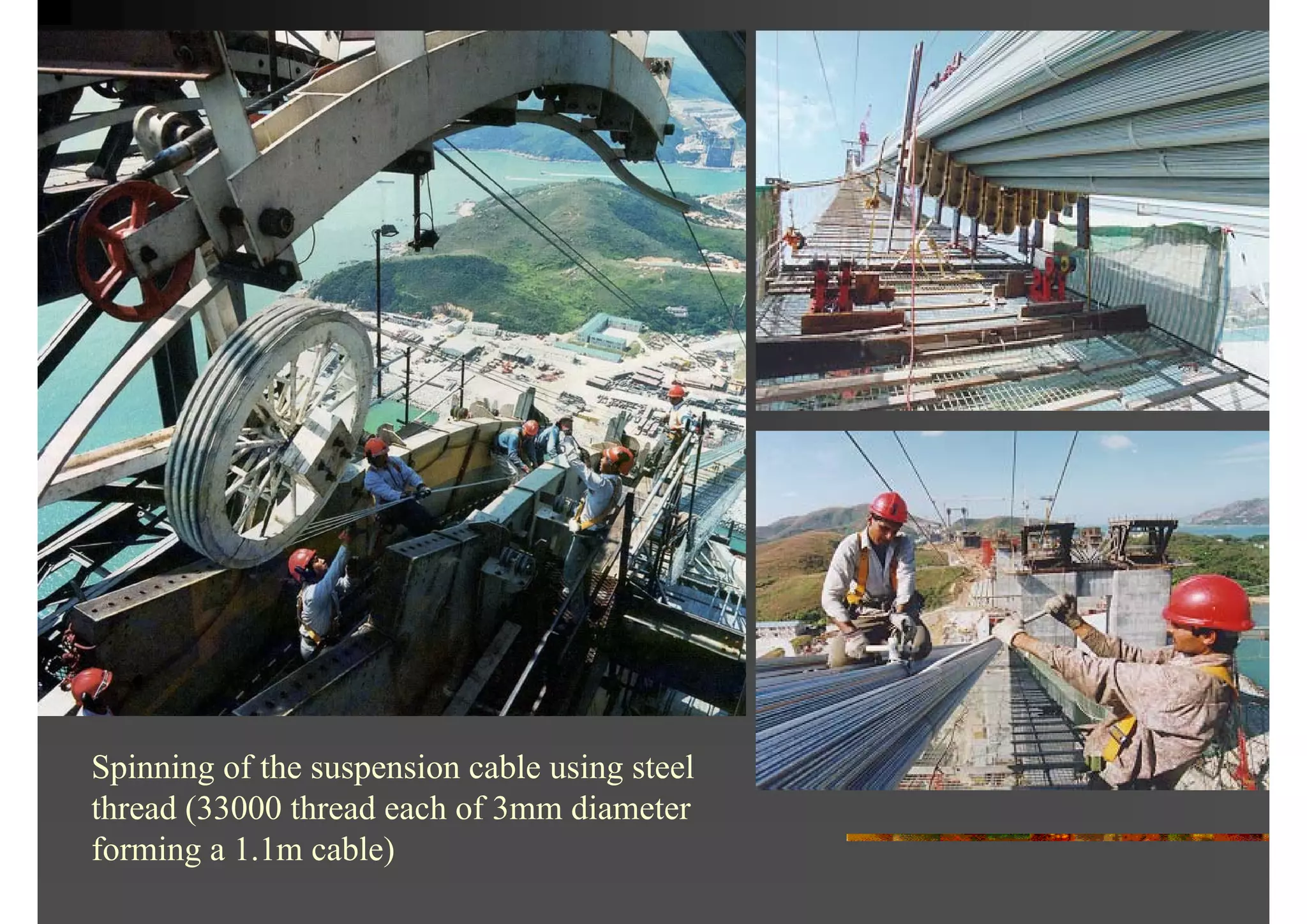
Spinning of the suspension cable using steel
thread (33000 thread each of 3mm diameter
forming a 1.1m cable)
Forming the deck of the
approach section of Tsing
Ma Bridge on Ma Wan side
using erection and hoisting
approach
Forming the deck of
the approach section
of Tsing Ma Bridge
on Tsing Yi side
Completing the deck of
Tsing Ma Bridge (abutting
section at Tsing Yi side)
by erecting of the steel
truss at spot
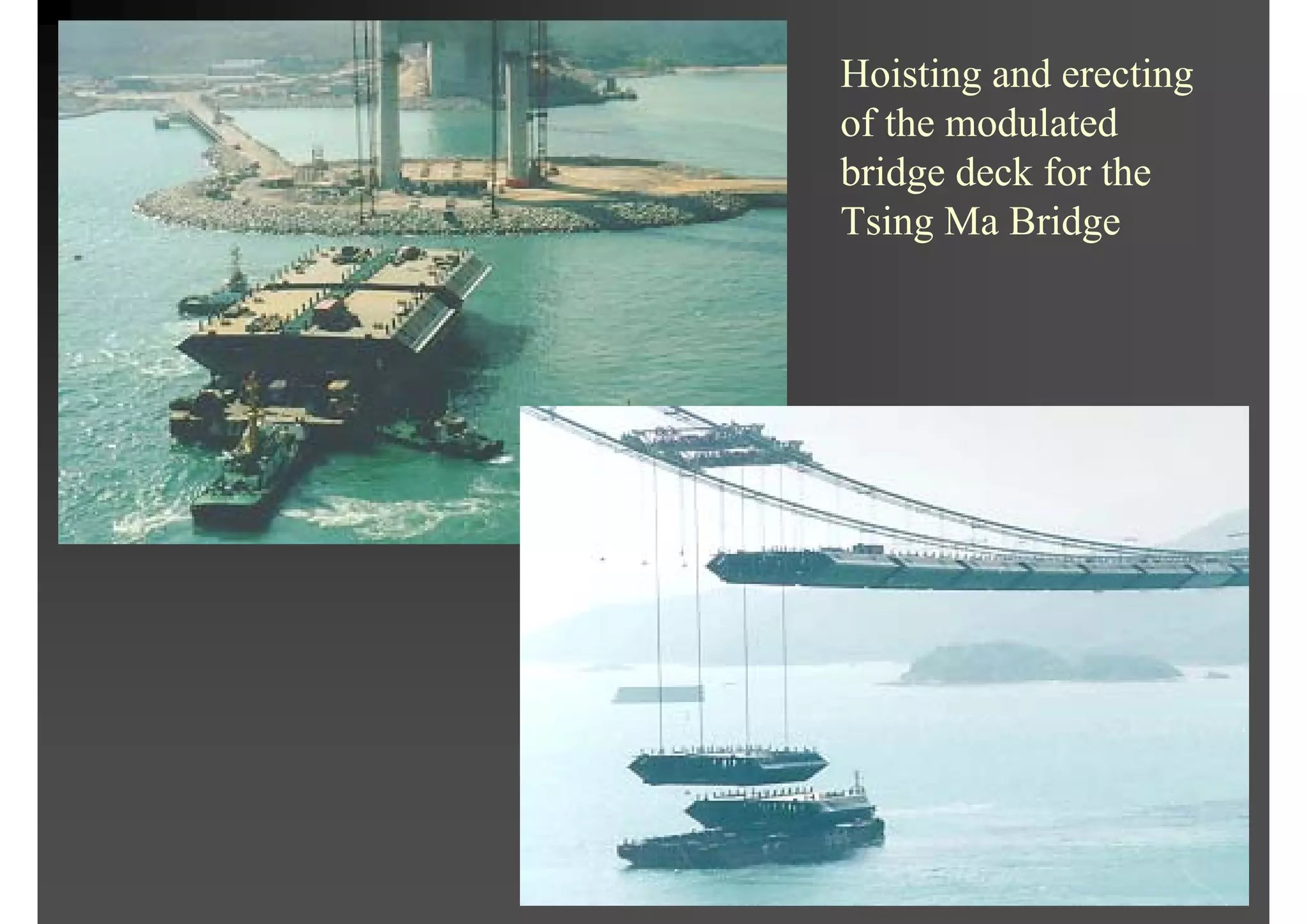
Hoisting and erecting
of the modulated
bridge deck for the
Tsing Ma Bridge
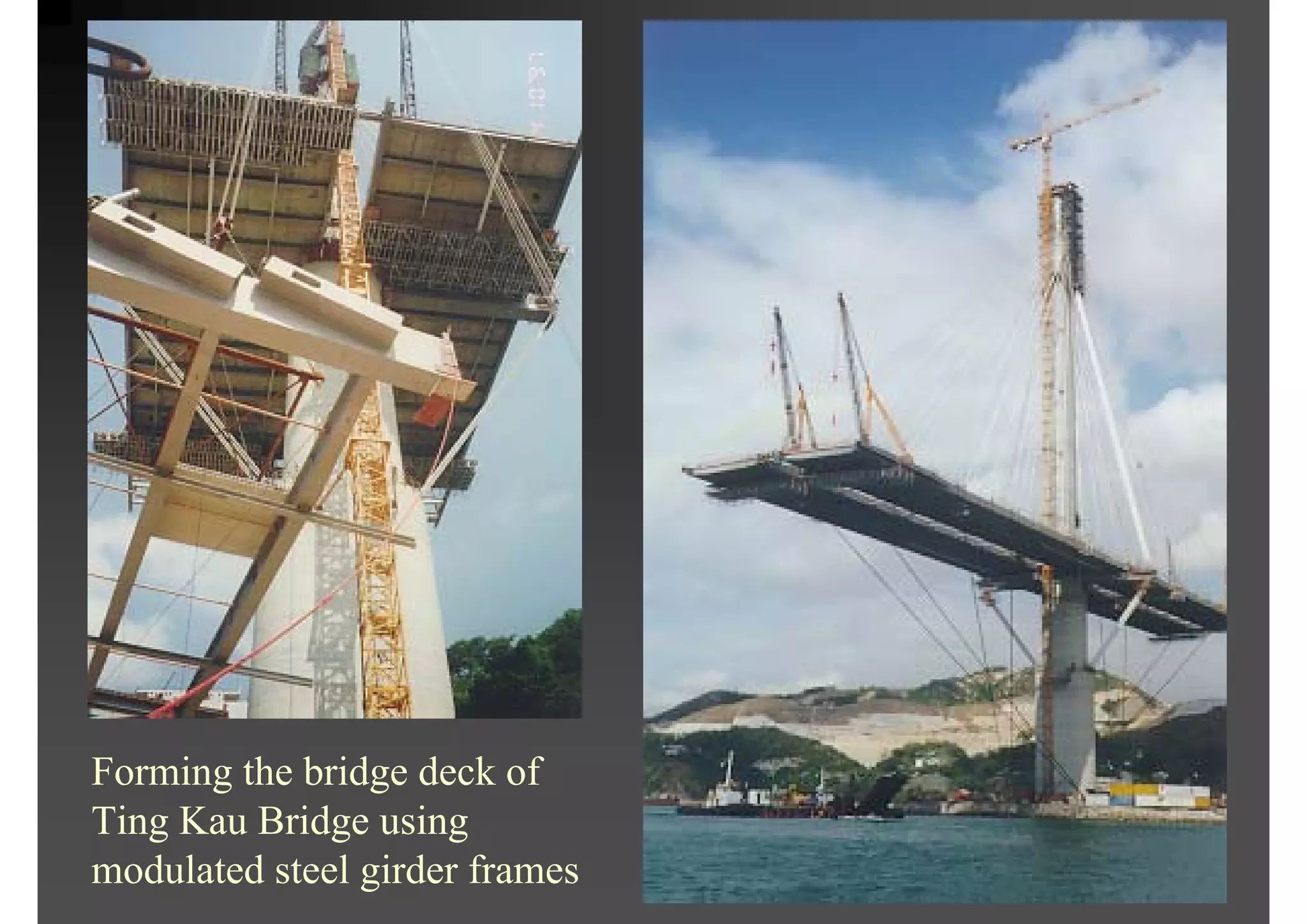
Forming the bridge deck of
Ting Kau Bridge using
modulated steel girder frames
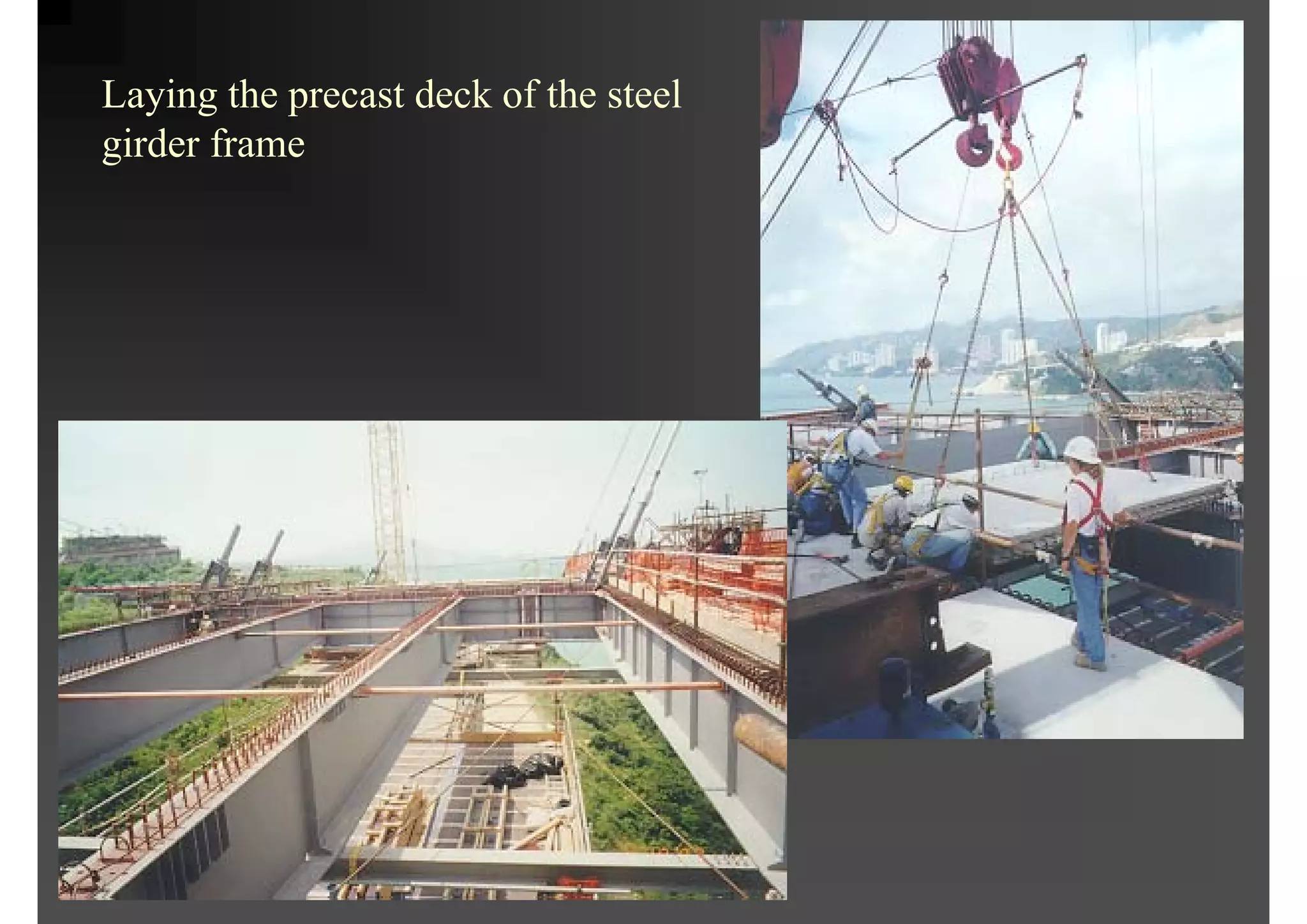
Laying the precast deck of the steel
girder frame
Other methods to form the deck of bridges
1. Balanced cantilever method
2. Construct in-situ
3. Construct using precast beam
4. Construct using precast girder section and erected by a
launching machine (viaduct)
5. Construct using incremental launching method
(the photos of project cases as shown in the following pages are for
reference only in order to help students to understand more
about bridge construction)
Forming the deck of using balanced-cantilever
traveling formwork system
Detail of the traveling
formwork system
Viewing inside the
traveling formwork
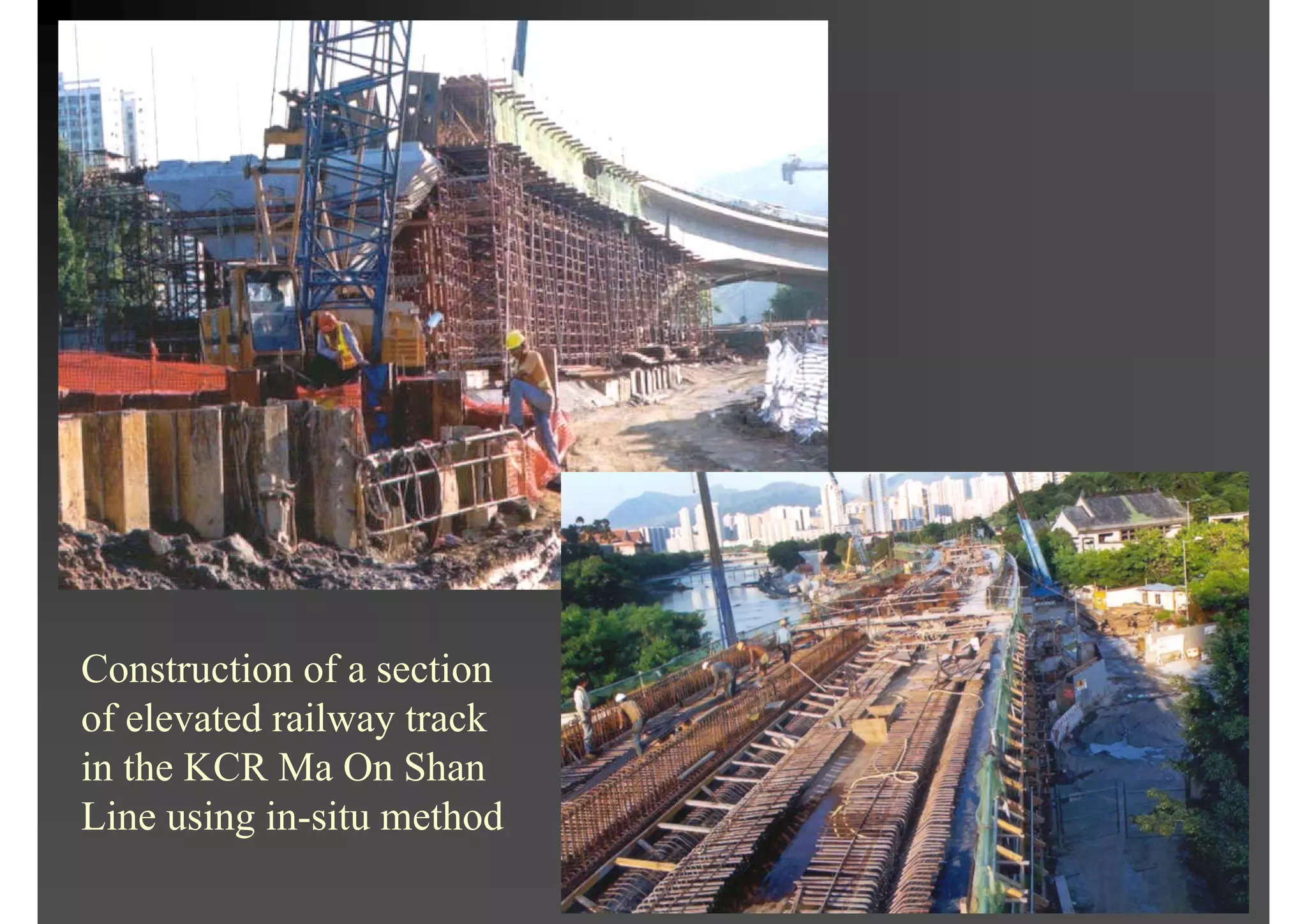
Construction of a section
of elevated railway track
in the KCR Ma On Shan
Line using in-situ method
Construction of an extension
section of elevated roadway as
part of the Tolo Harbor Highway
extension project
Construction of a section of elevated roadway using in-situ method
Special points to note:
- The provision of a adequate falsework system to support the formwork with
the weight of concrete during concreting process.
- Allow temporary road traffic on the ground level for general public or for site
operation.
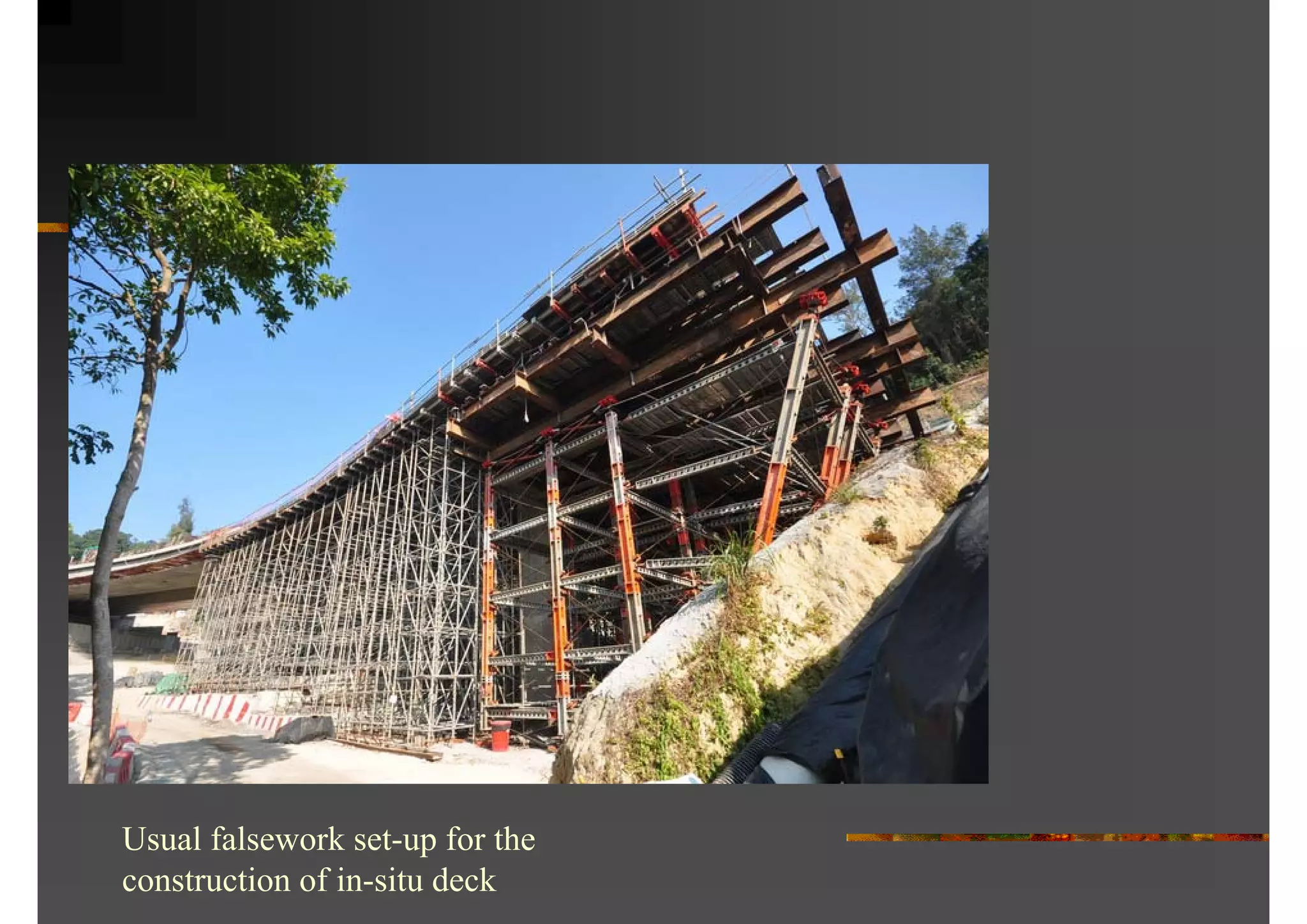
Usual falsework set-up for the
construction of in-situ deck
Formwork and steel fixing
work on the in-situ deck
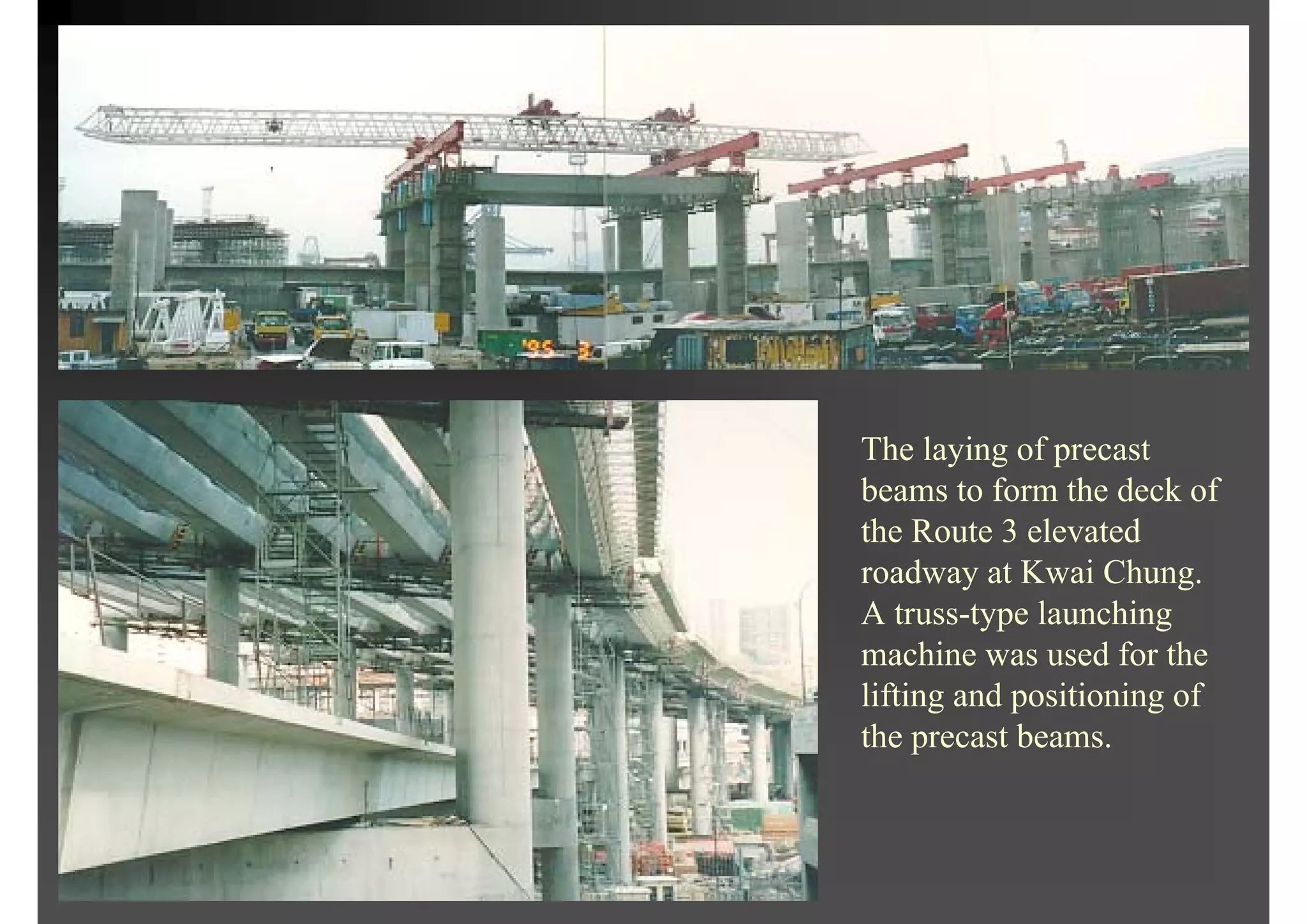
The laying of precast
beams to form the deck of
the Route 3 elevated
roadway at Kwai Chung.
A truss-type launching
machine was used for the
lifting and positioning of
the precast beams.
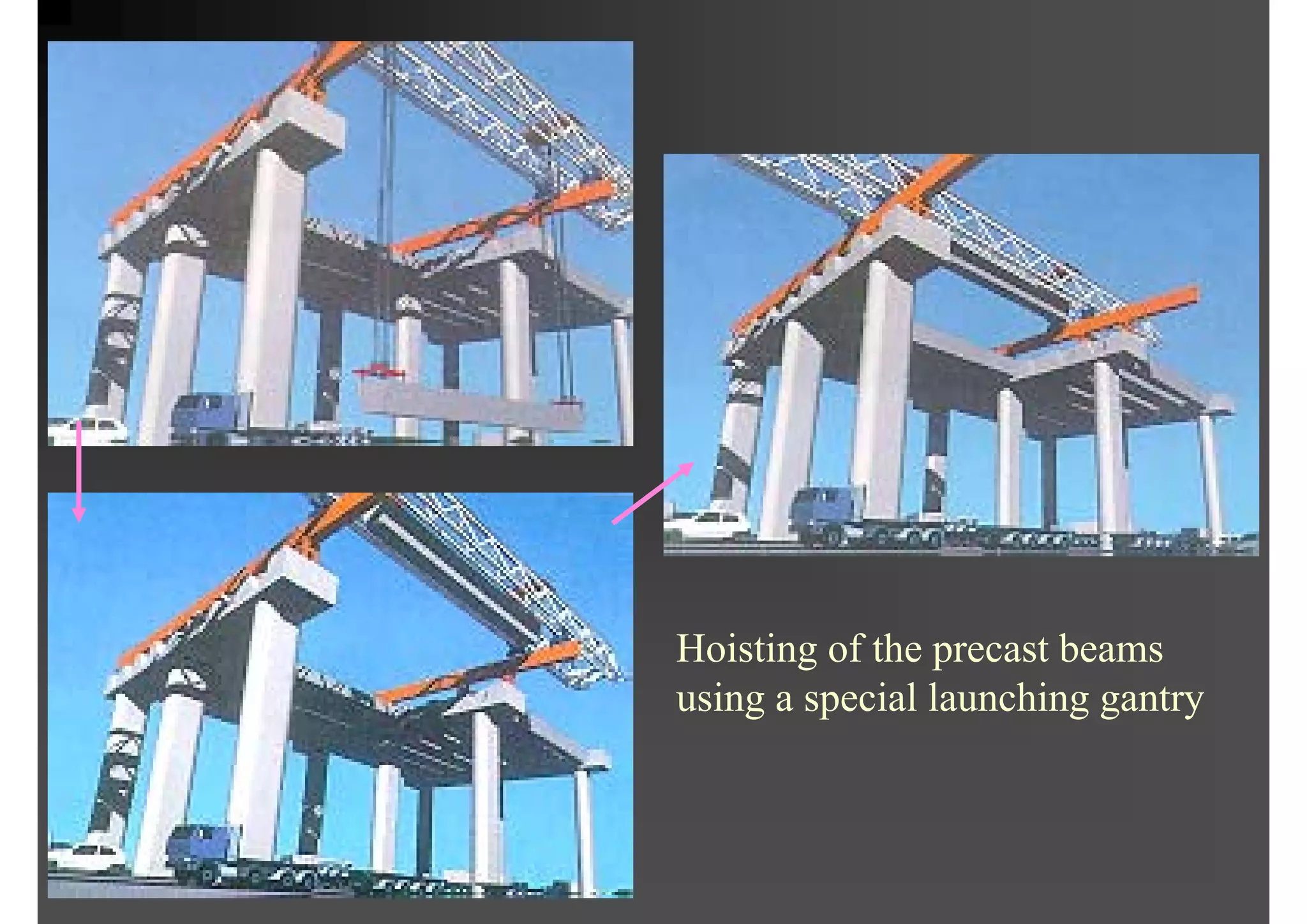
Hoisting of the precast beams
using a special launching gantry
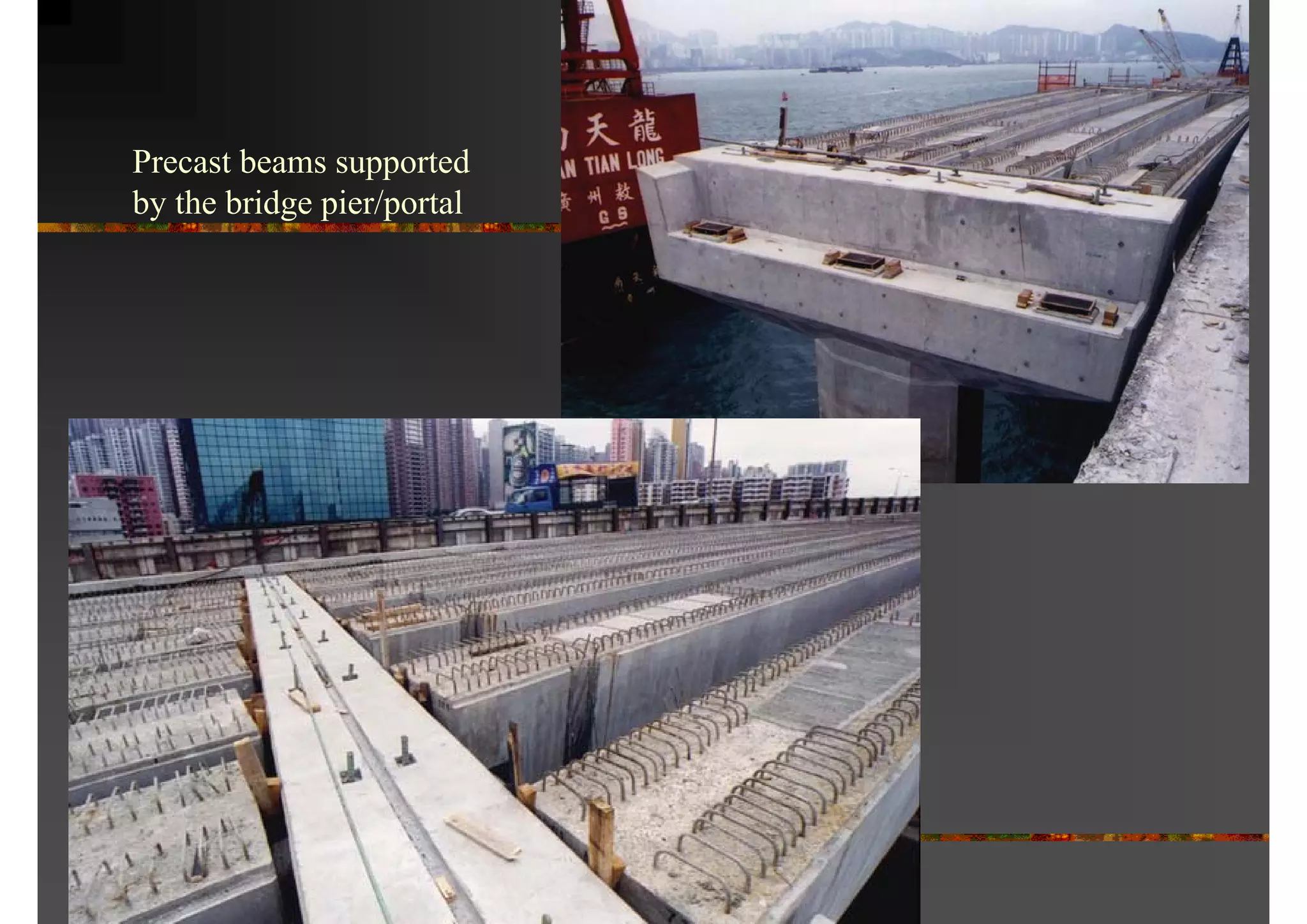
Precast beams supported
by the bridge pier/portal
Precast concrete planks are used to cover the gaps between the beams
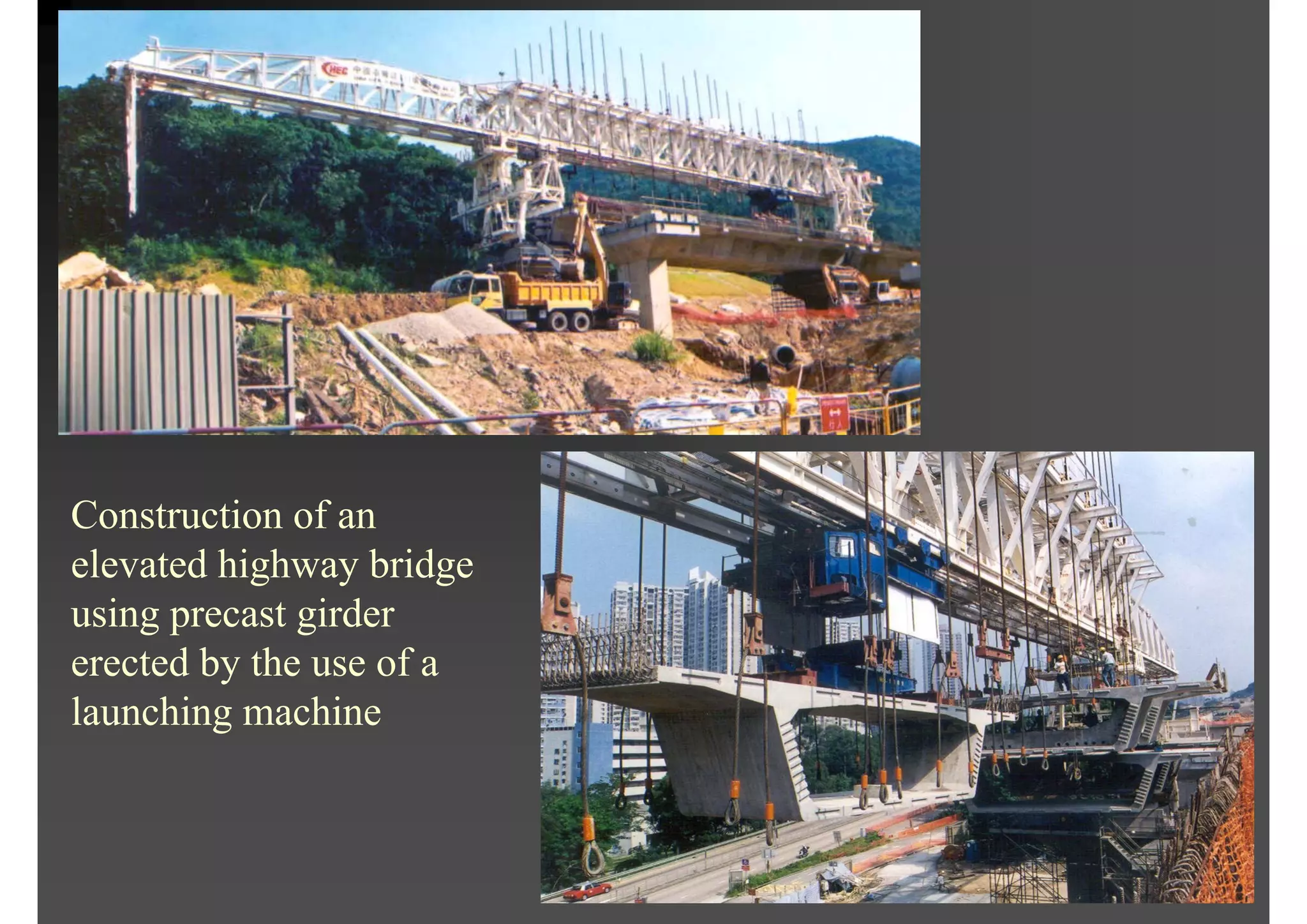
Construction of an
elevated highway bridge
using precast girder
erected by the use of a
launching machine
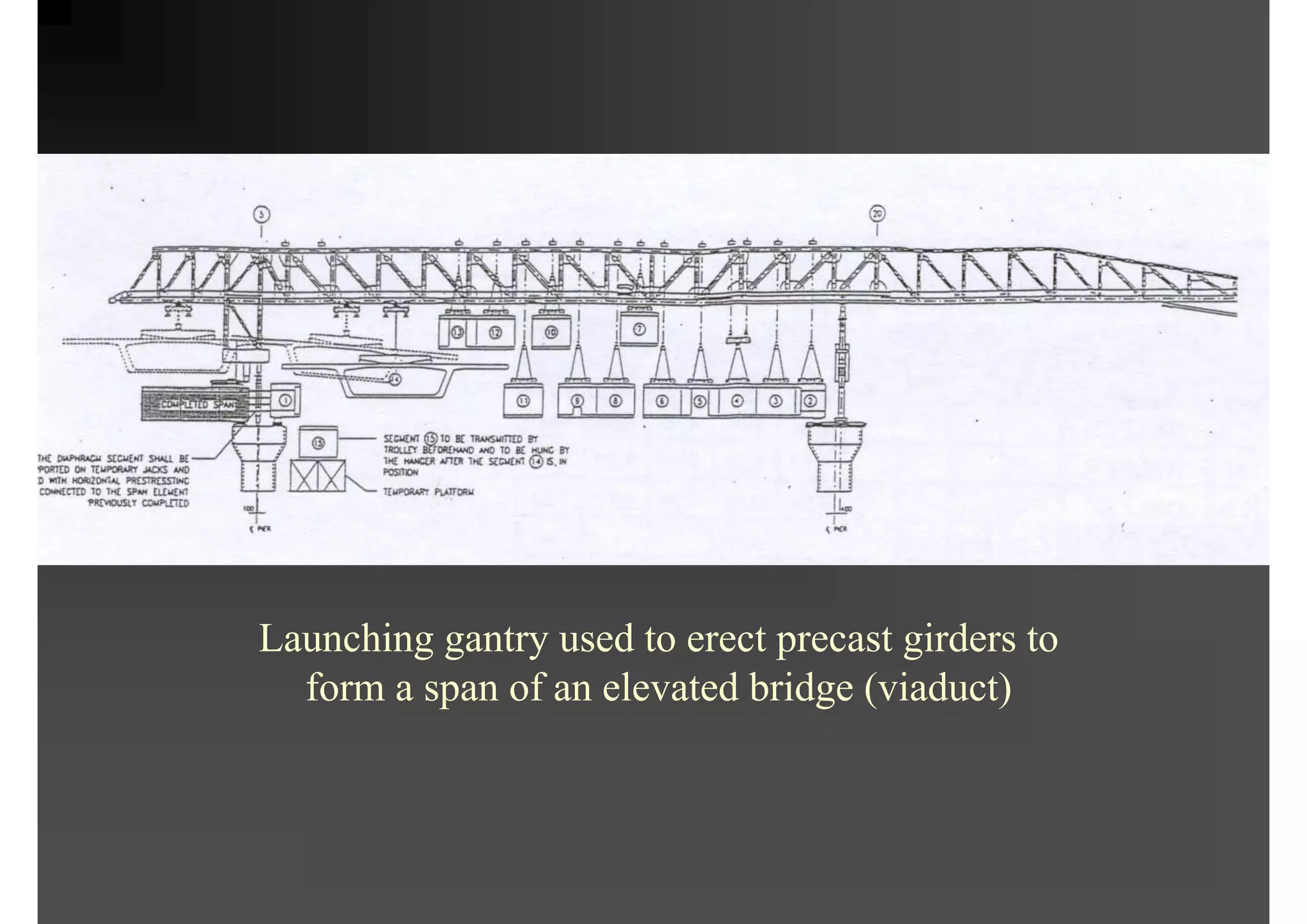
Launching gantry used to erect precast girders to
form a span of an elevated bridge (viaduct)
Cast the first section of bridge
Push the first section of bridge deck
outward using hydraulic jack. Use the same
formwork to cast the second section of deck
Temporary support
in the mid-span
Abutment or bridge
pier to support the
first bridge
Temporary support to be removed
after the deck being tensioned
Concept of Incremental
Launching method
Remaining roadwork to be
continued on both ends of the span
Formwork to cast the 2nd
section of bridge deck
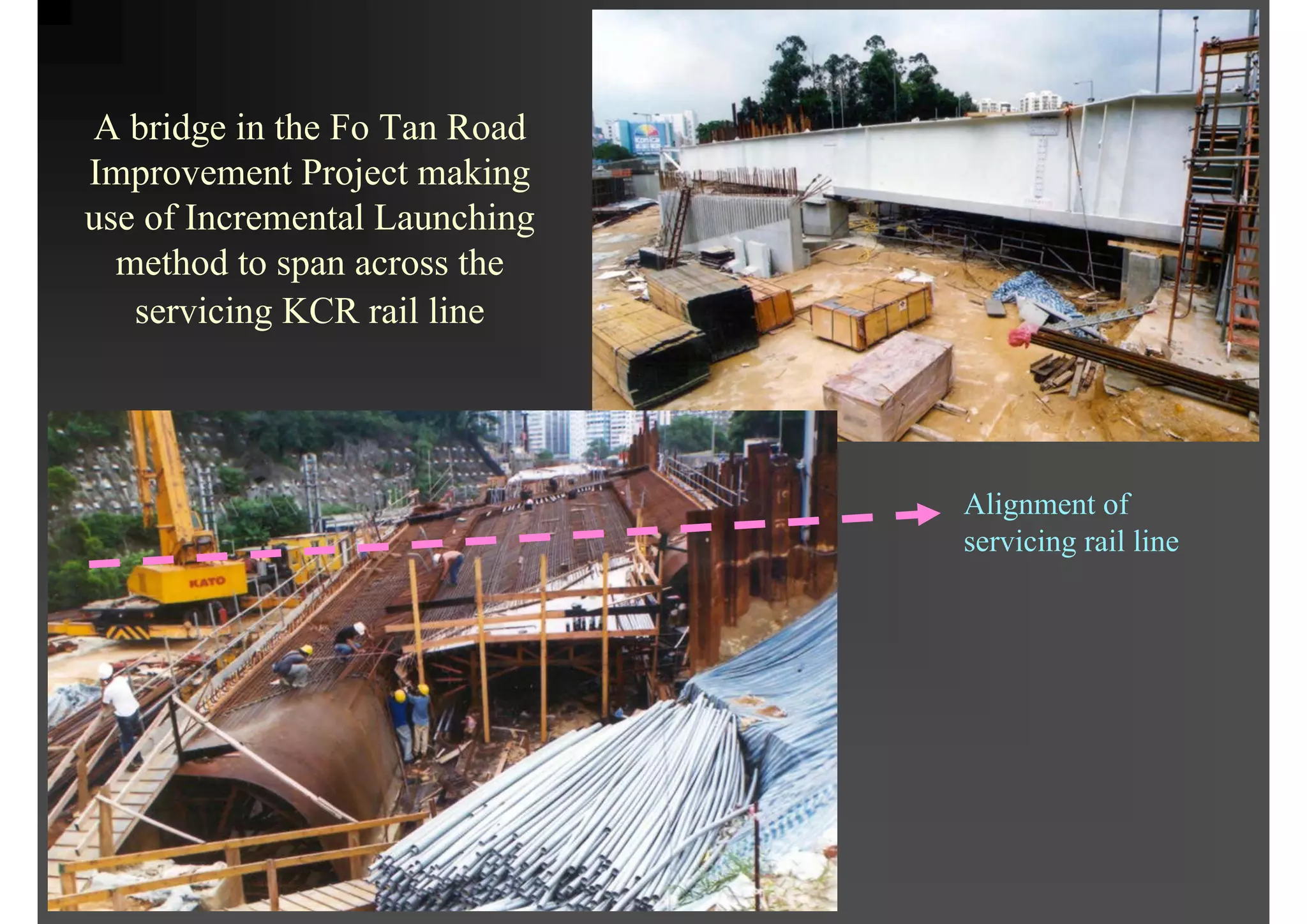
A bridge in the Fo Tan Road
Improvement Project making
use of Incremental Launching
method to span across the
servicing KCR rail line
Alignment of
servicing rail line
Constructing the linking bridge between Tung Chung and Chek lap Kok
(the Airport Railway) using Incremental Launching method
– elevated roadway constructed in the
form of viaduct
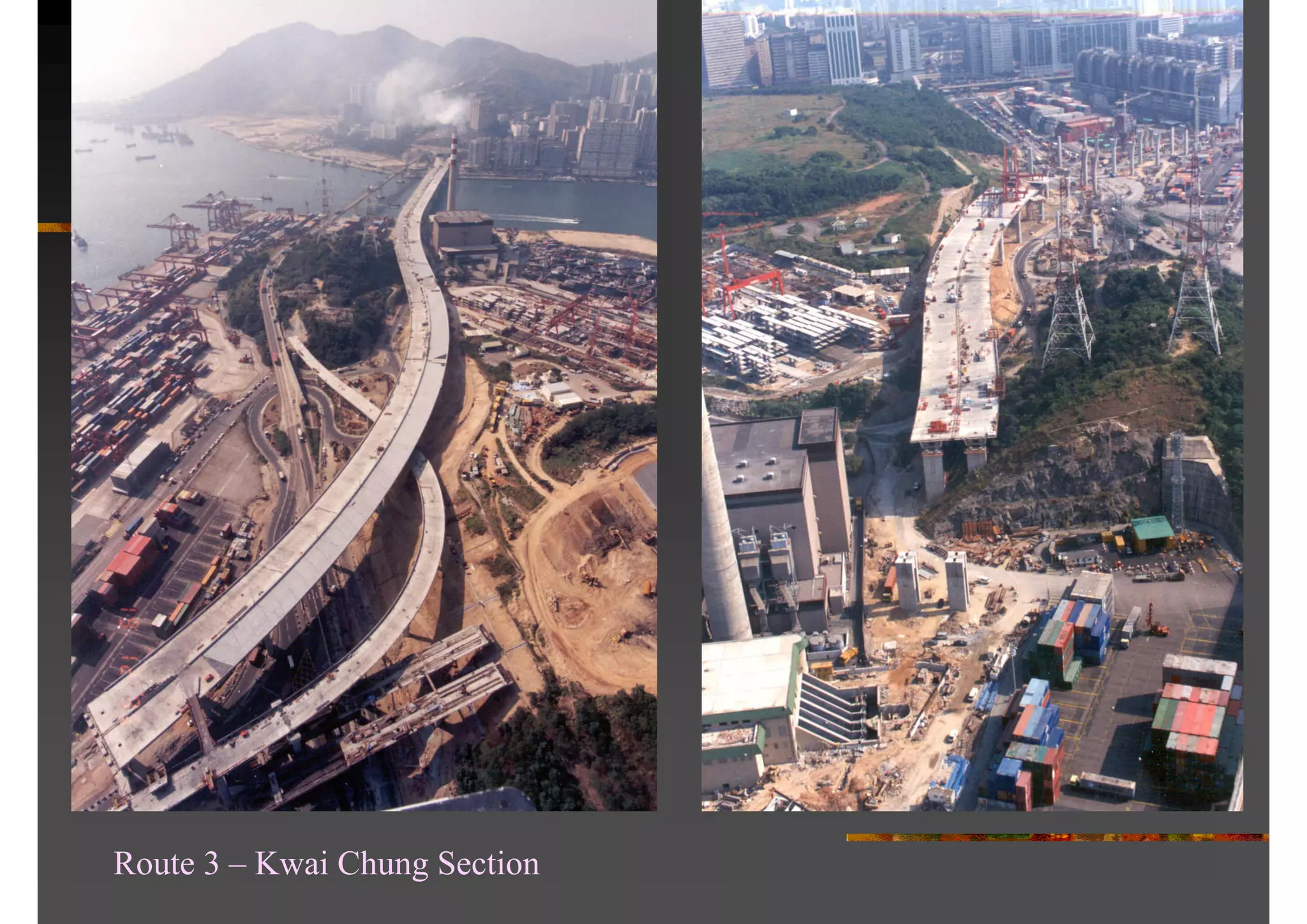
Route 3 – Kwai Chung Section
Route 3 – Country Park Section at Au Tau Interchange
Hung Hom Bypass
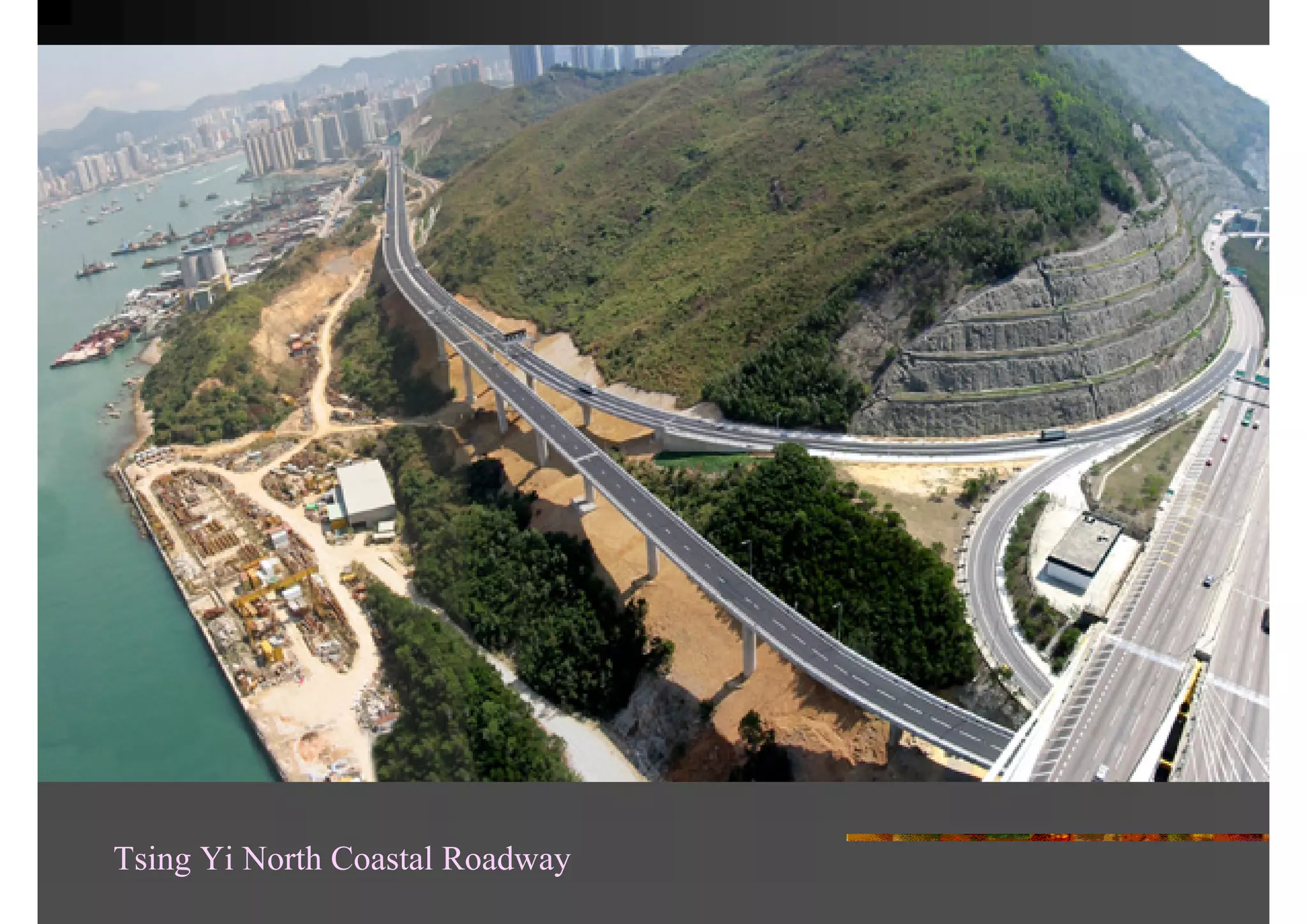
Tsing Yi North Coastal Roadway
Highway project in
Ma On Shan
Launching gantry used in the Hung Hom Bypass
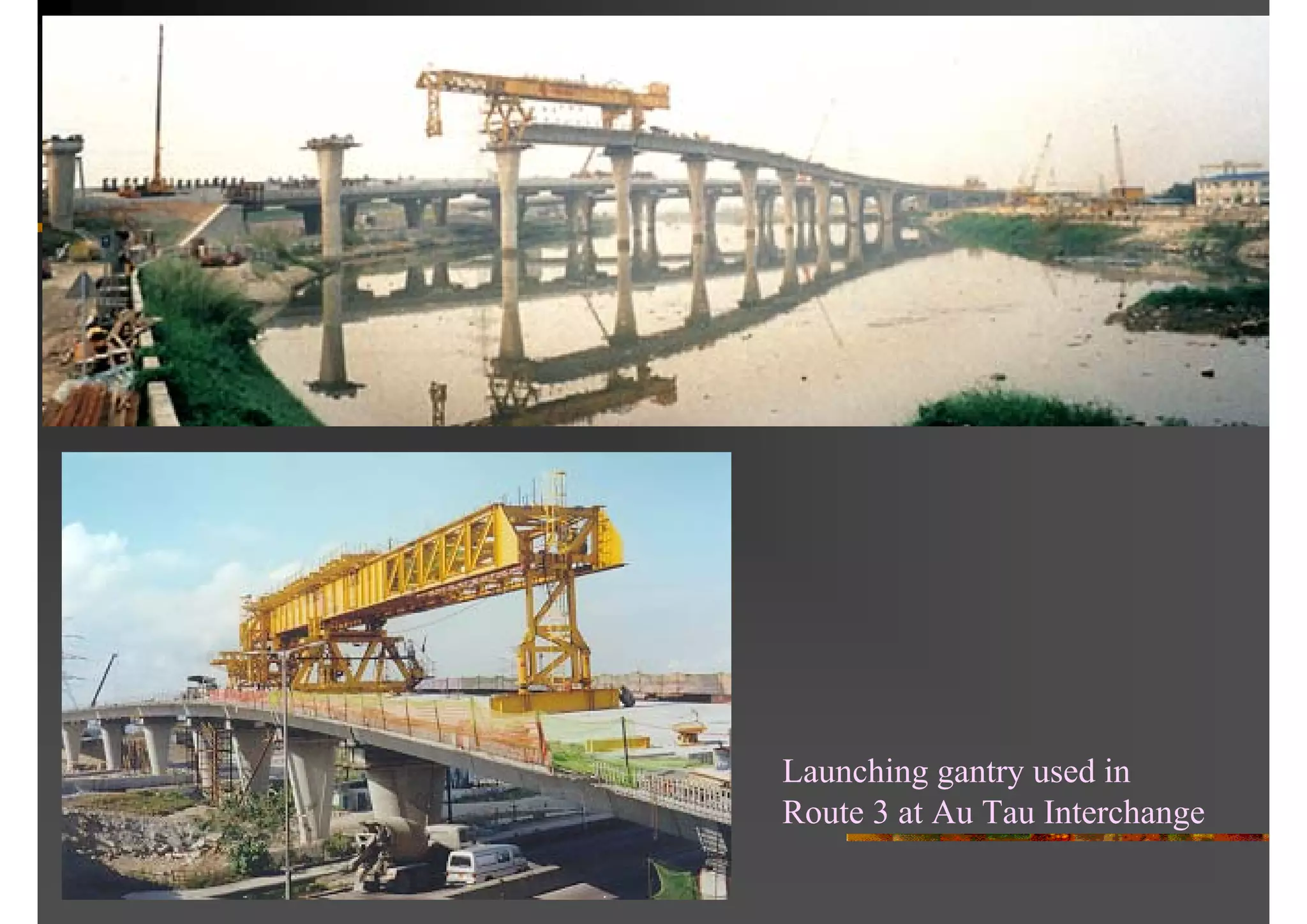
Launching gantry used in
Route 3 at Au Tau Interchange
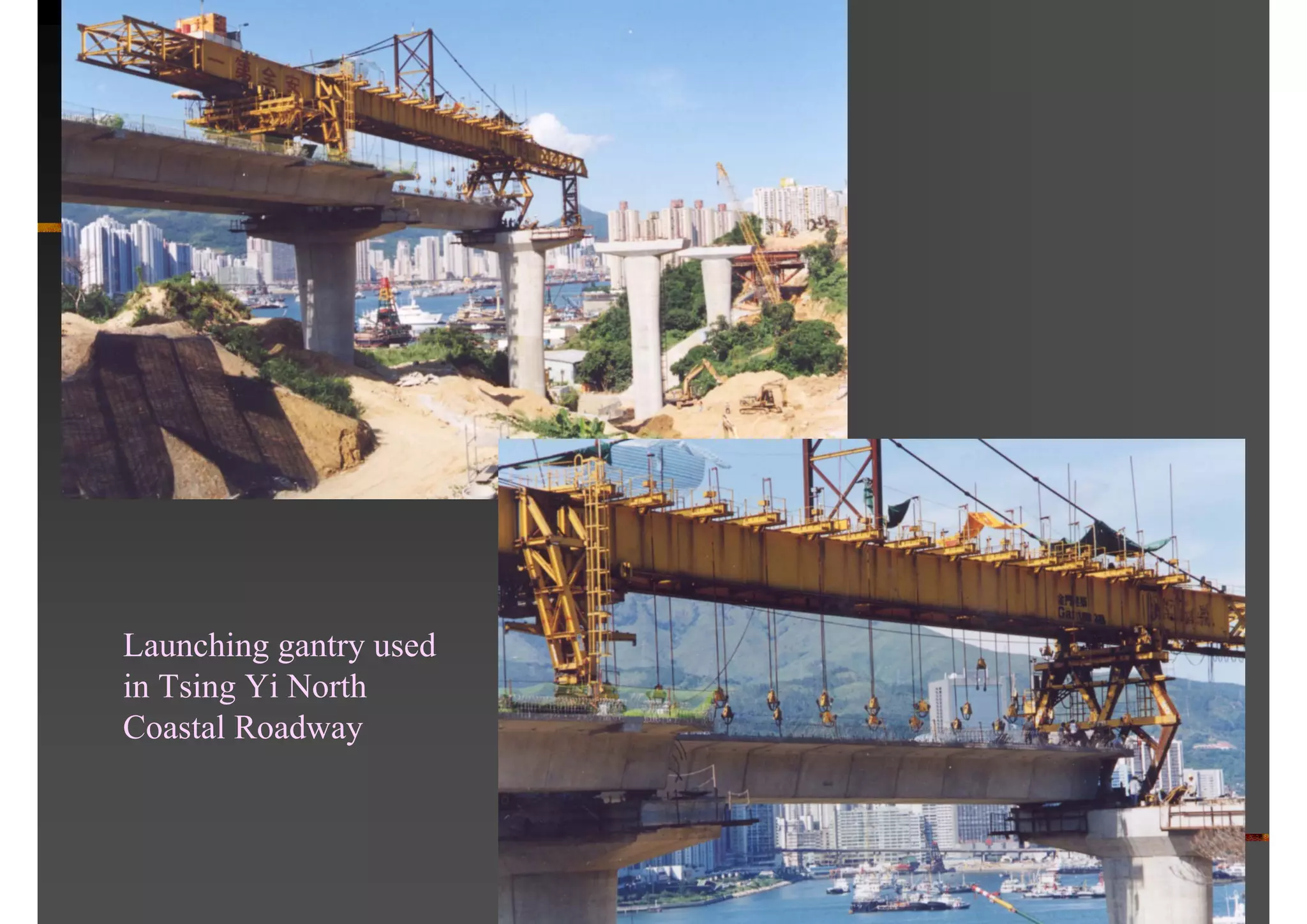
Launching gantry used
in Tsing Yi North
Coastal Roadway
Launching gantry used in the Ma On Shan highway project (T7)
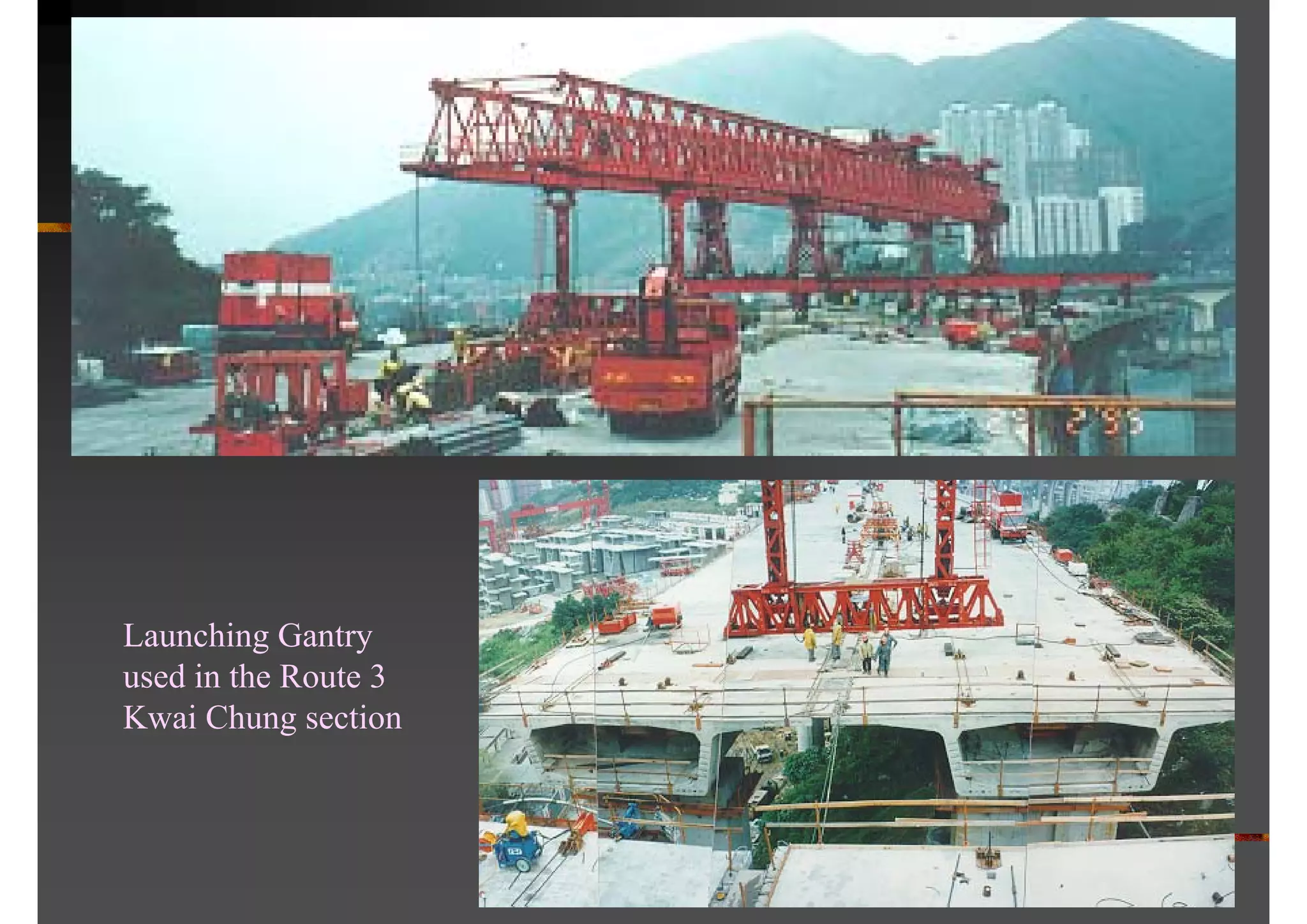
Launching Gantry
used in the Route 3
Kwai Chung section
Launching Gantry
used in the Route 8
Tsing Yi Section
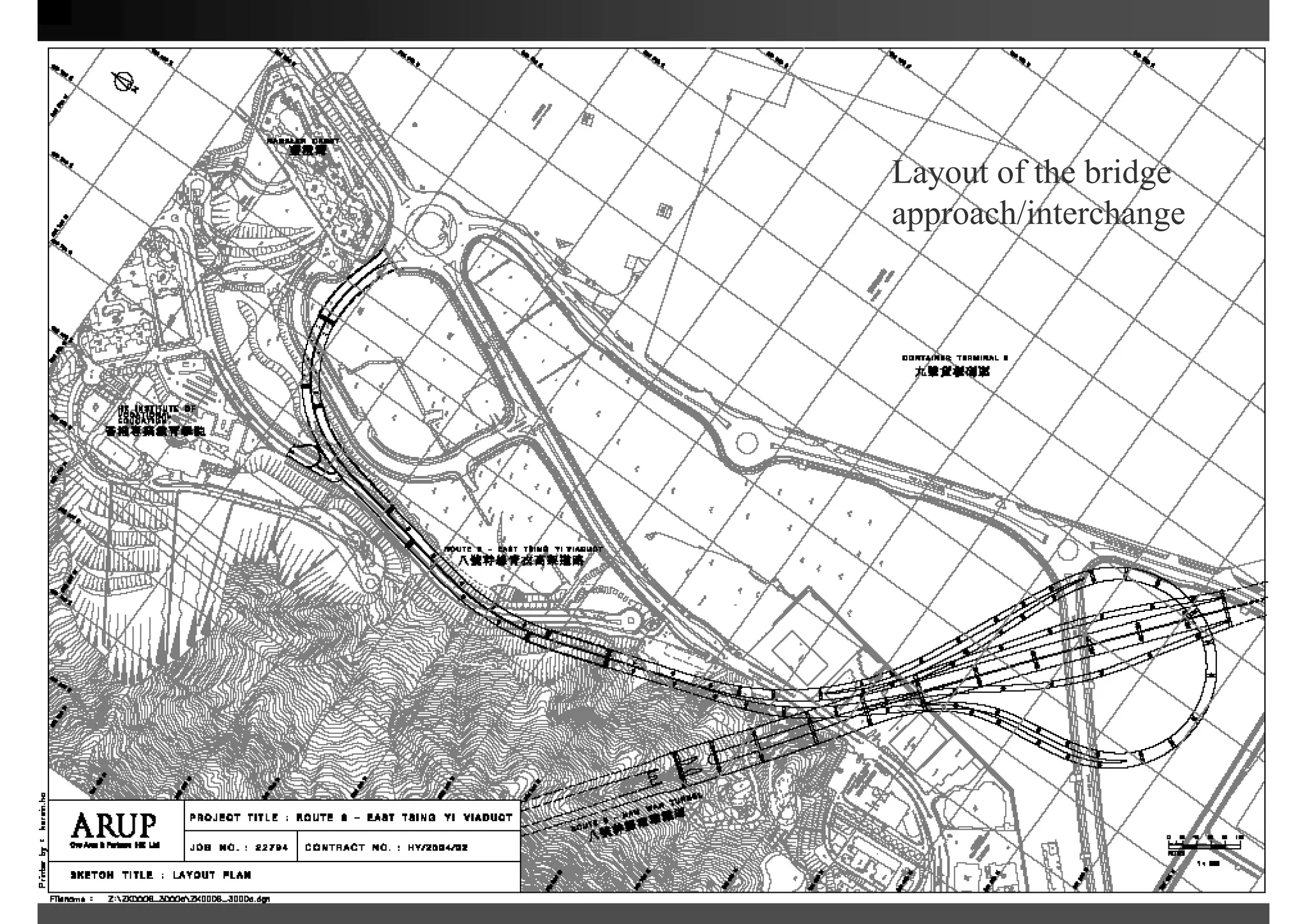
Layout of the bridge
approach/interchange
The bridge approach/interchange after completion
Front leg
Master winch
Rear leg
Slave winch
Rear
support
Hangers
Front
support
116m long
Main Truss
(For end span and 1st pair segment erection)(SWL = 105 T)
(SWL = 120T)
Elevation of the Launching Machine
A review of other highway and
railway bridges
– construction of the viaduct systems
for the West Rail projects
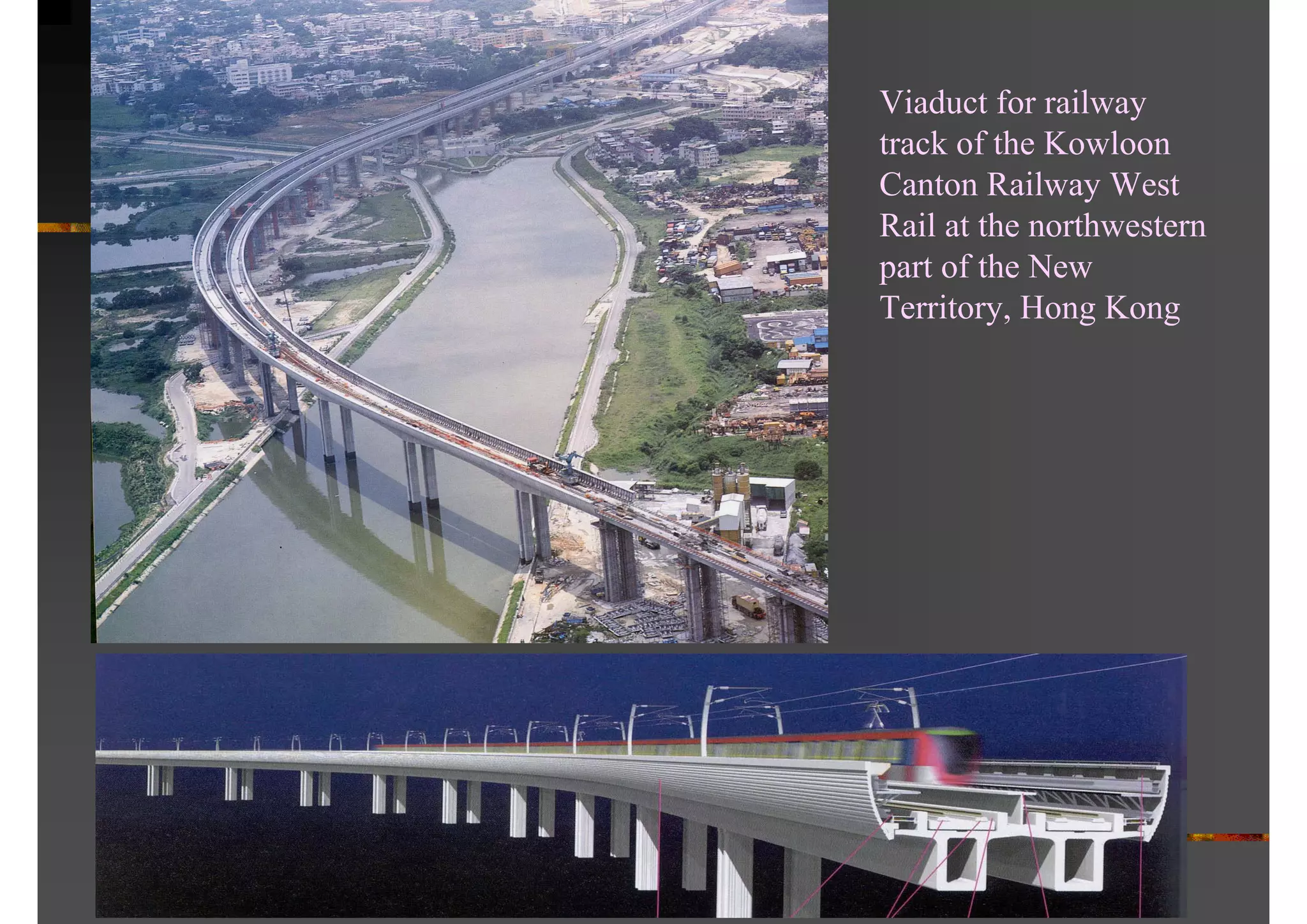
Viaduct for railway
track of the Kowloon
Canton Railway West
Rail at the northwestern
part of the New
Territory, Hong Kong
Some sections of viaduct
spanning more than 40m
at Au Tau Interchange
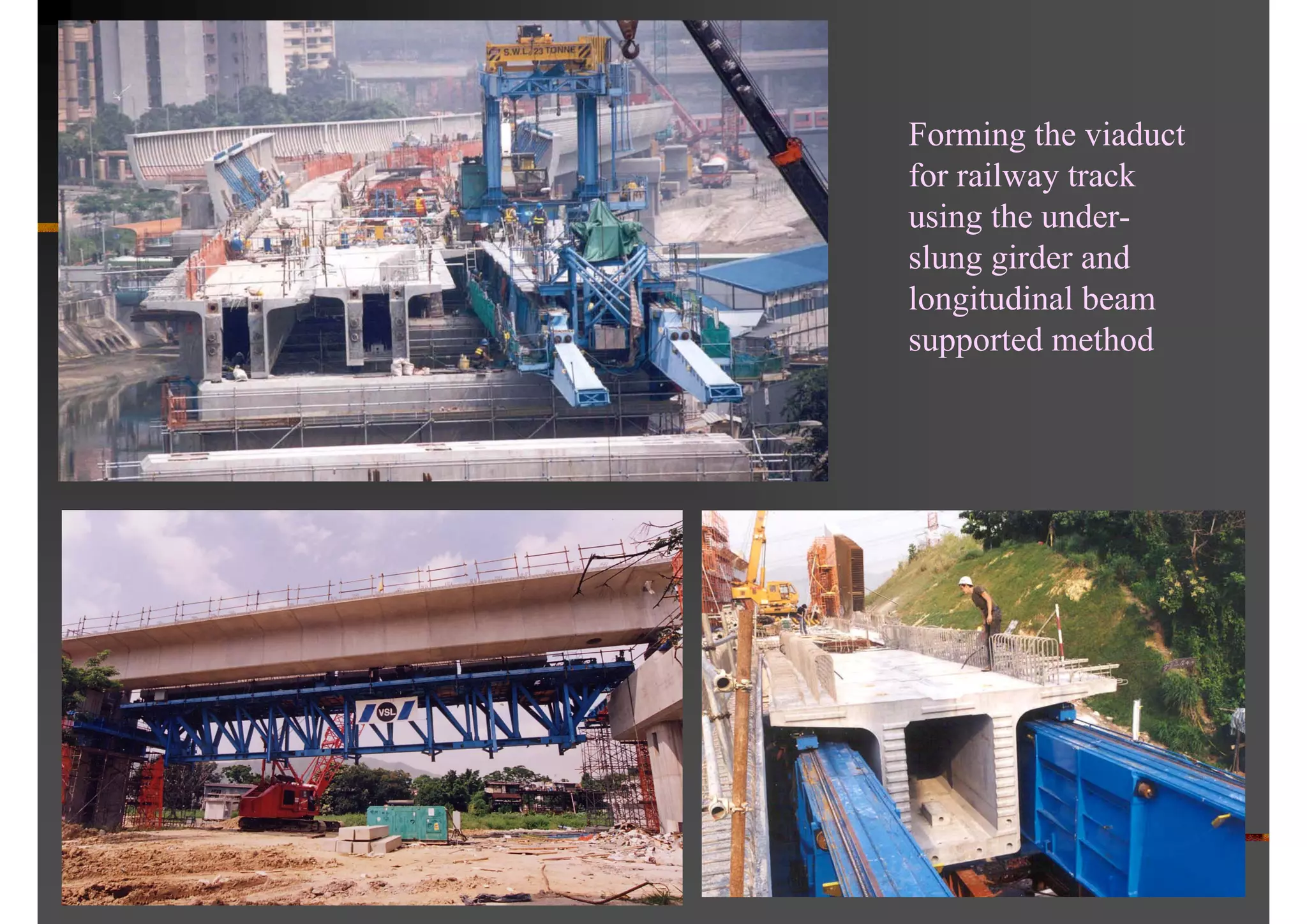
Forming the viaduct
for railway track
using the under-
slung girder and
longitudinal beam
supported method
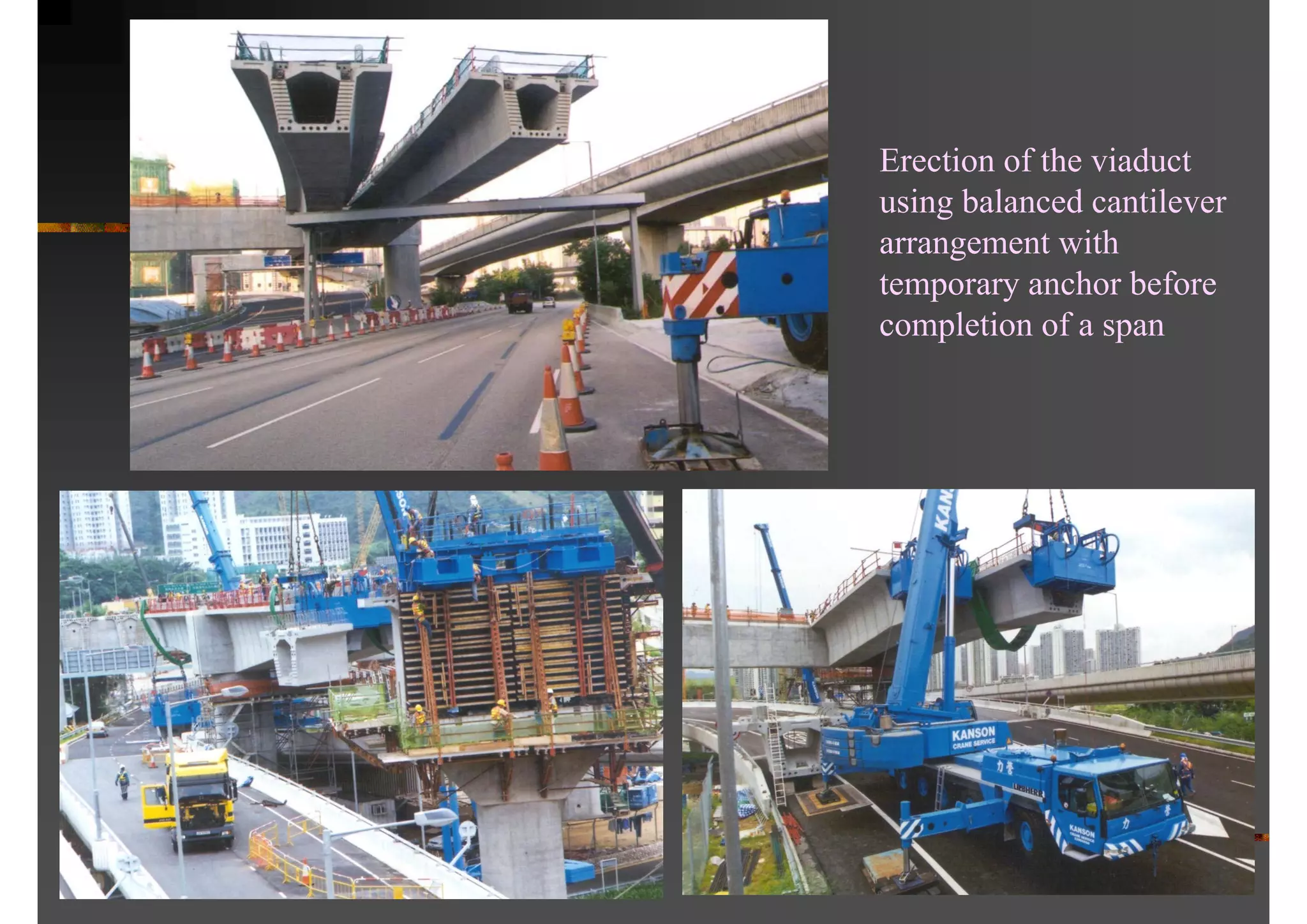
Erection of the viaduct
using balanced cantilever
arrangement with
temporary anchor before
completion of a span
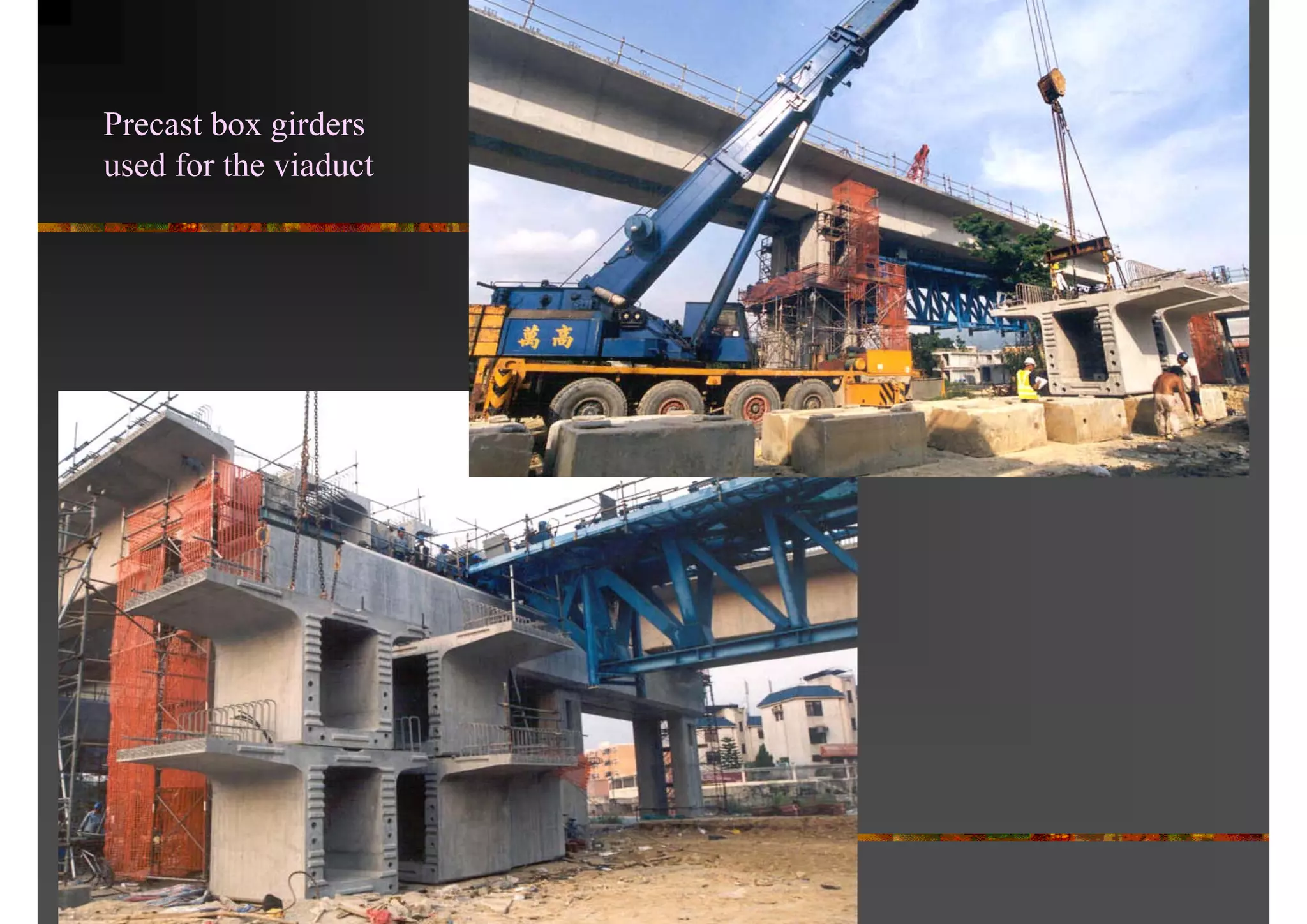
Precast box girders
used for the viaduct
A section of viaduct with provision for an extension to the future northern link
Case study –
construction of the
Stonecutters Bridge
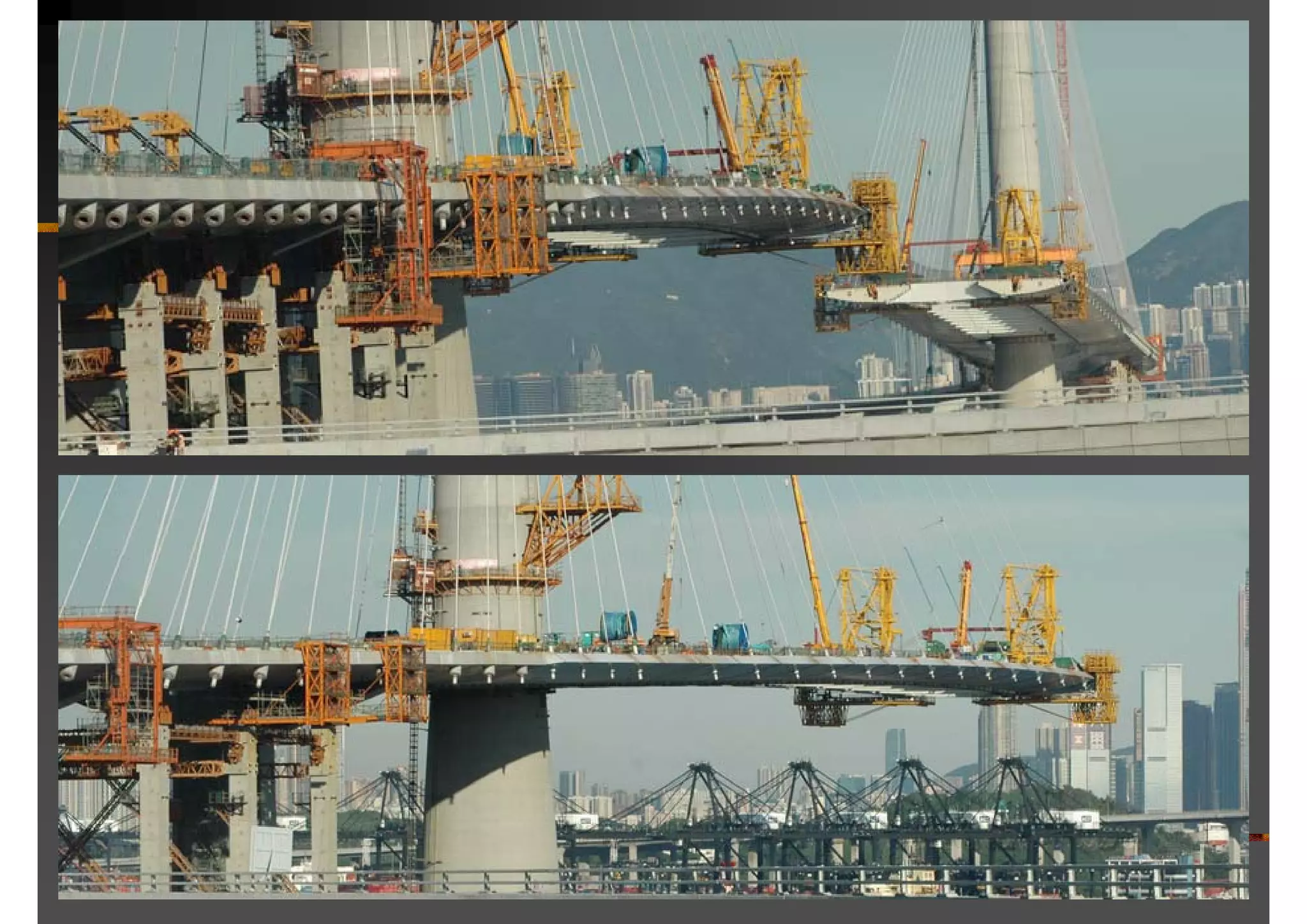
Erection for main span
steel deck segments
Lifting gantry for
the lifting of the
steel deck segment
The 1088m span of the
bridge deck approaching its
closing up at the mid-span.
Other innovative example of bridge form,
the Helix, Marina Bay, Singapore
Other innovative example of bridge form,
the Helix, Marina Bay, Singapore
Other innovative example of bridge form, the Helix, Marina Bay, Singapore
The Helix, structural details
The end of the presentation

Bridge construction atlas

  • 1.
    Construction of Bridges Informationprepared by Raymond Wong Division of Building Science and Technology, City University of Hong Kong January 2012 e-mail of Raymond Wong bswmwong@cityu.edu.hk
  • 2.
    Materials suitable forthe Construction of Long-span Bridges 1. Stone – in arch masonry 2. Steel – in girder or box-section constructed in steel plates and standard sections 3. Steel – truss constructed of standard sections 4. Reinforced Concrete – in arch or spanned forms 5. Tensioned RC – in various forms 6. Precast – mainly in box-section girder
  • 3.
  • 4.
    Simple Supported –span effective from 10m to 60m Actual example – Route 3 Interchange at Au Tau, Yuen Long
  • 5.
    Continuous Span –from 10m to 100m Actual example – construction of a span of continual section of elevated highway bridge at Route 3, Kwai Chung
  • 6.
    Balanced Cantilever –span from 25m to 200m Actual example – balanced cantilever bridge series forming the approach to the Ting Kau Bridge
  • 7.
    Balanced cantilever bridge forviaduct of West Rail at Au Tau Interchange
  • 8.
    Balanced Cantilever SuspendedSpan – span from 50m to 300m
  • 9.
    Steel Truss –50m to 100m Actual example – 5-span steel truss bridge in western part of Pearl River, Guangzhou
  • 10.
    Footbridge (Langham Place) about25m span constructed using steel truss supported on bearing beam on two sides and with a suspended deck erected afterward Main truss A suspended deck from the main truss will become the pedestrian walkway afterward
  • 11.
  • 12.
    Steel Arch (framedor trussed) – from 150m to 500m
  • 13.
  • 14.
    Close up viewof the bridge trusses
  • 15.
    Close up ofthe bridge at the tower support
  • 16.
    Steel arch-truss bridgecrossing Pearl River Delta for the China Express Rail
  • 17.
    Steel arch-truss bridgeis very common and can be found in many parts of the world
  • 18.
    Concrete Arch (ribbedor unribbed) – from 50m to 300m
  • 19.
  • 20.
    Steel Arch –from 100m to 500m
  • 21.
    The actual example– LuPoa Bridge, Shanghai (550m main span)
  • 22.
    Cable suspension –from 400m to 1500m The 1377m span Tsing Ma Bridge
  • 23.
  • 24.
  • 25.
    Cable stayed (multi-spanned)– from 50 to 500m per span The 3-span cable-stayed Ting Kau Bridge
  • 26.
    The Kap ShiuMun Bridge, Lantau Link
  • 27.
  • 28.
    Nanpu Bridge and theapproach bridge, Shanghai
  • 29.
    Cable stayed span– from 200m to 800m Actual example – the connecting bridge from Macau Mainland to the Island of Taipa in Macau
  • 30.
  • 31.
    A traffic interchangeusing large amount steel section deck for elevated bridges ( Rainbow Bridge, Toyko)
  • 33.
    Structural Elements forTypical Bridges 1. Foundation foundation is required to support the bridge towers, portal frames or piers Usual foundation methods such as H-pile, pipe-pile, bore- pile or precast concrete pile can be used for such purpose. 2. Bridge Tower This is the vertical supporting structure only for cable suspension or cable-stayed bridges. The tower is usually construction in high-strength concrete using in-situ method. Mechanical climb form is most efficient for casting the bridge tower. In some cases, the tower can be constructed in a structural frame type.
  • 34.
    The foundation of thebridge tower of Ting Kau Bridge on Tsing Yi side
  • 35.
    The foundation forthe Bridge Tower of Tsing Ma Bridge on the Tsing Yi side
  • 36.
    Foundation of bridgesmay need to be carried out in very difficult location such as along an un-accessible slope
  • 37.
    Structural Elements forTypical Bridges 3. Pier is the vertical supporting structure for usual spanned bridges. Pier is more suitable for bridge with maximum width of deck up to about 8m (2 traffic lanes). Usually bridge pier is constructed using in-situ method with large panel formwork. 4. Portal frame A portal usually consists on two piers on each side with cross beam in between to support the deck. In this case the width of deck can be up to 20m (6 traffic lanes). In some situations the height of a portal frame can be up to 50m from ground. Climb form can be used in this high- headroom cases. The erection of a complicated falsework system to support the portal construction is usually involved.
  • 38.
    Forming the foundationfor piers of elevated highway bridges
  • 39.
  • 40.
    Pier supports foran elevated roadway A portal frame serving also as a transfer beam in the Route 3/Airport Railway at Kwai Chung
  • 41.
  • 42.
    Single piers tosupport the bridge deck Portal frame to support wider deck for multi-lane traffic
  • 43.
    Bridge tower forTsing Ma Bridge and Kap Shiu Mun Bridge Tsing Ma Tower
  • 44.
    Bridge tower forStonecutter Bridge
  • 45.
    Bridge tower &side span/approach bridge of Stonecutter Bridge
  • 46.
    Structural Elements forTypical Bridges 5. Bridge deck – the horizontal part of a bridge that support pedestrian or traffic activities. The construction methods for the deck is shown in the following slides. 6. Bridge anchor – required only for suspension or cable-stay bridges to resist the pull from the suspension cable or counter-span of the bridge. Bridge anchor can be of gravity type using great mass for the counter-balancing, or using ground anchors for the same purpose. 7. Suspension cable – for suspension and cable-stayed bridges for the hanging, support or counter-balancing of the bridge deck
  • 47.
    The forming ofthe cable anchor of Tsing Ma Bridge on Ma Wan side (this is a gravity anchor weighting about 300,000 tons to resist the pull from the suspension cable)
  • 48.
    The forming ofthe cable anchor of Tsing Ma Bridge on Tsing Yi side
  • 49.
    Cable anchor ofTsing Ma Bridge on Ma Wan side with the suspension cable fixed onto it. The anchor structure also serves as the abutment for the future bridge deck
  • 50.
    Spinning of thesuspension cable using steel thread (33000 thread each of 3mm diameter forming a 1.1m cable)
  • 51.
    Forming the deckof the approach section of Tsing Ma Bridge on Ma Wan side using erection and hoisting approach
  • 52.
    Forming the deckof the approach section of Tsing Ma Bridge on Tsing Yi side
  • 53.
    Completing the deckof Tsing Ma Bridge (abutting section at Tsing Yi side) by erecting of the steel truss at spot
  • 54.
    Hoisting and erecting ofthe modulated bridge deck for the Tsing Ma Bridge
  • 55.
    Forming the bridgedeck of Ting Kau Bridge using modulated steel girder frames
  • 56.
    Laying the precastdeck of the steel girder frame
  • 57.
    Other methods toform the deck of bridges 1. Balanced cantilever method 2. Construct in-situ 3. Construct using precast beam 4. Construct using precast girder section and erected by a launching machine (viaduct) 5. Construct using incremental launching method (the photos of project cases as shown in the following pages are for reference only in order to help students to understand more about bridge construction)
  • 58.
    Forming the deckof using balanced-cantilever traveling formwork system
  • 59.
    Detail of thetraveling formwork system
  • 60.
  • 61.
    Construction of asection of elevated railway track in the KCR Ma On Shan Line using in-situ method
  • 62.
    Construction of anextension section of elevated roadway as part of the Tolo Harbor Highway extension project
  • 63.
    Construction of asection of elevated roadway using in-situ method Special points to note: - The provision of a adequate falsework system to support the formwork with the weight of concrete during concreting process. - Allow temporary road traffic on the ground level for general public or for site operation.
  • 64.
    Usual falsework set-upfor the construction of in-situ deck
  • 65.
    Formwork and steelfixing work on the in-situ deck
  • 66.
    The laying ofprecast beams to form the deck of the Route 3 elevated roadway at Kwai Chung. A truss-type launching machine was used for the lifting and positioning of the precast beams.
  • 67.
    Hoisting of theprecast beams using a special launching gantry
  • 68.
    Precast beams supported bythe bridge pier/portal
  • 69.
    Precast concrete planksare used to cover the gaps between the beams
  • 70.
    Construction of an elevatedhighway bridge using precast girder erected by the use of a launching machine
  • 71.
    Launching gantry usedto erect precast girders to form a span of an elevated bridge (viaduct)
  • 72.
    Cast the firstsection of bridge Push the first section of bridge deck outward using hydraulic jack. Use the same formwork to cast the second section of deck Temporary support in the mid-span Abutment or bridge pier to support the first bridge Temporary support to be removed after the deck being tensioned Concept of Incremental Launching method Remaining roadwork to be continued on both ends of the span Formwork to cast the 2nd section of bridge deck
  • 73.
    A bridge inthe Fo Tan Road Improvement Project making use of Incremental Launching method to span across the servicing KCR rail line Alignment of servicing rail line
  • 74.
    Constructing the linkingbridge between Tung Chung and Chek lap Kok (the Airport Railway) using Incremental Launching method
  • 75.
    – elevated roadwayconstructed in the form of viaduct
  • 76.
    Route 3 –Kwai Chung Section
  • 77.
    Route 3 –Country Park Section at Au Tau Interchange
  • 78.
  • 79.
    Tsing Yi NorthCoastal Roadway
  • 80.
  • 81.
    Launching gantry usedin the Hung Hom Bypass
  • 82.
    Launching gantry usedin Route 3 at Au Tau Interchange
  • 83.
    Launching gantry used inTsing Yi North Coastal Roadway
  • 84.
    Launching gantry usedin the Ma On Shan highway project (T7)
  • 85.
    Launching Gantry used inthe Route 3 Kwai Chung section
  • 86.
    Launching Gantry used inthe Route 8 Tsing Yi Section
  • 90.
    Layout of thebridge approach/interchange
  • 91.
  • 92.
    Front leg Master winch Rearleg Slave winch Rear support Hangers Front support 116m long Main Truss (For end span and 1st pair segment erection)(SWL = 105 T) (SWL = 120T) Elevation of the Launching Machine
  • 93.
    A review ofother highway and railway bridges – construction of the viaduct systems for the West Rail projects
  • 94.
    Viaduct for railway trackof the Kowloon Canton Railway West Rail at the northwestern part of the New Territory, Hong Kong
  • 95.
    Some sections ofviaduct spanning more than 40m at Au Tau Interchange
  • 96.
    Forming the viaduct forrailway track using the under- slung girder and longitudinal beam supported method
  • 97.
    Erection of theviaduct using balanced cantilever arrangement with temporary anchor before completion of a span
  • 98.
    Precast box girders usedfor the viaduct
  • 99.
    A section ofviaduct with provision for an extension to the future northern link
  • 100.
    Case study – constructionof the Stonecutters Bridge
  • 102.
    Erection for mainspan steel deck segments
  • 104.
    Lifting gantry for thelifting of the steel deck segment
  • 105.
    The 1088m spanof the bridge deck approaching its closing up at the mid-span.
  • 106.
    Other innovative exampleof bridge form, the Helix, Marina Bay, Singapore
  • 107.
    Other innovative exampleof bridge form, the Helix, Marina Bay, Singapore
  • 108.
    Other innovative exampleof bridge form, the Helix, Marina Bay, Singapore
  • 109.
    Other innovative exampleof bridge form, the Helix, Marina Bay, Singapore
  • 110.
  • 111.
  • 112.
  • 113.
    The end ofthe presentation