Work
Readine
ss Skills
What are Work Readiness
Skills?
Why Work Readiness Skills?
• Minimizes additional on-the-job training
• Work readiness skills required in order to be
promoted into management
• Work is becoming very service-oriented
• New technologies and changing work
environments require adaptability
• Interacting with people from many backgrounds
requires cultural competence
Group task
•How does your picture
relate to your word?
•How would you define
this skill?
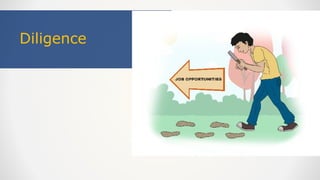
Diligence
Diligence: Takes initiative, works hard to do his or her
best work, pays attention to detail and quality, and is
able to set and achieve goals
Taking initiative at work, work ethic
Takes initiative and responsibility for his/her own work
Knows how to work under and respect supervision
Hard work and perseverance
Is willing to work hard and persists to accomplish a task in
the face of difficulty
Demonstrates steady effort
Seeks help when needed
Attention to detail
Is conscientious and pays attention to details
Is disciplined in terms of delivery
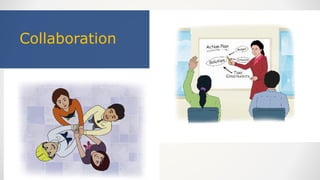
Collaboration
Collaboration: Works well with others to
achieve individual and group goals in a
variety of settings
Cooperating and work as a team member
Works with others to achieve individual and
group goals
Understands that team members need each
other in order to complete the group’s task
(positive interdependence)
Gets along well with others, in a variety of
settings and for a range of purposes
Leading teamwork/group cooperation
Motivates and organizes others and able to
lead a team in accomplishing its goals
Promotes social skills— leadership, decision-
making, trust-building, communication, and
conflict-management
Promotes other group members’ learning by
helping, sharing, and encouraging them
Is responsible for, and accountable to
teammates by, completing some part of the
task
Communicating in a collaborative team
Explains, discusses, and teaches what he/she
knows to other team members
Gets along well with others, in a variety of
settings and for a range of purposes
Group reflection
As a team, reflects on their own learning on
their work in order to improve overall
performance
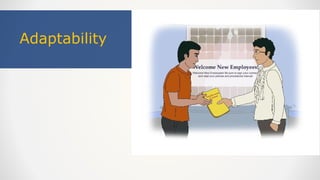
Adaptability
Adaptability: Receptive to change and
solve problems as they arise
Workplace behavior and attitudes
Demonstrates behavior and attitudes that are appropriate for the
workplace
Incorporates feedback effectively; deals positively with praise, setbacks,
and criticism
Understands that workplaces have policies and procedures that need to be
followed
Adapts to varied roles, jobs, responsibilities, schedules, and context
Flexible Thinking and Behavior
Receptive to change and able to identify a new course of action when
things do not go as planned or expected
Anticipates and responds positively to changing environments
Balances diverse views and beliefs to reach workable solutions
Taking on Challenges
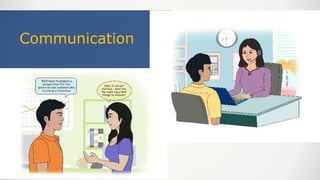
Communication
Communication: Communicates clearly
and gets along well with others for a
range of purposes
Listening skills and speaking strategies,
speaking with clarity
Speaks and listens actively and appropriately
one-on-one and in groups
Speaks clearly and directly
Listens actively to improve understanding
Treats the ideas of others respectfully and
develops mutual trust
Giving presentations
Gives presentations about with confidence
and clarity
Engages the audience and pays attention to
their needs
Communicates clearly, concisely, and
naturally
Makes eye contact, and uses non-verbal cues
to engage the audience
Uses well-designed visual aids
Recognizing nonverbal communication
Recognizes nonverbal cues in themselves and
others
Giving and receiving instructions and feedback
Follows instructions and seeks clarification
Asks questions
Gives clear instructions to others
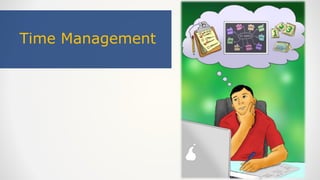
Time Management
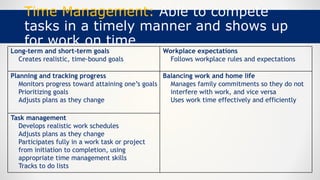
Time Management: Able to compete
tasks in a timely manner and shows up
for work on time
Long-term and short-term goals
Creates realistic, time-bound goals
Workplace expectations
Follows workplace rules and expectations
Planning and tracking progress
Monitors progress toward attaining one’s goals
Prioritizing goals
Adjusts plans as they change
Balancing work and home life
Manages family commitments so they do not
interfere with work, and vice versa
Uses work time effectively and efficiently
Task management
Develops realistic work schedules
Adjusts plans as they change
Participates fully in a work task or project
from initiation to completion, using
appropriate time management skills
Tracks to do lists
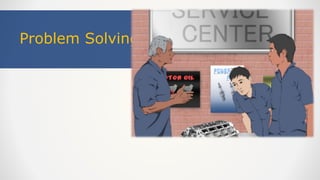
Problem Solving
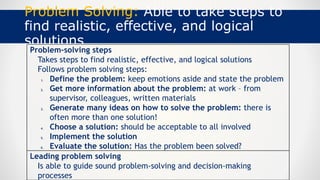
Problem Solving: Able to take steps to
find realistic, effective, and logical
solutions
Problem-solving steps
Takes steps to find realistic, effective, and logical solutions
Follows problem solving steps:
1. Define the problem: keep emotions aside and state the problem
2. Get more information about the problem: at work – from
supervisor, colleagues, written materials
3. Generate many ideas on how to solve the problem: there is
often more than one solution!
4. Choose a solution: should be acceptable to all involved
5. Implement the solution
6. Evaluate the solution: Has the problem been solved?
Leading problem solving
Is able to guide sound problem-solving and decision-making
processes
Reflect on the Project-Oriented
Learning Activity
•How did you develop work readiness
skills in the car sale activity?
•How do learner-centered methods like
project-oriented learning build work
readiness skills?
Prepare 1 brief sentence on each
point to share with the large
group.
How do we do this?
• Relate learning to real world problems
• Complex activities such as project-oriented
learning build work readiness skills by forcing
learners to collaborate, manage their time, solve
problems, etc.
• Build work readiness skills through your class by
teaching in a learner-centered manner
• Keep these skills in mind as you develop
classroom activities
• Lead by example

4 work readiness and reflection on wr and pol

  • 1.
  • 2.
    What are WorkReadiness Skills?
  • 3.
    Why Work ReadinessSkills? • Minimizes additional on-the-job training • Work readiness skills required in order to be promoted into management • Work is becoming very service-oriented • New technologies and changing work environments require adaptability • Interacting with people from many backgrounds requires cultural competence
  • 4.
    Group task •How doesyour picture relate to your word? •How would you define this skill?
  • 5.
  • 6.
    Diligence: Takes initiative,works hard to do his or her best work, pays attention to detail and quality, and is able to set and achieve goals Taking initiative at work, work ethic Takes initiative and responsibility for his/her own work Knows how to work under and respect supervision Hard work and perseverance Is willing to work hard and persists to accomplish a task in the face of difficulty Demonstrates steady effort Seeks help when needed Attention to detail Is conscientious and pays attention to details Is disciplined in terms of delivery
  • 7.
  • 8.
    Collaboration: Works wellwith others to achieve individual and group goals in a variety of settings Cooperating and work as a team member Works with others to achieve individual and group goals Understands that team members need each other in order to complete the group’s task (positive interdependence) Gets along well with others, in a variety of settings and for a range of purposes Leading teamwork/group cooperation Motivates and organizes others and able to lead a team in accomplishing its goals Promotes social skills— leadership, decision- making, trust-building, communication, and conflict-management Promotes other group members’ learning by helping, sharing, and encouraging them Is responsible for, and accountable to teammates by, completing some part of the task Communicating in a collaborative team Explains, discusses, and teaches what he/she knows to other team members Gets along well with others, in a variety of settings and for a range of purposes Group reflection As a team, reflects on their own learning on their work in order to improve overall performance
  • 9.
  • 10.
    Adaptability: Receptive tochange and solve problems as they arise Workplace behavior and attitudes Demonstrates behavior and attitudes that are appropriate for the workplace Incorporates feedback effectively; deals positively with praise, setbacks, and criticism Understands that workplaces have policies and procedures that need to be followed Adapts to varied roles, jobs, responsibilities, schedules, and context Flexible Thinking and Behavior Receptive to change and able to identify a new course of action when things do not go as planned or expected Anticipates and responds positively to changing environments Balances diverse views and beliefs to reach workable solutions Taking on Challenges
  • 11.
  • 12.
    Communication: Communicates clearly andgets along well with others for a range of purposes Listening skills and speaking strategies, speaking with clarity Speaks and listens actively and appropriately one-on-one and in groups Speaks clearly and directly Listens actively to improve understanding Treats the ideas of others respectfully and develops mutual trust Giving presentations Gives presentations about with confidence and clarity Engages the audience and pays attention to their needs Communicates clearly, concisely, and naturally Makes eye contact, and uses non-verbal cues to engage the audience Uses well-designed visual aids Recognizing nonverbal communication Recognizes nonverbal cues in themselves and others Giving and receiving instructions and feedback Follows instructions and seeks clarification Asks questions Gives clear instructions to others
  • 13.
  • 14.
    Time Management: Ableto compete tasks in a timely manner and shows up for work on time Long-term and short-term goals Creates realistic, time-bound goals Workplace expectations Follows workplace rules and expectations Planning and tracking progress Monitors progress toward attaining one’s goals Prioritizing goals Adjusts plans as they change Balancing work and home life Manages family commitments so they do not interfere with work, and vice versa Uses work time effectively and efficiently Task management Develops realistic work schedules Adjusts plans as they change Participates fully in a work task or project from initiation to completion, using appropriate time management skills Tracks to do lists
  • 15.
  • 16.
    Problem Solving: Ableto take steps to find realistic, effective, and logical solutions Problem-solving steps Takes steps to find realistic, effective, and logical solutions Follows problem solving steps: 1. Define the problem: keep emotions aside and state the problem 2. Get more information about the problem: at work – from supervisor, colleagues, written materials 3. Generate many ideas on how to solve the problem: there is often more than one solution! 4. Choose a solution: should be acceptable to all involved 5. Implement the solution 6. Evaluate the solution: Has the problem been solved? Leading problem solving Is able to guide sound problem-solving and decision-making processes
  • 17.
    Reflect on theProject-Oriented Learning Activity •How did you develop work readiness skills in the car sale activity? •How do learner-centered methods like project-oriented learning build work readiness skills? Prepare 1 brief sentence on each point to share with the large group.
  • 18.
    How do wedo this? • Relate learning to real world problems • Complex activities such as project-oriented learning build work readiness skills by forcing learners to collaborate, manage their time, solve problems, etc. • Build work readiness skills through your class by teaching in a learner-centered manner • Keep these skills in mind as you develop classroom activities • Lead by example