Managers as Leaders
Chapter-18
©Tanvir Ahmed
1
Leader & Leadership
• Leader: Someone who can
influence others and who has
managerial authority.
• Leadership: A process of
influencing a group to achieve
goals.
2
Early readership Theories
• People have been interested since they
started coming together in groups to
accomplish goals. However, it wasn’t until
the early part of the twentieth century that
researchers actually began to study
leadership. These early leadership theories
focused on the leader( leadership trait
theories) and how the leader interact with his
or her group members( leadership behavior
theories).
3
Trait Theories
1. Drive.
2. Desire to Lead.
3. Honesty and Integrity.
4. Self-confident.
5. Intelligence.
6. Job-relevant knowledge.
7. Extraversion.
8. Proneness to guilt.
4
Behavioral Theories
• Leadership theories that
identify behaviors that
differentiated effective
leaders from ineffective
leaders.
5
Autocratic Style
• A leader who dictates
work methods, makes
unilateral decisions and
limits employee
participation.
6
Democratic style
• A leader who involves
employees in decision
making, delegates authority,
and uses feedback as an
opportunity for coaching
employees.
7
Laissez–faire style
• A leader who lets the
group make decisions
and complete the work in
whatever way it sees fit.
8
Fiedler contingency model
• A leadership theory proposing
that effective group performance
depends on the proper match
between a leader’s style and the
degree to which the situation
allows the leader to control and
influence.
9
Situational Leadership
Theory(SLT)
• A leadership
contingency theory that
focused on follower’s
readiness.
10
Path-Goal Theory
• A leadership theory that says
the leader’s job is to assist
followers in attaining there
goals and to provide direction
or support needed to ensure
that their goals are compatible
with the goals of the group or
organization.
11
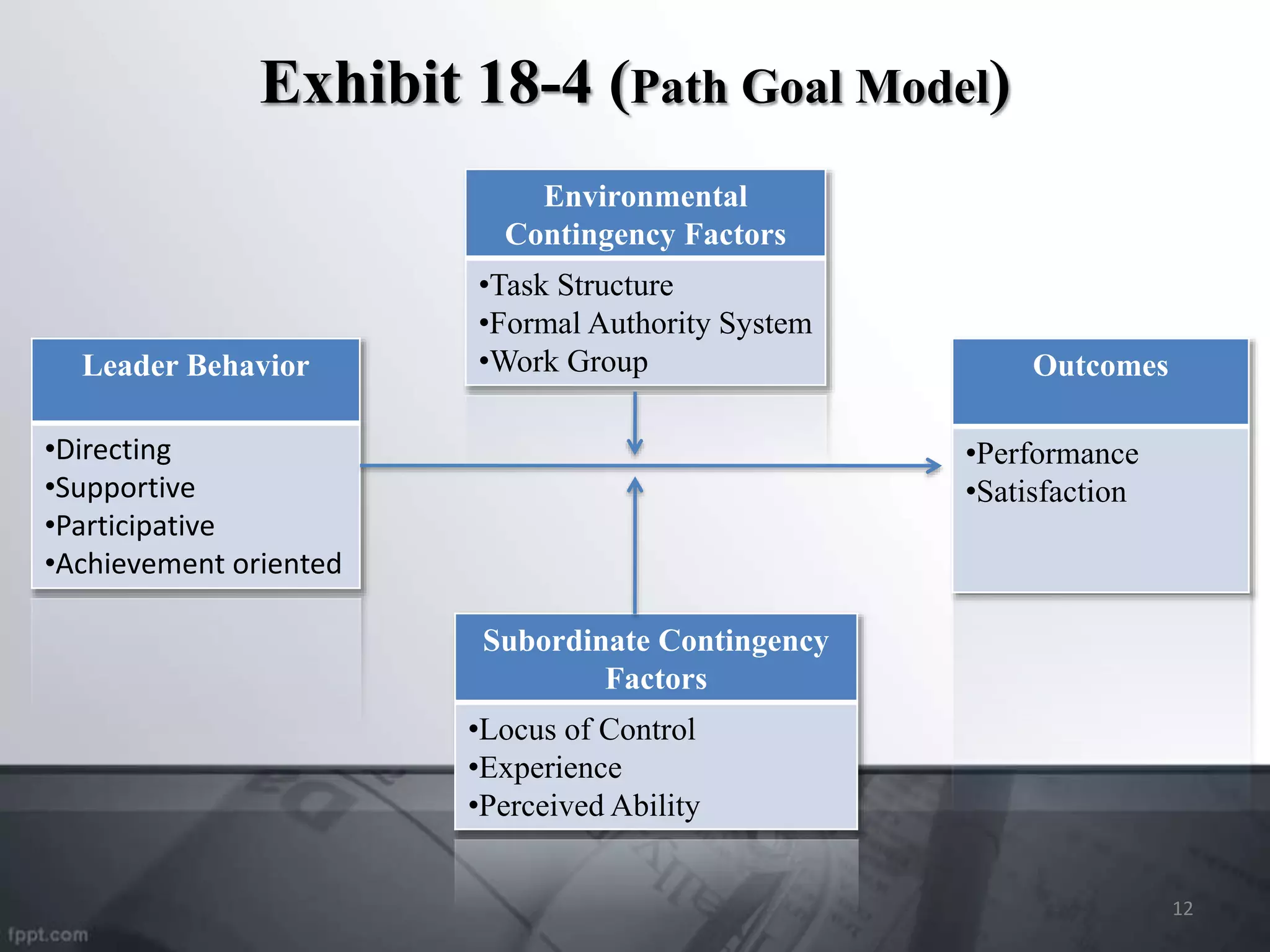
Exhibit 18-4 (Path Goal Model)
Leader Behavior
•Directing
•Supportive
•Participative
•Achievement oriented
Outcomes
•Performance
•Satisfaction
Environmental
Contingency Factors
•Task Structure
•Formal Authority System
•Work Group
Subordinate Contingency
Factors
•Locus of Control
•Experience
•Perceived Ability
12
Contemporary Views of Leadership
1. Leader-Member Exchange theory.
2. Transformational-Transactional
Leadership.
3. Charismatic-Visionary Leadership.
4. Team Leadership
13
Leader-member exchange
theory
• The leadership theory that
says leaders create in-groups
and out-groups and those in
the in-group will have the
higher performance ratings,
less turnover, and grater job
satisfaction.
14
Transformational-Transactional
Leadership
• Transactional leaders: Leaders
who lead primarily by using
social exchange(or transactions).
• Transformational leaders:
Leaders who simulate and
inspire(transform) followers to
achieve extraordinary outcomes.
15
Charismatic-Visionary
Leadership
• Charismatic Leader: An enthusiastic,
self-confident leader whose personality
and actions influence people to behave
in certain way.
• Visionary leadership: The ability to
create and articulate a realistic, credible,
and attractive vision of the future that
improves upon the present situation.
16
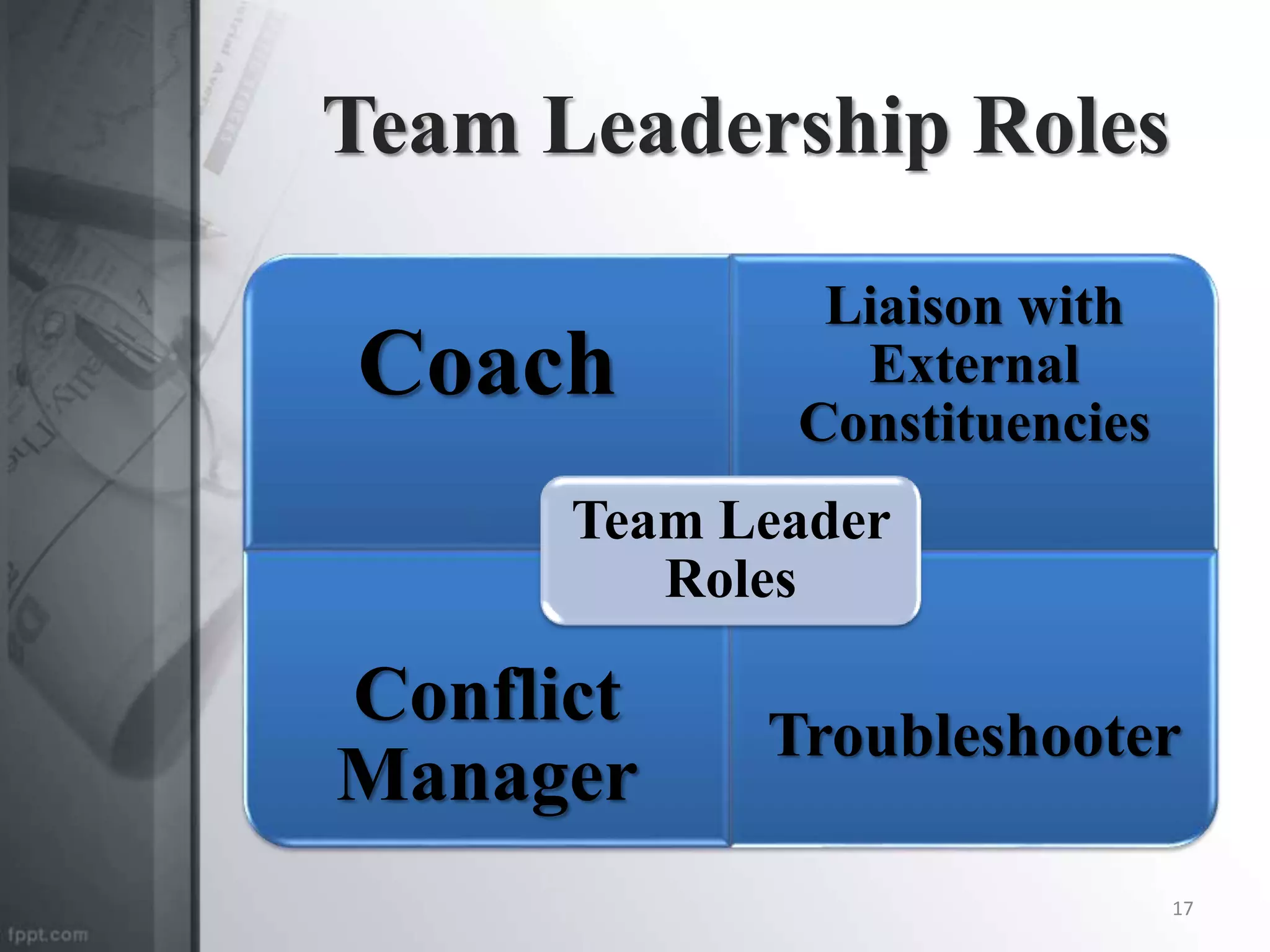
Team Leadership Roles
Coach
Liaison with
External
Constituencies
Conflict
Manager
Troubleshooter
Team Leader
Roles
17

Managers as leaders chapter 18

  • 1.
  • 2.
    Leader & Leadership •Leader: Someone who can influence others and who has managerial authority. • Leadership: A process of influencing a group to achieve goals. 2
  • 3.
    Early readership Theories •People have been interested since they started coming together in groups to accomplish goals. However, it wasn’t until the early part of the twentieth century that researchers actually began to study leadership. These early leadership theories focused on the leader( leadership trait theories) and how the leader interact with his or her group members( leadership behavior theories). 3
  • 4.
    Trait Theories 1. Drive. 2.Desire to Lead. 3. Honesty and Integrity. 4. Self-confident. 5. Intelligence. 6. Job-relevant knowledge. 7. Extraversion. 8. Proneness to guilt. 4
  • 5.
    Behavioral Theories • Leadershiptheories that identify behaviors that differentiated effective leaders from ineffective leaders. 5
  • 6.
    Autocratic Style • Aleader who dictates work methods, makes unilateral decisions and limits employee participation. 6
  • 7.
    Democratic style • Aleader who involves employees in decision making, delegates authority, and uses feedback as an opportunity for coaching employees. 7
  • 8.
    Laissez–faire style • Aleader who lets the group make decisions and complete the work in whatever way it sees fit. 8
  • 9.
    Fiedler contingency model •A leadership theory proposing that effective group performance depends on the proper match between a leader’s style and the degree to which the situation allows the leader to control and influence. 9
  • 10.
    Situational Leadership Theory(SLT) • Aleadership contingency theory that focused on follower’s readiness. 10
  • 11.
    Path-Goal Theory • Aleadership theory that says the leader’s job is to assist followers in attaining there goals and to provide direction or support needed to ensure that their goals are compatible with the goals of the group or organization. 11
  • 12.
    Exhibit 18-4 (PathGoal Model) Leader Behavior •Directing •Supportive •Participative •Achievement oriented Outcomes •Performance •Satisfaction Environmental Contingency Factors •Task Structure •Formal Authority System •Work Group Subordinate Contingency Factors •Locus of Control •Experience •Perceived Ability 12
  • 13.
    Contemporary Views ofLeadership 1. Leader-Member Exchange theory. 2. Transformational-Transactional Leadership. 3. Charismatic-Visionary Leadership. 4. Team Leadership 13
  • 14.
    Leader-member exchange theory • Theleadership theory that says leaders create in-groups and out-groups and those in the in-group will have the higher performance ratings, less turnover, and grater job satisfaction. 14
  • 15.
    Transformational-Transactional Leadership • Transactional leaders:Leaders who lead primarily by using social exchange(or transactions). • Transformational leaders: Leaders who simulate and inspire(transform) followers to achieve extraordinary outcomes. 15
  • 16.
    Charismatic-Visionary Leadership • Charismatic Leader:An enthusiastic, self-confident leader whose personality and actions influence people to behave in certain way. • Visionary leadership: The ability to create and articulate a realistic, credible, and attractive vision of the future that improves upon the present situation. 16
  • 17.
    Team Leadership Roles Coach Liaisonwith External Constituencies Conflict Manager Troubleshooter Team Leader Roles 17