Listening to
Customer Requirements
Understanding Customer Expectation & Perception
• Companies miss by believing they know what customer should
want rather than finding out what do they really want
– Services don’t match expectations
– Important features are left out
– Levels of performance on features provided are inadequate
• Think OUTSIDE IN not INSIDEOUT
• Market Research is the essential task a service provider should
perform to understand customer expectation and access
perception of services
• Research tells you what company can and should do
Research Objective for Services
• Critical part of Market Research is to define problem and research objective.
• Research objective in services are a bit different:
 First, services research must continually monitor and track service
performance because they are subject to human variability and heterogeneity.
 Capturing variations in performance at individual, team, branch, organizational or
competitors’ level
 Second, consider and monitor the dynamic gap between expectations and
perceptions – performance or expectation or demand/supply
• Some Research Objectives:
– To discover customer requirements or expectations for service.
– To monitor and track service performance.
– To assess overall company performance compared with that of competition.
– To assess gaps between customer expectations and perceptions.
– To identify dissatisfied customers, so that service recovery can be attempted.
– To gauge effectiveness of changes in service delivery.
– To appraise the service performance of individuals and teams for evaluation, recognition,
and rewards.
– To determine customer expectations for a new service.
– To monitor changing customer expectations in an industry.
– To forecast future expectations of customers.
Research
Objectives
Includes
Perceptions
and
Expectations
of
Customers
Includes
Measures
of
Loyalty or
Behavioral
Intentions
Includes
Statistical
Validity
When Necessary
Measures
Priorities
or
Importance
Occurs
with
Appropriate
Frequency
Criteria for Effective Services Research Program
Elements in an
Effective Services Marketing Research Program
Complaint Solicitation
• Collecting & documenting complaints of customers and using them to identify
dissatisfied customers, correct individual problems where possible, and
identify common service failure points
• Most common type of research to stay connect to customers
• Improves failure points
• Improves/corrects the performance of contact personnel
• Only 4% of dissatisfied customers complain, 96% don’t and tell it to other 10
people in average
• Categorize types of complains
• Continuous rigorous recording required
Elements in an
Effective Services Marketing Research Program
Critical Incidents Studies
• Customers provide verbatim stories about satisfying and dissatisfying service
encounters
• Powerful and vivid in eliciting customer requirements particularly when the
research is focused on behavioral dimensions of employee performance at the
transaction level
• Gives a list of employees’ desirable and undesirable behavior and take necessary
actions
• Provides concrete information about the way the company & its employees behave
& react, there by making the research easy to translate into action,
• Finally this method is suited for assessing perception of customers from different
cultures.
• Example:
Think of a times when, as a customer, you had a particularly satisfying interaction with a
restaurant.
– When did the incident happen?
– What specific circumstances led up to this situation?
– Exactly what did the employee say or do?
– What resulted that made you fell the interaction was satisfying?
– What could or should have been done differently?
Elements in an
Effective Services Marketing Research Program
Requirements Research
• Focused towards identifying the benefits and attributes customers expect in a
service
• Basic but essential research for improvement in service
• Basically qualitative first and quantitative later, in nature
• Example:
1. IBM’s structured brainstorming technique
– Sample of existing and/or potential customers
– Facilitator asks to imagine idea provider
• “What” customer want – to elicit fundamental requirements
• “Why” they want it – to elicit the underlying need or benefit sought
• “How” they will know when they receive it – to elicit specific service features
2. Examine existing research about requirements in similar/same service industry
Elements in an
Effective Services Marketing Research Program
“Relationship” Survey
• Determine suitable and feasible relationship among all elements in service
provision like service, product, price, employee, servicescape, tangibles
• Helps in diagnosing firm’s (services’) strengths and weaknesses against
competitors (benchmarked competitor service)
• Conducted annually and should have random respondents selection for
validation of results
• Survey questions accompanies both the firm’s and competitors’
• A sound measure of service quality is necessary for identifying the aspect
of service needing performance improvement ,assessing how much
improvement is needed for each aspect ,and evaluating the impact of
improvement efforts.
• Example:
SERVQUAL, a multidimensional scale for measuring customer perceptions and evaluations.
Elements in an
Effective Services Marketing Research Program
Trailer Calls or Post-transaction Survey
• Capturing information of experiences about one or all of the key service
encounters with the customers about the transaction, contact personnel and
other related issues
• Administered continuously to a broad spectrum of customers, they are more
effective than complaint solicitation where the information comes only from
dissatisfied customers
• Generally done right after or some times while after the service consumption
• Double Duty - Works both as empathetic service call and a survey both
• Simple, fresh and provides continuous information about quality performance
with individual contact personnel aiding performance evaluation and reward
system
• Example:
– A computer terminal after check out Vs. comment cards in the rooms in a Hotel
Elements in an
Effective Services Marketing Research Program
Service Expectation Meetings and Reviews
• B2B large business meetings involves eliciting the expectations of the clients
at a specified time of the year and then following up at later times
• The meeting deals with almost completely with the service expected and
provided by an account assigned to the client
• Meetings are not in the form of intense research.
• Providers basically listen most than talk to the client
– Asking clients what they expect in terms of 8 to 10 basic requirements determined
from focus group research
– Inquiring what particular aspects of these requirements the account team
performed will in the past as well as what aspects need improvement
– Requesting that the client provide a ranking of the relative importance of the
requirements
• After meeting senior managers plan theirs goals with teams and let clients
know what can be accomplished
Elements in an
Effective Services Marketing Research Program
Process Checkpoint Evaluation
• Professional service like consulting, construction, architecture can last longer
than a year.
• There may not be always favorable time and obvious ways to collect the
feedback
• Neither is it valid to take information from client at the end or after many
service transaction since by then information obtained from the client may not
be fresh and correct
• Smart way is to structure feed back mechanism in the process, checking in at
frequent points to ensure that the client’s expectations are being met
– A doctor treatment process
– Counselor’s frequent check point to ask if he is meeting customer’s expectation
Elements in an
Effective Services Marketing Research Program
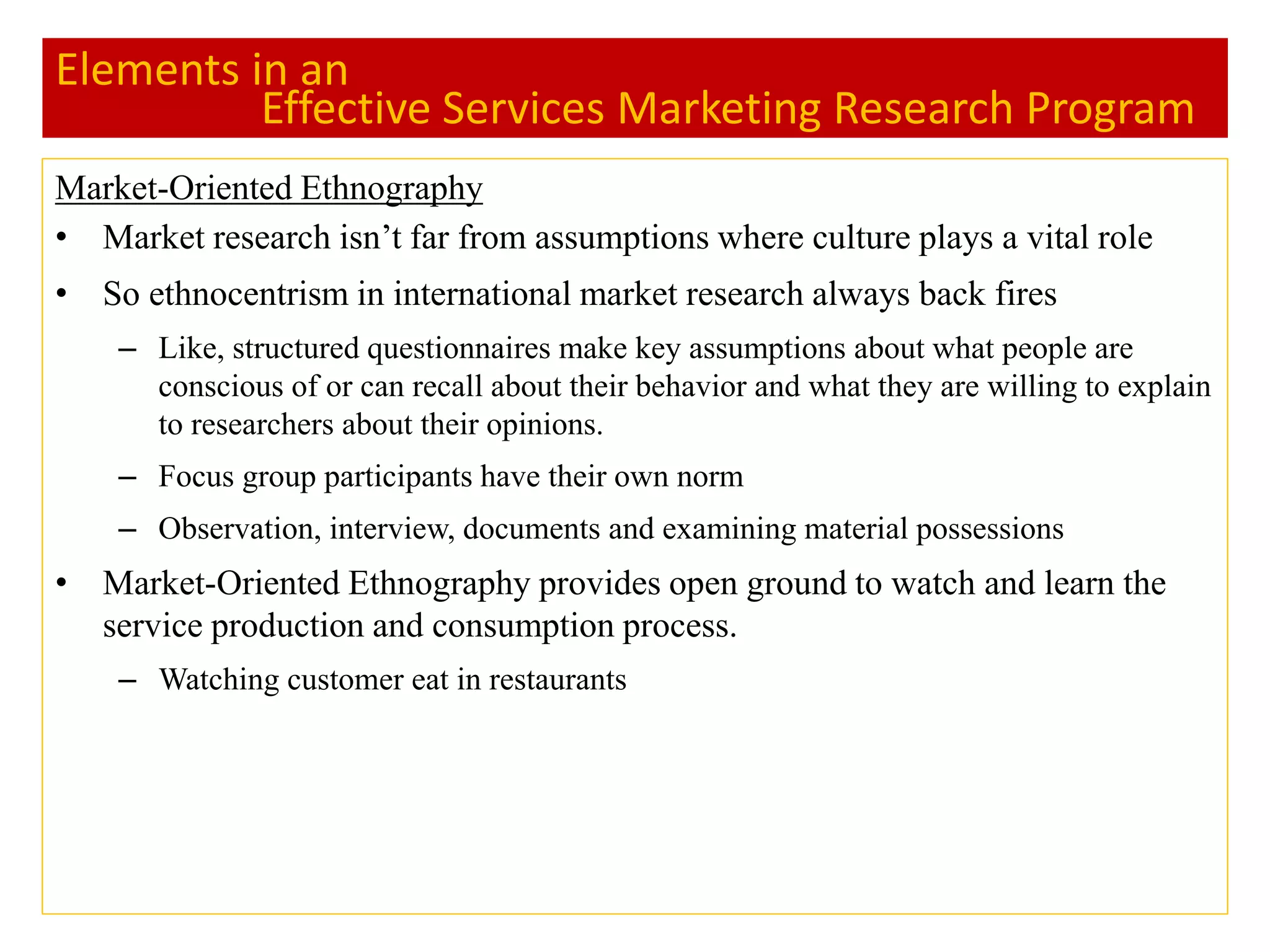
Market-Oriented Ethnography
• Market research isn’t far from assumptions where culture plays a vital role
• So ethnocentrism in international market research always back fires
– Like, structured questionnaires make key assumptions about what people are
conscious of or can recall about their behavior and what they are willing to explain
to researchers about their opinions.
– Focus group participants have their own norm
– Observation, interview, documents and examining material possessions
• Market-Oriented Ethnography provides open ground to watch and learn the
service production and consumption process.
– Watching customer eat in restaurants
Elements in an
Effective Services Marketing Research Program
“Mystery” Shopping
• Company (provider) hire outside research organizations to send people into service
establishments and experience the service as if they were customers
• Mystery shoppers know the customer expectation and criteria important for quality of
service
• Objective assessments about service performance containing items about important
service standards are completed in a questionnaire
– Important service standards may include any or all of the service quality dimensions
• Ex: Au Bon Pain sends “Mystery” shoppers and lets them complete questionnaires by
analyzing service encounters:
– Acknowledged within three seconds of entry
– Acknowledged pleasantly
– Server suggested additional items
– Server requested payment prior to delivering orders
– Received receipt
– Correct order received
• Sense of being evaluated at any time keeps employees awake for the best
• Effective way of reinforcing service standards and of rewarding employees
Elements in an
Effective Services Marketing Research Program
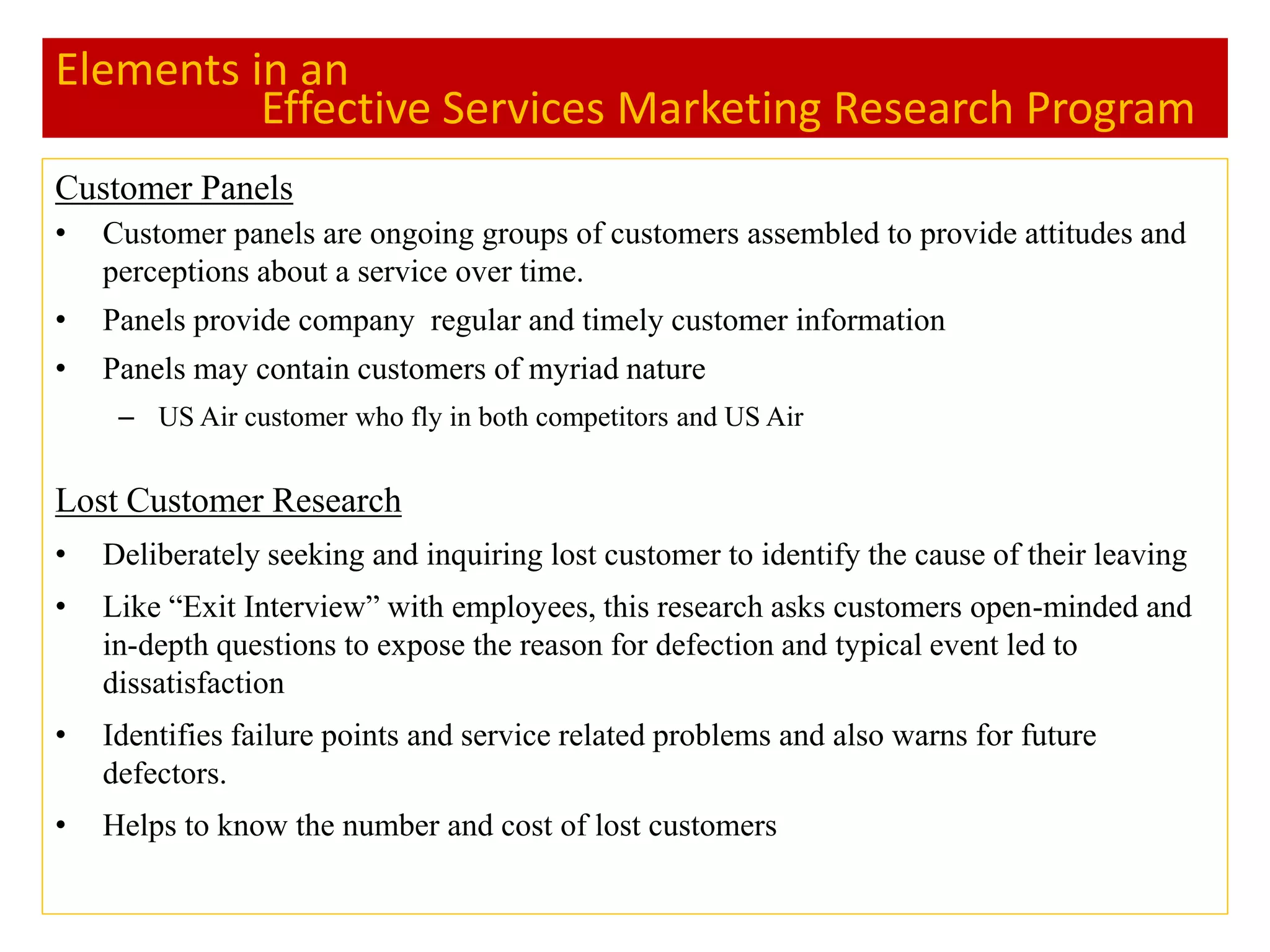
Customer Panels
• Customer panels are ongoing groups of customers assembled to provide attitudes and
perceptions about a service over time.
• Panels provide company regular and timely customer information
• Panels may contain customers of myriad nature
– US Air customer who fly in both competitors and US Air
Lost Customer Research
• Deliberately seeking and inquiring lost customer to identify the cause of their leaving
• Like “Exit Interview” with employees, this research asks customers open-minded and
in-depth questions to expose the reason for defection and typical event led to
dissatisfaction
• Identifies failure points and service related problems and also warns for future
defectors.
• Helps to know the number and cost of lost customers
Elements in an
Effective Services Marketing Research Program
Future Expectation Research
• Service market is highly competitive and volatile like the dynamic and rapid changing
customer expectation
• Firm should move along the change and be the change factor too
• Companies must continue to update their information and strategies
• Companies should acquire knowledge of the possible future changes in expectations
– Service feature desired in the future (Augmentation)
– Ex: Features research, Lead user research
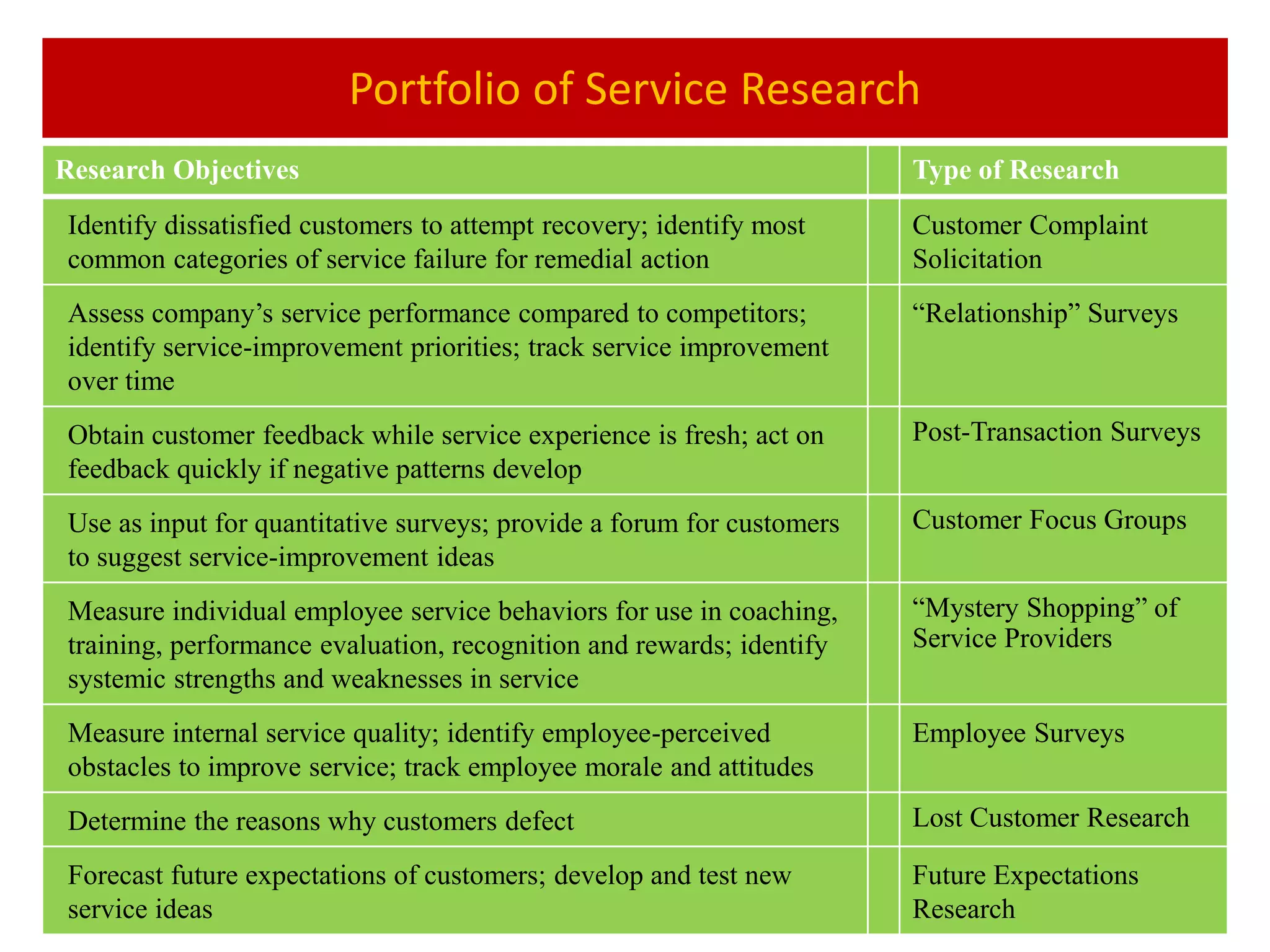
Portfolio of Service Research
Research Objectives Type of Research
Identify dissatisfied customers to attempt recovery; identify most
common categories of service failure for remedial action
Customer Complaint
Solicitation
Assess company’s service performance compared to competitors;
identify service-improvement priorities; track service improvement
over time
“Relationship” Surveys
Obtain customer feedback while service experience is fresh; act on
feedback quickly if negative patterns develop
Post-Transaction Surveys
Use as input for quantitative surveys; provide a forum for customers
to suggest service-improvement ideas
Customer Focus Groups
Measure individual employee service behaviors for use in coaching,
training, performance evaluation, recognition and rewards; identify
systemic strengths and weaknesses in service
“Mystery Shopping” of
Service Providers
Measure internal service quality; identify employee-perceived
obstacles to improve service; track employee morale and attitudes
Employee Surveys
Determine the reasons why customers defect Lost Customer Research
Forecast future expectations of customers; develop and test new
service ideas
Future Expectations
Research
Analyzing & Interpreting Marketing Research Findings
Tracking of Customer Expectations and Perceptions of Service Reliability
Analyzing & Interpreting Marketing Research Findings
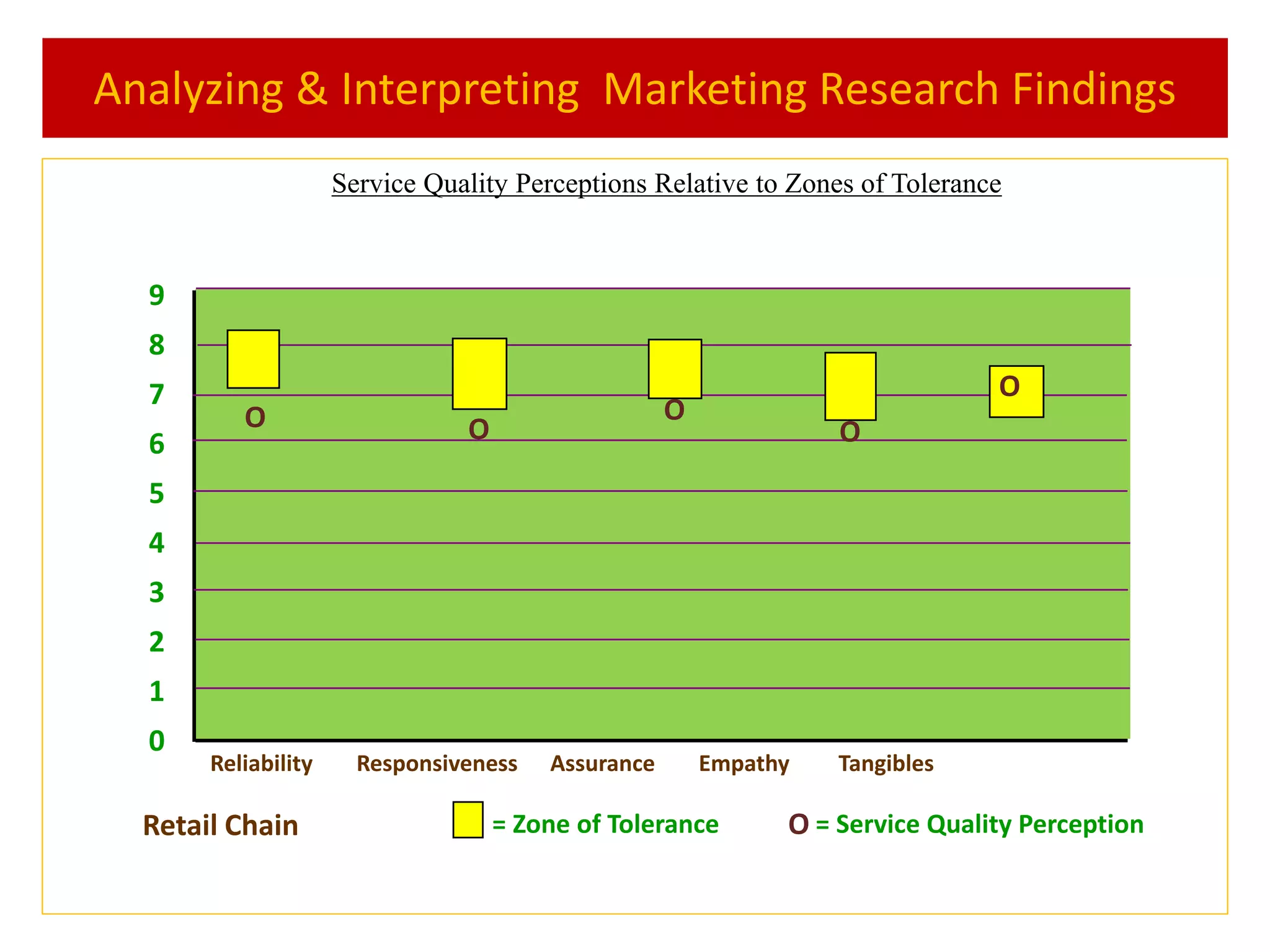
Service Quality Perceptions Relative to Zones of Tolerance
Retail Chain
9
8
7
6
5
4
3
2
1
0
Reliability Responsiveness Assurance Empathy Tangibles
OO
= Zone of Tolerance = Service Quality PerceptionO
O
O
O
Analyzing & Interpreting Marketing Research Findings
Importance/Performance Matrix
HIGH
HIGHLOW Performance
Importance


 






Attributes to Improve Attributes to Maintain
High
Leverage
Attributes to De-emphasizeAttributes to Maintain
Low
Leverage
Low
Leverage
Listening to Customer requirements
Building
Customer Relationships
Preface
• Case : PeopleSoft Case
• Many companies fail to understand customer accurately because they fail to
focus on customer relationships
• Don’t fixate too much on acquiring new customers neglecting your existing
customer base
• View your customer as assets who need to be nurtured and retained
• A firm’s business strategy solely focusing on acquiring new customers fall into
the traps of short-term promotions, price discounts, or catchy ads that bring
customers in but not enough to bring them back every time
• Better relationship leads to better understanding over the time in greater depth
• Adopting relationship philosophy are better able to meet customers’ changing
needs and expectations
• Strategies that understand customer over time and builds long-term relationships
can focus on “cash cows” customers and lose relatively far less turnover than
others
Relationship Marketing
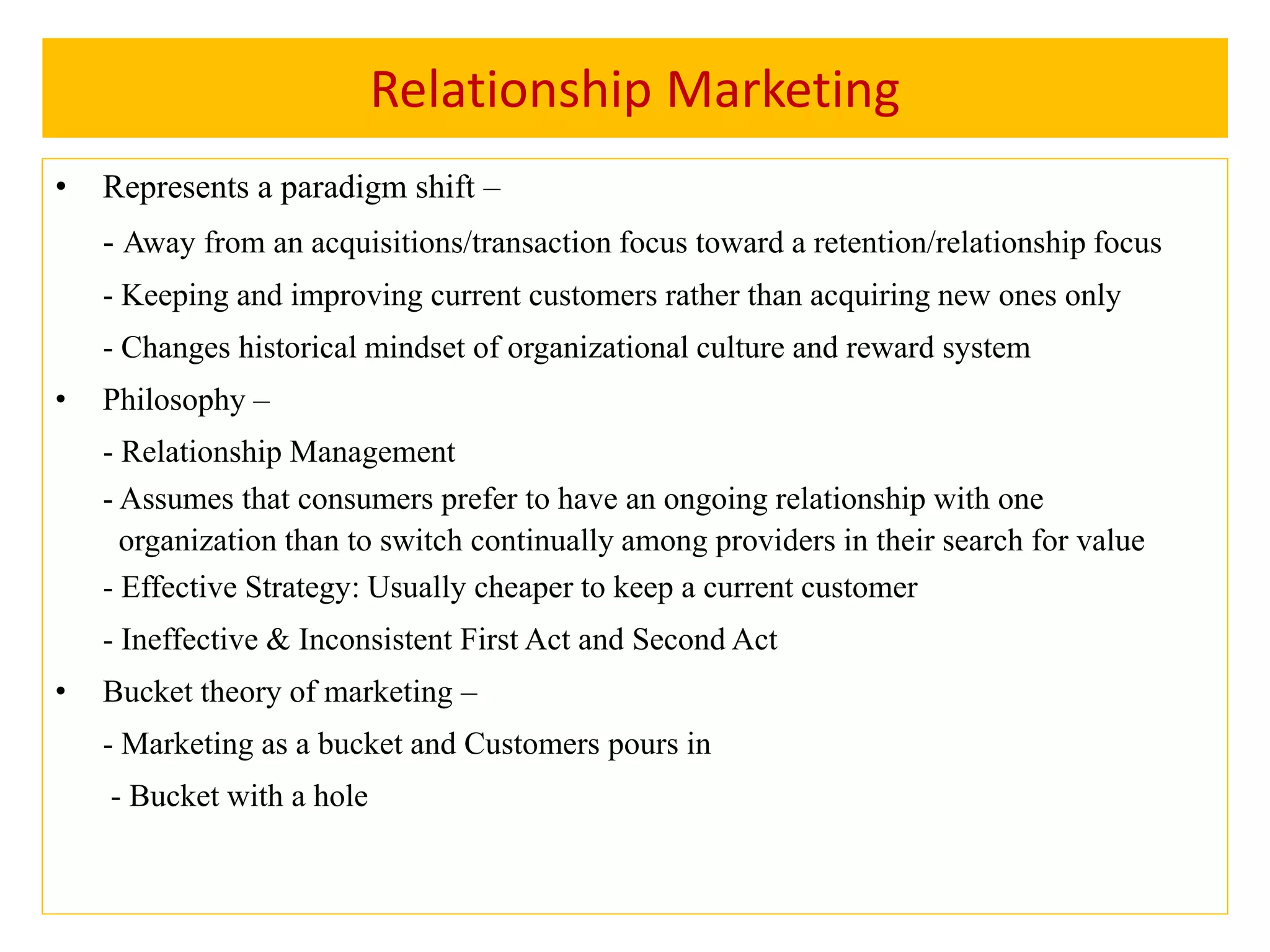
• Represents a paradigm shift –
- Away from an acquisitions/transaction focus toward a retention/relationship focus
- Keeping and improving current customers rather than acquiring new ones only
- Changes historical mindset of organizational culture and reward system
• Philosophy –
- Relationship Management
- Assumes that consumers prefer to have an ongoing relationship with one
organization than to switch continually among providers in their search for value
- Effective Strategy: Usually cheaper to keep a current customer
- Ineffective & Inconsistent First Act and Second Act
• Bucket theory of marketing –
- Marketing as a bucket and Customers pours in
- Bucket with a hole
Goals of Relationship Marketing
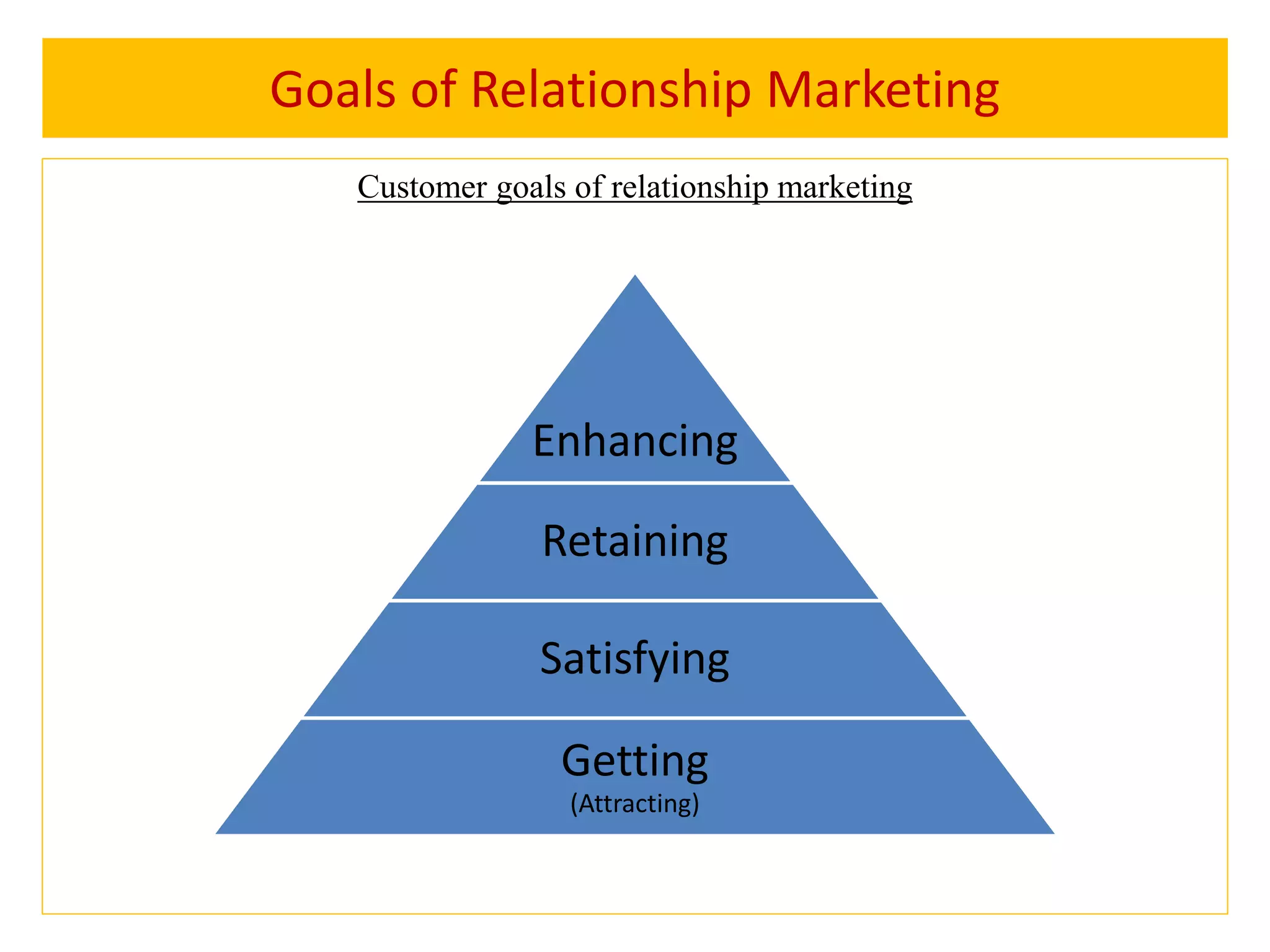
• Build and maintain a base of committed customers who are profitable
- Attraction, retention and enhancement of customer relationships
• Attraction
- Attract ones who are more likely to be longer-term customers
- Better market segmentation for building long lasting customers
- As relationship grows with current customer, they in turn help in “Word of Mouth”
• Retentions
- Attracted and needs served customers more likely stay in the relationship when they
are consistently provided with quality products and services and good value
- Harder for competitors to pull then when they feel the company understands their
changing needs and seems willing to invest in the relationship by constantly improving
and evolving its service mix
- USAA spontaneous customization
• Enhancement
- A solid base and growth potential is the strength of loyal customer segment
- Loyal customer can be better if they buy more. Ex.; corporate accounts, Bank Customer
Goals of Relationship Marketing
Customer goals of relationship marketing
Enhancing
Retaining
Satisfying
Getting
(Attracting)

Benefits of Customer/Firm Relationship
Benefits for Customers
• Consumers always have choice to switch but what matters is the “perceived value”?
- Loyalty is proportional to the obtained value | Value Loyalty
- Perceived value is the consumer’s overall assessment of the utility of a service based
on perceptions of what is received and what is given
- Value = Gets (Satisfaction, quality, specific benefits) – Gives ( [non]-monetary)
- Continuous value delivery by firm results to constant stay incentive in consumers
• Not just the specific inherent benefits and the attributes of the core service, rather the
relationship benefits keep the customers more loyal to a firm more
- Bank: feel comfortable, know what to expect, good working relationship, confidence
of being taken care of during unusual request
• Confidence Benefits
• Social Benefits
• Special Treatment Benefits
Benefits of Customer/Firm Relationship
Benefits for Customers
Confidence Benefits
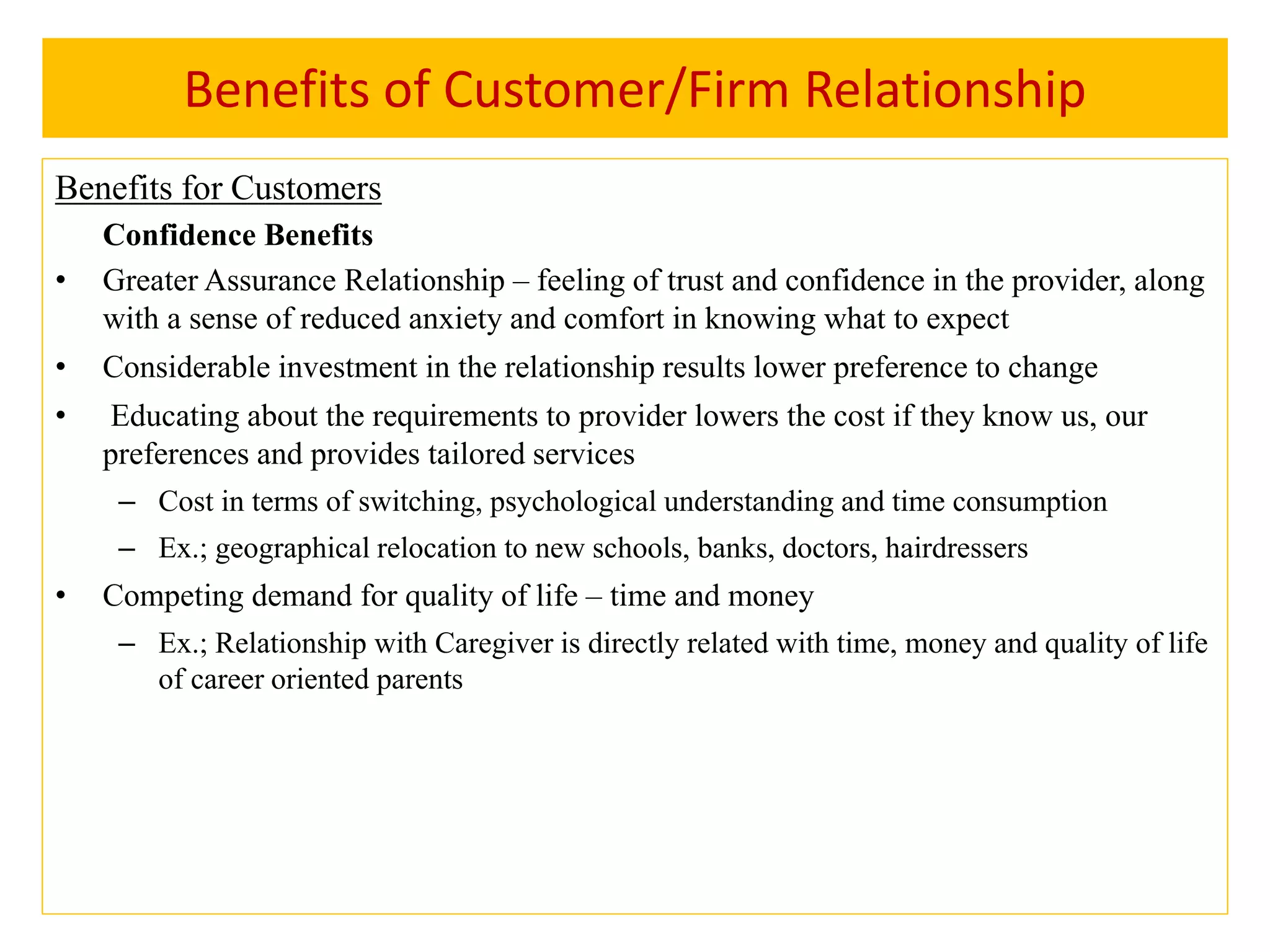
• Greater Assurance Relationship – feeling of trust and confidence in the provider, along
with a sense of reduced anxiety and comfort in knowing what to expect
• Considerable investment in the relationship results lower preference to change
• Educating about the requirements to provider lowers the cost if they know us, our
preferences and provides tailored services
– Cost in terms of switching, psychological understanding and time consumption
– Ex.; geographical relocation to new schools, banks, doctors, hairdressers
• Competing demand for quality of life – time and money
– Ex.; Relationship with Caregiver is directly related with time, money and quality of life
of career oriented parents
Benefits of Customer/Firm Relationship
Benefits for Customers
Social Benefits
• Special bond, familiarity and social relationship (ties) with provider makes customer
less likely to switch even with other better providers and lower prices
– Familiarity with Hair stylist
Special Treatment Benefits
• Benefits over doubts, special deal or price, preferential treatment
– Delayed VISA bill payment without service charge/fees
– Back door entry to avoid other sick patients
– Research suggests as compared to other two earlier benefits this benefit was less
important in most industries but can highly overcome the expectations. In other cases,
like airline industry, for instance, frequent flyer, treatment was found to be critical
Benefits of Customer/Firm Relationship
Benefits for Organization
• Benefit of customer relations is much of critical factor determinants in case of firms
- Loyalty is proportional to the bottom line | Loyalty Profitability
• Increasing Purchases
• Lower Costs
• Free Advertising through Word of Mouth
• Employee Retention
Benefits of Customer/Firm Relationship
Benefits for Organization
Increasing Purchases
• Research reports show that across industries customer tend to spend more each year
with a particular relationship partner than they did in the preceding period
• Especially in B2B, as the business ages, growth improves and lifecycle enhances, the
clients frequently require more of a particular service
Lifetime Value of an Average Business Customer at Telecheck International
Benefits of Customer/Firm Relationship
Benefits for Organization
Lower Cost
• High start-up costs in acquiring new account generally outweighs the profit from that
particular customer in early months, years.
• Advertising cost, promotion costs, operating costs like setting up accounts and
systems, time costs of getting to know and building the relationship
– Ex.; insurance agents and companies, Credit Card companies
• Ongoing relationship costs lower with the time
– Lower time to spent with knowing requirements, dealing with problems and building
trust and confidence, even less number of queries and doubts
• Lower Attraction investment – feeling of trust and confidence in the provider makes it
easy to sell more with less effort
Benefits of Customer/Firm Relationship
Benefits for Organization
Free Advertising through Word of Mouth
• Relatively few pre-purchase information in service and more importance given to
personal sources in making decision makes Word of Mouth absolutely important
• Satisfied loyal customers endorse companies strongly than one time customers
• Reduces the cost of promotional activities
• Perhaps, referral customers tend to show better trust and quality resulting in higher
likelihood of being loyal and profitable compared to customers obtained from other
forms of advertisements
Employee Retention
• Indirect benefit of customer retention is employee retention
• Easier to retain employees with stable customer base
• Loyal & Happy customers -> Loyal & Happy employees
• More time in fostering relationship than acquiring new ones
• A positive upward spiral
• Improves QoS, lowers employee turnover, increases profitability
Quality
of
Service
Employee
Loyalty
Customer
Retention
Increased
Profits
Customer
Satisfaction
Segmentation
&
Targeting
Segmentation & Targeting
• Learning & defining who the organization wants to have relationships with
• The ability to create and sustain a meaningful competitive advantage requires a deep
knowledge of customer needs and a disciplined sales and marketing process to ensure
that needs are effectively addressed.
• Market segmentation is a strategic process for achieving alignment between service
offerings and customer need.
• Segmentation is aggregating prospective buyers into groups that have common needs
and will respond similarly to a marketing action.
• There are two extreme service markets – highly customized and highly standardized
• Marketers create win-win situation by offering different services to different groups of
customers
• Marketers rely on segmentation to
– Optimize allocation of sales and marketing resources by targeting high-value customers
– Guide service development and customize service offerings to accommodate needs of
target segments
– Increase promotional impact by positioning service and customizing messages to align
with segment-specific orientations
Segmentation & Targeting
Bases for Market Segmentation Requirements for Effective Segmentation
Demographic: Dividing the market to form
groups based on variables such as sage, sex
family, size, income, occupation, or religion
Geographic: Dividing the market to form
different geographic units such as nations,
counties or states
Psychographic: Dividing buyers to form
groups based on social class, lifestyle, or
personality characteristics
Behavioral: Dividing buyers to form groups
based on knowledge, attitude, usages, or
responses to a service
Measurability: Degree to which the size and
purchasing power of the segments can be
measured
Accessibility: Degree to which the segments
can be reached and served
Substantiality: Degree to which the segments
are large or profitable enough
Actionability: Degree to which effective
programs can be designed for attracting and
servicing the segments
Criteria for evaluating market segments for market targeting
Segment size & growth: Includes information on current dollar sales, projected growth rates,
and expected profit margins
Segment structural attractiveness: Includes current & potential competitors, substitute
services, relative buyers power, relative suppliers power
Company objectives & resources: Involves whether the segment fits the company’s objectives
 Basic differences in goods and service in market segmentation are:
I. Incompatibility: Need for compatibility in market segments because other customers
are often present during service delivery. Make sure incompatible segments are not
receiving service at the same time.
II. Customization: Providers have greater flexibility to customized production and
delivery of service offerings in real time.
Process for Market Segmentation & Targeting
Step 1:
Identify
Bases for
Segmenting
the Market
Step 2:
Develop
Profiles of
Resulting
Segments
Step 3:
Develop
Measures of
Segment
Attractivenes
s
Step 4:
Select
Target
Segment
s
Step 5:
Ensure
that
Segments
are
Compatibl
e
Process for Market Segmentation & Targeting
Identify Bases for Segmenting the Market
• Segments are formed by grouping customers who share common characteristics that
are in some way meaningful to the design, delivery, promotion, or pricing of the
service
• Gym club service for adults, working professionals, school kids may be different
• Restaurant service based on time for family, friends, kids, etc
Demographics Geographic Psychographic Behavioral
• Age
• Gender
• Income
• Occupation
• Education
• Social Class
• Generation
• Family size
• Family life cycle
• Home Ownership
• Religion
• Ethnic group/Race
• Nationality
• Regions
• (by country, nation,
state, neighborhood)
• Population Density
• (Urban, suburban, rural)
• City size
• (Size of area, population
size and growth rate)
• Climate
• (Regions having similar
climate pattern)
• Social class
• Lifestyle
• Personality characteristics
• Interests
• Opinions
• Personality
• Self image
• Activities
• Values
• Attitudes
• Knowledge
• Attitude
• Usages Rate
• Responses to a service
• Product benefits
• Brand Loyalty
• Price Consciousness
• Occasions
(holidays like mother’s
day, New Year and Eid)
• User Status
(First Time, Regular or
Potential)
Process for Market Segmentation & Targeting
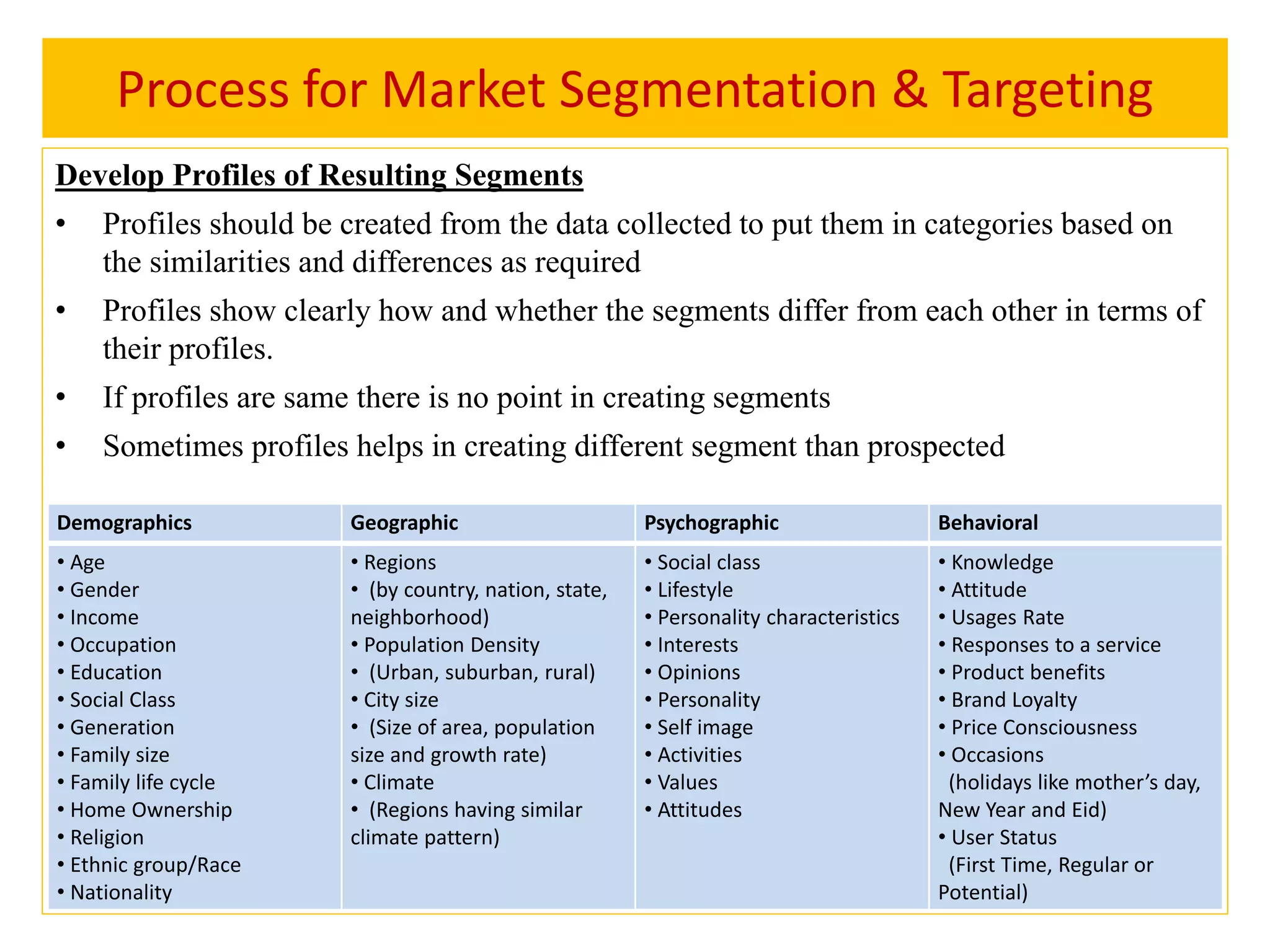
Develop Profiles of Resulting Segments
• Profiles should be created from the data collected to put them in categories based on
the similarities and differences as required
• Profiles show clearly how and whether the segments differ from each other in terms of
their profiles.
• If profiles are same there is no point in creating segments
• Sometimes profiles helps in creating different segment than prospected
Demographics Geographic Psychographic Behavioral
• Age
• Gender
• Income
• Occupation
• Education
• Social Class
• Generation
• Family size
• Family life cycle
• Home Ownership
• Religion
• Ethnic group/Race
• Nationality
• Regions
• (by country, nation, state,
neighborhood)
• Population Density
• (Urban, suburban, rural)
• City size
• (Size of area, population
size and growth rate)
• Climate
• (Regions having similar
climate pattern)
• Social class
• Lifestyle
• Personality characteristics
• Interests
• Opinions
• Personality
• Self image
• Activities
• Values
• Attitudes
• Knowledge
• Attitude
• Usages Rate
• Responses to a service
• Product benefits
• Brand Loyalty
• Price Consciousness
• Occasions
(holidays like mother’s day,
New Year and Eid)
• User Status
(First Time, Regular or
Potential)
Process for Market Segmentation & Targeting
Develop Measures of Segment Attractiveness
• Profiles showcase the availability of different segments but it doesn’t necessarily mean
those can all be targets
• Those categories of segments should be evaluated in terms of size & purchasing power
so that investment made in marketing and cost involved in building relationship is
comparatively praiseworthy; accessibility so that advertising or marketing vehicles can
reach the segment; and also actionability.
Requirements for Effective Segmentation
Measurability: Degree to which the size and purchasing power of the segments can be measured
Accessibility: Degree to which the segments can be reached and served
Substantiality: Degree to which the segments are large or profitable enough
Actionability: Degree to which effective programs can be designed for attracting and servicing the segments
Process for Market Segmentation & Targeting
Select the Target Segment
• Selection of target segment must not only look at current trend but also analyze the
future development too.
• Growth in sales, profitability, demand and supply forecast, competitive analysis,
substitute services and relative power of buyers and suppliers and overall evaluation of
company objective should be kept in mind before deciding the next potential segment
Criteria for evaluating market segments for market targeting
Segment size & growth:
Includes information on current dollar sales, projected growth rates, and expected profit margins
Segment structural attractiveness:
Includes current & potential competitors, substitute services, relative buyers power, relative suppliers power
Company objectives & resources:
Involves whether the segment fits the company’s objectives
Process for Market Segmentation & Targeting
Ensure that the Target Segments are Compatible
• The most crucial step is to be sure that the target market customers are compatible
– “Simultaneous production & consumption at the presence of other customers”
• If the interaction between the two incompatible groups in the segment turns wrong, the
image of the company is on the line
• These interactions may also negatively influence each others’ experiences hurting the
provider’s future business
• So, it’s absolutely necessary to maintain a right mix of customers in the segment
profile
Individualized Service: Segments of one
• Mass customization – services designed to fit each individual’s needs
• Delivered people to people, difficult to standardize, inconsistent outcomes and processes from provider to
provider, from customer to customer, time to time
• Opportunity for one-to-one customization in real time
• A limited number of large customers
• Thousands of service encounters customization made possible through technology & employee empowerment
Retention Strategies
Excellent
service
and
value
1.
Financial
bonds
2.
Social
bonds
4.
Structural
bonds
Volume and
frequency
rewards
3.
Customization
Bonds
Bundling and
cross selling
Stable
pricing
Social bonds
among
customers
Personal
relationships
Continuous
relationships
Customer
intimacy
Mass
customization
Anticipation/
innovation
Shared
processes
and
equipment
Joint
investments
Integrated
information
systems
Retention Strategies
Level 1 – Financial Bonds
• Primarily customer is attracted/tied to the firm through financial incentives
– Lower prices for greater volume purchases
– Lower prices for retained customers/loyal customer
• Frequent Flyer programs in airline industry, hotel, car rentals, telephone companies
• Financial incentive to customers is easy to initiate however results in short term gain
– Ncell Vs. NTC
• But don’t last longer so need to be done in collaboration with other strategies
• Easier for competitors to imitate since it’s tangible, price, customization only
• Cross-selling and bundling – Frequent Flyer -> Reward Points -> Multi-usage
• Lowest or stable prices to regular customer or at least lower price increases than new
customer
– Cost saving to customer and up selling or increased revenue over the time for the firm
• Volume and frequency rewards
• Stable pricing
• Bundling and cross selling
Retention Strategies
Level 2 – Social Bonds
• Customers are viewed as clients who they understand and are ready to offer service as
needed and also minimal customization is availed to meet their level of expectation
• Marketers constantly keep in touch with their clients to establish social and
interpersonal bond
• Personal communication like sending gifts, cards; sharing personal information with
clients all served to increase the likelihood that the client would stay with the firm
• Common in Professional and personal service
– Lawyers, accountants, teachers
– Personal care; hairdressers, counselors, health care providers
– Instance of dentist preliminary skimming through patient’s file
• B2B – PeopleSoft, Caterpillar’s strong distribution channel and community activities
• Relationship of customers with firm due to relationship among customers not only with
the organization makes social bond stronger and customers loyal
– This makes switching unlikely and reluctant
– Loyalty to the firm is partly due to loyalty to the relationship with other customers
– Ex.; Health clubs, educational settings, entertainment locations
• In the absence of strong reasons, interpersonal bonds can encourage customer to stay
Retention Strategies
Level 2 – Social Bonds
• In the absence of strong reasons, interpersonal bonds can encourage customer to stay
• Continuous relationships
• Personal relationships
• Social bonds among customers
Retention Strategies
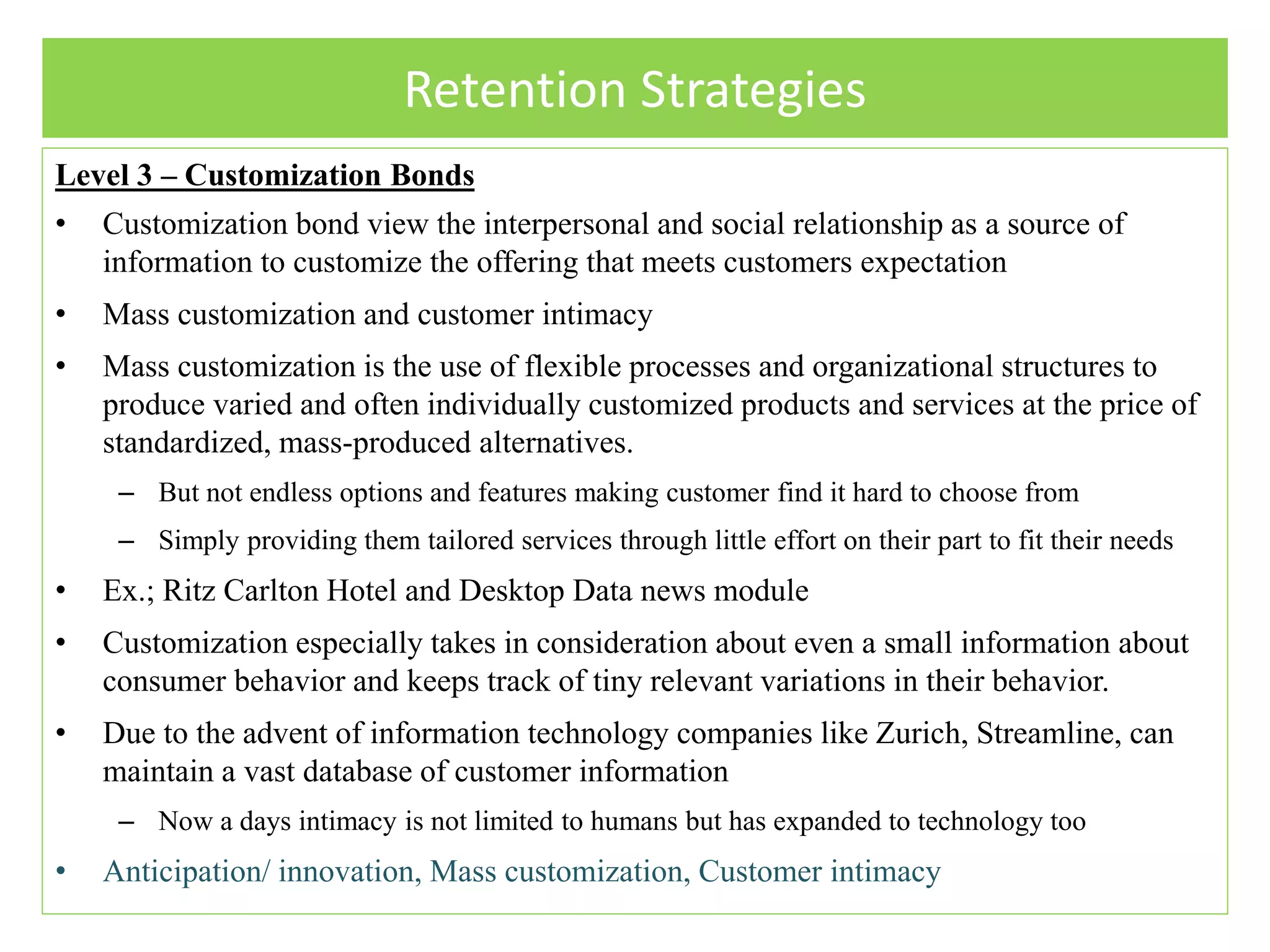
Level 3 – Customization Bonds
• Customization bond view the interpersonal and social relationship as a source of
information to customize the offering that meets customers expectation
• Mass customization and customer intimacy
• Mass customization is the use of flexible processes and organizational structures to
produce varied and often individually customized products and services at the price of
standardized, mass-produced alternatives.
– But not endless options and features making customer find it hard to choose from
– Simply providing them tailored services through little effort on their part to fit their needs
• Ex.; Ritz Carlton Hotel and Desktop Data news module
• Customization especially takes in consideration about even a small information about
consumer behavior and keeps track of tiny relevant variations in their behavior.
• Due to the advent of information technology companies like Zurich, Streamline, can
maintain a vast database of customer information
– Now a days intimacy is not limited to humans but has expanded to technology too
• Anticipation/ innovation, Mass customization, Customer intimacy
Retention Strategies
Level 4 – Structural Bonds
• Difficult to imitate and includes financial, social and customization bonds
• Structural bonds are created by providing services to the clients that are frequently
designed right into the service delivery system for that client
• The client or consumer uses the structure to consume services which it or s/he feels
comfortable in and this way provider installs a behavior in them.
– Ex.; Allegiance Healthcare Corporation has hospital specific pallet architecture
– FedEx and UPS provides its clients a specialized full-fledged computer system
• Integrated information systems
• Joint investments
• Shared processes and equipment
Service
Recovery
Service Recovery
• Service Recovery- the actions taken by an organization in response to a service failure
• Reasons for failure
– Unavailability of service when promised
– Late or slow delivery
– Incorrect or poorly execute outcome
– Rude or uncaring employees
• Results into dissatisfaction like negative feelings and responses from customer
• Outcome of dissatisfaction, if the service failed is not resolved
– Termination - Customer leaving or switching
– Bad word of mouth - Telling it to others like friends, family, relatives, co-workers, etc
– Legal/Formal actions – complaining to other third party organization to take legal actions
– Those who don’t complain are least likely to repurchase
• Outcome of satisfied service recovery
– Resolving problems has strong impact on customer satisfaction
– Increased Loyalty
– Increased bottom-line performance
– Higher likelihood of repurchase
– Positive word of mouth
Service Recovery
Learning from Service Recovery
• Well designed and documented service recovery strategy also provides information
that can be used to improve service as part of a continuous improvement effort
• Making adjustments to service processes, systems and outcomes based on learning
from service recovery experiences, companies increase the likelihood of “ doing it
right the first time”
• Helps in reducing costs of failures and increases initial customer satisfaction
No or Poor Service Recovery
• Poor service recovery after a dissatisfying service can result to “terrorist” customers
– Actively pursuing opportunities to openly criticize
– Even employees morale and retention is likely to go down with repeated service failures
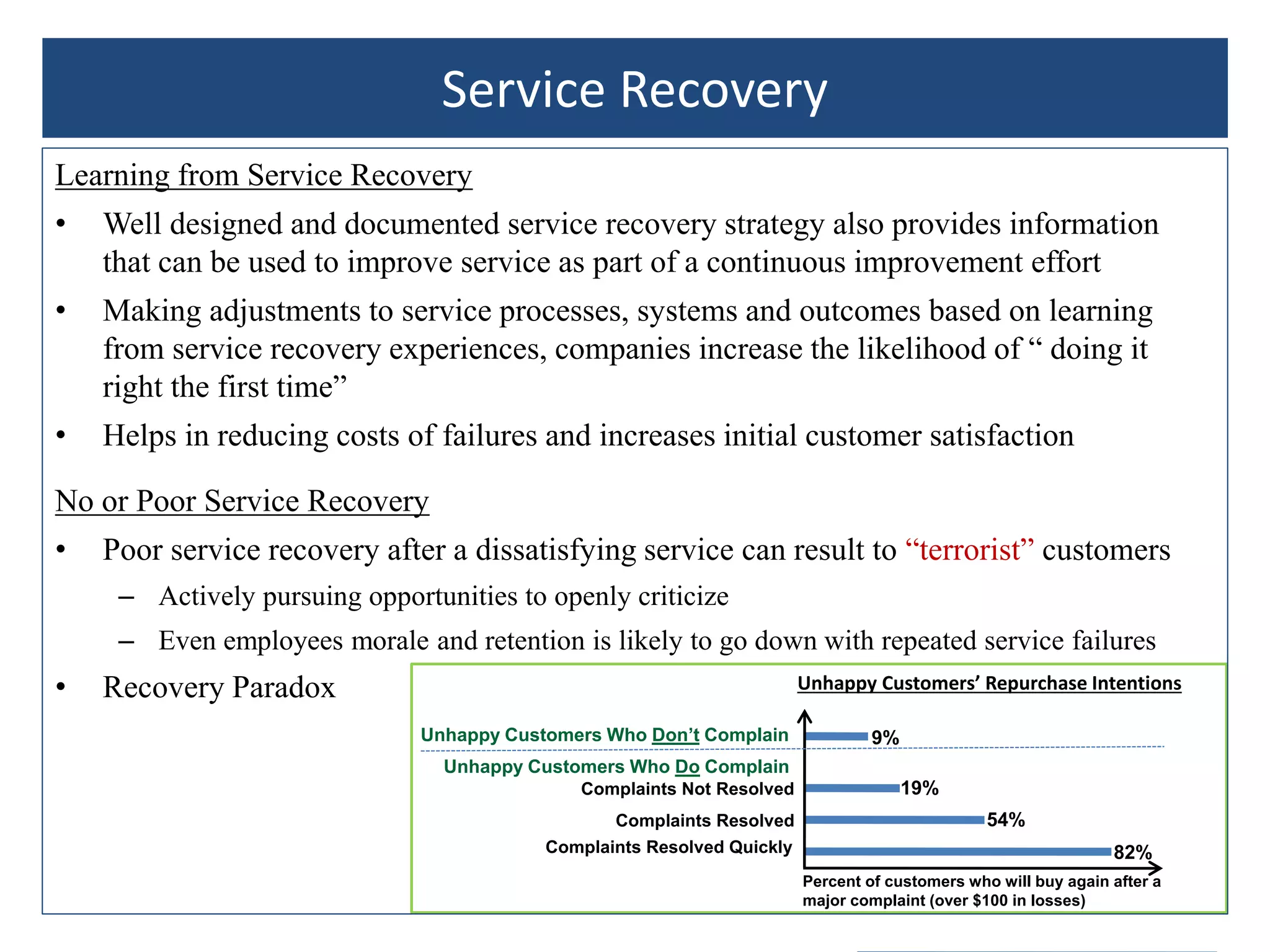
• Recovery Paradox
82%
54%
19%
9%
Complaints Resolved Quickly
Complaints Resolved
Complaints Not Resolved
Unhappy Customers Who Don’t Complain
Unhappy Customers Who Do Complain
Percent of customers who will buy again after a
major complaint (over $100 in losses)
Unhappy Customers’ Repurchase Intentions
How customers respond to Service Failures
Complain to
provider
Service Failure
Dissatisfaction/ Negative emotions
StayExit/Switch
Third-party
action
Negative word
of mouth
No complaint actionComplaint Action
StayExit/Switch
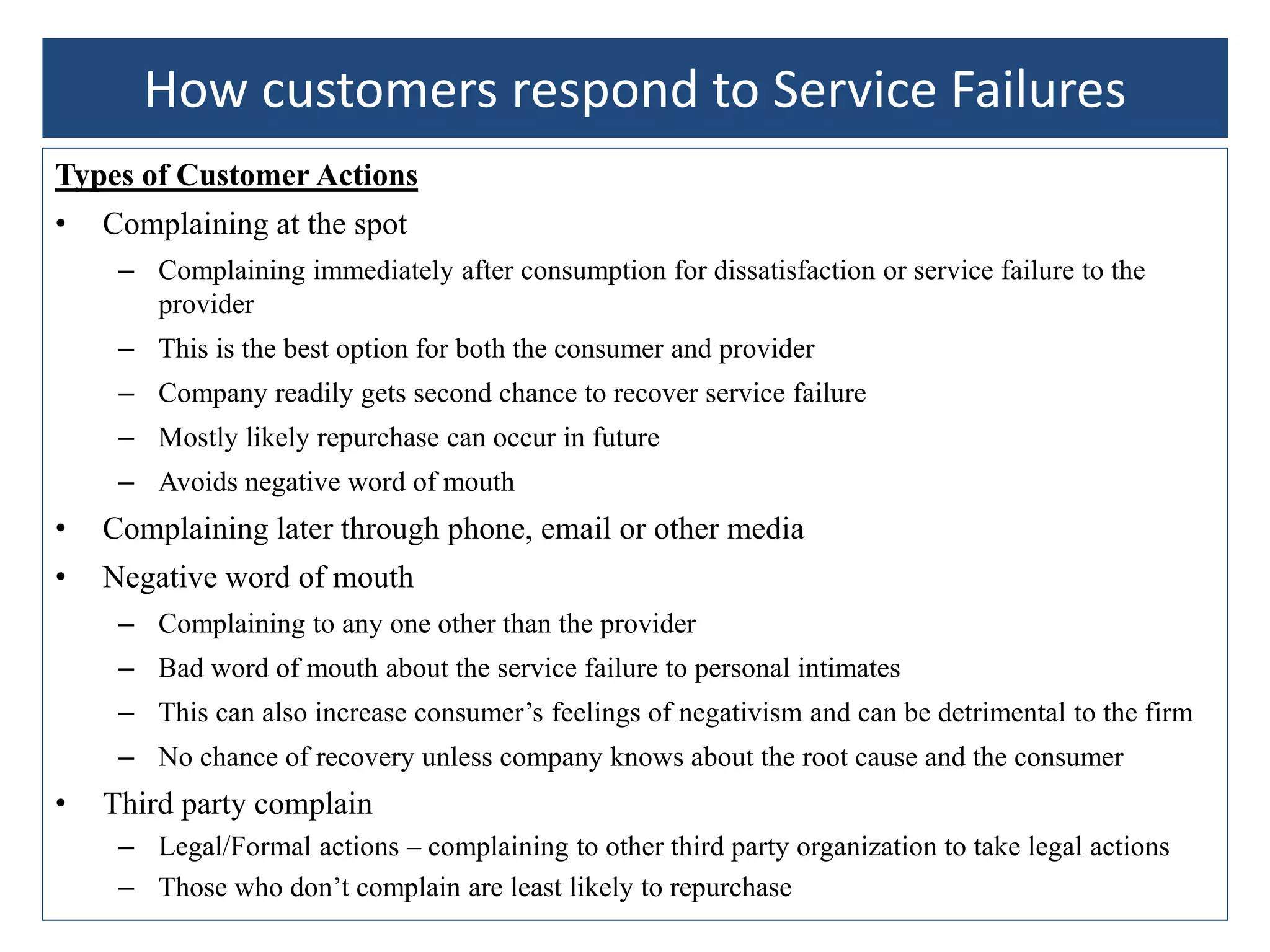
Types of Customer Actions
• Complaining at the spot
– Complaining immediately after consumption for dissatisfaction or service failure to the
provider
– This is the best option for both the consumer and provider
– Company readily gets second chance to recover service failure
– Mostly likely repurchase can occur in future
– Avoids negative word of mouth
• Complaining later through phone, email or other media
• Negative word of mouth
– Complaining to any one other than the provider
– Bad word of mouth about the service failure to personal intimates
– This can also increase consumer’s feelings of negativism and can be detrimental to the firm
– No chance of recovery unless company knows about the root cause and the consumer
• Third party complain
– Legal/Formal actions – complaining to other third party organization to take legal actions
– Those who don’t complain are least likely to repurchase
How customers respond to Service Failures
Types of Complainers
• Passives
– The group least likely to take actions
– Less likely to say anything to provider, to spread negative word of mouth, to complain to a
third party
– This category of consumer doubt the effectiveness of complaining and think that any effort
will simply not be worth taking.
– Less alienated from the market place than other types of complainers
• Voicers
– “Best Friends” to service provider
– Likely to take actions especially to complain about dissatisfaction to provider
– Always gives provider second chances
– Think it’s not wise to switch, spread negative word of mouth, to complain to a third party
– This category of consumer believe the will bring some change, a good one.
– Believe that complaining social benefits and don’t hesitate to voice their opinions
– Less alienated from the market place than two types of complainers
– Personal norms are consistent with complaining
How customers respond to Service Failures
Types of Complainers
• Irates
– Higly likely to spread negative word of mouth and switch brands
– Moderately likely to complain providers or other third parties
– Although they feel the effectiveness of complaining, they are more angry with providers
– So, they don’t want to give providers a second chance
– They feel alienated from the market place than other two earlier types
• Activists
– Highly likely to take all kinds of actions
– They complain to providers, tell about it to friends and family and also complain to third
parties.
– The believe in effectiveness of complaining and telling about service failures to others that
collectively they can bring positive change and socially beneficial
– They feel alienated from the market place
– Personal norms are consistent with complaining
• Why Do (/Don’t) people complain? What Do they Expect after complaining?
How customers respond to Service Failures
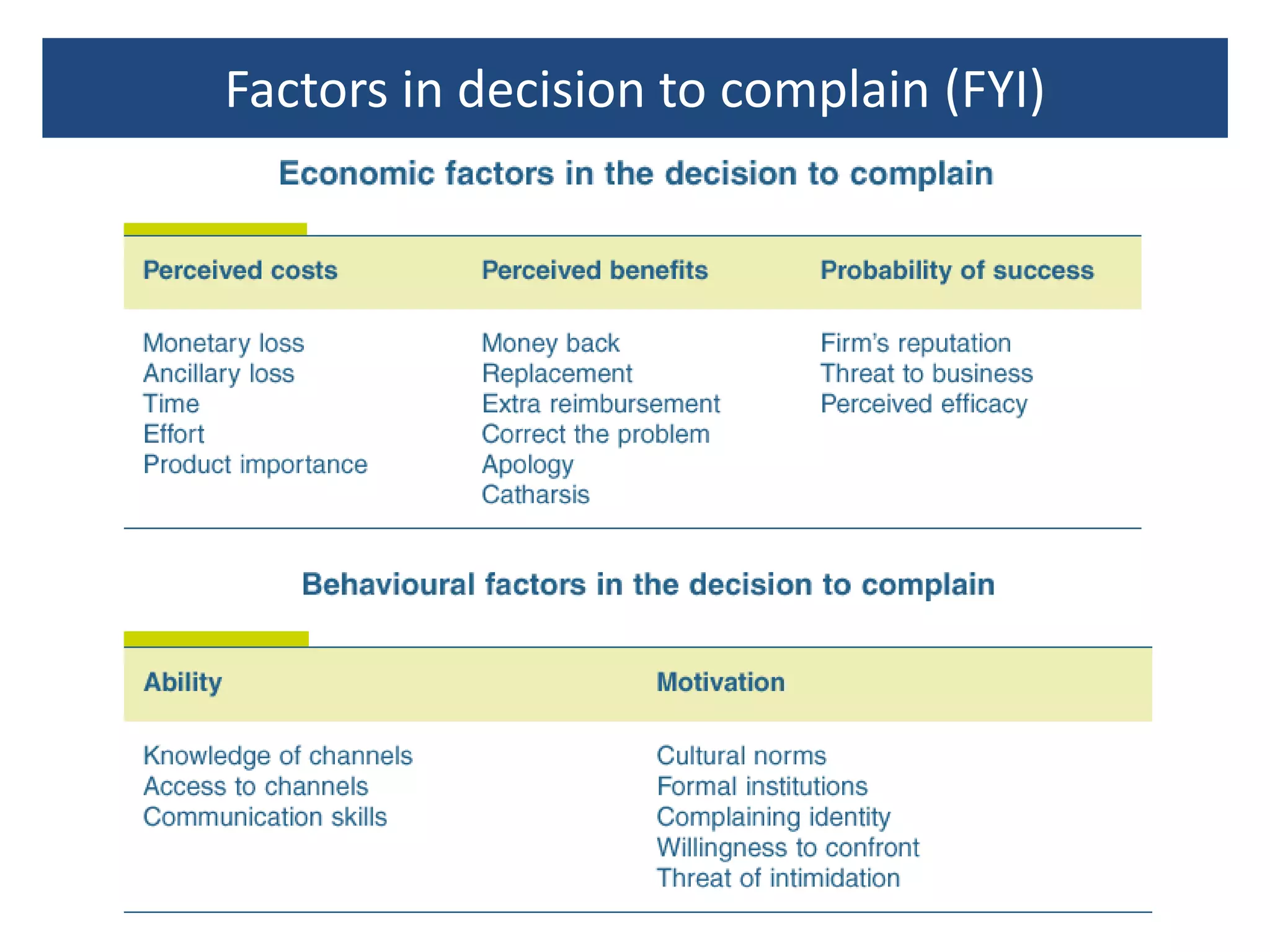
Factors in decision to complain (FYI)
Service Recovery Strategy (FYI)
(FYI)
LearnfromRecovery
ExperiencesAct
Quickly
Treat Customers
Fairly
Fail-safe
the Service
Service
Recovery
Strategies
• Guarantee = an assurance of the fulfillment of a condition
• In a business context, a guarantee is a pledge or assurance that a product offered by a
firm will perform as promised and, if not, then some form of reparation will be
undertaken by the firm for tangible products
• A guarantee is often done in the form of a warranty
• Services are often not guaranteed
– cannot return the service
– service experience is intangible
• A good service guarantee can be complementary to the company’s service recovery
strategy – serving as one tool to help accomplish the service recovery strategies
• So what do you guarantee?
Service Guarantee
• A good guarantee forces the company to focus on its customers.
• An effective guarantee sets clear standards for the organization.
• A good guarantee generates immediate and relevant feedback from customers.
• When the guarantee is invoked there is an instant opportunity to recover, thus
satisfying the customer and helping retain loyalty.
• Information generated through the guarantee can be tracked and integrated into
continuous improvement efforts.
• Employee morale and loyalty can be enhanced as a result of having a service guarantee
in place.
• A service guarantee reduces customers’ sense of risk and builds confidence in the
organization.
• Effective service guarantee can affect bottom line profitability through customer
loyalty, positive word of mouth, reduction in costs as service process improves,
decrement in recovery expenses, lower employee turnover.
Benefits of Service Guarantee
Unconditional Service Guarantee is good but may not be required always and also is not
a good idea to be used by every service provider.
- What if NTC says, “No Sharing. Enjoy always the FULL bandwidth in ADSL else money back Guaranteed.”
Satisfaction Vs. Service Attribute Guarantee
• Unconditional Satisfaction guarantee extends the wings to excel at every process,
encounter, deliverable and every aspect of a service.
– Ex. Lands End, a catalog retailer, has abbreviated its guarantee to “Guaranteed. Period.”
• But Service attribute guarantee provides excellent service encounter when and where
needed not to the overall service.
– It sounds more promising too since it’s mostly precise and practical. It focuses on any of the
service dimensions
– Only relevant service aspects are guaranteed which are important to the customer
– Ex., British Airways, “Comfort guaranteed or you get 25,000 miles.”
– Ex., McDonald’s, “Hot Food; Fast, Friendly Delivery; Double-Check Drive-Thru
Accuracy… We’ll make it right, or your next meal in on us.”
Types of Service Guarantee
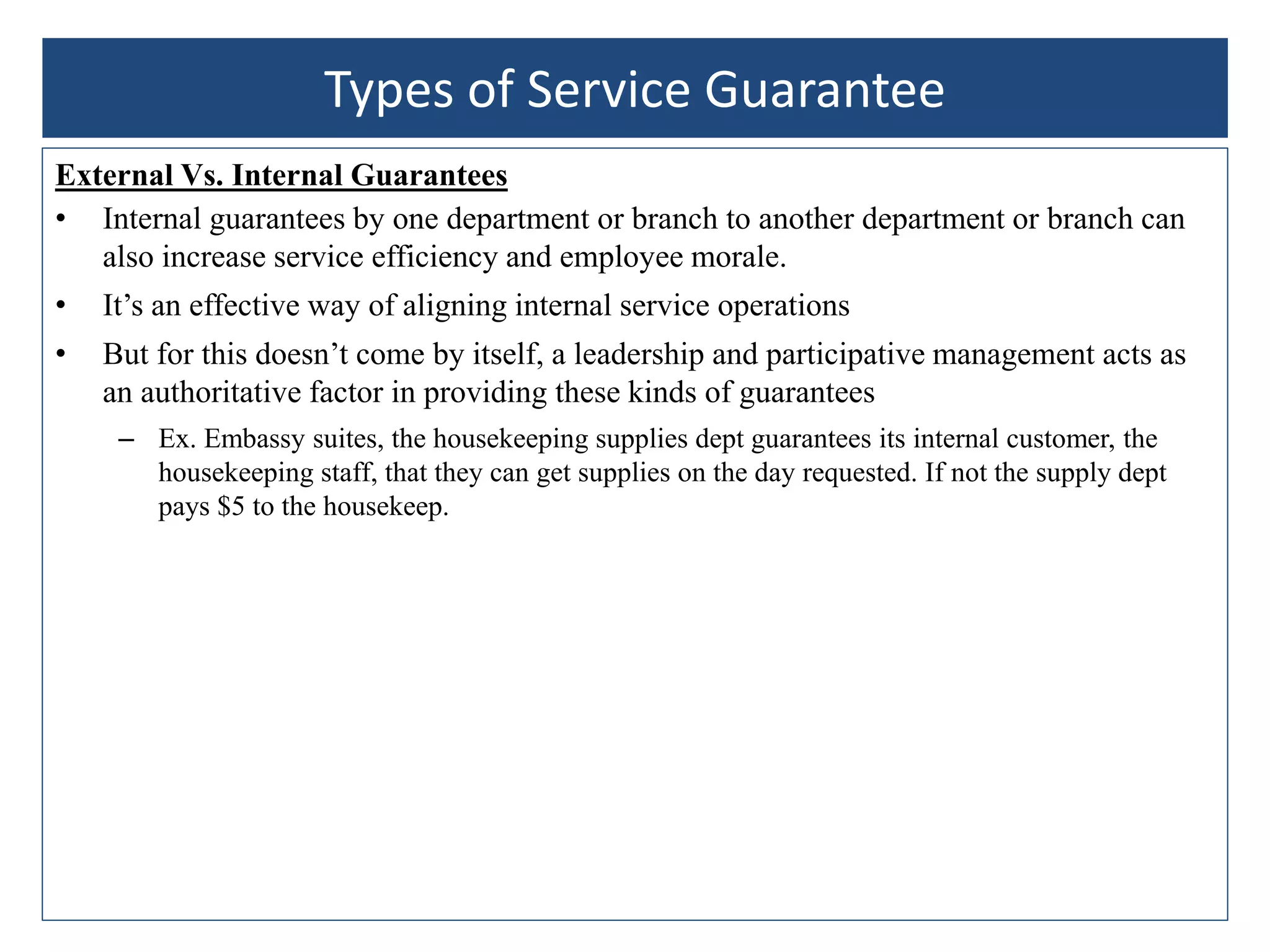
External Vs. Internal Guarantees
• Internal guarantees by one department or branch to another department or branch can
also increase service efficiency and employee morale.
• It’s an effective way of aligning internal service operations
• But for this doesn’t come by itself, a leadership and participative management acts as
an authoritative factor in providing these kinds of guarantees
– Ex. Embassy suites, the housekeeping supplies dept guarantees its internal customer, the
housekeeping staff, that they can get supplies on the day requested. If not the supply dept
pays $5 to the housekeep.
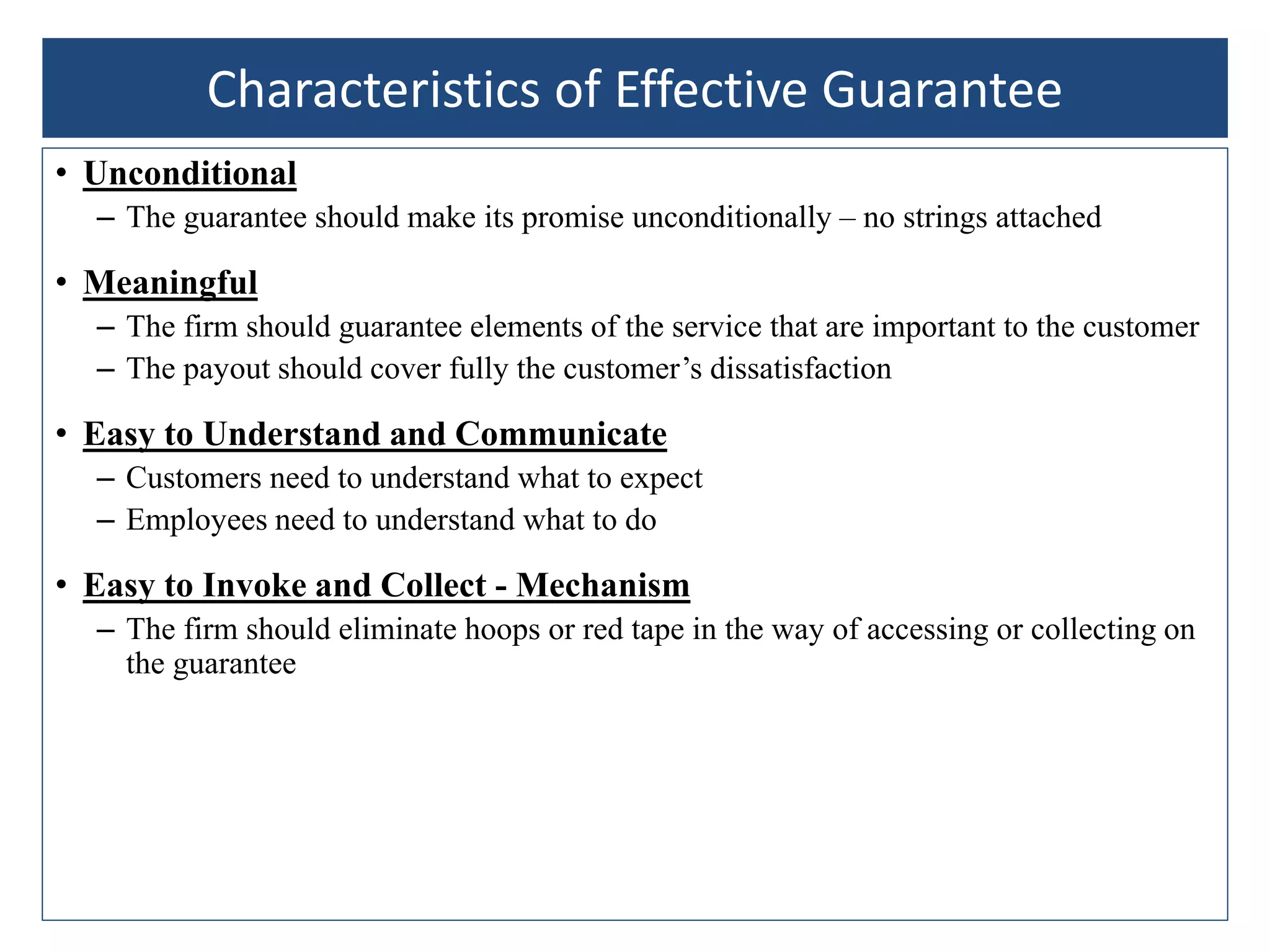
Types of Service Guarantee
• Unconditional
– The guarantee should make its promise unconditionally – no strings attached
• Meaningful
– The firm should guarantee elements of the service that are important to the customer
– The payout should cover fully the customer’s dissatisfaction
• Easy to Understand and Communicate
– Customers need to understand what to expect
– Employees need to understand what to do
• Easy to Invoke and Collect - Mechanism
– The firm should eliminate hoops or red tape in the way of accessing or collecting on
the guarantee
Characteristics of Effective Guarantee
Does everyone need a guarantee?
Reasons companies might NOT want to offer a service guarantee:
• Existing service quality is poor
• Guarantee does not fit the company’s image
• Too many uncontrollable external variables
• Costs of the guarantee outweigh the benefits
• Customers perceive little risk in the service
• Customers perceive little variability in service quality among competitors
Service Guarantees
Can I GUARANTEE that you
guys understood whatever’s
been taught?

4. listening to customer requirements

  • 1.
  • 2.
    Understanding Customer Expectation& Perception • Companies miss by believing they know what customer should want rather than finding out what do they really want – Services don’t match expectations – Important features are left out – Levels of performance on features provided are inadequate • Think OUTSIDE IN not INSIDEOUT • Market Research is the essential task a service provider should perform to understand customer expectation and access perception of services • Research tells you what company can and should do
  • 3.
    Research Objective forServices • Critical part of Market Research is to define problem and research objective. • Research objective in services are a bit different:  First, services research must continually monitor and track service performance because they are subject to human variability and heterogeneity.  Capturing variations in performance at individual, team, branch, organizational or competitors’ level  Second, consider and monitor the dynamic gap between expectations and perceptions – performance or expectation or demand/supply • Some Research Objectives: – To discover customer requirements or expectations for service. – To monitor and track service performance. – To assess overall company performance compared with that of competition. – To assess gaps between customer expectations and perceptions. – To identify dissatisfied customers, so that service recovery can be attempted. – To gauge effectiveness of changes in service delivery. – To appraise the service performance of individuals and teams for evaluation, recognition, and rewards. – To determine customer expectations for a new service. – To monitor changing customer expectations in an industry. – To forecast future expectations of customers.
  • 4.
  • 5.
    Elements in an EffectiveServices Marketing Research Program Complaint Solicitation • Collecting & documenting complaints of customers and using them to identify dissatisfied customers, correct individual problems where possible, and identify common service failure points • Most common type of research to stay connect to customers • Improves failure points • Improves/corrects the performance of contact personnel • Only 4% of dissatisfied customers complain, 96% don’t and tell it to other 10 people in average • Categorize types of complains • Continuous rigorous recording required
  • 6.
    Elements in an EffectiveServices Marketing Research Program Critical Incidents Studies • Customers provide verbatim stories about satisfying and dissatisfying service encounters • Powerful and vivid in eliciting customer requirements particularly when the research is focused on behavioral dimensions of employee performance at the transaction level • Gives a list of employees’ desirable and undesirable behavior and take necessary actions • Provides concrete information about the way the company & its employees behave & react, there by making the research easy to translate into action, • Finally this method is suited for assessing perception of customers from different cultures. • Example: Think of a times when, as a customer, you had a particularly satisfying interaction with a restaurant. – When did the incident happen? – What specific circumstances led up to this situation? – Exactly what did the employee say or do? – What resulted that made you fell the interaction was satisfying? – What could or should have been done differently?
  • 7.
    Elements in an EffectiveServices Marketing Research Program Requirements Research • Focused towards identifying the benefits and attributes customers expect in a service • Basic but essential research for improvement in service • Basically qualitative first and quantitative later, in nature • Example: 1. IBM’s structured brainstorming technique – Sample of existing and/or potential customers – Facilitator asks to imagine idea provider • “What” customer want – to elicit fundamental requirements • “Why” they want it – to elicit the underlying need or benefit sought • “How” they will know when they receive it – to elicit specific service features 2. Examine existing research about requirements in similar/same service industry
  • 8.
    Elements in an EffectiveServices Marketing Research Program “Relationship” Survey • Determine suitable and feasible relationship among all elements in service provision like service, product, price, employee, servicescape, tangibles • Helps in diagnosing firm’s (services’) strengths and weaknesses against competitors (benchmarked competitor service) • Conducted annually and should have random respondents selection for validation of results • Survey questions accompanies both the firm’s and competitors’ • A sound measure of service quality is necessary for identifying the aspect of service needing performance improvement ,assessing how much improvement is needed for each aspect ,and evaluating the impact of improvement efforts. • Example: SERVQUAL, a multidimensional scale for measuring customer perceptions and evaluations.
  • 9.
    Elements in an EffectiveServices Marketing Research Program Trailer Calls or Post-transaction Survey • Capturing information of experiences about one or all of the key service encounters with the customers about the transaction, contact personnel and other related issues • Administered continuously to a broad spectrum of customers, they are more effective than complaint solicitation where the information comes only from dissatisfied customers • Generally done right after or some times while after the service consumption • Double Duty - Works both as empathetic service call and a survey both • Simple, fresh and provides continuous information about quality performance with individual contact personnel aiding performance evaluation and reward system • Example: – A computer terminal after check out Vs. comment cards in the rooms in a Hotel
  • 10.
    Elements in an EffectiveServices Marketing Research Program Service Expectation Meetings and Reviews • B2B large business meetings involves eliciting the expectations of the clients at a specified time of the year and then following up at later times • The meeting deals with almost completely with the service expected and provided by an account assigned to the client • Meetings are not in the form of intense research. • Providers basically listen most than talk to the client – Asking clients what they expect in terms of 8 to 10 basic requirements determined from focus group research – Inquiring what particular aspects of these requirements the account team performed will in the past as well as what aspects need improvement – Requesting that the client provide a ranking of the relative importance of the requirements • After meeting senior managers plan theirs goals with teams and let clients know what can be accomplished
  • 11.
    Elements in an EffectiveServices Marketing Research Program Process Checkpoint Evaluation • Professional service like consulting, construction, architecture can last longer than a year. • There may not be always favorable time and obvious ways to collect the feedback • Neither is it valid to take information from client at the end or after many service transaction since by then information obtained from the client may not be fresh and correct • Smart way is to structure feed back mechanism in the process, checking in at frequent points to ensure that the client’s expectations are being met – A doctor treatment process – Counselor’s frequent check point to ask if he is meeting customer’s expectation
  • 12.
    Elements in an EffectiveServices Marketing Research Program Market-Oriented Ethnography • Market research isn’t far from assumptions where culture plays a vital role • So ethnocentrism in international market research always back fires – Like, structured questionnaires make key assumptions about what people are conscious of or can recall about their behavior and what they are willing to explain to researchers about their opinions. – Focus group participants have their own norm – Observation, interview, documents and examining material possessions • Market-Oriented Ethnography provides open ground to watch and learn the service production and consumption process. – Watching customer eat in restaurants
  • 13.
    Elements in an EffectiveServices Marketing Research Program “Mystery” Shopping • Company (provider) hire outside research organizations to send people into service establishments and experience the service as if they were customers • Mystery shoppers know the customer expectation and criteria important for quality of service • Objective assessments about service performance containing items about important service standards are completed in a questionnaire – Important service standards may include any or all of the service quality dimensions • Ex: Au Bon Pain sends “Mystery” shoppers and lets them complete questionnaires by analyzing service encounters: – Acknowledged within three seconds of entry – Acknowledged pleasantly – Server suggested additional items – Server requested payment prior to delivering orders – Received receipt – Correct order received • Sense of being evaluated at any time keeps employees awake for the best • Effective way of reinforcing service standards and of rewarding employees
  • 14.
    Elements in an EffectiveServices Marketing Research Program Customer Panels • Customer panels are ongoing groups of customers assembled to provide attitudes and perceptions about a service over time. • Panels provide company regular and timely customer information • Panels may contain customers of myriad nature – US Air customer who fly in both competitors and US Air Lost Customer Research • Deliberately seeking and inquiring lost customer to identify the cause of their leaving • Like “Exit Interview” with employees, this research asks customers open-minded and in-depth questions to expose the reason for defection and typical event led to dissatisfaction • Identifies failure points and service related problems and also warns for future defectors. • Helps to know the number and cost of lost customers
  • 15.
    Elements in an EffectiveServices Marketing Research Program Future Expectation Research • Service market is highly competitive and volatile like the dynamic and rapid changing customer expectation • Firm should move along the change and be the change factor too • Companies must continue to update their information and strategies • Companies should acquire knowledge of the possible future changes in expectations – Service feature desired in the future (Augmentation) – Ex: Features research, Lead user research
  • 16.
    Portfolio of ServiceResearch Research Objectives Type of Research Identify dissatisfied customers to attempt recovery; identify most common categories of service failure for remedial action Customer Complaint Solicitation Assess company’s service performance compared to competitors; identify service-improvement priorities; track service improvement over time “Relationship” Surveys Obtain customer feedback while service experience is fresh; act on feedback quickly if negative patterns develop Post-Transaction Surveys Use as input for quantitative surveys; provide a forum for customers to suggest service-improvement ideas Customer Focus Groups Measure individual employee service behaviors for use in coaching, training, performance evaluation, recognition and rewards; identify systemic strengths and weaknesses in service “Mystery Shopping” of Service Providers Measure internal service quality; identify employee-perceived obstacles to improve service; track employee morale and attitudes Employee Surveys Determine the reasons why customers defect Lost Customer Research Forecast future expectations of customers; develop and test new service ideas Future Expectations Research
  • 17.
    Analyzing & InterpretingMarketing Research Findings Tracking of Customer Expectations and Perceptions of Service Reliability
  • 18.
    Analyzing & InterpretingMarketing Research Findings Service Quality Perceptions Relative to Zones of Tolerance Retail Chain 9 8 7 6 5 4 3 2 1 0 Reliability Responsiveness Assurance Empathy Tangibles OO = Zone of Tolerance = Service Quality PerceptionO O O O
  • 19.
    Analyzing & InterpretingMarketing Research Findings Importance/Performance Matrix HIGH HIGHLOW Performance Importance           Attributes to Improve Attributes to Maintain High Leverage Attributes to De-emphasizeAttributes to Maintain Low Leverage Low Leverage
  • 20.
    Listening to Customerrequirements Building Customer Relationships
  • 21.
    Preface • Case :PeopleSoft Case • Many companies fail to understand customer accurately because they fail to focus on customer relationships • Don’t fixate too much on acquiring new customers neglecting your existing customer base • View your customer as assets who need to be nurtured and retained • A firm’s business strategy solely focusing on acquiring new customers fall into the traps of short-term promotions, price discounts, or catchy ads that bring customers in but not enough to bring them back every time • Better relationship leads to better understanding over the time in greater depth • Adopting relationship philosophy are better able to meet customers’ changing needs and expectations • Strategies that understand customer over time and builds long-term relationships can focus on “cash cows” customers and lose relatively far less turnover than others
  • 22.
    Relationship Marketing • Representsa paradigm shift – - Away from an acquisitions/transaction focus toward a retention/relationship focus - Keeping and improving current customers rather than acquiring new ones only - Changes historical mindset of organizational culture and reward system • Philosophy – - Relationship Management - Assumes that consumers prefer to have an ongoing relationship with one organization than to switch continually among providers in their search for value - Effective Strategy: Usually cheaper to keep a current customer - Ineffective & Inconsistent First Act and Second Act • Bucket theory of marketing – - Marketing as a bucket and Customers pours in - Bucket with a hole
  • 23.
    Goals of RelationshipMarketing • Build and maintain a base of committed customers who are profitable - Attraction, retention and enhancement of customer relationships • Attraction - Attract ones who are more likely to be longer-term customers - Better market segmentation for building long lasting customers - As relationship grows with current customer, they in turn help in “Word of Mouth” • Retentions - Attracted and needs served customers more likely stay in the relationship when they are consistently provided with quality products and services and good value - Harder for competitors to pull then when they feel the company understands their changing needs and seems willing to invest in the relationship by constantly improving and evolving its service mix - USAA spontaneous customization • Enhancement - A solid base and growth potential is the strength of loyal customer segment - Loyal customer can be better if they buy more. Ex.; corporate accounts, Bank Customer
  • 24.
    Goals of RelationshipMarketing Customer goals of relationship marketing Enhancing Retaining Satisfying Getting (Attracting)
  • 25.
    Benefits of Customer/FirmRelationship Benefits for Customers • Consumers always have choice to switch but what matters is the “perceived value”? - Loyalty is proportional to the obtained value | Value Loyalty - Perceived value is the consumer’s overall assessment of the utility of a service based on perceptions of what is received and what is given - Value = Gets (Satisfaction, quality, specific benefits) – Gives ( [non]-monetary) - Continuous value delivery by firm results to constant stay incentive in consumers • Not just the specific inherent benefits and the attributes of the core service, rather the relationship benefits keep the customers more loyal to a firm more - Bank: feel comfortable, know what to expect, good working relationship, confidence of being taken care of during unusual request • Confidence Benefits • Social Benefits • Special Treatment Benefits
  • 26.
    Benefits of Customer/FirmRelationship Benefits for Customers Confidence Benefits • Greater Assurance Relationship – feeling of trust and confidence in the provider, along with a sense of reduced anxiety and comfort in knowing what to expect • Considerable investment in the relationship results lower preference to change • Educating about the requirements to provider lowers the cost if they know us, our preferences and provides tailored services – Cost in terms of switching, psychological understanding and time consumption – Ex.; geographical relocation to new schools, banks, doctors, hairdressers • Competing demand for quality of life – time and money – Ex.; Relationship with Caregiver is directly related with time, money and quality of life of career oriented parents
  • 27.
    Benefits of Customer/FirmRelationship Benefits for Customers Social Benefits • Special bond, familiarity and social relationship (ties) with provider makes customer less likely to switch even with other better providers and lower prices – Familiarity with Hair stylist Special Treatment Benefits • Benefits over doubts, special deal or price, preferential treatment – Delayed VISA bill payment without service charge/fees – Back door entry to avoid other sick patients – Research suggests as compared to other two earlier benefits this benefit was less important in most industries but can highly overcome the expectations. In other cases, like airline industry, for instance, frequent flyer, treatment was found to be critical
  • 28.
    Benefits of Customer/FirmRelationship Benefits for Organization • Benefit of customer relations is much of critical factor determinants in case of firms - Loyalty is proportional to the bottom line | Loyalty Profitability • Increasing Purchases • Lower Costs • Free Advertising through Word of Mouth • Employee Retention
  • 29.
    Benefits of Customer/FirmRelationship Benefits for Organization Increasing Purchases • Research reports show that across industries customer tend to spend more each year with a particular relationship partner than they did in the preceding period • Especially in B2B, as the business ages, growth improves and lifecycle enhances, the clients frequently require more of a particular service Lifetime Value of an Average Business Customer at Telecheck International
  • 30.
    Benefits of Customer/FirmRelationship Benefits for Organization Lower Cost • High start-up costs in acquiring new account generally outweighs the profit from that particular customer in early months, years. • Advertising cost, promotion costs, operating costs like setting up accounts and systems, time costs of getting to know and building the relationship – Ex.; insurance agents and companies, Credit Card companies • Ongoing relationship costs lower with the time – Lower time to spent with knowing requirements, dealing with problems and building trust and confidence, even less number of queries and doubts • Lower Attraction investment – feeling of trust and confidence in the provider makes it easy to sell more with less effort
  • 31.
    Benefits of Customer/FirmRelationship Benefits for Organization Free Advertising through Word of Mouth • Relatively few pre-purchase information in service and more importance given to personal sources in making decision makes Word of Mouth absolutely important • Satisfied loyal customers endorse companies strongly than one time customers • Reduces the cost of promotional activities • Perhaps, referral customers tend to show better trust and quality resulting in higher likelihood of being loyal and profitable compared to customers obtained from other forms of advertisements Employee Retention • Indirect benefit of customer retention is employee retention • Easier to retain employees with stable customer base • Loyal & Happy customers -> Loyal & Happy employees • More time in fostering relationship than acquiring new ones • A positive upward spiral • Improves QoS, lowers employee turnover, increases profitability Quality of Service Employee Loyalty Customer Retention Increased Profits Customer Satisfaction
  • 32.
  • 33.
    Segmentation & Targeting •Learning & defining who the organization wants to have relationships with • The ability to create and sustain a meaningful competitive advantage requires a deep knowledge of customer needs and a disciplined sales and marketing process to ensure that needs are effectively addressed. • Market segmentation is a strategic process for achieving alignment between service offerings and customer need. • Segmentation is aggregating prospective buyers into groups that have common needs and will respond similarly to a marketing action. • There are two extreme service markets – highly customized and highly standardized • Marketers create win-win situation by offering different services to different groups of customers • Marketers rely on segmentation to – Optimize allocation of sales and marketing resources by targeting high-value customers – Guide service development and customize service offerings to accommodate needs of target segments – Increase promotional impact by positioning service and customizing messages to align with segment-specific orientations
  • 34.
    Segmentation & Targeting Basesfor Market Segmentation Requirements for Effective Segmentation Demographic: Dividing the market to form groups based on variables such as sage, sex family, size, income, occupation, or religion Geographic: Dividing the market to form different geographic units such as nations, counties or states Psychographic: Dividing buyers to form groups based on social class, lifestyle, or personality characteristics Behavioral: Dividing buyers to form groups based on knowledge, attitude, usages, or responses to a service Measurability: Degree to which the size and purchasing power of the segments can be measured Accessibility: Degree to which the segments can be reached and served Substantiality: Degree to which the segments are large or profitable enough Actionability: Degree to which effective programs can be designed for attracting and servicing the segments Criteria for evaluating market segments for market targeting Segment size & growth: Includes information on current dollar sales, projected growth rates, and expected profit margins Segment structural attractiveness: Includes current & potential competitors, substitute services, relative buyers power, relative suppliers power Company objectives & resources: Involves whether the segment fits the company’s objectives
  • 35.
     Basic differencesin goods and service in market segmentation are: I. Incompatibility: Need for compatibility in market segments because other customers are often present during service delivery. Make sure incompatible segments are not receiving service at the same time. II. Customization: Providers have greater flexibility to customized production and delivery of service offerings in real time. Process for Market Segmentation & Targeting Step 1: Identify Bases for Segmenting the Market Step 2: Develop Profiles of Resulting Segments Step 3: Develop Measures of Segment Attractivenes s Step 4: Select Target Segment s Step 5: Ensure that Segments are Compatibl e
  • 36.
    Process for MarketSegmentation & Targeting Identify Bases for Segmenting the Market • Segments are formed by grouping customers who share common characteristics that are in some way meaningful to the design, delivery, promotion, or pricing of the service • Gym club service for adults, working professionals, school kids may be different • Restaurant service based on time for family, friends, kids, etc Demographics Geographic Psychographic Behavioral • Age • Gender • Income • Occupation • Education • Social Class • Generation • Family size • Family life cycle • Home Ownership • Religion • Ethnic group/Race • Nationality • Regions • (by country, nation, state, neighborhood) • Population Density • (Urban, suburban, rural) • City size • (Size of area, population size and growth rate) • Climate • (Regions having similar climate pattern) • Social class • Lifestyle • Personality characteristics • Interests • Opinions • Personality • Self image • Activities • Values • Attitudes • Knowledge • Attitude • Usages Rate • Responses to a service • Product benefits • Brand Loyalty • Price Consciousness • Occasions (holidays like mother’s day, New Year and Eid) • User Status (First Time, Regular or Potential)
  • 37.
    Process for MarketSegmentation & Targeting Develop Profiles of Resulting Segments • Profiles should be created from the data collected to put them in categories based on the similarities and differences as required • Profiles show clearly how and whether the segments differ from each other in terms of their profiles. • If profiles are same there is no point in creating segments • Sometimes profiles helps in creating different segment than prospected Demographics Geographic Psychographic Behavioral • Age • Gender • Income • Occupation • Education • Social Class • Generation • Family size • Family life cycle • Home Ownership • Religion • Ethnic group/Race • Nationality • Regions • (by country, nation, state, neighborhood) • Population Density • (Urban, suburban, rural) • City size • (Size of area, population size and growth rate) • Climate • (Regions having similar climate pattern) • Social class • Lifestyle • Personality characteristics • Interests • Opinions • Personality • Self image • Activities • Values • Attitudes • Knowledge • Attitude • Usages Rate • Responses to a service • Product benefits • Brand Loyalty • Price Consciousness • Occasions (holidays like mother’s day, New Year and Eid) • User Status (First Time, Regular or Potential)
  • 38.
    Process for MarketSegmentation & Targeting Develop Measures of Segment Attractiveness • Profiles showcase the availability of different segments but it doesn’t necessarily mean those can all be targets • Those categories of segments should be evaluated in terms of size & purchasing power so that investment made in marketing and cost involved in building relationship is comparatively praiseworthy; accessibility so that advertising or marketing vehicles can reach the segment; and also actionability. Requirements for Effective Segmentation Measurability: Degree to which the size and purchasing power of the segments can be measured Accessibility: Degree to which the segments can be reached and served Substantiality: Degree to which the segments are large or profitable enough Actionability: Degree to which effective programs can be designed for attracting and servicing the segments
  • 39.
    Process for MarketSegmentation & Targeting Select the Target Segment • Selection of target segment must not only look at current trend but also analyze the future development too. • Growth in sales, profitability, demand and supply forecast, competitive analysis, substitute services and relative power of buyers and suppliers and overall evaluation of company objective should be kept in mind before deciding the next potential segment Criteria for evaluating market segments for market targeting Segment size & growth: Includes information on current dollar sales, projected growth rates, and expected profit margins Segment structural attractiveness: Includes current & potential competitors, substitute services, relative buyers power, relative suppliers power Company objectives & resources: Involves whether the segment fits the company’s objectives
  • 40.
    Process for MarketSegmentation & Targeting Ensure that the Target Segments are Compatible • The most crucial step is to be sure that the target market customers are compatible – “Simultaneous production & consumption at the presence of other customers” • If the interaction between the two incompatible groups in the segment turns wrong, the image of the company is on the line • These interactions may also negatively influence each others’ experiences hurting the provider’s future business • So, it’s absolutely necessary to maintain a right mix of customers in the segment profile Individualized Service: Segments of one • Mass customization – services designed to fit each individual’s needs • Delivered people to people, difficult to standardize, inconsistent outcomes and processes from provider to provider, from customer to customer, time to time • Opportunity for one-to-one customization in real time • A limited number of large customers • Thousands of service encounters customization made possible through technology & employee empowerment
  • 41.
    Retention Strategies Excellent service and value 1. Financial bonds 2. Social bonds 4. Structural bonds Volume and frequency rewards 3. Customization Bonds Bundlingand cross selling Stable pricing Social bonds among customers Personal relationships Continuous relationships Customer intimacy Mass customization Anticipation/ innovation Shared processes and equipment Joint investments Integrated information systems
  • 42.
    Retention Strategies Level 1– Financial Bonds • Primarily customer is attracted/tied to the firm through financial incentives – Lower prices for greater volume purchases – Lower prices for retained customers/loyal customer • Frequent Flyer programs in airline industry, hotel, car rentals, telephone companies • Financial incentive to customers is easy to initiate however results in short term gain – Ncell Vs. NTC • But don’t last longer so need to be done in collaboration with other strategies • Easier for competitors to imitate since it’s tangible, price, customization only • Cross-selling and bundling – Frequent Flyer -> Reward Points -> Multi-usage • Lowest or stable prices to regular customer or at least lower price increases than new customer – Cost saving to customer and up selling or increased revenue over the time for the firm • Volume and frequency rewards • Stable pricing • Bundling and cross selling
  • 43.
    Retention Strategies Level 2– Social Bonds • Customers are viewed as clients who they understand and are ready to offer service as needed and also minimal customization is availed to meet their level of expectation • Marketers constantly keep in touch with their clients to establish social and interpersonal bond • Personal communication like sending gifts, cards; sharing personal information with clients all served to increase the likelihood that the client would stay with the firm • Common in Professional and personal service – Lawyers, accountants, teachers – Personal care; hairdressers, counselors, health care providers – Instance of dentist preliminary skimming through patient’s file • B2B – PeopleSoft, Caterpillar’s strong distribution channel and community activities • Relationship of customers with firm due to relationship among customers not only with the organization makes social bond stronger and customers loyal – This makes switching unlikely and reluctant – Loyalty to the firm is partly due to loyalty to the relationship with other customers – Ex.; Health clubs, educational settings, entertainment locations • In the absence of strong reasons, interpersonal bonds can encourage customer to stay
  • 44.
    Retention Strategies Level 2– Social Bonds • In the absence of strong reasons, interpersonal bonds can encourage customer to stay • Continuous relationships • Personal relationships • Social bonds among customers
  • 45.
    Retention Strategies Level 3– Customization Bonds • Customization bond view the interpersonal and social relationship as a source of information to customize the offering that meets customers expectation • Mass customization and customer intimacy • Mass customization is the use of flexible processes and organizational structures to produce varied and often individually customized products and services at the price of standardized, mass-produced alternatives. – But not endless options and features making customer find it hard to choose from – Simply providing them tailored services through little effort on their part to fit their needs • Ex.; Ritz Carlton Hotel and Desktop Data news module • Customization especially takes in consideration about even a small information about consumer behavior and keeps track of tiny relevant variations in their behavior. • Due to the advent of information technology companies like Zurich, Streamline, can maintain a vast database of customer information – Now a days intimacy is not limited to humans but has expanded to technology too • Anticipation/ innovation, Mass customization, Customer intimacy
  • 46.
    Retention Strategies Level 4– Structural Bonds • Difficult to imitate and includes financial, social and customization bonds • Structural bonds are created by providing services to the clients that are frequently designed right into the service delivery system for that client • The client or consumer uses the structure to consume services which it or s/he feels comfortable in and this way provider installs a behavior in them. – Ex.; Allegiance Healthcare Corporation has hospital specific pallet architecture – FedEx and UPS provides its clients a specialized full-fledged computer system • Integrated information systems • Joint investments • Shared processes and equipment
  • 47.
  • 48.
    Service Recovery • ServiceRecovery- the actions taken by an organization in response to a service failure • Reasons for failure – Unavailability of service when promised – Late or slow delivery – Incorrect or poorly execute outcome – Rude or uncaring employees • Results into dissatisfaction like negative feelings and responses from customer • Outcome of dissatisfaction, if the service failed is not resolved – Termination - Customer leaving or switching – Bad word of mouth - Telling it to others like friends, family, relatives, co-workers, etc – Legal/Formal actions – complaining to other third party organization to take legal actions – Those who don’t complain are least likely to repurchase • Outcome of satisfied service recovery – Resolving problems has strong impact on customer satisfaction – Increased Loyalty – Increased bottom-line performance – Higher likelihood of repurchase – Positive word of mouth
  • 49.
    Service Recovery Learning fromService Recovery • Well designed and documented service recovery strategy also provides information that can be used to improve service as part of a continuous improvement effort • Making adjustments to service processes, systems and outcomes based on learning from service recovery experiences, companies increase the likelihood of “ doing it right the first time” • Helps in reducing costs of failures and increases initial customer satisfaction No or Poor Service Recovery • Poor service recovery after a dissatisfying service can result to “terrorist” customers – Actively pursuing opportunities to openly criticize – Even employees morale and retention is likely to go down with repeated service failures • Recovery Paradox 82% 54% 19% 9% Complaints Resolved Quickly Complaints Resolved Complaints Not Resolved Unhappy Customers Who Don’t Complain Unhappy Customers Who Do Complain Percent of customers who will buy again after a major complaint (over $100 in losses) Unhappy Customers’ Repurchase Intentions
  • 50.
    How customers respondto Service Failures Complain to provider Service Failure Dissatisfaction/ Negative emotions StayExit/Switch Third-party action Negative word of mouth No complaint actionComplaint Action StayExit/Switch
  • 51.
    Types of CustomerActions • Complaining at the spot – Complaining immediately after consumption for dissatisfaction or service failure to the provider – This is the best option for both the consumer and provider – Company readily gets second chance to recover service failure – Mostly likely repurchase can occur in future – Avoids negative word of mouth • Complaining later through phone, email or other media • Negative word of mouth – Complaining to any one other than the provider – Bad word of mouth about the service failure to personal intimates – This can also increase consumer’s feelings of negativism and can be detrimental to the firm – No chance of recovery unless company knows about the root cause and the consumer • Third party complain – Legal/Formal actions – complaining to other third party organization to take legal actions – Those who don’t complain are least likely to repurchase How customers respond to Service Failures
  • 52.
    Types of Complainers •Passives – The group least likely to take actions – Less likely to say anything to provider, to spread negative word of mouth, to complain to a third party – This category of consumer doubt the effectiveness of complaining and think that any effort will simply not be worth taking. – Less alienated from the market place than other types of complainers • Voicers – “Best Friends” to service provider – Likely to take actions especially to complain about dissatisfaction to provider – Always gives provider second chances – Think it’s not wise to switch, spread negative word of mouth, to complain to a third party – This category of consumer believe the will bring some change, a good one. – Believe that complaining social benefits and don’t hesitate to voice their opinions – Less alienated from the market place than two types of complainers – Personal norms are consistent with complaining How customers respond to Service Failures
  • 53.
    Types of Complainers •Irates – Higly likely to spread negative word of mouth and switch brands – Moderately likely to complain providers or other third parties – Although they feel the effectiveness of complaining, they are more angry with providers – So, they don’t want to give providers a second chance – They feel alienated from the market place than other two earlier types • Activists – Highly likely to take all kinds of actions – They complain to providers, tell about it to friends and family and also complain to third parties. – The believe in effectiveness of complaining and telling about service failures to others that collectively they can bring positive change and socially beneficial – They feel alienated from the market place – Personal norms are consistent with complaining • Why Do (/Don’t) people complain? What Do they Expect after complaining? How customers respond to Service Failures
  • 54.
    Factors in decisionto complain (FYI)
  • 55.
    Service Recovery Strategy(FYI) (FYI) LearnfromRecovery ExperiencesAct Quickly Treat Customers Fairly Fail-safe the Service Service Recovery Strategies
  • 56.
    • Guarantee =an assurance of the fulfillment of a condition • In a business context, a guarantee is a pledge or assurance that a product offered by a firm will perform as promised and, if not, then some form of reparation will be undertaken by the firm for tangible products • A guarantee is often done in the form of a warranty • Services are often not guaranteed – cannot return the service – service experience is intangible • A good service guarantee can be complementary to the company’s service recovery strategy – serving as one tool to help accomplish the service recovery strategies • So what do you guarantee? Service Guarantee
  • 57.
    • A goodguarantee forces the company to focus on its customers. • An effective guarantee sets clear standards for the organization. • A good guarantee generates immediate and relevant feedback from customers. • When the guarantee is invoked there is an instant opportunity to recover, thus satisfying the customer and helping retain loyalty. • Information generated through the guarantee can be tracked and integrated into continuous improvement efforts. • Employee morale and loyalty can be enhanced as a result of having a service guarantee in place. • A service guarantee reduces customers’ sense of risk and builds confidence in the organization. • Effective service guarantee can affect bottom line profitability through customer loyalty, positive word of mouth, reduction in costs as service process improves, decrement in recovery expenses, lower employee turnover. Benefits of Service Guarantee
  • 58.
    Unconditional Service Guaranteeis good but may not be required always and also is not a good idea to be used by every service provider. - What if NTC says, “No Sharing. Enjoy always the FULL bandwidth in ADSL else money back Guaranteed.” Satisfaction Vs. Service Attribute Guarantee • Unconditional Satisfaction guarantee extends the wings to excel at every process, encounter, deliverable and every aspect of a service. – Ex. Lands End, a catalog retailer, has abbreviated its guarantee to “Guaranteed. Period.” • But Service attribute guarantee provides excellent service encounter when and where needed not to the overall service. – It sounds more promising too since it’s mostly precise and practical. It focuses on any of the service dimensions – Only relevant service aspects are guaranteed which are important to the customer – Ex., British Airways, “Comfort guaranteed or you get 25,000 miles.” – Ex., McDonald’s, “Hot Food; Fast, Friendly Delivery; Double-Check Drive-Thru Accuracy… We’ll make it right, or your next meal in on us.” Types of Service Guarantee
  • 59.
  • 60.
    External Vs. InternalGuarantees • Internal guarantees by one department or branch to another department or branch can also increase service efficiency and employee morale. • It’s an effective way of aligning internal service operations • But for this doesn’t come by itself, a leadership and participative management acts as an authoritative factor in providing these kinds of guarantees – Ex. Embassy suites, the housekeeping supplies dept guarantees its internal customer, the housekeeping staff, that they can get supplies on the day requested. If not the supply dept pays $5 to the housekeep. Types of Service Guarantee
  • 61.
    • Unconditional – Theguarantee should make its promise unconditionally – no strings attached • Meaningful – The firm should guarantee elements of the service that are important to the customer – The payout should cover fully the customer’s dissatisfaction • Easy to Understand and Communicate – Customers need to understand what to expect – Employees need to understand what to do • Easy to Invoke and Collect - Mechanism – The firm should eliminate hoops or red tape in the way of accessing or collecting on the guarantee Characteristics of Effective Guarantee
  • 62.
    Does everyone needa guarantee? Reasons companies might NOT want to offer a service guarantee: • Existing service quality is poor • Guarantee does not fit the company’s image • Too many uncontrollable external variables • Costs of the guarantee outweigh the benefits • Customers perceive little risk in the service • Customers perceive little variability in service quality among competitors Service Guarantees
  • 63.
    Can I GUARANTEEthat you guys understood whatever’s been taught?