
Radiotherapy for bladder cancerNicholas JamesSchool of Cancer SciencesUniversity of Birmingham
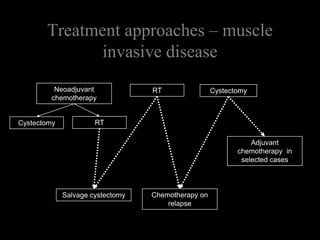
Treatment approaches – muscle invasive diseaseNeoadjuvant chemotherapyRTCystectomyRTCystectomyAdjuvant chemotherapy  in selected casesChemotherapy on relapseSalvage cystectomy
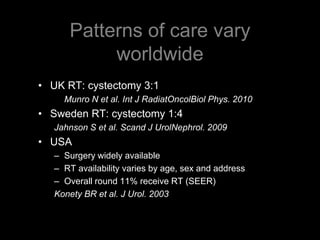
Patterns of care vary worldwideUK RT: cystectomy 3:1 	Munro N et al. Int J RadiatOncolBiol Phys. 2010Sweden RT: cystectomy 1:4Jahnson S et al. Scand J UrolNephrol. 2009USA Surgery widely availableRT availability varies by age, sex and addressOverall round 11% receive RT (SEER)Konety BR et al. J Urol. 2003
Some misconceptions about non-surgical therapy for bladder cancerSurvival is better after surgeryRadiotherapy results in a small shrunken bladder and poor quality of lifeBy giving RT urologists pass control of the patients to the oncologists
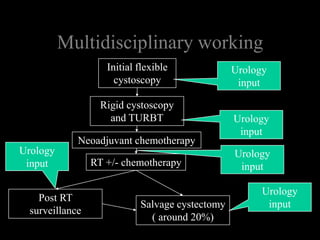
Multidisciplinary workingInitial flexible cystoscopyUrology inputRigid cystoscopy and TURBTUrology inputNeoadjuvant chemotherapyUrology inputUrology inputRT +/- chemotherapyUrology inputPost RT surveillanceSalvage cystectomy ( around 20%)
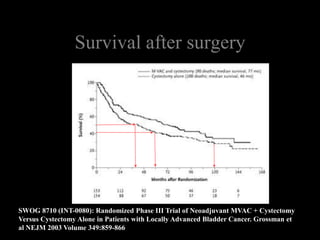
Survival after surgery SWOG 8710 (INT-0080): Randomized Phase III Trial of Neoadjuvant MVAC + Cystectomy Versus Cystectomy Alone in Patients with Locally Advanced Bladder Cancer. Grossman et al NEJM 2003 Volume 349:859-866
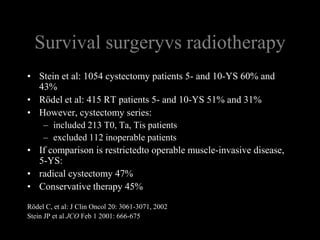
Survival surgeryvs radiotherapyStein et al: 1054 cystectomy patients 5- and 10-YS 60% and 43%Rödel et al: 415 RT patients 5- and 10-YS 51% and 31% However, cystectomy series:included 213 T0, Ta, Tis patientsexcluded 112 inoperable patients If comparison is restrictedto operable muscle-invasive disease, 5-YS: radical cystectomy 47%Conservative therapy 45%Rödel C, et al: J Clin Oncol 20: 3061-3071, 2002 Stein JP et al JCO Feb 1 2001: 666-675
Conclusion: surgery vs. RTPatterns of care very variableLong term survival rates comparable with surgery or RTNo compelling evidence for superiority of surgery
Is surgery better than radiotherapy for bladder cancer?It doesn’t matter
Patients unsuitable for surgeryElderlySevere cardiovascular or chest problemsObeseDiabetesPatients reluctant or unable to cope with stomaetc
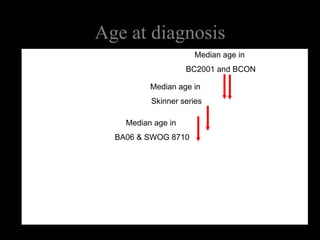
Age at diagnosisMedian age in BC2001 and BCONMedian age in Skinner seriesMedian age in BA06 & SWOG 8710
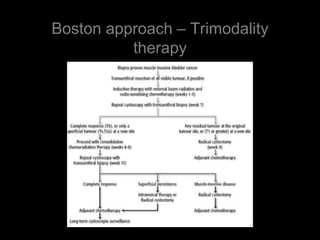
Can we select good responders?Biological markersSelect patients for radiotherapy on basis of initial response to therapyRationale for Boston approach
Boston approach – Trimodality therapy
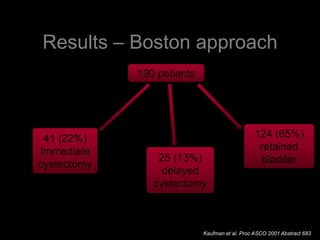
Results – Boston approach190 patients124 (65%) retained bladder41 (22%) Immediate cystectomy25 (13%) delayed cystectomyKaufman et al. Proc ASCO 2001 Abstract 683
Can we improve local control rates?Neoadjuvant therapySynchronous therapyAdjuvant therapy
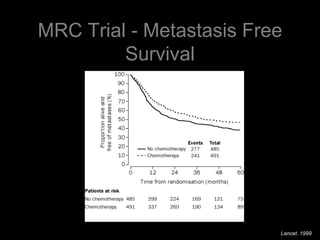
MRC Trial - Metastasis Free SurvivalLancet. 1999
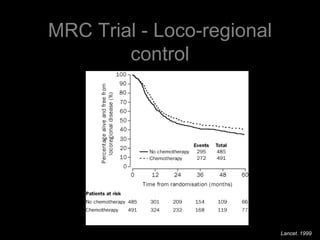
MRC Trial - Loco-regional controlLancet. 1999
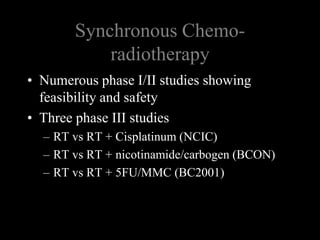
Synchronous Chemo-radiotherapyNumerous phase I/II studies showing feasibility and safetyThree phase III studiesRT vs RT + Cisplatinum (NCIC)RT vs RT + nicotinamide/carbogen (BCON)RT vs RT + 5FU/MMC (BC2001)
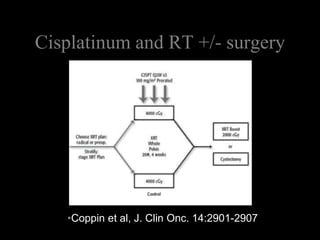
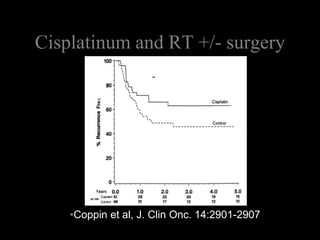
Cisplatinum and RT +/- surgeryCoppin et al, J. Clin Onc. 14:2901-2907Coppin et al, J. Clin Onc. 14:2901-2907Cisplatinum and RT +/- surgery
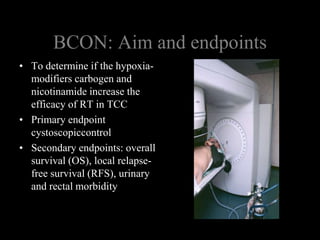
BCON: Aim and endpointsTo determine if the hypoxia-modifiers carbogen and nicotinamide increase the efficacy of RT in TCCPrimary endpoint cystoscopiccontrolSecondary endpoints: overall survival (OS), local relapse-free survival (RFS), urinary and rectal morbidity
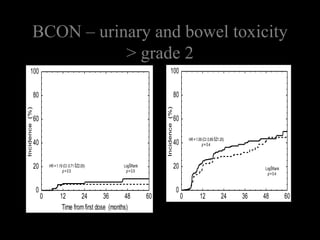
RT+ CONRT aloneBCON – urinary and bowel toxicity > grade 2
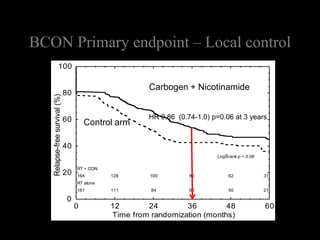
Carbogen + NicotinamideHR 0.86  (0.74-1.0) p=0.06 at 3 yearsControl armBCON Primary endpoint – Local control
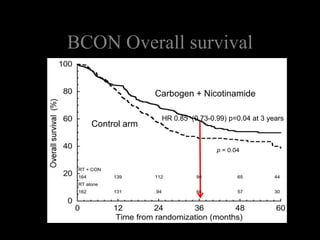
Carbogen + NicotinamideControl armBCON Overall survivalHR 0.85  (0.73-0.99) p=0.04 at 3 years
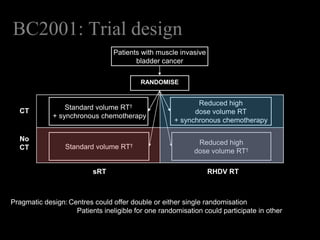
CTNoCTsRTRHDV RT BC2001: Trial designPatients with muscle invasive bladder cancerRANDOMISEReduced highdose volume RT+ synchronous chemotherapyStandard volume RT†  + synchronous chemotherapyReduced highdose volume RT†Standard volume RT†Pragmatic design:	Centres could offer double or either single randomisation 								Patients ineligible for one randomisation could participate in other
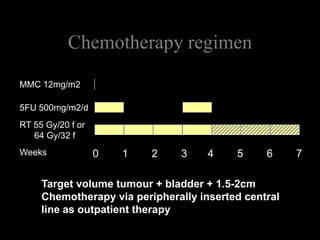
Chemotherapy regimenMMC 12mg/m25FU 500mg/m2/dRT 55 Gy/20 f or       64 Gy/32 fWeeks0        1        2        3       4        5        6        7 Target volume tumour + bladder + 1.5-2cmChemotherapy via peripherally inserted central line as outpatient therapy
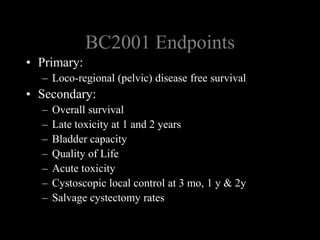
BC2001 EndpointsPrimary: Loco-regional (pelvic) disease free survivalSecondary: Overall survival Late toxicity at 1 and 2 years Bladder capacityQuality of Life Acute toxicity Cystoscopic local control at 3 mo, 1 y & 2y  Salvage cystectomy rates
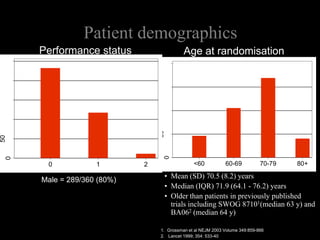
Patient demographicsPerformance statusAge at randomisationMean (SD) 70.5 (8.2) yearsMedian (IQR) 71.9 (64.1 - 76.2) yearsOlder than patients in previously published trials including SWOG 87101(median 63 y) and BA062 (median 64 y)Male = 289/360 (80%)Grossman et al NEJM 2003 Volume 349:859-866   Lancet 1999; 354: 533-40
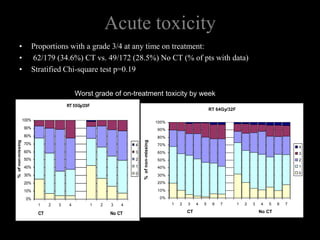
Acute toxicityProportions with a grade 3/4 at any time on treatment: 62/179 (34.6%) CT vs. 49/172 (28.5%) No CT (% of pts with data)  Stratified Chi-square test p=0.19Worst grade of on-treatment toxicity by week
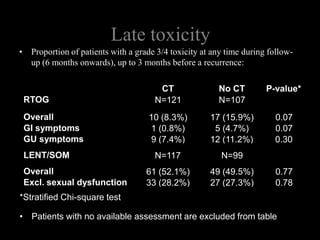
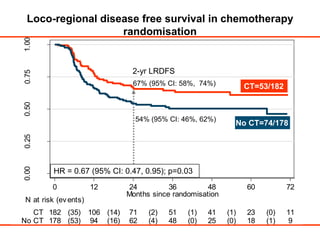
CTNo CTP-value*RTOGN=121N=107Overall10 (8.3%)17 (15.9%)0.07GI symptoms1 (0.8%)5 (4.7%)0.07GU symptoms9 (7.4%)12 (11.2%)0.30LENT/SOMN=117N=99Overall61 (52.1%)49 (49.5%)0.77Excl. sexual dysfunction33 (28.2%)27 (27.3%)0.78Late toxicityProportion of patients with a grade 3/4 toxicity at any time during follow-up (6 months onwards), up to 3 months before a recurrence:*Stratified Chi-square testPatients with no available assessment are excluded from tableLoco-regional disease free survival in chemotherapy randomisation 2-yr LRDFS 67% (95% CI: 58%,  74%)CT=53/18254% (95% CI: 46%, 62%)No CT=74/178HR = 0.67 (95% CI: 0.47, 0.95); p=0.03
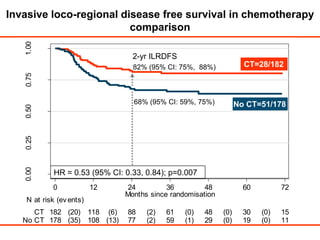
Invasive loco-regional disease free survival in chemotherapy comparison 2-yr ILRDFS CT=28/18282% (95% CI: 75%,  88%)68% (95% CI: 59%, 75%)No CT=51/178HR = 0.53 (95% CI: 0.33, 0.84); p=0.007
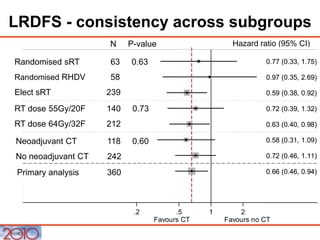
LRDFS - consistency across subgroupsHazard ratio (95% CI)N     P-valueRandomised sRT	63     0.63Randomised RHDV	58Elect sRT        	            239RT dose 55Gy/20F         140     0.73RT dose 64Gy/32F         212Neoadjuvant CT             118     0.60No neoadjuvant CT        242Primary analysis            360
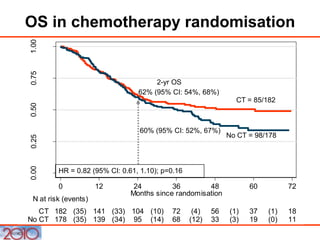
OS in chemotherapy randomisation 2-yr OS 62% (95% CI: 54%, 68%)CT = 85/18260% (95% CI: 52%, 67%)No CT = 98/178HR = 0.82 (95% CI: 0.61, 1.10); p=0.16
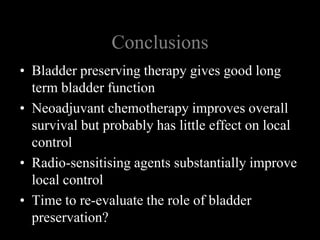
Conclusions Bladder preserving therapy gives good long term bladder functionNeoadjuvant chemotherapy improves overall survival but probably has little effect on local controlRadio-sensitising agents substantially improve local controlTime to re-evaluate the role of bladder preservation?
ECCLU 2011 - N. James - Localised invasive bladder cancer - Radiotherapy

ECCLU 2011 - N. James - Localised invasive bladder cancer - Radiotherapy

  • 1.
    Radiotherapy for bladdercancerNicholas JamesSchool of Cancer SciencesUniversity of Birmingham
  • 2.
    Treatment approaches –muscle invasive diseaseNeoadjuvant chemotherapyRTCystectomyRTCystectomyAdjuvant chemotherapy in selected casesChemotherapy on relapseSalvage cystectomy
  • 3.
    Patterns of carevary worldwideUK RT: cystectomy 3:1 Munro N et al. Int J RadiatOncolBiol Phys. 2010Sweden RT: cystectomy 1:4Jahnson S et al. Scand J UrolNephrol. 2009USA Surgery widely availableRT availability varies by age, sex and addressOverall round 11% receive RT (SEER)Konety BR et al. J Urol. 2003
  • 4.
    Some misconceptions aboutnon-surgical therapy for bladder cancerSurvival is better after surgeryRadiotherapy results in a small shrunken bladder and poor quality of lifeBy giving RT urologists pass control of the patients to the oncologists
  • 5.
    Multidisciplinary workingInitial flexiblecystoscopyUrology inputRigid cystoscopy and TURBTUrology inputNeoadjuvant chemotherapyUrology inputUrology inputRT +/- chemotherapyUrology inputPost RT surveillanceSalvage cystectomy ( around 20%)
  • 6.
    Survival after surgerySWOG 8710 (INT-0080): Randomized Phase III Trial of Neoadjuvant MVAC + Cystectomy Versus Cystectomy Alone in Patients with Locally Advanced Bladder Cancer. Grossman et al NEJM 2003 Volume 349:859-866
  • 7.
    Survival surgeryvs radiotherapySteinet al: 1054 cystectomy patients 5- and 10-YS 60% and 43%Rödel et al: 415 RT patients 5- and 10-YS 51% and 31% However, cystectomy series:included 213 T0, Ta, Tis patientsexcluded 112 inoperable patients If comparison is restrictedto operable muscle-invasive disease, 5-YS: radical cystectomy 47%Conservative therapy 45%Rödel C, et al: J Clin Oncol 20: 3061-3071, 2002 Stein JP et al JCO Feb 1 2001: 666-675
  • 8.
    Conclusion: surgery vs.RTPatterns of care very variableLong term survival rates comparable with surgery or RTNo compelling evidence for superiority of surgery
  • 9.
    Is surgery betterthan radiotherapy for bladder cancer?It doesn’t matter
  • 10.
    Patients unsuitable forsurgeryElderlySevere cardiovascular or chest problemsObeseDiabetesPatients reluctant or unable to cope with stomaetc
  • 11.
    Age at diagnosisMedianage in BC2001 and BCONMedian age in Skinner seriesMedian age in BA06 & SWOG 8710
  • 12.
    Can we selectgood responders?Biological markersSelect patients for radiotherapy on basis of initial response to therapyRationale for Boston approach
  • 13.
    Boston approach –Trimodality therapy
  • 14.
    Results – Bostonapproach190 patients124 (65%) retained bladder41 (22%) Immediate cystectomy25 (13%) delayed cystectomyKaufman et al. Proc ASCO 2001 Abstract 683
  • 15.
    Can we improvelocal control rates?Neoadjuvant therapySynchronous therapyAdjuvant therapy
  • 16.
    MRC Trial -Metastasis Free SurvivalLancet. 1999
  • 17.
    MRC Trial -Loco-regional controlLancet. 1999
  • 18.
    Synchronous Chemo-radiotherapyNumerous phaseI/II studies showing feasibility and safetyThree phase III studiesRT vs RT + Cisplatinum (NCIC)RT vs RT + nicotinamide/carbogen (BCON)RT vs RT + 5FU/MMC (BC2001)
  • 19.
    Cisplatinum and RT+/- surgeryCoppin et al, J. Clin Onc. 14:2901-2907Coppin et al, J. Clin Onc. 14:2901-2907Cisplatinum and RT +/- surgery
  • 20.
    BCON: Aim andendpointsTo determine if the hypoxia-modifiers carbogen and nicotinamide increase the efficacy of RT in TCCPrimary endpoint cystoscopiccontrolSecondary endpoints: overall survival (OS), local relapse-free survival (RFS), urinary and rectal morbidity
  • 21.
    RT+ CONRT aloneBCON– urinary and bowel toxicity > grade 2
  • 22.
    Carbogen + NicotinamideHR0.86 (0.74-1.0) p=0.06 at 3 yearsControl armBCON Primary endpoint – Local control
  • 23.
    Carbogen + NicotinamideControlarmBCON Overall survivalHR 0.85 (0.73-0.99) p=0.04 at 3 years
  • 24.
    CTNoCTsRTRHDV RT BC2001:Trial designPatients with muscle invasive bladder cancerRANDOMISEReduced highdose volume RT+ synchronous chemotherapyStandard volume RT† + synchronous chemotherapyReduced highdose volume RT†Standard volume RT†Pragmatic design: Centres could offer double or either single randomisation Patients ineligible for one randomisation could participate in other
  • 25.
    Chemotherapy regimenMMC 12mg/m25FU500mg/m2/dRT 55 Gy/20 f or 64 Gy/32 fWeeks0 1 2 3 4 5 6 7 Target volume tumour + bladder + 1.5-2cmChemotherapy via peripherally inserted central line as outpatient therapy
  • 26.
    BC2001 EndpointsPrimary: Loco-regional(pelvic) disease free survivalSecondary: Overall survival Late toxicity at 1 and 2 years Bladder capacityQuality of Life Acute toxicity Cystoscopic local control at 3 mo, 1 y & 2y Salvage cystectomy rates
  • 27.
    Patient demographicsPerformance statusAgeat randomisationMean (SD) 70.5 (8.2) yearsMedian (IQR) 71.9 (64.1 - 76.2) yearsOlder than patients in previously published trials including SWOG 87101(median 63 y) and BA062 (median 64 y)Male = 289/360 (80%)Grossman et al NEJM 2003 Volume 349:859-866 Lancet 1999; 354: 533-40
  • 28.
    Acute toxicityProportions witha grade 3/4 at any time on treatment: 62/179 (34.6%) CT vs. 49/172 (28.5%) No CT (% of pts with data) Stratified Chi-square test p=0.19Worst grade of on-treatment toxicity by week
  • 29.
    CTNo CTP-value*RTOGN=121N=107Overall10 (8.3%)17(15.9%)0.07GI symptoms1 (0.8%)5 (4.7%)0.07GU symptoms9 (7.4%)12 (11.2%)0.30LENT/SOMN=117N=99Overall61 (52.1%)49 (49.5%)0.77Excl. sexual dysfunction33 (28.2%)27 (27.3%)0.78Late toxicityProportion of patients with a grade 3/4 toxicity at any time during follow-up (6 months onwards), up to 3 months before a recurrence:*Stratified Chi-square testPatients with no available assessment are excluded from tableLoco-regional disease free survival in chemotherapy randomisation 2-yr LRDFS 67% (95% CI: 58%, 74%)CT=53/18254% (95% CI: 46%, 62%)No CT=74/178HR = 0.67 (95% CI: 0.47, 0.95); p=0.03
  • 30.
    Invasive loco-regional diseasefree survival in chemotherapy comparison 2-yr ILRDFS CT=28/18282% (95% CI: 75%, 88%)68% (95% CI: 59%, 75%)No CT=51/178HR = 0.53 (95% CI: 0.33, 0.84); p=0.007
  • 31.
    LRDFS - consistencyacross subgroupsHazard ratio (95% CI)N P-valueRandomised sRT 63 0.63Randomised RHDV 58Elect sRT 239RT dose 55Gy/20F 140 0.73RT dose 64Gy/32F 212Neoadjuvant CT 118 0.60No neoadjuvant CT 242Primary analysis 360
  • 32.
    OS in chemotherapyrandomisation 2-yr OS 62% (95% CI: 54%, 68%)CT = 85/18260% (95% CI: 52%, 67%)No CT = 98/178HR = 0.82 (95% CI: 0.61, 1.10); p=0.16
  • 33.
    Conclusions Bladder preservingtherapy gives good long term bladder functionNeoadjuvant chemotherapy improves overall survival but probably has little effect on local controlRadio-sensitising agents substantially improve local controlTime to re-evaluate the role of bladder preservation?