Factors Affecting Health
In Middle Adulthood
PSY 1170
By: Nichole Giokas
November 4, 2015
Figure 1.
Health and Wellness
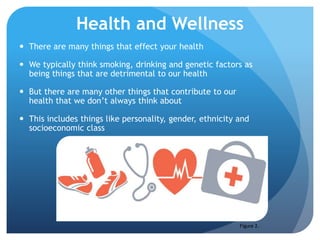
 There are many things that effect your health
 We typically think smoking, drinking and genetic factors as
being things that are detrimental to our health
 But there are many other things that contribute to our
health that we don’t always think about
 This includes things like personality, gender, ethnicity and
socioeconomic class
Figure 2.
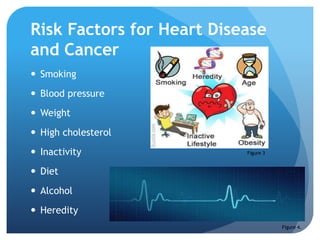
Risk Factors for Heart Disease
and Cancer
 Smoking
 Blood pressure
 Weight
 High cholesterol
 Inactivity
 Diet
 Alcohol
 Heredity
Figure 3
Figure 4.
Personality
 Personality has been thought to contribute to heart disease
 Meyer Friedman and Ray Rosenman are two cardiologists
that noticed that many of their patients that had heart
disease possessed many other similar characteristics with
one another
 These characteristics included things like sense of urgency,
hostility and aggressiveness, striving for achievement and
competitiveness.
 These are characteristics common with type A personality
Personality
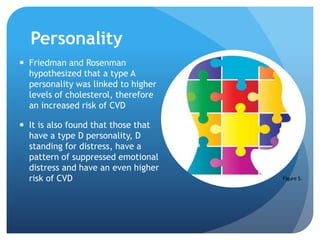
 Friedman and Rosenman
hypothesized that a type A
personality was linked to higher
levels of cholesterol, therefore
an increased risk of CVD
 It is also found that those that
have a type D personality, D
standing for distress, have a
pattern of suppressed emotional
distress and have an even higher
risk of CVD Figure 5.
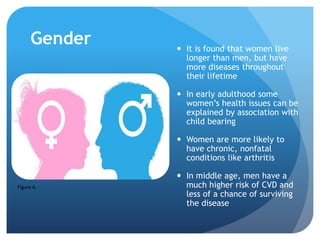
Gender  It is found that women live
longer than men, but have
more diseases throughout
their lifetime
 In early adulthood some
women’s health issues can be
explained by association with
child bearing
 Women are more likely to
have chronic, nonfatal
conditions like arthritis
 In middle age, men have a
much higher risk of CVD and
less of a chance of surviving
the disease
Figure 6.
Gender
 It is thought that women’s heart muscles are better
at adapting to stresses
 After a heart attack women tend to recover with a
higher level of functioning than men
 Women more likely to seek medical attention and
go for regular checkups than men, which could
contribute to their greater life expectancy
Socioeconomic Class
 In middle adulthood, job status and education collaborate to effect
health
 Those with higher paying jobs will be able to afford better health care
and benefits and therefore may be more healthy
 But it has also been shown that when there is two men, one with a high-
status occupation and one with a lower-status occupation, that both
believe that health care is “unmanly”, the man with the high-status
occupation will be less likely to visit the doctor and therefore may be
less healthy overall
Figure 7.
Socioeconomic Class
 A high-status job often comes with more stress and
responsibility and stress is a big risk factor for disease
 While these higher class individuals may have better
access to healthcare, they could be more unhealthy due
to their lifestyle
 Lower class individuals are more likely to live in
undesirable conditions and have more dangerous jobs
which can effect their health
 Those in the lower class may also not be able to afford
to have a healthy diet
Ethnicity
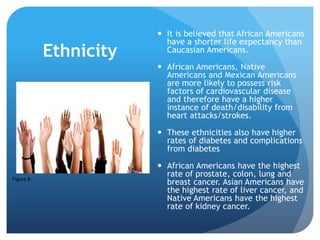
 It is believed that African Americans
have a shorter life expectancy than
Caucasian Americans.
 African Americans, Native
Americans and Mexican Americans
are more likely to possess risk
factors of cardiovascular disease
and therefore have a higher
instance of death/disability from
heart attacks/strokes.
 These ethnicities also have higher
rates of diabetes and complications
from diabetes
 African Americans have the highest
rate of prostate, colon, lung and
breast cancer. Asian Americans have
the highest rate of liver cancer, and
Native Americans have the highest
rate of kidney cancer.
Figure 8.
Ethnicity
 75% of Mexican American women, 80% of African
American women, and 58% of White Americans women
are overweight (NCHS 2010) which is a risk factor for
cardiovascular disease.
 15% of White and Mexican men, and 27% of African
American men have high blood pressure (NCHS 2010)
 Minorities often have less access to health care and are
less likely to seek care and medical interventions
Cognitive Functioning
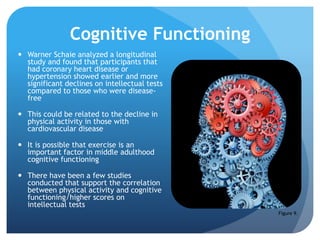
 Warner Schaie analyzed a longitudinal
study and found that participants that
had coronary heart disease or
hypertension showed earlier and more
significant declines on intellectual tests
compared to those who were disease-
free
 This could be related to the decline in
physical activity in those with
cardiovascular disease
 It is possible that exercise is an
important factor in middle adulthood
cognitive functioning
 There have been a few studies
conducted that support the correlation
between physical activity and cognitive
functioning/higher scores on
intellectual tests
Figure 9.
How is This Information Relevant
to Me?
 I think that it is important to know what puts your at risk for
certain diseases
 By knowing the risk factors for particular diseases I can
change the factors that are modifiable or be aware of the
factors that are unmodifiable
 I know that because I’m a woman I may live longer but I’m
also at a higher risk for chronic disease throughout my
lifetime and could take steps to prevent certain diseases
 I could include more physical activity into my life, knowing
that it not only could reduce my chance of disease but also
prevent the decline of my cognitive functioning
How Can I Use This Information
in My Professional Life?
 As a bachelor of nursing student, my career
will be revolved around the health and
wellness of other people
 Knowing risk factors can help me to teach
my patients about prevention as well as
explain to them what could have put them at
risk for a disease they already have
 For example, if I had a patient that has a
very obvious type A personality, I could use
this information to teach them. I could
explain to them how their personality can
correspond with their health and possibly
teach them how to live a more low stress life
and prevent cardiovascular disease.
 Many patients don’t know about risk factors
like ethnicity and gender and it is my job to
teach them about what contributes to their
overall health
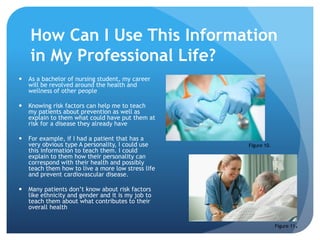
Figure 10.
Figure 11.
References
Boyd, D., Johnson P., Bee, H. (2015) Lifespan Development. (5th Canadian Ed.) Toronto, ON: Prentice Hall Canada Inc.
Images
Figure 1. (2014). Health. [online image]. Retrieved from http://www.foreignstudents.com/health
Figure 2. (2015). Risk Factors. [online image]. Retrieved from https://www.emaze.com/@ALCFLOQO/Heart-Disease
Figure 3. (2013). ECG. [online image]. Retrieved from http://learning.bmj.com/learning/module-intro/ecg-electrocardiographic-athletes-
cardiomyopathy-amssm-fifa.html?moduleId=10042584
Figure 4. (2015). Health and Wellness. [online image]. Retrieved from http://www.globoforce.com/how-it-works/versatile-programs/health-wellness/
Figure 5. (2013). Personality. [online image]. Retrieved from http://www.livescience.com/41313-personality-traits.html
Figure 6. (2015). Gender. [online image]. Retrieved from http://mrsguillory.weebly.com/blog/february-16th-2015
Figure 7. (2012). Health and Money. [online image]. Retrieved from http://www.stateofdisparity.org/?m=201202
Figure 8. (2015). Ethnicity. [online image]. Retrieved from http://www.thebackroadcafe.com/who-i-say-i-that-i-am-i-am-r/
Figure 9. (2013). Cognitive Function. [online image]. Retrieved from
http://www.meschinohealth.com/ArticleDirectory/B_Vitamins_Memory_And_Cognitive_Function
Figure 10. (2015). Nursing. [online image]. Retrieved from http://blogs.vancouversun.com/2015/06/17/nurses-airing-dirty-laundry-the-nasty-legal-
spat-fracturing-the-bc-nursing-profession/
Figure 11. (2012). Nursing Care. [online image]. Retrieved from http://www.telegraph.co.uk/news/health/news/9003772/Nurses-are-losing-their-
sense-of-compassion.html

Factors Affecting Health

  • 1.
    Factors Affecting Health InMiddle Adulthood PSY 1170 By: Nichole Giokas November 4, 2015 Figure 1.
  • 2.
    Health and Wellness There are many things that effect your health  We typically think smoking, drinking and genetic factors as being things that are detrimental to our health  But there are many other things that contribute to our health that we don’t always think about  This includes things like personality, gender, ethnicity and socioeconomic class Figure 2.
  • 3.
    Risk Factors forHeart Disease and Cancer  Smoking  Blood pressure  Weight  High cholesterol  Inactivity  Diet  Alcohol  Heredity Figure 3 Figure 4.
  • 4.
    Personality  Personality hasbeen thought to contribute to heart disease  Meyer Friedman and Ray Rosenman are two cardiologists that noticed that many of their patients that had heart disease possessed many other similar characteristics with one another  These characteristics included things like sense of urgency, hostility and aggressiveness, striving for achievement and competitiveness.  These are characteristics common with type A personality
  • 5.
    Personality  Friedman andRosenman hypothesized that a type A personality was linked to higher levels of cholesterol, therefore an increased risk of CVD  It is also found that those that have a type D personality, D standing for distress, have a pattern of suppressed emotional distress and have an even higher risk of CVD Figure 5.
  • 6.
    Gender  Itis found that women live longer than men, but have more diseases throughout their lifetime  In early adulthood some women’s health issues can be explained by association with child bearing  Women are more likely to have chronic, nonfatal conditions like arthritis  In middle age, men have a much higher risk of CVD and less of a chance of surviving the disease Figure 6.
  • 7.
    Gender  It isthought that women’s heart muscles are better at adapting to stresses  After a heart attack women tend to recover with a higher level of functioning than men  Women more likely to seek medical attention and go for regular checkups than men, which could contribute to their greater life expectancy
  • 8.
    Socioeconomic Class  Inmiddle adulthood, job status and education collaborate to effect health  Those with higher paying jobs will be able to afford better health care and benefits and therefore may be more healthy  But it has also been shown that when there is two men, one with a high- status occupation and one with a lower-status occupation, that both believe that health care is “unmanly”, the man with the high-status occupation will be less likely to visit the doctor and therefore may be less healthy overall Figure 7.
  • 9.
    Socioeconomic Class  Ahigh-status job often comes with more stress and responsibility and stress is a big risk factor for disease  While these higher class individuals may have better access to healthcare, they could be more unhealthy due to their lifestyle  Lower class individuals are more likely to live in undesirable conditions and have more dangerous jobs which can effect their health  Those in the lower class may also not be able to afford to have a healthy diet
  • 10.
    Ethnicity  It isbelieved that African Americans have a shorter life expectancy than Caucasian Americans.  African Americans, Native Americans and Mexican Americans are more likely to possess risk factors of cardiovascular disease and therefore have a higher instance of death/disability from heart attacks/strokes.  These ethnicities also have higher rates of diabetes and complications from diabetes  African Americans have the highest rate of prostate, colon, lung and breast cancer. Asian Americans have the highest rate of liver cancer, and Native Americans have the highest rate of kidney cancer. Figure 8.
  • 11.
    Ethnicity  75% ofMexican American women, 80% of African American women, and 58% of White Americans women are overweight (NCHS 2010) which is a risk factor for cardiovascular disease.  15% of White and Mexican men, and 27% of African American men have high blood pressure (NCHS 2010)  Minorities often have less access to health care and are less likely to seek care and medical interventions
  • 12.
    Cognitive Functioning  WarnerSchaie analyzed a longitudinal study and found that participants that had coronary heart disease or hypertension showed earlier and more significant declines on intellectual tests compared to those who were disease- free  This could be related to the decline in physical activity in those with cardiovascular disease  It is possible that exercise is an important factor in middle adulthood cognitive functioning  There have been a few studies conducted that support the correlation between physical activity and cognitive functioning/higher scores on intellectual tests Figure 9.
  • 13.
    How is ThisInformation Relevant to Me?  I think that it is important to know what puts your at risk for certain diseases  By knowing the risk factors for particular diseases I can change the factors that are modifiable or be aware of the factors that are unmodifiable  I know that because I’m a woman I may live longer but I’m also at a higher risk for chronic disease throughout my lifetime and could take steps to prevent certain diseases  I could include more physical activity into my life, knowing that it not only could reduce my chance of disease but also prevent the decline of my cognitive functioning
  • 14.
    How Can IUse This Information in My Professional Life?  As a bachelor of nursing student, my career will be revolved around the health and wellness of other people  Knowing risk factors can help me to teach my patients about prevention as well as explain to them what could have put them at risk for a disease they already have  For example, if I had a patient that has a very obvious type A personality, I could use this information to teach them. I could explain to them how their personality can correspond with their health and possibly teach them how to live a more low stress life and prevent cardiovascular disease.  Many patients don’t know about risk factors like ethnicity and gender and it is my job to teach them about what contributes to their overall health Figure 10. Figure 11.
  • 15.
    References Boyd, D., JohnsonP., Bee, H. (2015) Lifespan Development. (5th Canadian Ed.) Toronto, ON: Prentice Hall Canada Inc. Images Figure 1. (2014). Health. [online image]. Retrieved from http://www.foreignstudents.com/health Figure 2. (2015). Risk Factors. [online image]. Retrieved from https://www.emaze.com/@ALCFLOQO/Heart-Disease Figure 3. (2013). ECG. [online image]. Retrieved from http://learning.bmj.com/learning/module-intro/ecg-electrocardiographic-athletes- cardiomyopathy-amssm-fifa.html?moduleId=10042584 Figure 4. (2015). Health and Wellness. [online image]. Retrieved from http://www.globoforce.com/how-it-works/versatile-programs/health-wellness/ Figure 5. (2013). Personality. [online image]. Retrieved from http://www.livescience.com/41313-personality-traits.html Figure 6. (2015). Gender. [online image]. Retrieved from http://mrsguillory.weebly.com/blog/february-16th-2015 Figure 7. (2012). Health and Money. [online image]. Retrieved from http://www.stateofdisparity.org/?m=201202 Figure 8. (2015). Ethnicity. [online image]. Retrieved from http://www.thebackroadcafe.com/who-i-say-i-that-i-am-i-am-r/ Figure 9. (2013). Cognitive Function. [online image]. Retrieved from http://www.meschinohealth.com/ArticleDirectory/B_Vitamins_Memory_And_Cognitive_Function Figure 10. (2015). Nursing. [online image]. Retrieved from http://blogs.vancouversun.com/2015/06/17/nurses-airing-dirty-laundry-the-nasty-legal- spat-fracturing-the-bc-nursing-profession/ Figure 11. (2012). Nursing Care. [online image]. Retrieved from http://www.telegraph.co.uk/news/health/news/9003772/Nurses-are-losing-their- sense-of-compassion.html