Health Problems In
Elderly
Presented by:
• Roll no. 19040 to 19046
Introduction
 Ageing is a progressive and generalised
impairment of body function resulting in
loss of adaptive responses to stress and
increasing the risk of age related
diseases.
 Geriatrics –
Means the care of Aged.It is derived
from Greek word ‘geras’ means ‘old age’
and ‘iatros’ means ‘doctor’.
A) Problems due to aging process
With the passage of time , certain
biological changes take place in the
human body that eventually lead to
death.
Ageing is associated with
deterioration in vitality and
lowering of biological efficiency.
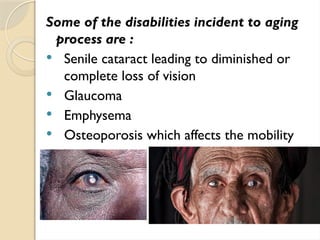
Some of the disabilities incident to aging
process are :
 Senile cataract leading to diminished or
complete loss of vision
 Glaucoma
 Emphysema
 Osteoporosis which affects the mobility
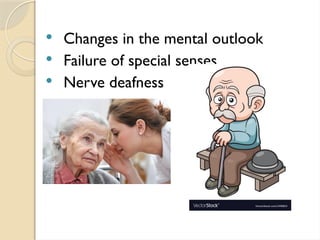
 Changes in the mental outlook
 Failure of special senses
 Nerve deafness
B) Problems associated with long term
illness
Some chronic diseases are more
frequent among the older people
than younger people.
1. Degenerative diseases of heart
and blood vessels : eg.
Atherosclerosis and narrowing of
vessels leads to diminished blood
supply, thromus formation, rupture of
blood vessels and high BP.
2. Cancer:
 It is the leading cause of death in
developed countries.
 Incidence of cancer rises after 40
years of age.
 Prostate cancer is common after
65 years of age.
3. Accidents :
 Due to aging process, the bones of
elderly people become fragile due to
decalcification as a result of which
bones break easily.
 More common in home than
outside.
 Most common problem is fracture
of femur.
4. Diabetes :
 Leading cause of death as the
population grows older.
 75% of diabetics are over 50
years of age.
5. Diseases of locomotor system :
 Common in elderly.
 Cause more discomfort and
disability than any other chronic
disease in elderly.
 Example: Rheumatoid
arthritis,Gout, myositis,fibrositis,
osteoarthritis,etc.
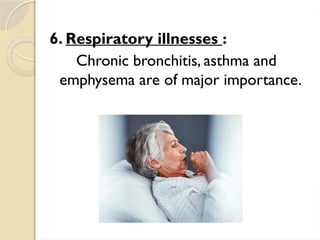
6. Respiratory illnesses :
Chronic bronchitis, asthma and
emphysema are of major importance.
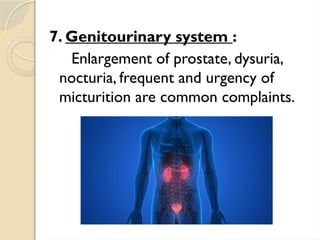
7. Genitourinary system :
Enlargement of prostate, dysuria,
nocturia, frequent and urgency of
micturition are common complaints.
C) Psychological Problems:
 Mental Illnes:
1. Impaired memory
2. Rigidity of outlook
3. Dislike of changes
 Sexual Adjustment:
Between 40-50 years there is
menopause in females and decrease in
sexual activity in males
It leads to irritability, jealousy, physical
& emotional disturbances.
 Emotional Disorder:
1. Results from social maladjustment
2. Failure to adapt can results in
bitterness, depression,or even
suicide.
Lifestyle and Healthy Ageing
People can do a great deal to influence the
individual risk of developing many of the
diseases of later life by paying careful
attention to lifestyle factors
These Factors are :
1.Diet and Nutrition
 A good diet reduces the chances of
developing the diseases of old age.
 The diet should be balanced with less
saturated fats and oils; should contain
lots of fruits and vegetables; salt and
sugar should be less; include plenty of
calcium rich food; eat high fibre diet.
2.Exercise
 It helps maintain good health as –
1. it helps to control weight
2. Improves emotional well being and
releives stress
3. Improves blood circulation
4. Increases flexibility and improves
balance
5. Lowers BP and blood sugar levels
6. Improves bone density
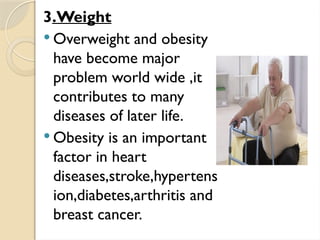
3.Weight
 Overweight and obesity
have become major
problem world wide ,it
contributes to many
diseases of later life.
 Obesity is an important
factor in heart
diseases,stroke,hypertens
ion,diabetes,arthritis and
breast cancer.
4.Refrain fromTobacco and Alcohol
use
 Tobacco consumption either in smoke or
smokeless form is associtaed with oral,
lung and esophageal cancer
 Alcohol consumption is associated with
liver diseases, stomach ulcer,gout,
depression, osteoporosis, heart diseases,
breast cancer, diabetes, and hypertension.
 Older people are more sensitive to effects
of alcohol then younger people.
4. Participation in social activites
 In old age ,people tend to get socially
isolated.
 Therefore an active effort should be
made to mingle with others of the
same age group.
 Being part of support group is
encouraged.
 Family members should also make an
active effort to involve the elders in all
the family activities.
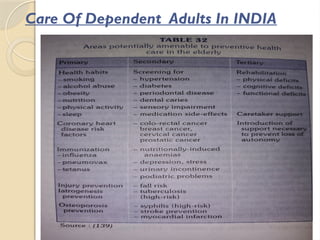
Care Of Dependent Adults In INDIA
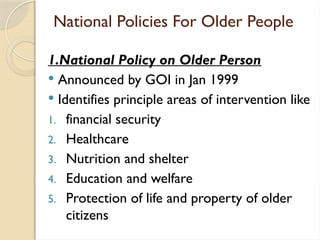
National Policies For Older People
1.National Policy on Older Person
 Announced by GOI in Jan 1999
 Identifies principle areas of intervention like
1. financial security
2. Healthcare
3. Nutrition and shelter
4. Education and welfare
5. Protection of life and property of older
citizens
 The programme for the first time
recognizes formation of self
groups,association of older persons for
advancement of their rights and utilization
of their experience and services
 234 old age homes , 398 daycare centres ,
40 mobile medical units are operational.
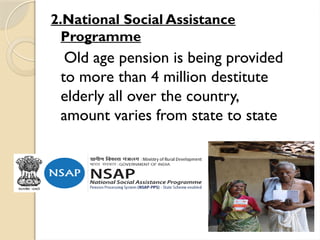
2.National Social Assistance
Programme
Old age pension is being provided
to more than 4 million destitute
elderly all over the country,
amount varies from state to state
3.Old age social and income
security project
 Was launched comprehensively
examine policy questions connected
with old age income security
4.Health Care facilities are
provided by -
 Bhavishya Arogya Mediclaim
 Rural group life insurance scheme
5.Indira Gandhi National Old Age
Pension Scheme
 Was launched on 19 November 2007
 To provide monthly pension to people
over 65 years and living below poverty
line.
 Cover about 1.57 crore people
6.Helpage India
 Biggest voluntary organization
working for cause and care of senior
citizens facing disadvantages
 It supports the following
programmes to make life easier for
older people-
-Free cataract operations
-Mobile medicare units
-Income generation and micro credits
-Old age homes and day care centres
-Adopt a gran
-Disaster mitigation
Reference:
 Park’s Textbook of Preventive and Social
Medicine( Edition 26).
 Images from Google.
THANKYOU

Health Problems In Elderly population.pptx

  • 1.
    Health Problems In Elderly Presentedby: • Roll no. 19040 to 19046
  • 2.
    Introduction  Ageing isa progressive and generalised impairment of body function resulting in loss of adaptive responses to stress and increasing the risk of age related diseases.  Geriatrics – Means the care of Aged.It is derived from Greek word ‘geras’ means ‘old age’ and ‘iatros’ means ‘doctor’.
  • 3.
    A) Problems dueto aging process With the passage of time , certain biological changes take place in the human body that eventually lead to death. Ageing is associated with deterioration in vitality and lowering of biological efficiency.
  • 4.
    Some of thedisabilities incident to aging process are :  Senile cataract leading to diminished or complete loss of vision  Glaucoma  Emphysema  Osteoporosis which affects the mobility
  • 5.
     Changes inthe mental outlook  Failure of special senses  Nerve deafness
  • 6.
    B) Problems associatedwith long term illness Some chronic diseases are more frequent among the older people than younger people. 1. Degenerative diseases of heart and blood vessels : eg. Atherosclerosis and narrowing of vessels leads to diminished blood supply, thromus formation, rupture of blood vessels and high BP.
  • 7.
    2. Cancer:  Itis the leading cause of death in developed countries.  Incidence of cancer rises after 40 years of age.  Prostate cancer is common after 65 years of age.
  • 8.
    3. Accidents : Due to aging process, the bones of elderly people become fragile due to decalcification as a result of which bones break easily.  More common in home than outside.  Most common problem is fracture of femur.
  • 9.
    4. Diabetes : Leading cause of death as the population grows older.  75% of diabetics are over 50 years of age.
  • 10.
    5. Diseases oflocomotor system :  Common in elderly.  Cause more discomfort and disability than any other chronic disease in elderly.  Example: Rheumatoid arthritis,Gout, myositis,fibrositis, osteoarthritis,etc.
  • 11.
    6. Respiratory illnesses: Chronic bronchitis, asthma and emphysema are of major importance.
  • 12.
    7. Genitourinary system: Enlargement of prostate, dysuria, nocturia, frequent and urgency of micturition are common complaints.
  • 13.
    C) Psychological Problems: Mental Illnes: 1. Impaired memory 2. Rigidity of outlook 3. Dislike of changes  Sexual Adjustment: Between 40-50 years there is menopause in females and decrease in sexual activity in males
  • 14.
    It leads toirritability, jealousy, physical & emotional disturbances.  Emotional Disorder: 1. Results from social maladjustment 2. Failure to adapt can results in bitterness, depression,or even suicide.
  • 15.
    Lifestyle and HealthyAgeing People can do a great deal to influence the individual risk of developing many of the diseases of later life by paying careful attention to lifestyle factors These Factors are :
  • 16.
    1.Diet and Nutrition A good diet reduces the chances of developing the diseases of old age.  The diet should be balanced with less saturated fats and oils; should contain lots of fruits and vegetables; salt and sugar should be less; include plenty of calcium rich food; eat high fibre diet.
  • 17.
    2.Exercise  It helpsmaintain good health as – 1. it helps to control weight 2. Improves emotional well being and releives stress 3. Improves blood circulation 4. Increases flexibility and improves balance 5. Lowers BP and blood sugar levels 6. Improves bone density
  • 18.
    3.Weight  Overweight andobesity have become major problem world wide ,it contributes to many diseases of later life.  Obesity is an important factor in heart diseases,stroke,hypertens ion,diabetes,arthritis and breast cancer.
  • 19.
    4.Refrain fromTobacco andAlcohol use  Tobacco consumption either in smoke or smokeless form is associtaed with oral, lung and esophageal cancer  Alcohol consumption is associated with liver diseases, stomach ulcer,gout, depression, osteoporosis, heart diseases, breast cancer, diabetes, and hypertension.  Older people are more sensitive to effects of alcohol then younger people.
  • 20.
    4. Participation insocial activites  In old age ,people tend to get socially isolated.  Therefore an active effort should be made to mingle with others of the same age group.  Being part of support group is encouraged.  Family members should also make an active effort to involve the elders in all the family activities.
  • 21.
    Care Of DependentAdults In INDIA
  • 22.
    National Policies ForOlder People 1.National Policy on Older Person  Announced by GOI in Jan 1999  Identifies principle areas of intervention like 1. financial security 2. Healthcare 3. Nutrition and shelter 4. Education and welfare 5. Protection of life and property of older citizens
  • 23.
     The programmefor the first time recognizes formation of self groups,association of older persons for advancement of their rights and utilization of their experience and services  234 old age homes , 398 daycare centres , 40 mobile medical units are operational.
  • 24.
    2.National Social Assistance Programme Oldage pension is being provided to more than 4 million destitute elderly all over the country, amount varies from state to state
  • 25.
    3.Old age socialand income security project  Was launched comprehensively examine policy questions connected with old age income security
  • 26.
    4.Health Care facilitiesare provided by -  Bhavishya Arogya Mediclaim  Rural group life insurance scheme
  • 27.
    5.Indira Gandhi NationalOld Age Pension Scheme  Was launched on 19 November 2007  To provide monthly pension to people over 65 years and living below poverty line.  Cover about 1.57 crore people
  • 28.
    6.Helpage India  Biggestvoluntary organization working for cause and care of senior citizens facing disadvantages  It supports the following programmes to make life easier for older people- -Free cataract operations -Mobile medicare units -Income generation and micro credits
  • 29.
    -Old age homesand day care centres -Adopt a gran -Disaster mitigation
  • 30.
    Reference:  Park’s Textbookof Preventive and Social Medicine( Edition 26).  Images from Google.
  • 31.