Balance & Imbalance
(VERTIGO)
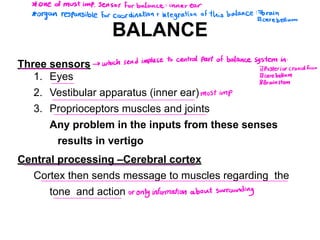
BALANCE
Three sensors
1. Eyes
2. Vestibular apparatus (inner ear)
3. Proprioceptors muscles and joints
Any problem in the inputs from these senses
results in vertigo
Central processing –Cerebral cortex
Cortex then sends message to muscles regarding the
tone and action
one ofmostImpSensorforbalance inner ear
organresponsibleforcoordination integrationofthisbalancein
brain
27
cerebellum
whichsendimpulsetocentralpartofbalancesystemin
17
Posterior
cranial
fos
27
cerebellum
37
Brainstem
mostimp
oronly
informationaboutsurrounding
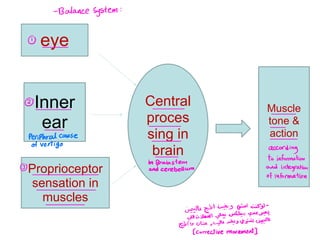
Inner
ear
Central
proces
sing in
brain
eye
Proprioceptor
sensation in
muscles
Muscle
tone &
action
Balancesystem
Peripheralcause
ofVertigo
according
toinformation
inBrainstem
and
cerebellum andintegration
ofinformation
ids 1 Ias I od
di Idi Is WH E's
to ow wsisms Itf
correctivemovement
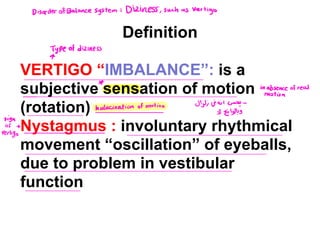
Definition
VERTIGO “IMBALANCE”: is a
subjective sensation of motion
(rotation)
Nystagmus : involuntary rhythmical
movement “oscillation” of eyeballs,
due to problem in vestibular
function
Disorderof
Balance
system
inDT2
in
CSSsuchas Vertigo
Typeofdiziness
9
inabsenceofreal
motion
halucination ofmotion i i ios
I
Ign
f
Higo
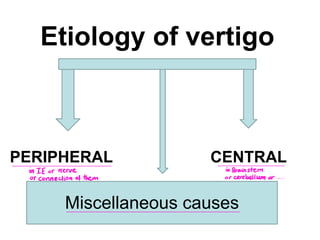
Etiology of vertigo
PERIPHERAL CENTRAL
Miscellaneous causes
inIEor nerve inBrainstem
orconnectionof
them orcerebellumor
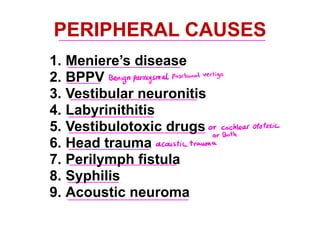
PERIPHERAL CAUSES
1. Meniere’s disease
2. BPPV
3. Vestibular neuronitis
4. Labyrinithitis
5. Vestibulotoxic drugs
6. Head trauma
7. Perilymph fistula
8. Syphilis
9. Acoustic neuroma
Benignparoxysmalpositionalvertigo
or cochlear
oto
toxic
orBoth
acoustictrauma
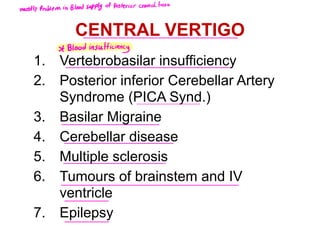
CENTRAL VERTIGO
1. Vertebrobasilar insufficiency
2. Posterior inferior Cerebellar Artery
Syndrome (PICA Synd.)
3. Basilar Migraine
4. Cerebellar disease
5. Multiple sclerosis
6. Tumours of brainstem and IV
ventricle
7. Epilepsy
mostly
problem
inBlood
supplyofPosterior
cranial
fossa
Bloodinsufficiency
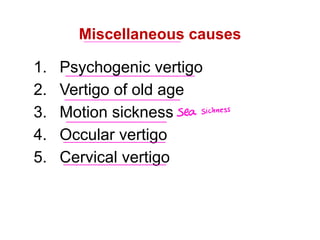
Miscellaneous causes
1. Psychogenic vertigo
2. Vertigo of old age
3. Motion sickness
4. Occular vertigo
5. Cervical vertigo
Sea sickness
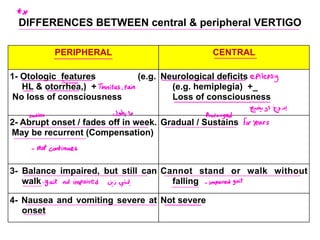
DIFFERENCES BETWEEN central & peripheral VERTIGO
PERIPHERAL CENTRAL
1- Otologic features (e.g.
HL & otorrhea,) +
No loss of consciousness
Neurological deficits
(e.g. hemiplegia) +_
Loss of consciousness
2- Abrupt onset / fades off in week.
May be recurrent (Compensation)
Gradual / Sustains
3- Balance impaired, but still can
walk
Cannot stand or walk without
falling
4- Nausea and vomiting severe at
onset
Not severe
epilepsy
Discharge
TinnitusPain
Gigs a
sudden 6 prolonged
for
years
notcontinues
gaitnotimpaired end impaired
gait
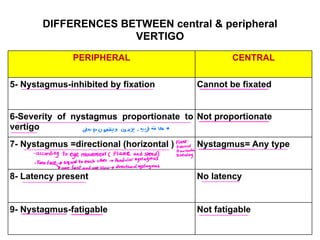
DIFFERENCES BETWEEN central & peripheral
VERTIGO
PERIPHERAL CENTRAL
5- Nystagmus-inhibited by fixation Cannot be fixated
6-Severity of nystagmus proportionate to
vertigo
Not proportionate
7- Nystagmus =directional (horizontal ) Nystagmus= Any type
8- Latency present No latency
9- Nystagmus-fatigable Not fatigable
i.ba fsosoI.eI ow
plane
vertical
anorizontai
accordingtoeyemovement Planeand
speed arotatory
Two
face equal
to
eachother pendolar
nystagmus
onefastandoneslow directional
nystagmus
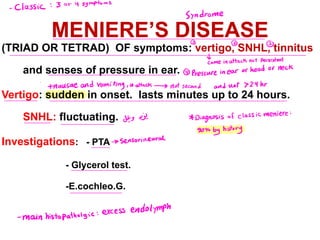
MENIERE’S DISEASE
(TRIAD OR TETRAD) OF symptoms: vertigo, SNHL, tinnitus
and senses of pressure in ear.
Vertigo: sudden in onset. lasts minutes up to 24 hours.
SNHL: fluctuating.
Investigations: - PTA
- Glycerol test.
-E.cochleo.G.
Classic 3 or 4symptoms
syndrome
omeinattacknotpersistent
Pressurein ear orhead orneck
nausaeandvomiting inattack not
second andnot 724hr
ofclassic
meniere
I Diagnosis
Sensorineural
90 byhistory
main histopatholgic
excess endolymph
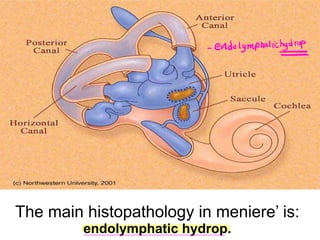
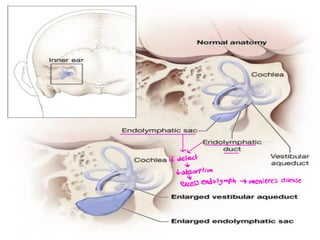
The main histopathology in meniere’ is:
endolymphatic hydrop.
eddolymphatic
hydrop
a
ifdefect
absorption
excess
endolymph meniere'sdisease
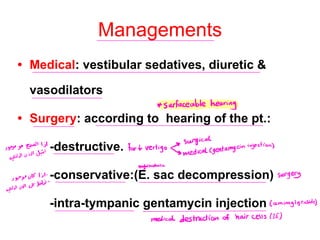
Managements
• Medical: vestibular sedatives, diuretic &
vasodilators
• Surgery: according to hearing of the pt.:
-destructive.
-conservative:(E. sac decompression)
-intra-tympanic gentamycin injection
surfaceablehearing
surgical
3 Tc l'd fortvertigo egentamycin
injection
I medical
fills
engolymphatic
is lil surgery
Is
I'd WIG
aminoglycosid
medicaldestructionof haircellsCIE
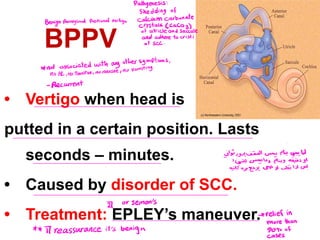
BPPV
• Vertigo when head is
putted in a certain position. Lasts
seconds – minutes.
• Caused by disorder of SCC.
• Treatment: EPLEY’s maneuver.
Pathogenesis
Shedding of
Benign
Paroxysmal
Positional
vertigo calciumcarbonate
crystals cacoz
ofutricle
and
saccule
andadhere
tocristi
ofScc
notassociated
withany
other
symptoms
noHLno
Tinnitusno
nausaenovomiting
Recurrent
If tis I W
s W WI Is Iasi
In os.es I d 61 d W
27 orSemon's
reliefin
morethan
Tfreassurance it's benign 90 of
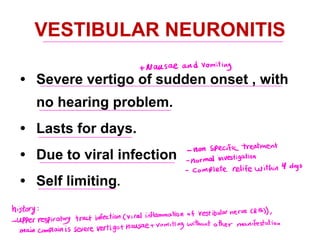
VESTIBULAR NEURONITIS
• Severe vertigo of sudden onset , with
no hearing problem.
• Lasts for days.
• Due to viral infection
• Self limiting.
NanSae andvomiting
non specific
treatment
normal
investigation
complete relifewithin 4days
historyi
Upper
respiratorytractinfection
eviralinflammation ofvestibular
nerve 8th
maincomplainissevereVertigo
thausaet
vomiting
without
othermanifestation
LABYRINTHITIS
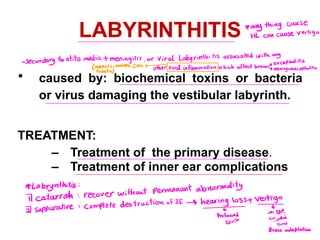
• caused by: biochemical toxins or bacteria
or virus damaging the vestibular labyrinth.
TREATMENT:
– Treatment of the primary disease.
– Treatment of inner ear complications
anything cause
HLcancauseverti
secondarytootitismedia1meningitis or viral Labyrinthitisassociatedwith
any
encephalitis
measis
mumpsenve other
viralinflammationwhich
affect
brain
Ismeningoencephali
Rubella
Labrynthitis
I catarrah recoverwithout permanantabnormality
27suppurative i completedestructionofIE hearingloss Vertigo
d
Profound ed
i
est w
Brainadaptation
VESTIBULOTOXIC DRUGS
➢Certain drugs damage the hair cells
in vestibulococholear system eg;
1. Amino glycosides
2. Antihypertensive drugs
3. Oestrogen preparations
4. Diuretics
5. Antimalarials etc.
HEAD TRAUMA
• Head injury cause concussion of
labyrinth, disrupt bony labyrinth or 8th
nerve.
• Operative trauma.
• Severe acoustic trauma like explosion
also cause vertigo
Physical
ACOUSTIC NEUROMA
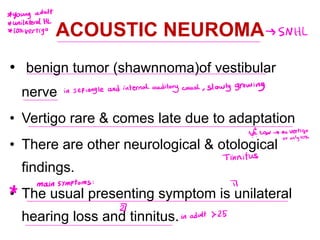
• benign tumor (shawnnoma)of vestibular
nerve
• Vertigo rare & comes late due to adaptation
• There are other neurological & otological
findings.
• The usual presenting symptom is unilateral
hearing loss and tinnitus.
youngadult
unilateral
HL
10 vertigo SNHL
inSepangleandinternalauditorycanal slowlygrowing
w's no
vertigo
oronly
10
Tinnitus
mainsymptoms Ty
27
inadult 25
diagnosis
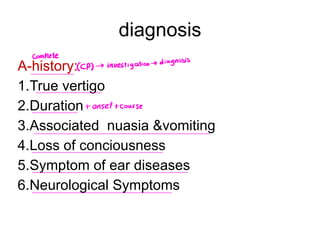
A-history:
1.True vertigo
2.Duration
3.Associated nuasia &vomiting
4.Loss of conciousness
5.Symptom of ear diseases
6.Neurological Symptoms
Complete
CP investigation diagnosis
onset course
Diagnosis
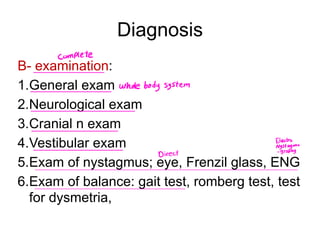
B- examination:
1.General exam
2.Neurological exam
3.Cranial n exam
4.Vestibular exam
5.Exam of nystagmus; eye, Frenzil glass, ENG
6.Exam of balance: gait test, romberg test, test
for dysmetria,
Complete
wholebodysystem
Electro
Nystagmo
Direct graphy
diagnosis
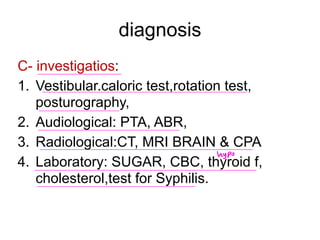
C- investigatios:
1. Vestibular.caloric test,rotation test,
posturography,
2. Audiological: PTA, ABR,
3. Radiological:CT, MRI BRAIN & CPA
4. Laboratory: SUGAR, CBC, thyroid f,
cholesterol,test for Syphilis.
hypo
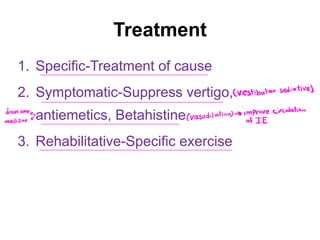
Treatment
1. Specific-Treatment of cause
2. Symptomatic-Suppress vertigo,
antiemetics, Betahistine
3. Rehabilitative-Specific exercise
vestibularsediative
dramamine
pragodilation improvecirculation
medizined of IE
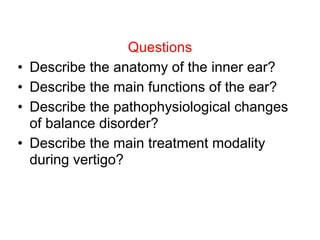
Questions
• Describe the anatomy of the inner ear?
• Describe the main functions of the ear?
• Describe the pathophysiological changes
of balance disorder?
• Describe the main treatment modality
during vertigo?
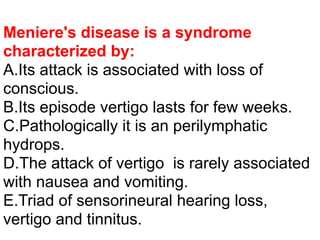
Meniere's disease is a syndrome
characterized by:
A.Its attack is associated with loss of
conscious.
B.Its episode vertigo lasts for few weeks.
C.Pathologically it is an perilymphatic
hydrops.
D.The attack of vertigo is rarely associated
with nausea and vomiting.
E.Triad of sensorineural hearing loss,
vertigo and tinnitus.
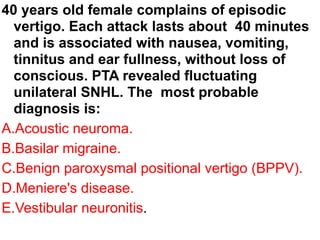
40 years old female complains of episodic
vertigo. Each attack lasts about 40 minutes
and is associated with nausea, vomiting,
tinnitus and ear fullness, without loss of
conscious. PTA revealed fluctuating
unilateral SNHL. The most probable
diagnosis is:
A.Acoustic neuroma.
B.Basilar migraine.
C.Benign paroxysmal positional vertigo (BPPV).
D.Meniere's disease.
E.Vestibular neuronitis.

4-Vertigo=4.pdf

  • 1.
  • 2.
    BALANCE Three sensors 1. Eyes 2.Vestibular apparatus (inner ear) 3. Proprioceptors muscles and joints Any problem in the inputs from these senses results in vertigo Central processing –Cerebral cortex Cortex then sends message to muscles regarding the tone and action one ofmostImpSensorforbalance inner ear organresponsibleforcoordination integrationofthisbalancein brain 27 cerebellum whichsendimpulsetocentralpartofbalancesystemin 17 Posterior cranial fos 27 cerebellum 37 Brainstem mostimp oronly informationaboutsurrounding
  • 3.
    Inner ear Central proces sing in brain eye Proprioceptor sensation in muscles Muscle tone& action Balancesystem Peripheralcause ofVertigo according toinformation inBrainstem and cerebellum andintegration ofinformation ids 1 Ias I od di Idi Is WH E's to ow wsisms Itf correctivemovement
  • 4.
    Definition VERTIGO “IMBALANCE”: isa subjective sensation of motion (rotation) Nystagmus : involuntary rhythmical movement “oscillation” of eyeballs, due to problem in vestibular function Disorderof Balance system inDT2 in CSSsuchas Vertigo Typeofdiziness 9 inabsenceofreal motion halucination ofmotion i i ios I Ign f Higo
  • 5.
    Etiology of vertigo PERIPHERALCENTRAL Miscellaneous causes inIEor nerve inBrainstem orconnectionof them orcerebellumor
  • 6.
    PERIPHERAL CAUSES 1. Meniere’sdisease 2. BPPV 3. Vestibular neuronitis 4. Labyrinithitis 5. Vestibulotoxic drugs 6. Head trauma 7. Perilymph fistula 8. Syphilis 9. Acoustic neuroma Benignparoxysmalpositionalvertigo or cochlear oto toxic orBoth acoustictrauma
  • 7.
    CENTRAL VERTIGO 1. Vertebrobasilarinsufficiency 2. Posterior inferior Cerebellar Artery Syndrome (PICA Synd.) 3. Basilar Migraine 4. Cerebellar disease 5. Multiple sclerosis 6. Tumours of brainstem and IV ventricle 7. Epilepsy mostly problem inBlood supplyofPosterior cranial fossa Bloodinsufficiency
  • 8.
    Miscellaneous causes 1. Psychogenicvertigo 2. Vertigo of old age 3. Motion sickness 4. Occular vertigo 5. Cervical vertigo Sea sickness
  • 9.
    DIFFERENCES BETWEEN central& peripheral VERTIGO PERIPHERAL CENTRAL 1- Otologic features (e.g. HL & otorrhea,) + No loss of consciousness Neurological deficits (e.g. hemiplegia) +_ Loss of consciousness 2- Abrupt onset / fades off in week. May be recurrent (Compensation) Gradual / Sustains 3- Balance impaired, but still can walk Cannot stand or walk without falling 4- Nausea and vomiting severe at onset Not severe epilepsy Discharge TinnitusPain Gigs a sudden 6 prolonged for years notcontinues gaitnotimpaired end impaired gait
  • 10.
    DIFFERENCES BETWEEN central& peripheral VERTIGO PERIPHERAL CENTRAL 5- Nystagmus-inhibited by fixation Cannot be fixated 6-Severity of nystagmus proportionate to vertigo Not proportionate 7- Nystagmus =directional (horizontal ) Nystagmus= Any type 8- Latency present No latency 9- Nystagmus-fatigable Not fatigable i.ba fsosoI.eI ow plane vertical anorizontai accordingtoeyemovement Planeand speed arotatory Two face equal to eachother pendolar nystagmus onefastandoneslow directional nystagmus
  • 11.
    MENIERE’S DISEASE (TRIAD ORTETRAD) OF symptoms: vertigo, SNHL, tinnitus and senses of pressure in ear. Vertigo: sudden in onset. lasts minutes up to 24 hours. SNHL: fluctuating. Investigations: - PTA - Glycerol test. -E.cochleo.G. Classic 3 or 4symptoms syndrome omeinattacknotpersistent Pressurein ear orhead orneck nausaeandvomiting inattack not second andnot 724hr ofclassic meniere I Diagnosis Sensorineural 90 byhistory main histopatholgic excess endolymph
  • 12.
    The main histopathologyin meniere’ is: endolymphatic hydrop. eddolymphatic hydrop
  • 13.
  • 14.
    Managements • Medical: vestibularsedatives, diuretic & vasodilators • Surgery: according to hearing of the pt.: -destructive. -conservative:(E. sac decompression) -intra-tympanic gentamycin injection surfaceablehearing surgical 3 Tc l'd fortvertigo egentamycin injection I medical fills engolymphatic is lil surgery Is I'd WIG aminoglycosid medicaldestructionof haircellsCIE
  • 15.
    BPPV • Vertigo whenhead is putted in a certain position. Lasts seconds – minutes. • Caused by disorder of SCC. • Treatment: EPLEY’s maneuver. Pathogenesis Shedding of Benign Paroxysmal Positional vertigo calciumcarbonate crystals cacoz ofutricle and saccule andadhere tocristi ofScc notassociated withany other symptoms noHLno Tinnitusno nausaenovomiting Recurrent If tis I W s W WI Is Iasi In os.es I d 61 d W 27 orSemon's reliefin morethan Tfreassurance it's benign 90 of
  • 16.
    VESTIBULAR NEURONITIS • Severevertigo of sudden onset , with no hearing problem. • Lasts for days. • Due to viral infection • Self limiting. NanSae andvomiting non specific treatment normal investigation complete relifewithin 4days historyi Upper respiratorytractinfection eviralinflammation ofvestibular nerve 8th maincomplainissevereVertigo thausaet vomiting without othermanifestation
  • 17.
    LABYRINTHITIS • caused by:biochemical toxins or bacteria or virus damaging the vestibular labyrinth. TREATMENT: – Treatment of the primary disease. – Treatment of inner ear complications anything cause HLcancauseverti secondarytootitismedia1meningitis or viral Labyrinthitisassociatedwith any encephalitis measis mumpsenve other viralinflammationwhich affect brain Ismeningoencephali Rubella Labrynthitis I catarrah recoverwithout permanantabnormality 27suppurative i completedestructionofIE hearingloss Vertigo d Profound ed i est w Brainadaptation
  • 18.
    VESTIBULOTOXIC DRUGS ➢Certain drugsdamage the hair cells in vestibulococholear system eg; 1. Amino glycosides 2. Antihypertensive drugs 3. Oestrogen preparations 4. Diuretics 5. Antimalarials etc.
  • 19.
    HEAD TRAUMA • Headinjury cause concussion of labyrinth, disrupt bony labyrinth or 8th nerve. • Operative trauma. • Severe acoustic trauma like explosion also cause vertigo Physical
  • 20.
    ACOUSTIC NEUROMA • benigntumor (shawnnoma)of vestibular nerve • Vertigo rare & comes late due to adaptation • There are other neurological & otological findings. • The usual presenting symptom is unilateral hearing loss and tinnitus. youngadult unilateral HL 10 vertigo SNHL inSepangleandinternalauditorycanal slowlygrowing w's no vertigo oronly 10 Tinnitus mainsymptoms Ty 27 inadult 25
  • 21.
    diagnosis A-history: 1.True vertigo 2.Duration 3.Associated nuasia&vomiting 4.Loss of conciousness 5.Symptom of ear diseases 6.Neurological Symptoms Complete CP investigation diagnosis onset course
  • 22.
    Diagnosis B- examination: 1.General exam 2.Neurologicalexam 3.Cranial n exam 4.Vestibular exam 5.Exam of nystagmus; eye, Frenzil glass, ENG 6.Exam of balance: gait test, romberg test, test for dysmetria, Complete wholebodysystem Electro Nystagmo Direct graphy
  • 23.
    diagnosis C- investigatios: 1. Vestibular.calorictest,rotation test, posturography, 2. Audiological: PTA, ABR, 3. Radiological:CT, MRI BRAIN & CPA 4. Laboratory: SUGAR, CBC, thyroid f, cholesterol,test for Syphilis. hypo
  • 24.
    Treatment 1. Specific-Treatment ofcause 2. Symptomatic-Suppress vertigo, antiemetics, Betahistine 3. Rehabilitative-Specific exercise vestibularsediative dramamine pragodilation improvecirculation medizined of IE
  • 25.
    Questions • Describe theanatomy of the inner ear? • Describe the main functions of the ear? • Describe the pathophysiological changes of balance disorder? • Describe the main treatment modality during vertigo?
  • 26.
    Meniere's disease isa syndrome characterized by: A.Its attack is associated with loss of conscious. B.Its episode vertigo lasts for few weeks. C.Pathologically it is an perilymphatic hydrops. D.The attack of vertigo is rarely associated with nausea and vomiting. E.Triad of sensorineural hearing loss, vertigo and tinnitus.
  • 27.
    40 years oldfemale complains of episodic vertigo. Each attack lasts about 40 minutes and is associated with nausea, vomiting, tinnitus and ear fullness, without loss of conscious. PTA revealed fluctuating unilateral SNHL. The most probable diagnosis is: A.Acoustic neuroma. B.Basilar migraine. C.Benign paroxysmal positional vertigo (BPPV). D.Meniere's disease. E.Vestibular neuronitis.