4G WIRELESS
SYSTEM
MEMBERS NAME:-
MUHAMMAD AMMAR ALTAF
FAIZAN AKRAM
1
CONTENTS
 INTRODUCTION
 ABOUT 4G
 IMPLEMENTATION USING 4G
 TRANSMISSION
 FEATURES OF 4G
 APPLICATIONS
 CONCLUSIONS
2
INTRODUCTION
 4TH generation or 4G is the wireless system is a package switched
wireless system with wide area coverage and high throughput.
 It is designed to be cost effective and to provide high spectral
efficiency.
 The 4G wireless uses Orthogonal Frequency Division Multiplexing(OFDM),
Ultra Wide Radio Band(UWB), and millimeter wireless.
 Data rate of 20mbps is employed. Mobile speed will be up to 200km/hr.
 The high performance is achieved by the use of long term channel
prediction, in both Time and Frequency , scheduling among users and
smart antennas combined with adaptive modulation and power
control.
 Frequency band is 2-8 GHz. It gives the ability for World Wide roaming to
access cell anywhere.
3
ABOUT 4G
 The now generation of wireless is intended to complement and replace
the 3G systems, perhaps in 5 to 10 years.
 Accessing information anywhere, anytime, with a seamless connection
to a wide range of information and services and receiving a large
volume of information, data, pictures, video, and so on, are the keys of
the 4G infrastructures.
 The future 4G infrastructures will consist of a set of various networks using
IP(Internet Protocol) as a common protocol so that users are in control
because they will be able to choose every application and
environment.
 The key concept is integrating the 4G capabilities with all of existing
mobile technologies through advanced technologies.
 Application adaptability and been highly dynamic are the main
features of 4G services of interest to users.
4
IMPLEMENTATION USING 4G
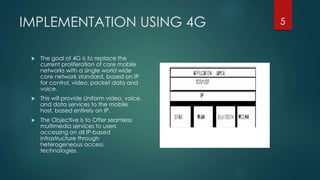
 The goal of 4G is to replace the
current proliferation of core mobile
networks with a single world wide
core network standard, based on IP
for control, video, packet data and
voice.
 This will provide Uniform video, voice,
and data services to the mobile
host, based entirely on IP.
 The Objective is to Offer seamless
multimedia services to users
accessing on all IP-based
infrastructure through
heterogeneous access
technologies.
5
IMPLEMENTATION USING 4G
 IP is assumed to act as an adhesive for providing Global
connectivity and mobility among networks.
 Today, wireless communications are heavily based toward voice,
even through studies indicate the growth in wireless data traffic is
rising exponentially relative to demand for voice traffic.
 Because on all IP core layer is easily scalable, it is ideally suited to
meet this challenge.
 The goal is merged data/voice/multimedia network the available
bandwidth.
 Today, wireless communications are heavily biased toward voice,
even through studies indicate that growth in wireless data traffic is
rising exponentially relative to demand for voice traffic.
6
TRANSMISSION
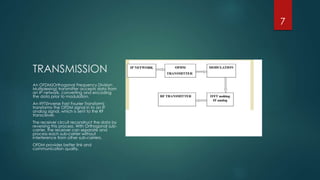
An OFDM(Orthogonal Frequency Division
Multiplexing) transmitter accepts data from
an IP network, converting and encoding
the data prior to modulation.
An IFFT(Inverse Fast Fourier Transform)
transforms the OFDM signal in to an IF
analog signal, which is sent to the RF
transceiver.
The receiver circuit reconstruct the data by
reversing this process. With Orthogonal sub-
carrier, the receiver can separate and
process each sub-carrier without
interference from other sub-carriers.
OFDM provides better link and
communication quality.
7
FEATURES OF 4G WIRELESS SYSTEM
 Support for interactive multimedia, voice, streaming video, Internet, and other
broadband services
 IP based mobile system
 High speed, high capacity, and low cost per bit
 Global access, service portability, and scalable mobile services
 Seamless switching, and a variety of Quality of Service driven services
 Better scheduling and call admission control techniques
 Ad hoc and multi hop networks (the strict delay requirements of voice make multi
hop network service a difficult problem)
 Better spectral efficiency
 Seamless network of multiple protocols and air interfaces (since 4G will be all •]IP, look
for 4G systems to be compatible with all common network technologies,
including802.11, WCDMA, Blue tooth, and Hyper LAN).
 An infrastructure to handle pre existing 3G systems along with other wireless
technologies, some of which are currently under development.
8
APPLICATIONS
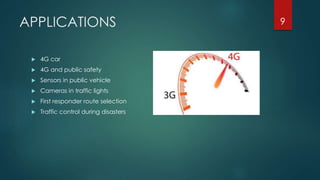
 4G car
 4G and public safety
 Sensors in public vehicle
 Cameras in traffic lights
 First responder route selection
 Traffic control during disasters
9
CONCLUSIONS
 The mobile technology through reached only at 2.5G now, 4G offers
us to provide with a very efficient and reliable wireless
communication system for seamless roaming over various network
including internet, which uses IP network.
 The 4G system will be implemented in the coming years, which are
a miracle in a field of communication engineering technology.
10
11
THANKS FOR YOUR ATTENTION 

4 g wireless technology

  • 1.
  • 2.
    CONTENTS  INTRODUCTION  ABOUT4G  IMPLEMENTATION USING 4G  TRANSMISSION  FEATURES OF 4G  APPLICATIONS  CONCLUSIONS 2
  • 3.
    INTRODUCTION  4TH generationor 4G is the wireless system is a package switched wireless system with wide area coverage and high throughput.  It is designed to be cost effective and to provide high spectral efficiency.  The 4G wireless uses Orthogonal Frequency Division Multiplexing(OFDM), Ultra Wide Radio Band(UWB), and millimeter wireless.  Data rate of 20mbps is employed. Mobile speed will be up to 200km/hr.  The high performance is achieved by the use of long term channel prediction, in both Time and Frequency , scheduling among users and smart antennas combined with adaptive modulation and power control.  Frequency band is 2-8 GHz. It gives the ability for World Wide roaming to access cell anywhere. 3
  • 4.
    ABOUT 4G  Thenow generation of wireless is intended to complement and replace the 3G systems, perhaps in 5 to 10 years.  Accessing information anywhere, anytime, with a seamless connection to a wide range of information and services and receiving a large volume of information, data, pictures, video, and so on, are the keys of the 4G infrastructures.  The future 4G infrastructures will consist of a set of various networks using IP(Internet Protocol) as a common protocol so that users are in control because they will be able to choose every application and environment.  The key concept is integrating the 4G capabilities with all of existing mobile technologies through advanced technologies.  Application adaptability and been highly dynamic are the main features of 4G services of interest to users. 4
  • 5.
    IMPLEMENTATION USING 4G The goal of 4G is to replace the current proliferation of core mobile networks with a single world wide core network standard, based on IP for control, video, packet data and voice.  This will provide Uniform video, voice, and data services to the mobile host, based entirely on IP.  The Objective is to Offer seamless multimedia services to users accessing on all IP-based infrastructure through heterogeneous access technologies. 5
  • 6.
    IMPLEMENTATION USING 4G IP is assumed to act as an adhesive for providing Global connectivity and mobility among networks.  Today, wireless communications are heavily based toward voice, even through studies indicate the growth in wireless data traffic is rising exponentially relative to demand for voice traffic.  Because on all IP core layer is easily scalable, it is ideally suited to meet this challenge.  The goal is merged data/voice/multimedia network the available bandwidth.  Today, wireless communications are heavily biased toward voice, even through studies indicate that growth in wireless data traffic is rising exponentially relative to demand for voice traffic. 6
  • 7.
    TRANSMISSION An OFDM(Orthogonal FrequencyDivision Multiplexing) transmitter accepts data from an IP network, converting and encoding the data prior to modulation. An IFFT(Inverse Fast Fourier Transform) transforms the OFDM signal in to an IF analog signal, which is sent to the RF transceiver. The receiver circuit reconstruct the data by reversing this process. With Orthogonal sub- carrier, the receiver can separate and process each sub-carrier without interference from other sub-carriers. OFDM provides better link and communication quality. 7
  • 8.
    FEATURES OF 4GWIRELESS SYSTEM  Support for interactive multimedia, voice, streaming video, Internet, and other broadband services  IP based mobile system  High speed, high capacity, and low cost per bit  Global access, service portability, and scalable mobile services  Seamless switching, and a variety of Quality of Service driven services  Better scheduling and call admission control techniques  Ad hoc and multi hop networks (the strict delay requirements of voice make multi hop network service a difficult problem)  Better spectral efficiency  Seamless network of multiple protocols and air interfaces (since 4G will be all •]IP, look for 4G systems to be compatible with all common network technologies, including802.11, WCDMA, Blue tooth, and Hyper LAN).  An infrastructure to handle pre existing 3G systems along with other wireless technologies, some of which are currently under development. 8
  • 9.
    APPLICATIONS  4G car 4G and public safety  Sensors in public vehicle  Cameras in traffic lights  First responder route selection  Traffic control during disasters 9
  • 10.
    CONCLUSIONS  The mobiletechnology through reached only at 2.5G now, 4G offers us to provide with a very efficient and reliable wireless communication system for seamless roaming over various network including internet, which uses IP network.  The 4G system will be implemented in the coming years, which are a miracle in a field of communication engineering technology. 10
  • 11.
    11 THANKS FOR YOURATTENTION 