1 2
3
4
5
6
7
8
9
11
12
10
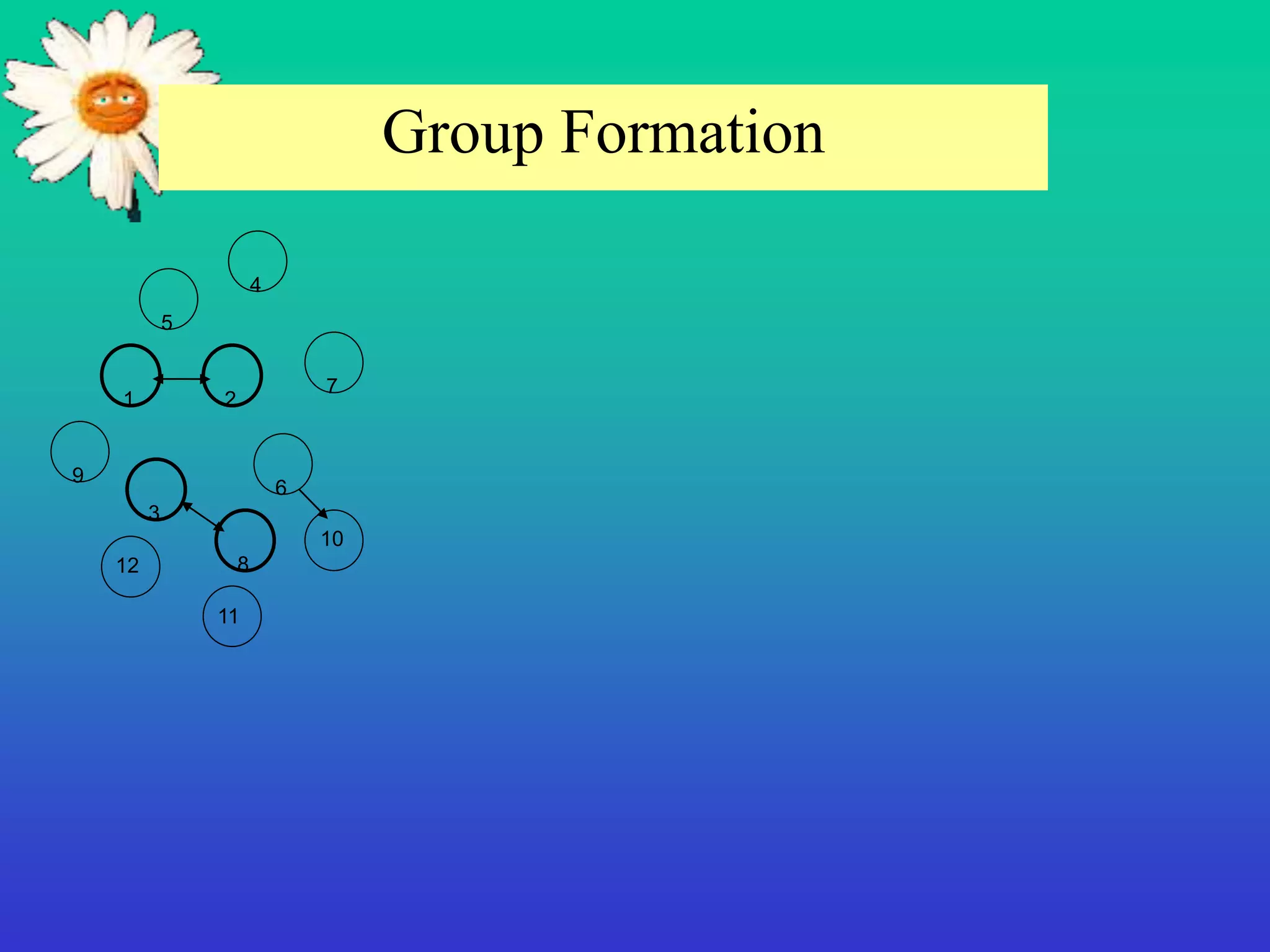
Group Formation
What Factors Determine When a Group Will
Form?
• People: joining with others in a group depends on
individuals' personal qualities, including traits, social
motives, and gender.
• Situations: some situations prompt people to affiliate with
one another, including
– Ambiguous, dangerous situations
– Tasks and goals that can only be achieved by
collaborating with others
• Relationships: groups form when individuals find they like
one another.
Who Joins Groups and Who Remains Apart?
• Personality
– Introversion-extraversion: extraverts are drawn
to other people and groups and introverts avoid
them (extraverts tend to be happier individuals)
– Relationality: individuals who adopt values,
attitudes, and outlooks that emphasize and
facilitate connections with others seek out
group memberships
Who Joins Groups and Who Remains Apart?
• Social motivation
– Need for affiliation
– Need for intimacy
– Need for power
– Fundamental Interpersonal Relations
Orientation (FIRO) theory: Individuals’ need to
receive and express inclusion, control, and
affection influences group-seeking tendencies
Who Joins Groups and Who Remains Apart?
• Prior experiences in groups
• Attachment style
– Secure
– Avoidant
– Anxious
• Sex differences in joining groups
When and Why Do People Seek Out Others?
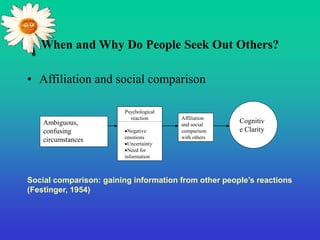
• Affiliation and social comparison
Ambiguous,
confusing
circumstances
Psychological
reaction
Negative
emotions
Uncertainty
Need for
information
Affiliation
and social
comparison
with others
Cognitiv
e Clarity
Social comparison: gaining information from other people’s reactions
(Festinger, 1954)
When and Why Do People Seek Out Others?
• Schachter’s studies of affiliation
– How do people react in an ambiguous,
frightening situation?
• Misery loves company: People affiliate with
others
• Misery loves miserable company: Schachter
found people prefer to wait with others
facing a similar experience.
When and Why Do People Seek Out Others?
• Schachter’s studies of affiliation (cont.)
– Directional comparison:
• downward social comparison: bolsters sense
of competence
• upward social comparison: hope and
motivation
– The self-evaluation maintenance (SEM) model:
people affiliate with individuals who do not
outperform them in areas that are very relevant
to their self-esteem.
When and Why Do People Seek Out Others?
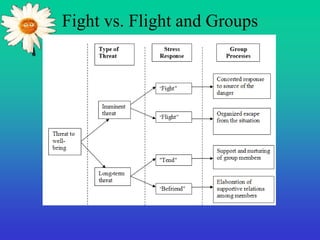
• Social support
– Safety in numbers
• "fight-or-flight"
• "tend-and-befriend“
– Types of social support: approval, emotional,
informational, instrumental, spiritual
Fight vs. Flight and Groups
When and Why Do People Seek Out Others?
• Collaboration
– Groups form when individuals seek goals that
they cannot attain working alone.
• How difficult is the task?
• How complex is the task?
• How important is the task?
– Example: Gangs as a means to achieve goals
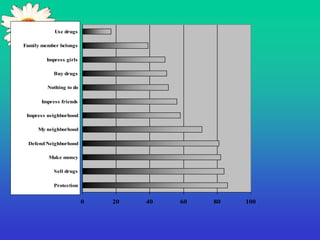
0 20 40 60 80 100
Protection
Sell drugs
Make money
DefendNeighborhood
My neighborhood
Impress neighborhood
Impress friends
Nothing to do
Buy drugs
Impress girls
Family member belongs
Use drugs
When Do Processes of Interpersonal Attraction Between
Individuals Contribute to Group Formation?
• Newcomb: The acquaintance process
• Principles of attraction
– proximity principle: People tend to like those who are
situated near by.
– elaboration principle: Groups often emerge when
groups, as complex system, grow as additional elements
(people) become linked to original members.
– similarity principle: People like those who are similar
to them in some way.
• homophily: similarity in attitudes, values,
appearance, etc.
When Do Processes of Interpersonal Attraction Between
Individuals Contribute to Group Formation?
– complementarity principle: People like others whose
qualities complement their own qualities.
– reciprocity principle: Liking tends to be mutual
– minimax principle: Individuals are attracted to groups
that offer them maximum rewards and minimal costs.
When Do Processes of Interpersonal Attraction Between
Individuals Contribute to Group Formation?
• Social exchange theory
– Relationships are like economic exchanges, bargains
where maximum outcomes sought with minimum
investment
– Satisfaction is determined by comparison level (CL)
– Value of other groups determines comparison level for
alternatives (CLalt)

4 formation

  • 1.
  • 2.
    What Factors DetermineWhen a Group Will Form? • People: joining with others in a group depends on individuals' personal qualities, including traits, social motives, and gender. • Situations: some situations prompt people to affiliate with one another, including – Ambiguous, dangerous situations – Tasks and goals that can only be achieved by collaborating with others • Relationships: groups form when individuals find they like one another.
  • 3.
    Who Joins Groupsand Who Remains Apart? • Personality – Introversion-extraversion: extraverts are drawn to other people and groups and introverts avoid them (extraverts tend to be happier individuals) – Relationality: individuals who adopt values, attitudes, and outlooks that emphasize and facilitate connections with others seek out group memberships
  • 4.
    Who Joins Groupsand Who Remains Apart? • Social motivation – Need for affiliation – Need for intimacy – Need for power – Fundamental Interpersonal Relations Orientation (FIRO) theory: Individuals’ need to receive and express inclusion, control, and affection influences group-seeking tendencies
  • 5.
    Who Joins Groupsand Who Remains Apart? • Prior experiences in groups • Attachment style – Secure – Avoidant – Anxious • Sex differences in joining groups
  • 6.
    When and WhyDo People Seek Out Others? • Affiliation and social comparison Ambiguous, confusing circumstances Psychological reaction Negative emotions Uncertainty Need for information Affiliation and social comparison with others Cognitiv e Clarity Social comparison: gaining information from other people’s reactions (Festinger, 1954)
  • 7.
    When and WhyDo People Seek Out Others? • Schachter’s studies of affiliation – How do people react in an ambiguous, frightening situation? • Misery loves company: People affiliate with others • Misery loves miserable company: Schachter found people prefer to wait with others facing a similar experience.
  • 8.
    When and WhyDo People Seek Out Others? • Schachter’s studies of affiliation (cont.) – Directional comparison: • downward social comparison: bolsters sense of competence • upward social comparison: hope and motivation – The self-evaluation maintenance (SEM) model: people affiliate with individuals who do not outperform them in areas that are very relevant to their self-esteem.
  • 9.
    When and WhyDo People Seek Out Others? • Social support – Safety in numbers • "fight-or-flight" • "tend-and-befriend“ – Types of social support: approval, emotional, informational, instrumental, spiritual
  • 10.
    Fight vs. Flightand Groups
  • 11.
    When and WhyDo People Seek Out Others? • Collaboration – Groups form when individuals seek goals that they cannot attain working alone. • How difficult is the task? • How complex is the task? • How important is the task? – Example: Gangs as a means to achieve goals
  • 12.
    0 20 4060 80 100 Protection Sell drugs Make money DefendNeighborhood My neighborhood Impress neighborhood Impress friends Nothing to do Buy drugs Impress girls Family member belongs Use drugs
  • 13.
    When Do Processesof Interpersonal Attraction Between Individuals Contribute to Group Formation? • Newcomb: The acquaintance process • Principles of attraction – proximity principle: People tend to like those who are situated near by. – elaboration principle: Groups often emerge when groups, as complex system, grow as additional elements (people) become linked to original members. – similarity principle: People like those who are similar to them in some way. • homophily: similarity in attitudes, values, appearance, etc.
  • 14.
    When Do Processesof Interpersonal Attraction Between Individuals Contribute to Group Formation? – complementarity principle: People like others whose qualities complement their own qualities. – reciprocity principle: Liking tends to be mutual – minimax principle: Individuals are attracted to groups that offer them maximum rewards and minimal costs.
  • 15.
    When Do Processesof Interpersonal Attraction Between Individuals Contribute to Group Formation? • Social exchange theory – Relationships are like economic exchanges, bargains where maximum outcomes sought with minimum investment – Satisfaction is determined by comparison level (CL) – Value of other groups determines comparison level for alternatives (CLalt)