PROACTIVE CAREER BEHAVIOUR
DR.TAZEENTAJ MAHAT
GBS HUBLI
THE WORLD OF WORK
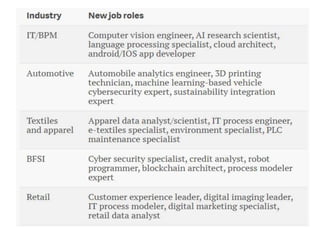
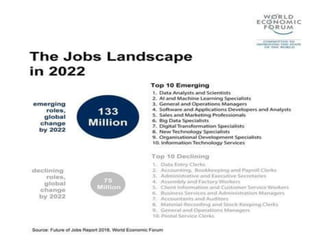
• By 2022, one in 10 workers in India would
have to be employed in jobs that do not even
exist today. In other words, one in current 10
jobs will be gone in the next five years.
Globalisation, demographic changes and new-
age technologies will change the face of Indian
industries. (Ernst & Young in December 2018)
• Even existing jobs will evolve and 37% of the
workforce will likely be deployed in roles that
will require radically changed skill sets.
JOB LESS WORLD
individuals need time to adapt,
more firms go bankrupt and more people are
laid off.
Difficult to find jobs since their skill sets are
outdated
as does the divide between rich countries that
innovate, and poor countries that depend on
cheap labour.
Lifelong learning and acquire new skills
self employed, start their own business or
join the gig economy, and become their own “employer
of choice”.
GIG ECONOMY a labour market characterized by the
prevalence of short-term contracts or freelance work as
opposed to permanent jobs.
"working in the gig economy means constantly being
subjected to last-minute scheduling"
The future of work
• Mobility within the
organisation,
• learn new skills at work,
less averse to change ,
• continually learn ,
• adapt to new ways of
working (e.g. with AI)
• and new responsibilities.
• “Employees need to develop “cross-
professional” skills in order to remain
competitive on the labor market.
Employers can no longer promise career
for their employees. Employees need to
take care of their own Career”
The future of work
• Networked organisations ,
• Mobility across teams, geographies, and
professions.
• Mobility within and beyond a specific sector or
industry,
• Soft skills and Critical thinking
• Lifelong learning and a highly volatile job market
• the daily gymnastics of learning on the job
lifelong learning and agile organisations
SKILLS NEEDED
IN FUTURE
WORKPLACE
“As digital transforms the business landscape,
the successful organizations of the future will
likely be those that can move faster, adapt more
quickly, learn more rapidly, and embrace
dynamic career demands”(Deloitte 2017, italics
ours).
Career Self-Management
• There’s no map to help you navigate through
the world of work.
• What’s more, change is rife and new types of
work keep springing into existence.
• And that’s happening at an ever increasing
rate. The future of the world of work is
unpredictable.
• There’s no ready-made Satellite Navigation
system to guide your career. Is there?
CAREER SELF MANGEMENT
• In the faster-moving parts of our economy—
—job descriptions are disappearing and so is
the chain of command.
• Project teams are created to do specific tasks
and then disbanded.
• People may work on more than one team at a
time, hours are irregular and the only thing
that really matters is the results.
Career self-management
• Charting the institutional landscape,
• identifying gatekeepers,
• implementing career strategies and
• evaluating the effectiveness of those
strategies
• seeking guidance,
self-nomination,
networking, other
enhancement,
creating
opportunities,
extended work
•reflection on past
•prior strategies.
•sources of feedback
•career outcomes, verbal
or nonverbal
•individuals who have a
controlling
•influence over one’s
current and future career
steps
•understanding of
•the world of work, the
opportunities it offers, the
demands those
opportunities make,
•and the rewards and
satisfactions they offer
LANDSC
APE
Identify
the gate
keepers
Strategies
Evaluate
Career Strategies
• Career strategies are behaviors used to decrease the time required and
uncertainty in the career development. The career strategies dimensions
proposed for this study are:
• Creating Opportunities: Developing skills and seeking out experience critical
to a person's career success
• Extended Work Involvement: Working outside of the office hours and
preoccupation with work-related issues
• Self-Nomination: Communicating to superior a desire to assume greater
responsibility in the organization and presenting oneself in the best possible
light
• seeking career guidance: Seeking guidance from a more experienced
person.
• Networking : Connecting with people in or outside the organization
• Interpersonal Attraction: Holding the same opinion or thinking highly of
one’s superior, and expressing a favorable evaluation of the superior
Career Self-Management
• Career self-management means having a sense of direction in your career.
• It’s like having an internal compass.
• You know what’s truly important to you and you steer your career
accordingly.
• This doesn't mean you’re inflexible. On the contrary, you’re capable of
adapting to new opportunities and unexpected developments.
• you need to get to know yourself and the world of work as well as you
possibly can.
• What’s more, you have to be bold enough and capable enough to make
decisions. This is no mean feat.
• Most people find it rather difficult, because we haven’t learned much
about these kinds of thing. Which is why a lot of people could do with a bit
of help, e.g. from a coach or career advisor. Incentives from your boss and
facilities from your employer can also be a tremendous help.
• Career self-management is controlled by the
concerned individual and includes certain
plans and information applicable for future
career decision-making and problem solving.
It is comprised of continuously improving the
existent conditions at the present work place
and preparing yourself for a change.
Proactive behaviour
• Proactive behaviour refers to the anticipatory action that
individuals take to impact themselves and/or their
environments (Parker, Williams, & Turner, 2006).
• Proactivity isconceived as a process that can be applied to
any set of actions through anticipating,
• planning, and striving to have an impact (Grant & Ashford,
2008). The key criterion for identifying proactive behaviour
is whether the individual anticipates, plans for, and
attempts to create a future outcome that has an impact on
the self or environment (Grant & Ashford, 2008; Parker et
al., 2006). The notion of proactive behaviour in the
workplace challenges the conceptualization of employees
as relatively passive and reactive (Grant & Ashford, 2008)
and explicitly recognizes the deliberate actions
• Parker and Collins (2010), a diverse set of proactive
behaviours were categorized corresponding to the
primary intended target of impact.
• This resulted in three-higher order categories;
• (i) proactive work behaviour focused on the internal
environment of the organization;
• (ii) proactive strategic behaviour focused on the
organization’s alignment with its external environment;
and
• (iii) proactive person-environment fit behaviour
focused on the individual’s fit with the work
environment (Parker & Collins, 2010).
• It refers to an entrepreneurial approach one may adopt
towards one’s employability and career.
• This type of behaviour is not necessarily confined to
one’s present job or employing organization, but rather
involves a broader scope of actions that can occur
within as well as outside the context of the present job
or employing organization.
• Empirically, proactive career behaviour has been linked
to objective career success, namely career progression
and performance, as well as to subjective career
success, i.e., career satisfaction (Crant, 2000; Seibert et
al., 2001; Ng, Eby, Sorensen, & Feldman, 2005).
Proactive Career Behaviour
• fitting jobs that better fulfil their needs (Yu & Davis, 2016). fit with
the work environment may also be more likely to take initiative in
gathering feedback regarding their performance, capitalize on the
degrees of freedom in their job, negotiate about assignments and
role expectations, identify career opportunities, and/or engage in
career planning and consultation (Ashford & Black, 1996; Roberts et
al., 2005; Wrzesniewski & Dutton, 2001).
• job demands and individual abilities.
• Help in taking initiative in developing their skills and knowledge,
which should keep them more employable and make them more
capable of acting on altering job demands than people who are less
inclined to behave proactively (Parker & Liao, 2016).
• Hence, individuals who act more proactively vis-à-vis their career
(as compared to those who do not) are expected to higher career
success.
• employees take to influence their
environments
• In this respect ,proactive behaviour can be
distinguished from more general motivated
behavior and more reactive, passive behaviour
in that it encompasses acting in advance and
is directed towards an intended impact (Grant
& Ashford, 2008).
• Proactive career behaviours include the
deliberate actions undertaken by individuals in
order to realize their career goals
• two components of proactive career behaviours
can be discerned, i.e. a cognitive and a
behavioural component
• While the former refers to the insights
individuals develop into their own career
aspirations,
• the latter refers to the behaviours they initiate
with the aim of managing their career.
• individuals to develop career insight that allows them
to make meaningful choices.
• career planning has been identified as one important
dimension of proactive career behaviour
• Career planning includes setting goals, exploring
options, and formulating plans and in this sense it
reflects a person’s attempts to manage his or her
career in a conscious way.
• The behavioural component refers to the concrete
actions undertaken by employees to realize their
career goals
• Networking is one important type of proactive behaviour
that is considered pivotal for contemporary career success
• Networking behaviour refers to individuals’attempts to
develop and maintain relationships with others who have
the potential to assist them in their career by providing
emotional support, information, career advice,or advocacy
for employment or promotion
• individual ownership of careers, it is especially important
for graduates to be connected with relevant others who
can support them in their career choices,
• for instance by providing access to information about
available job opportunities
WHY NETWORKING IS IMPORTANT IN EVERY STAGE OF YOUR CAREER
professional network.
Consistent Networking Makes Perfect
Professionals genuine interest in helping you. Attend industry conferences or meetups to
meet new people in your industry.
Learn From People in Your Industry
the collective knowledge of others in your profession.
Networking will help you avoid the mistakes of your more seasoned peers. T
he right connections in your field can help you find important ways to run your business more
effectively, increase your leads, and keep up on the latest news in your industry.
If you are looking for an easy way to get started networking, joining an industry group that
meets up in town.
• the relationships between career progress
goal, career planning, networking behaviours,
and career success has been found to be
positive
• If young professions want to achieve career
progress they should resort to proactive
behaviors and career self-mangement

PROACTIVE CAREER BEHAVIOUR.pptx

  • 1.
  • 2.
    THE WORLD OFWORK • By 2022, one in 10 workers in India would have to be employed in jobs that do not even exist today. In other words, one in current 10 jobs will be gone in the next five years.
  • 3.
    Globalisation, demographic changesand new- age technologies will change the face of Indian industries. (Ernst & Young in December 2018) • Even existing jobs will evolve and 37% of the workforce will likely be deployed in roles that will require radically changed skill sets. JOB LESS WORLD
  • 9.
    individuals need timeto adapt, more firms go bankrupt and more people are laid off. Difficult to find jobs since their skill sets are outdated as does the divide between rich countries that innovate, and poor countries that depend on cheap labour.
  • 10.
    Lifelong learning andacquire new skills self employed, start their own business or join the gig economy, and become their own “employer of choice”. GIG ECONOMY a labour market characterized by the prevalence of short-term contracts or freelance work as opposed to permanent jobs. "working in the gig economy means constantly being subjected to last-minute scheduling"
  • 11.
    The future ofwork • Mobility within the organisation, • learn new skills at work, less averse to change , • continually learn , • adapt to new ways of working (e.g. with AI) • and new responsibilities.
  • 12.
    • “Employees needto develop “cross- professional” skills in order to remain competitive on the labor market. Employers can no longer promise career for their employees. Employees need to take care of their own Career”
  • 13.
    The future ofwork • Networked organisations , • Mobility across teams, geographies, and professions. • Mobility within and beyond a specific sector or industry, • Soft skills and Critical thinking • Lifelong learning and a highly volatile job market • the daily gymnastics of learning on the job lifelong learning and agile organisations
  • 14.
  • 16.
    “As digital transformsthe business landscape, the successful organizations of the future will likely be those that can move faster, adapt more quickly, learn more rapidly, and embrace dynamic career demands”(Deloitte 2017, italics ours).
  • 17.
    Career Self-Management • There’sno map to help you navigate through the world of work. • What’s more, change is rife and new types of work keep springing into existence. • And that’s happening at an ever increasing rate. The future of the world of work is unpredictable. • There’s no ready-made Satellite Navigation system to guide your career. Is there?
  • 18.
  • 19.
    • In thefaster-moving parts of our economy— —job descriptions are disappearing and so is the chain of command. • Project teams are created to do specific tasks and then disbanded. • People may work on more than one team at a time, hours are irregular and the only thing that really matters is the results.
  • 20.
    Career self-management • Chartingthe institutional landscape, • identifying gatekeepers, • implementing career strategies and • evaluating the effectiveness of those strategies
  • 21.
    • seeking guidance, self-nomination, networking,other enhancement, creating opportunities, extended work •reflection on past •prior strategies. •sources of feedback •career outcomes, verbal or nonverbal •individuals who have a controlling •influence over one’s current and future career steps •understanding of •the world of work, the opportunities it offers, the demands those opportunities make, •and the rewards and satisfactions they offer LANDSC APE Identify the gate keepers Strategies Evaluate
  • 22.
    Career Strategies • Careerstrategies are behaviors used to decrease the time required and uncertainty in the career development. The career strategies dimensions proposed for this study are: • Creating Opportunities: Developing skills and seeking out experience critical to a person's career success • Extended Work Involvement: Working outside of the office hours and preoccupation with work-related issues • Self-Nomination: Communicating to superior a desire to assume greater responsibility in the organization and presenting oneself in the best possible light • seeking career guidance: Seeking guidance from a more experienced person. • Networking : Connecting with people in or outside the organization • Interpersonal Attraction: Holding the same opinion or thinking highly of one’s superior, and expressing a favorable evaluation of the superior
  • 23.
    Career Self-Management • Careerself-management means having a sense of direction in your career. • It’s like having an internal compass. • You know what’s truly important to you and you steer your career accordingly. • This doesn't mean you’re inflexible. On the contrary, you’re capable of adapting to new opportunities and unexpected developments. • you need to get to know yourself and the world of work as well as you possibly can. • What’s more, you have to be bold enough and capable enough to make decisions. This is no mean feat. • Most people find it rather difficult, because we haven’t learned much about these kinds of thing. Which is why a lot of people could do with a bit of help, e.g. from a coach or career advisor. Incentives from your boss and facilities from your employer can also be a tremendous help.
  • 24.
    • Career self-managementis controlled by the concerned individual and includes certain plans and information applicable for future career decision-making and problem solving. It is comprised of continuously improving the existent conditions at the present work place and preparing yourself for a change.
  • 25.
    Proactive behaviour • Proactivebehaviour refers to the anticipatory action that individuals take to impact themselves and/or their environments (Parker, Williams, & Turner, 2006). • Proactivity isconceived as a process that can be applied to any set of actions through anticipating, • planning, and striving to have an impact (Grant & Ashford, 2008). The key criterion for identifying proactive behaviour is whether the individual anticipates, plans for, and attempts to create a future outcome that has an impact on the self or environment (Grant & Ashford, 2008; Parker et al., 2006). The notion of proactive behaviour in the workplace challenges the conceptualization of employees as relatively passive and reactive (Grant & Ashford, 2008) and explicitly recognizes the deliberate actions
  • 26.
    • Parker andCollins (2010), a diverse set of proactive behaviours were categorized corresponding to the primary intended target of impact. • This resulted in three-higher order categories; • (i) proactive work behaviour focused on the internal environment of the organization; • (ii) proactive strategic behaviour focused on the organization’s alignment with its external environment; and • (iii) proactive person-environment fit behaviour focused on the individual’s fit with the work environment (Parker & Collins, 2010).
  • 27.
    • It refersto an entrepreneurial approach one may adopt towards one’s employability and career. • This type of behaviour is not necessarily confined to one’s present job or employing organization, but rather involves a broader scope of actions that can occur within as well as outside the context of the present job or employing organization. • Empirically, proactive career behaviour has been linked to objective career success, namely career progression and performance, as well as to subjective career success, i.e., career satisfaction (Crant, 2000; Seibert et al., 2001; Ng, Eby, Sorensen, & Feldman, 2005).
  • 28.
    Proactive Career Behaviour •fitting jobs that better fulfil their needs (Yu & Davis, 2016). fit with the work environment may also be more likely to take initiative in gathering feedback regarding their performance, capitalize on the degrees of freedom in their job, negotiate about assignments and role expectations, identify career opportunities, and/or engage in career planning and consultation (Ashford & Black, 1996; Roberts et al., 2005; Wrzesniewski & Dutton, 2001). • job demands and individual abilities. • Help in taking initiative in developing their skills and knowledge, which should keep them more employable and make them more capable of acting on altering job demands than people who are less inclined to behave proactively (Parker & Liao, 2016). • Hence, individuals who act more proactively vis-à-vis their career (as compared to those who do not) are expected to higher career success.
  • 29.
    • employees taketo influence their environments • In this respect ,proactive behaviour can be distinguished from more general motivated behavior and more reactive, passive behaviour in that it encompasses acting in advance and is directed towards an intended impact (Grant & Ashford, 2008).
  • 30.
    • Proactive careerbehaviours include the deliberate actions undertaken by individuals in order to realize their career goals • two components of proactive career behaviours can be discerned, i.e. a cognitive and a behavioural component • While the former refers to the insights individuals develop into their own career aspirations, • the latter refers to the behaviours they initiate with the aim of managing their career.
  • 31.
    • individuals todevelop career insight that allows them to make meaningful choices. • career planning has been identified as one important dimension of proactive career behaviour • Career planning includes setting goals, exploring options, and formulating plans and in this sense it reflects a person’s attempts to manage his or her career in a conscious way. • The behavioural component refers to the concrete actions undertaken by employees to realize their career goals
  • 32.
    • Networking isone important type of proactive behaviour that is considered pivotal for contemporary career success • Networking behaviour refers to individuals’attempts to develop and maintain relationships with others who have the potential to assist them in their career by providing emotional support, information, career advice,or advocacy for employment or promotion • individual ownership of careers, it is especially important for graduates to be connected with relevant others who can support them in their career choices, • for instance by providing access to information about available job opportunities
  • 34.
    WHY NETWORKING ISIMPORTANT IN EVERY STAGE OF YOUR CAREER professional network. Consistent Networking Makes Perfect Professionals genuine interest in helping you. Attend industry conferences or meetups to meet new people in your industry. Learn From People in Your Industry the collective knowledge of others in your profession. Networking will help you avoid the mistakes of your more seasoned peers. T he right connections in your field can help you find important ways to run your business more effectively, increase your leads, and keep up on the latest news in your industry. If you are looking for an easy way to get started networking, joining an industry group that meets up in town.
  • 35.
    • the relationshipsbetween career progress goal, career planning, networking behaviours, and career success has been found to be positive • If young professions want to achieve career progress they should resort to proactive behaviors and career self-mangement