PRESENTATION
ON
WHAT EVERY LEADER NEEDS TO
KNOW ABOUT FOLLOWERS
Presented By:-
Narinder Kumar
DEPT. MBA(HRM&OB)
CONTENT
 Introduction of article
 Leader vs Followers
 A level of playing field
 Types of followers typology
 A new typology(by Barbara kellerman)
 Good and Bad followers
 Conclusion
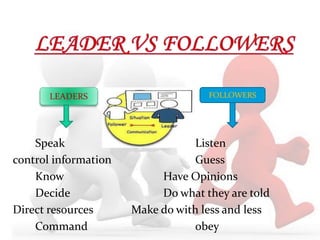
LEADERS FOLLOWERS
Speak Listen
control information Guess
Know Have Opinions
Decide Do what they are told
Direct resources Make do with less and less
Command obey
 Followers can be identified by: Rank or Behaviour
 Rank: Subordinate who has less powwer,authorty and
influence, and influence than do their superiors.
 Behaviour : Going along with what someone else wants
and intends.
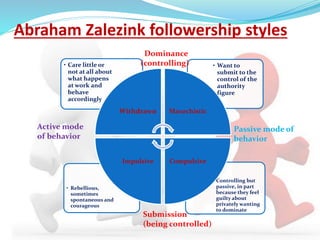
To various degrees, Harvard Business School professor Abraham Zalezink,
professor Robert Kelley, executive coach Ira Chaleff and Barbara
Kellerman have all argued that leader with even some understanding of
what drives their subordinates can be a great help to themselves, their
followers and their organizations.
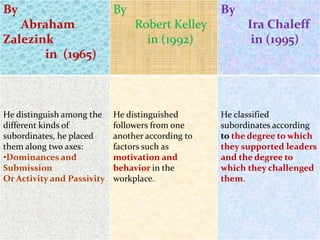
By
Abraham
Zalezink
in (1965)
By
Robert Kelley
in (1992)
By
Ira Chaleff
in (1995)
He distinguish among the
different kinds of
subordinates, he placed
them along two axes:
•Dominances and
Submission
Or Activity and Passivity
He distinguished
followers from one
another according to
factors such as
motivation and
behavior in the
workplace.
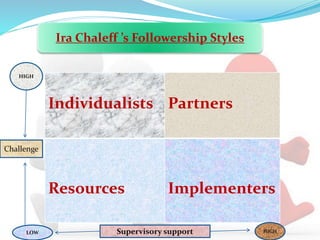
He classified
subordinates according
to the degree to which
they supported leaders
and the degree to
which they challenged
them.
Abraham Zalezink followership styles
• Controlling but
passive, in part
because they feel
guilty about
privately wanting
to dominate
• Rebellious,
sometimes
spontaneous and
courageous
• Want to
submit to the
control of the
authority
figure
• Care little or
not at all about
what happens
at work and
behave
accordingly
Withdrawn Masochistic
CompulsiveImpulsive
Dominance
(controlling)
Submission
(being controlled)
Active mode
of behavior
Passive mode of
behavior
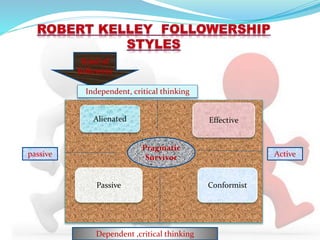
Pragmatic
Survivor
Alienated Effective
ConformistPassive
Kind of
followers
Independent, critical thinking
Dependent ,critical thinking
passive Active
Ira Chaleff ’s Followership Styles
Individualists Partners
Resources Implementers
Supervisory support HIGHLOW
HIGH
Challenge
IMPLEMENTERS
PARTNERS
INDIVIDUALISTS
RESOURCES Level of engagement
Barbara’s followership
 Followers can be identified by: Rank or Behavior
-Rank: subordinates who has less power, authority and
influence, and influence than do their superiors
-Behavior: going along with what someone else wants
and intends
“……implies a relationship(rank) between subordinate
and superior, and a response (behavior), of the former
to the latter.”
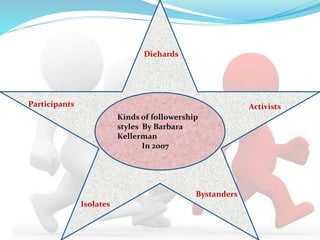
Isolates
Bystanders
Participants Activists
Diehards
Kinds of followership
styles By Barbara
Kellerman
In 2007
•Completely detached
•There to do what they must to get and nothing more
•Alienated from the system, the group the organization
•Silent and ignored
Isolates
 Observe, but do not participate.
 Make deliberate decisions to stand aside and disengage from
leaders and the group dynamic.
 Their withdrawal is a declaration of neutrality that amount to
support for whoever.
 They do nothing even when doing something is not
especially costly or especially risky.
 Are in some way engaged.
 They either clearly favour their leaders and groups
and organization or they are clearly opposed.
 They invest their engagement to try have an impact.
 By and leaders want followers who are participants
assuming they are in support and not in opposition.
 There are those followers who whiles generally
supportive of their leaders and of the organization of
which they are members, nevertheless go their own
way.
 Feel strongly about their leaders and act accordingly.
 They are eager, energetic, and engaged.
 They work either on behalf of their leaders or to
undermine and unseat them.
 They are either a major resource or a major bane.
 They care a great deal.
a. They care about their leaders, pro and con.
b. They care about each other, presumably pro.
c. They care about the whole of which they are a part.
• They should be watched and they should be judged.
 Are prepared to die if necessary for their causes,
whether an individual, an idea, or both.
 Deeply devoted to their leaders or ready to them
from positions of power, authority, and influence
by any means necessary.
 Defined by their dedication.
 Is all consuming it is who you are it determines
what you do.
 They are only so many diehards a society can take
and, there are only so many followers willing to
play the part.
Diehards
Activists
Participants
Bystanders
Isolates Level of Engagement
Followers Classifieds by level of Engagement
Types of followers
 Good followers will actively support a leader who is
good (effective and ethical) and will actively oppose a
leader who is bad (ineffective and unethical). Good
followers invest time and energy in making informed
judgement about who their leaders are and what they
espouse they take the appropriate action
 Conversely , bad followers will do nothing whatsoever
to contribute to the group or organization. Or they will
actively oppose a leader who is good. They will actively
support a leader who is bad.
 Leaders and followers as inseparable, indivisible, and
impossible to conceive the without the other.
 A good leader listens and talks to the team to find the
individual strengths of each team member.
 Activist follower strongly support their leader and
managers .
 Passive follower not strongly support their leader and
managers and never do anything.
 A sign of a good leader is not how many follower you
have , but how many leader you create.
Narinder sharma

Narinder sharma

  • 1.
    PRESENTATION ON WHAT EVERY LEADERNEEDS TO KNOW ABOUT FOLLOWERS Presented By:- Narinder Kumar DEPT. MBA(HRM&OB)
  • 2.
    CONTENT  Introduction ofarticle  Leader vs Followers  A level of playing field  Types of followers typology  A new typology(by Barbara kellerman)  Good and Bad followers  Conclusion
  • 3.
    LEADERS FOLLOWERS Speak Listen controlinformation Guess Know Have Opinions Decide Do what they are told Direct resources Make do with less and less Command obey
  • 4.
     Followers canbe identified by: Rank or Behaviour  Rank: Subordinate who has less powwer,authorty and influence, and influence than do their superiors.  Behaviour : Going along with what someone else wants and intends.
  • 5.
    To various degrees,Harvard Business School professor Abraham Zalezink, professor Robert Kelley, executive coach Ira Chaleff and Barbara Kellerman have all argued that leader with even some understanding of what drives their subordinates can be a great help to themselves, their followers and their organizations.
  • 6.
    By Abraham Zalezink in (1965) By Robert Kelley in(1992) By Ira Chaleff in (1995) He distinguish among the different kinds of subordinates, he placed them along two axes: •Dominances and Submission Or Activity and Passivity He distinguished followers from one another according to factors such as motivation and behavior in the workplace. He classified subordinates according to the degree to which they supported leaders and the degree to which they challenged them.
  • 7.
    Abraham Zalezink followershipstyles • Controlling but passive, in part because they feel guilty about privately wanting to dominate • Rebellious, sometimes spontaneous and courageous • Want to submit to the control of the authority figure • Care little or not at all about what happens at work and behave accordingly Withdrawn Masochistic CompulsiveImpulsive Dominance (controlling) Submission (being controlled) Active mode of behavior Passive mode of behavior
  • 8.
    Pragmatic Survivor Alienated Effective ConformistPassive Kind of followers Independent,critical thinking Dependent ,critical thinking passive Active
  • 9.
    Ira Chaleff ’sFollowership Styles Individualists Partners Resources Implementers Supervisory support HIGHLOW HIGH Challenge
  • 10.
  • 11.
    Barbara’s followership  Followerscan be identified by: Rank or Behavior -Rank: subordinates who has less power, authority and influence, and influence than do their superiors -Behavior: going along with what someone else wants and intends “……implies a relationship(rank) between subordinate and superior, and a response (behavior), of the former to the latter.”
  • 12.
    Isolates Bystanders Participants Activists Diehards Kinds offollowership styles By Barbara Kellerman In 2007
  • 13.
    •Completely detached •There todo what they must to get and nothing more •Alienated from the system, the group the organization •Silent and ignored Isolates
  • 14.
     Observe, butdo not participate.  Make deliberate decisions to stand aside and disengage from leaders and the group dynamic.  Their withdrawal is a declaration of neutrality that amount to support for whoever.  They do nothing even when doing something is not especially costly or especially risky.
  • 15.
     Are insome way engaged.  They either clearly favour their leaders and groups and organization or they are clearly opposed.  They invest their engagement to try have an impact.  By and leaders want followers who are participants assuming they are in support and not in opposition.  There are those followers who whiles generally supportive of their leaders and of the organization of which they are members, nevertheless go their own way.
  • 16.
     Feel stronglyabout their leaders and act accordingly.  They are eager, energetic, and engaged.  They work either on behalf of their leaders or to undermine and unseat them.  They are either a major resource or a major bane.  They care a great deal. a. They care about their leaders, pro and con. b. They care about each other, presumably pro. c. They care about the whole of which they are a part. • They should be watched and they should be judged.
  • 17.
     Are preparedto die if necessary for their causes, whether an individual, an idea, or both.  Deeply devoted to their leaders or ready to them from positions of power, authority, and influence by any means necessary.  Defined by their dedication.  Is all consuming it is who you are it determines what you do.  They are only so many diehards a society can take and, there are only so many followers willing to play the part.
  • 19.
    Diehards Activists Participants Bystanders Isolates Level ofEngagement Followers Classifieds by level of Engagement Types of followers
  • 20.
     Good followerswill actively support a leader who is good (effective and ethical) and will actively oppose a leader who is bad (ineffective and unethical). Good followers invest time and energy in making informed judgement about who their leaders are and what they espouse they take the appropriate action  Conversely , bad followers will do nothing whatsoever to contribute to the group or organization. Or they will actively oppose a leader who is good. They will actively support a leader who is bad.
  • 21.
     Leaders andfollowers as inseparable, indivisible, and impossible to conceive the without the other.  A good leader listens and talks to the team to find the individual strengths of each team member.  Activist follower strongly support their leader and managers .  Passive follower not strongly support their leader and managers and never do anything.  A sign of a good leader is not how many follower you have , but how many leader you create.