What is a Group?
two or more people who:
 interact with each other directly or indirectly
 share common goals/share norms
 have a stable relationship
 are interdependent
 perceive they are part of a group
not a collection of people in a lobby, street
corner, or elevator
Group Formation and Function
 People join groups to:
– satisfy important needs (e.g., belonging, safety)
– reach goals they cannot achieve alone
– boost their self-identity
 Groups function through:
– roles- expected behavior for different positions
– status- social standing within group
– norms- rules for behaving within group
– cohesiveness- forces that cause members to stay
in group (attraction, desire for status)
Decision-Making in Groups
Social Decision Schemes- rules comparing
initial group views to final group decisions
 majority-wins rule- group opts for whatever
decision majority agreed with initially
 truth-wins rule- group eventually accepts
correct decision
 first-shift rule- groups adopt decision
consistent with direction of first shift in opinion
these simple rules predict final outcome 80% of time
Consequences of Group Decision Making
 Conventional wisdom suggests groups would
make better decisions than individual
– Greater informational resources
– More likely to identify and correct errors
 Not clear if groups make better decisions
than individuals
– Group polarization
– Groupthink
– Mixed research support
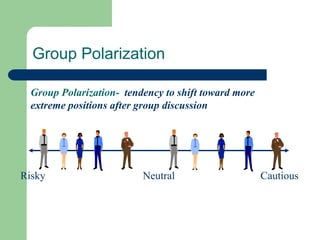
Group Polarization
Risky Cautious
Neutral
Group Polarization- tendency to shift toward more
extreme positions after group discussion
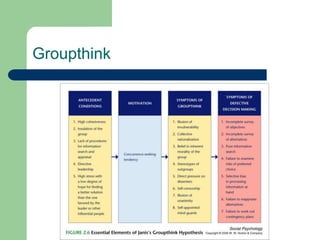
Groupthink
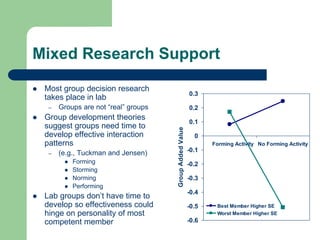
Mixed Research Support
 Most group decision research
takes place in lab
– Groups are not “real” groups
 Group development theories
suggest groups need time to
develop effective interaction
patterns
– (e.g., Tuckman and Jensen)
 Forming
 Storming
 Norming
 Performing
 Lab groups don’t have time to
develop so effectiveness could
hinge on personality of most
competent member -0.6
-0.5
-0.4
-0.3
-0.2
-0.1
0
0.1
0.2
0.3
Forming Activity No Forming Activity
Group
Added
Value
Best Member Higher SE
Worst Member Higher SE
Social Facilitation
Definition: The effect,
positive or negative,
of the presence of
others on
performance.
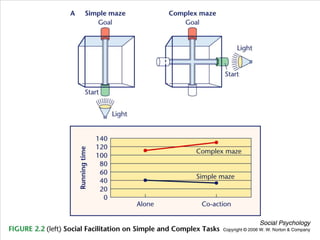
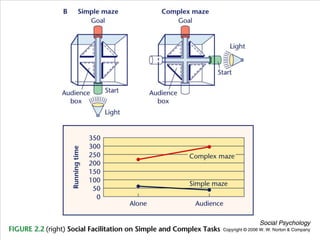
1. Initial Research
a. Triplett (1898)
Social Facilitation
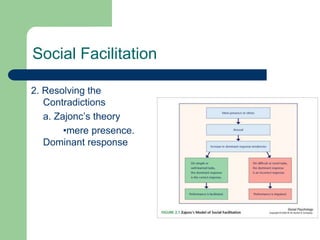
2. Resolving the
Contradictions
a. Zajonc’s theory
•mere presence.
Dominant response
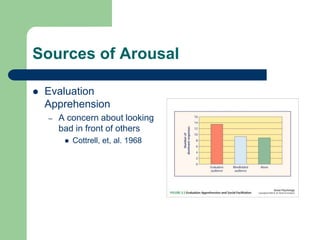
Sources of Arousal
 Evaluation
Apprehension
– A concern about looking
bad in front of others
 Cottrell, et, al. 1968
Sources of Arousal
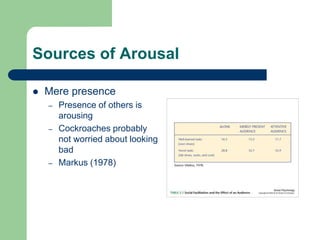
 Mere presence
– Presence of others is
arousing
– Cockroaches probably
not worried about looking
bad
– Markus (1978)
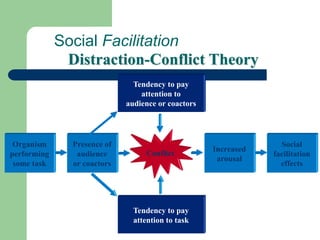
Social Facilitation
Organism
performing
some task
Presence of
audience
or coactors
Social
facilitation
effects
Increased
arousal
Conflict
Tendency to pay
attention to
audience or coactors
Tendency to pay
attention to task
Distraction-Conflict Theory
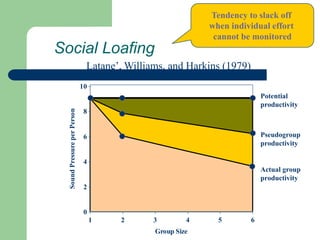
Social Loafing
1 2 3 4 5 6
0
2
4
6
8
10
Sound
Pressure
per
Person
Group Size
Actual group
productivity
Pseudogroup
productivity
Potential
productivity
Tendency to slack off
when individual effort
cannot be monitored
Latane’, Williams, and Harkins (1979)
Conflict in Groups
 Other causes of conflict besides incompatibility
– Faulty attributions—erroneous blame
– Poor communication—misinterpreted criticism,
grudges
– Tendency to see own views as objective, while
others have biased views
 Status quo bias—powerful groups often inaccurate
– Type A personality—highly competitive and hostile
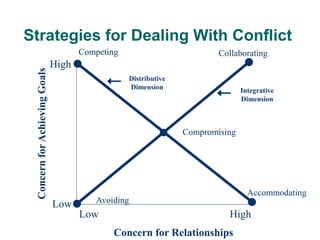
Conflict—perceived incompatible interests
Competing Collaborating
Avoiding
Accommodating
Compromising
Concern for Relationships
Low High
Concern
for
Achieving
Goals
High
Low
Distributive
Dimension Integrative
Dimension
Strategies for Dealing With Conflict
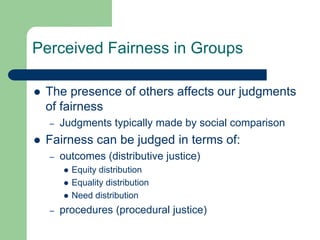
Perceived Fairness in Groups
 The presence of others affects our judgments
of fairness
– Judgments typically made by social comparison
 Fairness can be judged in terms of:
– outcomes (distributive justice)
 Equity distribution
 Equality distribution
 Need distribution
– procedures (procedural justice)
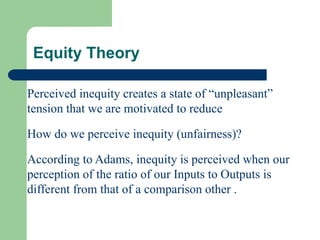
Perceived inequity creates a state of “unpleasant”
tension that we are motivated to reduce
How do we perceive inequity (unfairness)?
According to Adams, inequity is perceived when our
perception of the ratio of our Inputs to Outputs is
different from that of a comparison other .
Equity Theory
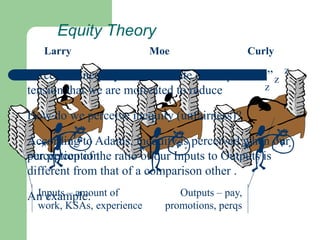
Equity Theory
z
z
z
Inputs – amount of
work, KSAs, experience
Outputs – pay,
promotions, perqs
Perceived inequity creates a state of “unpleasant”
tension that we are motivated to reduce
How do we perceive inequity (unfairness)?
According to Adams, inequity is perceived when our
perception of the ratio of our Inputs to Outputs is
different from that of a comparison other .
An example:
our perception
Larry Moe Curly
Study Smarter:
Student Website
 http://www.wwnorton.com/socialpsych
Chapter Reviews
Diagnostic Quizzes
Vocabulary Flashcards
Apply It! Exercises

Group notes in organizational behaviour.

  • 2.
    What is aGroup? two or more people who:  interact with each other directly or indirectly  share common goals/share norms  have a stable relationship  are interdependent  perceive they are part of a group not a collection of people in a lobby, street corner, or elevator
  • 3.
    Group Formation andFunction  People join groups to: – satisfy important needs (e.g., belonging, safety) – reach goals they cannot achieve alone – boost their self-identity  Groups function through: – roles- expected behavior for different positions – status- social standing within group – norms- rules for behaving within group – cohesiveness- forces that cause members to stay in group (attraction, desire for status)
  • 4.
    Decision-Making in Groups SocialDecision Schemes- rules comparing initial group views to final group decisions  majority-wins rule- group opts for whatever decision majority agreed with initially  truth-wins rule- group eventually accepts correct decision  first-shift rule- groups adopt decision consistent with direction of first shift in opinion these simple rules predict final outcome 80% of time
  • 5.
    Consequences of GroupDecision Making  Conventional wisdom suggests groups would make better decisions than individual – Greater informational resources – More likely to identify and correct errors  Not clear if groups make better decisions than individuals – Group polarization – Groupthink – Mixed research support
  • 6.
    Group Polarization Risky Cautious Neutral GroupPolarization- tendency to shift toward more extreme positions after group discussion
  • 7.
  • 8.
    Mixed Research Support Most group decision research takes place in lab – Groups are not “real” groups  Group development theories suggest groups need time to develop effective interaction patterns – (e.g., Tuckman and Jensen)  Forming  Storming  Norming  Performing  Lab groups don’t have time to develop so effectiveness could hinge on personality of most competent member -0.6 -0.5 -0.4 -0.3 -0.2 -0.1 0 0.1 0.2 0.3 Forming Activity No Forming Activity Group Added Value Best Member Higher SE Worst Member Higher SE
  • 9.
    Social Facilitation Definition: Theeffect, positive or negative, of the presence of others on performance. 1. Initial Research a. Triplett (1898)
  • 10.
    Social Facilitation 2. Resolvingthe Contradictions a. Zajonc’s theory •mere presence. Dominant response
  • 13.
    Sources of Arousal Evaluation Apprehension – A concern about looking bad in front of others  Cottrell, et, al. 1968
  • 14.
    Sources of Arousal Mere presence – Presence of others is arousing – Cockroaches probably not worried about looking bad – Markus (1978)
  • 15.
    Social Facilitation Organism performing some task Presenceof audience or coactors Social facilitation effects Increased arousal Conflict Tendency to pay attention to audience or coactors Tendency to pay attention to task Distraction-Conflict Theory
  • 16.
    Social Loafing 1 23 4 5 6 0 2 4 6 8 10 Sound Pressure per Person Group Size Actual group productivity Pseudogroup productivity Potential productivity Tendency to slack off when individual effort cannot be monitored Latane’, Williams, and Harkins (1979)
  • 17.
    Conflict in Groups Other causes of conflict besides incompatibility – Faulty attributions—erroneous blame – Poor communication—misinterpreted criticism, grudges – Tendency to see own views as objective, while others have biased views  Status quo bias—powerful groups often inaccurate – Type A personality—highly competitive and hostile Conflict—perceived incompatible interests
  • 18.
    Competing Collaborating Avoiding Accommodating Compromising Concern forRelationships Low High Concern for Achieving Goals High Low Distributive Dimension Integrative Dimension Strategies for Dealing With Conflict
  • 19.
    Perceived Fairness inGroups  The presence of others affects our judgments of fairness – Judgments typically made by social comparison  Fairness can be judged in terms of: – outcomes (distributive justice)  Equity distribution  Equality distribution  Need distribution – procedures (procedural justice)
  • 20.
    Perceived inequity createsa state of “unpleasant” tension that we are motivated to reduce How do we perceive inequity (unfairness)? According to Adams, inequity is perceived when our perception of the ratio of our Inputs to Outputs is different from that of a comparison other . Equity Theory
  • 21.
    Equity Theory z z z Inputs –amount of work, KSAs, experience Outputs – pay, promotions, perqs Perceived inequity creates a state of “unpleasant” tension that we are motivated to reduce How do we perceive inequity (unfairness)? According to Adams, inequity is perceived when our perception of the ratio of our Inputs to Outputs is different from that of a comparison other . An example: our perception Larry Moe Curly
  • 22.
    Study Smarter: Student Website http://www.wwnorton.com/socialpsych Chapter Reviews Diagnostic Quizzes Vocabulary Flashcards Apply It! Exercises

Editor's Notes