Proximate Analysis
MUHAMMAD ASIF 2K8-VAS-32
LUAWMS UTHAL BALOCHISTAN
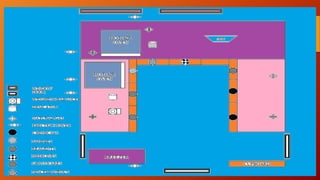
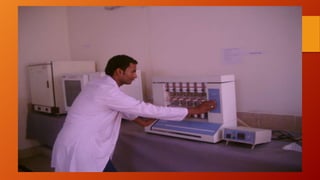
Setting of Analytical Laboratory
Following things are required
• Oven
• Weighing Balance

• Dessicator
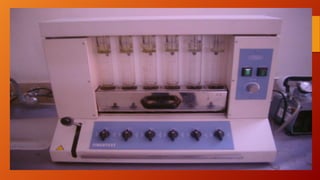
• Fiber Extraction Apparatus

• Furnace
• Suction Pump
• Racks

• Soxbelt Apparatus (Fat Digestion)
• kjeldahl Apparatus
Continue…

• Balance and oven are placed together so as to avoid the moisture loss
and less time is consumed.
• Dessicator is moisture absorbent having Ca and Silicate salts.
• Never place furnace near balance because its air current disturb
reading.
• Organic Substances - - - - - - - - 70 - 80oC
• Inorganic Substances - - - - - - - - - 100oC
Continue…
• For protein and fat digestion, fume hood with sliding roller used.
• Distillation apparatus should be placed near water supply and titration
flask.
• Acids and alkalis should be placed on lower side of rack.
• Fiber extraction apparatus and suction pump should be placed on same
shelf.
• Soxbelt apparatus and solvent should be on the same shelf.
Proximate Analysis
In 1865, for describing various feeds and fodders,
Hennebrg and Stobman at Weende Expi Station
Germany proposed a scheme of chemical
analysis,
also
called
Weende
Analysis
Scheme/Weende’s System of Analysis.
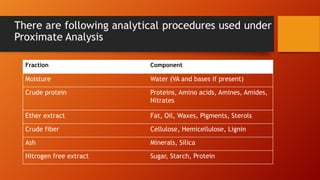
There are following analytical procedures used under
Proximate Analysis
Fraction

Component

Moisture

Water (VA and bases if present)

Crude protein

Proteins, Amino acids, Amines, Amides,
Nitrates

Ether extract

Fat, Oil, Waxes, Pigments, Sterols

Crude fiber

Cellulose, Hemicellulose, Lignin

Ash

Minerals, Silica

Nitrogen free extract

Sugar, Starch, Protein
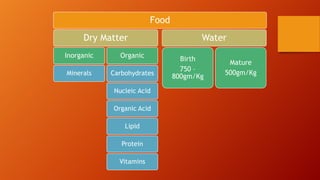
Food
Dry Matter
Inorganic

Organic

Minerals

Carbohydrates
Nucleic Acid

Organic Acid
Lipid
Protein
Vitamins

Water
Birth
750 –
800gm/Kg

Mature
500gm/Kg
Moisture
Moisture or water content is most important in a feed. It gives
information about the characteristics of feed whether it is succulent
or dry (bullkey feed stuff).
Moisture
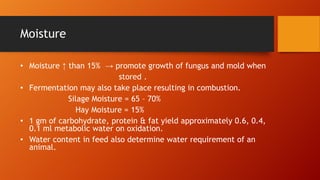
• Moisture ↑ than 15% → promote growth of fungus and mold when
stored .
• Fermentation may also take place resulting in combustion.
Silage Moisture = 65 – 70%
Hay Moisture = 15%
• 1 gm of carbohydrate, protein & fat yield approximately 0.6, 0.4,
0.1 ml metabolic water on oxidation.
• Water content in feed also determine water requirement of an
animal.
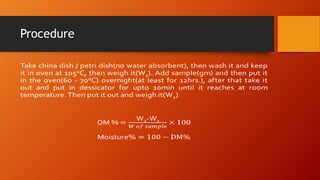
Procedure
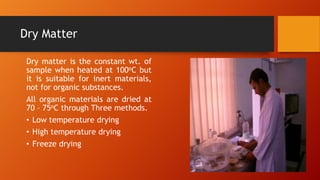
Dry Matter
Dry matter is the constant wt. of
sample when heated at 100oC but
it is suitable for inert materials,
not for organic substances.
All organic materials are dried at
70 – 75oC through Three methods.
• Low temperature drying
• High temperature drying
• Freeze drying
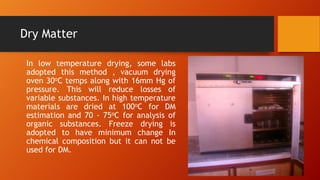
Dry Matter
In low temperature drying, some labs
adopted this method , vacuum drying
oven 30oC temps along with 16mm Hg of
pressure. This will reduce losses of
variable substances. In high temperature
materials are dried at 100oC for DM
estimation and 70 - 75oC for analysis of
organic substances. Freeze drying is
adopted to have minimum change In
chemical composition but it can not be
used for DM.
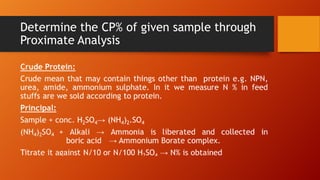
Determine the CP% of given sample through
Proximate Analysis
Determine the CP% of given sample through
Proximate Analysis
Detergents:
Mixed indicator for ammonia titration. Mix 10 mL of Bromocresol
green (0.1%) + 2 mL of methyl red (0.1%).
• Sulfuric acid solutions, 0.1 N (0.25%) and Concentrated sulfuric
acid, 98%.
• Digestion mixture :K2SO4 + CuSO4. + FeSO4
• Sodium hydroxide solution:(4%) Dissolve 40 gm sodium hydroxide
in 80 mL of distilled water and dilute it to 100 mL with distilled
water.
• Boric acid solution: (2%)
Dissolve 20 gm boric acid per liter of distilled water.
Determine the CP% of given sample through
Proximate Analysis
Procedure:
There are three steps.
• Digestion
• Distillation
• Titration
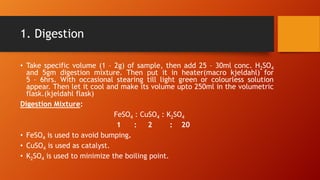
1. Digestion
• Take specific volume (1 – 2g) of sample, then add 25 – 30ml conc. H2SO4
and 5gm digestion mixture. Then put it in heater(macro kjeldahl) for
5 – 6hrs. With occasional stearing till light green or colourless solution
appear. Then let it cool and make its volume upto 250ml in the volumetric
flask.(kjeldahl flask)
Digestion Mixture:
FeSO4 : CuSO4 : K2SO4
1
:
2
: 20
• FeSO4 is used to avoid bumping.
• CuSO4 is used as catalyst.
• K2SO4 is used to minimize the boiling point.
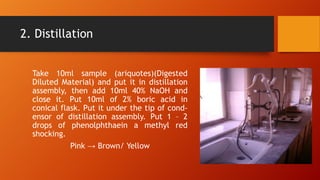
2. Distillation
Take 10ml sample (ariquotes)(Digested
Diluted Material) and put it in distillation
assembly, then add 10ml 40% NaOH and
close it. Put 10ml of 2% boric acid in
conical flask. Put it under the tip of condensor of distillation assembly. Put 1 – 2
drops of phenolphthaein a methyl red
shocking.

Pink → Brown/ Yellow
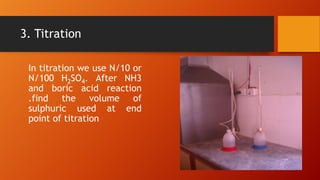
3. Titration
In titration we use N/10 or
N/100 H2SO4. After NH3
and boric acid reaction
.find the volume of
sulphuric used at end
point of titration
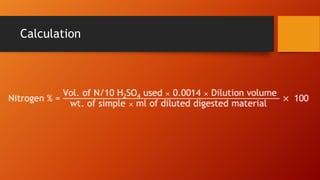
Calculation
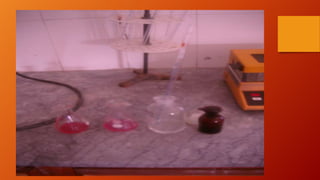
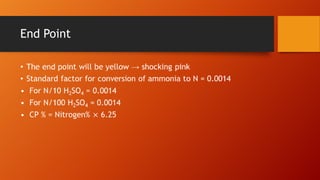
End Point
Determine the E.E% of given sample through
Proximate Analysis
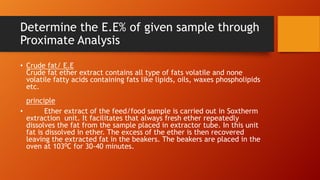
• Crude fat/ E.E
Crude fat ether extract contains all type of fats volatile and none
volatile fatty acids containing fats like lipids, oils, waxes phospholipids
etc.
principle
•
Ether extract of the feed/food sample is carried out in Soxtherm
extraction unit. It facilitates that always fresh ether repeatedly
dissolves the fat from the sample placed in extractor tube. In this unit
fat is dissolved in ether. The excess of the ether is then recovered
leaving the extracted fat in the beakers. The beakers are placed in the
oven at 1030C for 30-40 minutes.
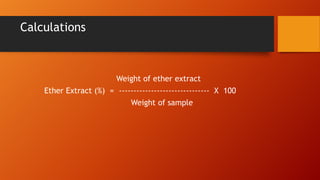
Weight of ether extract
Ether Extract (%) = ------------------------------- X 100
Weight of sample

Determine the E.E% of given sample through
Proximate Analysis
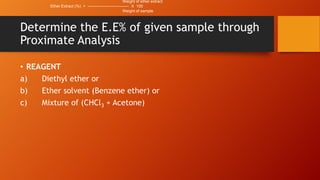
• REAGENT
a)
Diethyl ether or
b)
Ether solvent (Benzene ether) or
c)
Mixture of (CHCl3 + Acetone)
Procedure
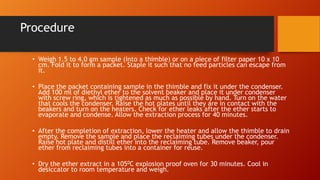
• Weigh 1.5 to 4.0 gm sample (into a thimble) or on a piece of filter paper 10 x 10
cm. Fold it to form a packet. Staple it such that no feed particles can escape from
it.
• Place the packet containing sample in the thimble and fix it under the condenser.
Add 100 ml of diethyl ether to the solvent beaker and place it under condenser
with screw ring, which is tightened as much as possible by hand. Turn on the water
that cools the condenser. Raise the hot plates until they are in contact with the
beakers and turn on the heaters. Check for ether leaks after the ether starts to
evaporate and condense. Allow the extraction process for 40 minutes.
• After the completion of extraction, lower the heater and allow the thimble to drain
empty. Remove the sample and place the reclaiming tubes under the condenser.
Raise hot plate and distill ether into the reclaiming tube. Remove beaker, pour
ether from reclaiming tubes into a container for reuse.
• Dry the ether extract in a 1050C explosion proof oven for 30 minutes. Cool in
desiccator to room temperature and weigh.
Calculations

Weight of ether extract
Ether Extract (%) = ------------------------------- X 100
Weight of sample
Determine the C.F% of given sample through
Proximate Analysis
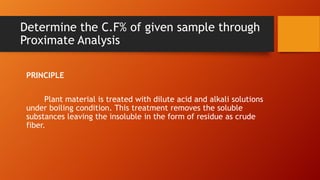
PRINCIPLE
Plant material is treated with dilute acid and alkali solutions
under boiling condition. This treatment removes the soluble
substances leaving the insoluble in the form of residue as crude
fiber.
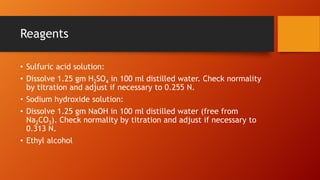
Reagents
• Sulfuric acid solution:
• Dissolve 1.25 gm H2SO4 in 100 ml distilled water. Check normality
by titration and adjust if necessary to 0.255 N.
• Sodium hydroxide solution:
• Dissolve 1.25 gm NaOH in 100 ml distilled water (free from
Na2CO3). Check normality by titration and adjust if necessary to
0.313 N.
• Ethyl alcohol
Procedure
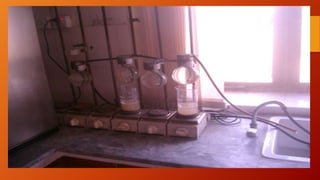
• The residue left after the extraction of crude fat is used for
determination of crude fiber (see method of ether extraction on
previous page).
• Transfer the extracted residue to the digestion container.
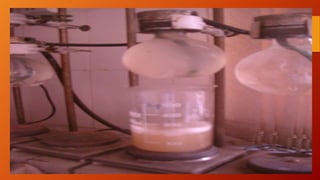
• Add 200 mL of 1.25% sulfuric acid solution into the digestion
container and heat it after covering with condenser.
• After boiling for 30 minutes cool the mixture and filter it with a linen
cloth in a filtration flask. Use vacuum pump if necessary. Wash the
residues thoroughly with boiling water.
• Put the residue back into the container and add 200 ml of 1.25%
sodium hydroxide solution and boil it for 30 minutes.
• After boiling cool the mixture and filter it with linen cloth as before.
Wash the sample with boiling water.
• Give final washing with ethyl alcohol (5-10 mL).
Procedure cont.
• Transfer the residue to a tared crucible.
• Dry the sample in oven at 1050C overnight.
• Cool the dried sample to room temperature in a dessicator and weigh it.
• Ignite the contents of crucible on oxidizing flame, till no fumes are
evolved.
• Ignite the contents of crucible in a muffle furnace at 5000C for 1 hour.
• After ignition transfer the crucible into a dessicator to cool and then weigh
• Note the loss of weight due to ignition as crude fiber.
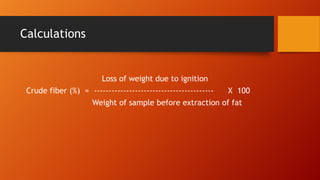
Calculations

Loss of weight due to ignition
Crude fiber (%) = ----------------------------------------X 100
Weight of sample before extraction of fat
Determine the Crude Ash of given sample
through Proximate Analysis
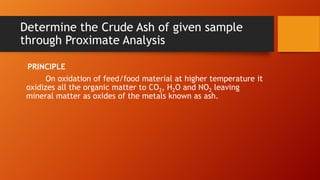
PRINCIPLE
On oxidation of feed/food material at higher temperature it
oxidizes all the organic matter to CO2, H2O and NO2 leaving
mineral matter as oxides of the metals known as ash.
Procedure
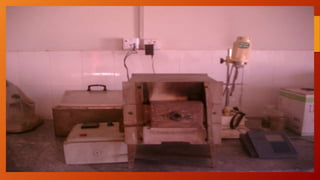
• Place a clean crucible in a muffle furnace at 6000C for one hour. Transfer
crucible from furnace to a dessicator and cool to room temperature.
• Weigh by difference 1.5 to 2 gm of sample into a pre-weighed porcelain
crucible.
• Heat the crucible on oxidizing flame till no smoke is evolved.
• Place the crucible in a muffle furnace at 5500C for four hours.
• After ashing transfer the crucible to a dessicator and cool to room
temperature.
• Weigh the crucible containing ash as quickly as possible to prevent moisture
absorption.
• Calculate the weight of ash by subtracting the weight of empty crucible from
the weight noted in step 6.
• Save the ash sample if mineral determination is to be done.
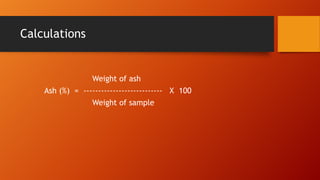
Calculations

Weight of ash
Ash (%) = --------------------------- X 100
Weight of sample
THANK YOU

Proximat analysis laboratory + proximat analysis

  • 1.
    Proximate Analysis MUHAMMAD ASIF2K8-VAS-32 LUAWMS UTHAL BALOCHISTAN
  • 2.
    Setting of AnalyticalLaboratory Following things are required • Oven • Weighing Balance • Dessicator • Fiber Extraction Apparatus • Furnace • Suction Pump • Racks • Soxbelt Apparatus (Fat Digestion) • kjeldahl Apparatus
  • 4.
    Continue… • Balance andoven are placed together so as to avoid the moisture loss and less time is consumed. • Dessicator is moisture absorbent having Ca and Silicate salts. • Never place furnace near balance because its air current disturb reading. • Organic Substances - - - - - - - - 70 - 80oC • Inorganic Substances - - - - - - - - - 100oC
  • 5.
    Continue… • For proteinand fat digestion, fume hood with sliding roller used. • Distillation apparatus should be placed near water supply and titration flask. • Acids and alkalis should be placed on lower side of rack. • Fiber extraction apparatus and suction pump should be placed on same shelf. • Soxbelt apparatus and solvent should be on the same shelf.
  • 6.
    Proximate Analysis In 1865,for describing various feeds and fodders, Hennebrg and Stobman at Weende Expi Station Germany proposed a scheme of chemical analysis, also called Weende Analysis Scheme/Weende’s System of Analysis.
  • 7.
    There are followinganalytical procedures used under Proximate Analysis Fraction Component Moisture Water (VA and bases if present) Crude protein Proteins, Amino acids, Amines, Amides, Nitrates Ether extract Fat, Oil, Waxes, Pigments, Sterols Crude fiber Cellulose, Hemicellulose, Lignin Ash Minerals, Silica Nitrogen free extract Sugar, Starch, Protein
  • 8.
    Food Dry Matter Inorganic Organic Minerals Carbohydrates Nucleic Acid OrganicAcid Lipid Protein Vitamins Water Birth 750 – 800gm/Kg Mature 500gm/Kg
  • 9.
    Moisture Moisture or watercontent is most important in a feed. It gives information about the characteristics of feed whether it is succulent or dry (bullkey feed stuff).
  • 10.
    Moisture • Moisture ↑than 15% → promote growth of fungus and mold when stored . • Fermentation may also take place resulting in combustion. Silage Moisture = 65 – 70% Hay Moisture = 15% • 1 gm of carbohydrate, protein & fat yield approximately 0.6, 0.4, 0.1 ml metabolic water on oxidation. • Water content in feed also determine water requirement of an animal.
  • 11.
  • 12.
    Dry Matter Dry matteris the constant wt. of sample when heated at 100oC but it is suitable for inert materials, not for organic substances. All organic materials are dried at 70 – 75oC through Three methods. • Low temperature drying • High temperature drying • Freeze drying
  • 13.
    Dry Matter In lowtemperature drying, some labs adopted this method , vacuum drying oven 30oC temps along with 16mm Hg of pressure. This will reduce losses of variable substances. In high temperature materials are dried at 100oC for DM estimation and 70 - 75oC for analysis of organic substances. Freeze drying is adopted to have minimum change In chemical composition but it can not be used for DM.
  • 14.
    Determine the CP%of given sample through Proximate Analysis
  • 15.
    Determine the CP%of given sample through Proximate Analysis Detergents: Mixed indicator for ammonia titration. Mix 10 mL of Bromocresol green (0.1%) + 2 mL of methyl red (0.1%). • Sulfuric acid solutions, 0.1 N (0.25%) and Concentrated sulfuric acid, 98%. • Digestion mixture :K2SO4 + CuSO4. + FeSO4 • Sodium hydroxide solution:(4%) Dissolve 40 gm sodium hydroxide in 80 mL of distilled water and dilute it to 100 mL with distilled water. • Boric acid solution: (2%) Dissolve 20 gm boric acid per liter of distilled water.
  • 16.
    Determine the CP%of given sample through Proximate Analysis Procedure: There are three steps. • Digestion • Distillation • Titration
  • 17.
    1. Digestion • Takespecific volume (1 – 2g) of sample, then add 25 – 30ml conc. H2SO4 and 5gm digestion mixture. Then put it in heater(macro kjeldahl) for 5 – 6hrs. With occasional stearing till light green or colourless solution appear. Then let it cool and make its volume upto 250ml in the volumetric flask.(kjeldahl flask) Digestion Mixture: FeSO4 : CuSO4 : K2SO4 1 : 2 : 20 • FeSO4 is used to avoid bumping. • CuSO4 is used as catalyst. • K2SO4 is used to minimize the boiling point.
  • 19.
    2. Distillation Take 10mlsample (ariquotes)(Digested Diluted Material) and put it in distillation assembly, then add 10ml 40% NaOH and close it. Put 10ml of 2% boric acid in conical flask. Put it under the tip of condensor of distillation assembly. Put 1 – 2 drops of phenolphthaein a methyl red shocking. Pink → Brown/ Yellow
  • 20.
    3. Titration In titrationwe use N/10 or N/100 H2SO4. After NH3 and boric acid reaction .find the volume of sulphuric used at end point of titration
  • 22.
  • 23.
  • 24.
    Determine the E.E%of given sample through Proximate Analysis • Crude fat/ E.E Crude fat ether extract contains all type of fats volatile and none volatile fatty acids containing fats like lipids, oils, waxes phospholipids etc. principle • Ether extract of the feed/food sample is carried out in Soxtherm extraction unit. It facilitates that always fresh ether repeatedly dissolves the fat from the sample placed in extractor tube. In this unit fat is dissolved in ether. The excess of the ether is then recovered leaving the extracted fat in the beakers. The beakers are placed in the oven at 1030C for 30-40 minutes.
  • 25.
    Weight of etherextract Ether Extract (%) = ------------------------------- X 100 Weight of sample Determine the E.E% of given sample through Proximate Analysis • REAGENT a) Diethyl ether or b) Ether solvent (Benzene ether) or c) Mixture of (CHCl3 + Acetone)
  • 26.
    Procedure • Weigh 1.5to 4.0 gm sample (into a thimble) or on a piece of filter paper 10 x 10 cm. Fold it to form a packet. Staple it such that no feed particles can escape from it. • Place the packet containing sample in the thimble and fix it under the condenser. Add 100 ml of diethyl ether to the solvent beaker and place it under condenser with screw ring, which is tightened as much as possible by hand. Turn on the water that cools the condenser. Raise the hot plates until they are in contact with the beakers and turn on the heaters. Check for ether leaks after the ether starts to evaporate and condense. Allow the extraction process for 40 minutes. • After the completion of extraction, lower the heater and allow the thimble to drain empty. Remove the sample and place the reclaiming tubes under the condenser. Raise hot plate and distill ether into the reclaiming tube. Remove beaker, pour ether from reclaiming tubes into a container for reuse. • Dry the ether extract in a 1050C explosion proof oven for 30 minutes. Cool in desiccator to room temperature and weigh.
  • 28.
    Calculations Weight of etherextract Ether Extract (%) = ------------------------------- X 100 Weight of sample
  • 29.
    Determine the C.F%of given sample through Proximate Analysis PRINCIPLE Plant material is treated with dilute acid and alkali solutions under boiling condition. This treatment removes the soluble substances leaving the insoluble in the form of residue as crude fiber.
  • 30.
    Reagents • Sulfuric acidsolution: • Dissolve 1.25 gm H2SO4 in 100 ml distilled water. Check normality by titration and adjust if necessary to 0.255 N. • Sodium hydroxide solution: • Dissolve 1.25 gm NaOH in 100 ml distilled water (free from Na2CO3). Check normality by titration and adjust if necessary to 0.313 N. • Ethyl alcohol
  • 31.
    Procedure • The residueleft after the extraction of crude fat is used for determination of crude fiber (see method of ether extraction on previous page). • Transfer the extracted residue to the digestion container. • Add 200 mL of 1.25% sulfuric acid solution into the digestion container and heat it after covering with condenser. • After boiling for 30 minutes cool the mixture and filter it with a linen cloth in a filtration flask. Use vacuum pump if necessary. Wash the residues thoroughly with boiling water. • Put the residue back into the container and add 200 ml of 1.25% sodium hydroxide solution and boil it for 30 minutes. • After boiling cool the mixture and filter it with linen cloth as before. Wash the sample with boiling water. • Give final washing with ethyl alcohol (5-10 mL).
  • 32.
    Procedure cont. • Transferthe residue to a tared crucible. • Dry the sample in oven at 1050C overnight. • Cool the dried sample to room temperature in a dessicator and weigh it. • Ignite the contents of crucible on oxidizing flame, till no fumes are evolved. • Ignite the contents of crucible in a muffle furnace at 5000C for 1 hour. • After ignition transfer the crucible into a dessicator to cool and then weigh • Note the loss of weight due to ignition as crude fiber.
  • 36.
    Calculations Loss of weightdue to ignition Crude fiber (%) = ----------------------------------------X 100 Weight of sample before extraction of fat
  • 37.
    Determine the CrudeAsh of given sample through Proximate Analysis PRINCIPLE On oxidation of feed/food material at higher temperature it oxidizes all the organic matter to CO2, H2O and NO2 leaving mineral matter as oxides of the metals known as ash.
  • 38.
    Procedure • Place aclean crucible in a muffle furnace at 6000C for one hour. Transfer crucible from furnace to a dessicator and cool to room temperature. • Weigh by difference 1.5 to 2 gm of sample into a pre-weighed porcelain crucible. • Heat the crucible on oxidizing flame till no smoke is evolved. • Place the crucible in a muffle furnace at 5500C for four hours. • After ashing transfer the crucible to a dessicator and cool to room temperature. • Weigh the crucible containing ash as quickly as possible to prevent moisture absorption. • Calculate the weight of ash by subtracting the weight of empty crucible from the weight noted in step 6. • Save the ash sample if mineral determination is to be done.
  • 40.
    Calculations Weight of ash Ash(%) = --------------------------- X 100 Weight of sample
  • 41.