Welcome to A LEVEL ART, this is the beginning of a hard, but
enjoyable two years. Art is not easy; it’s about hard work,
creativity and the will to do well. If you listen to the help,
advice and guidance that we will give you and give 100% in
every piece of work, and try your best, you will succeed.
You’re A level is very important and to get the maximum from
your coursework you must complete all set assignments and
make sure you live, breathe and eat art.
You have chosen this option, so we expect nothing but your
best.
We currently run the EDEXCEL UNENDORSED ART,
CRAFT AND DESIGN course. This allows you the
freedom to explore different areas of art, such as
painting, printmaking, textiles, photography,
graphical communication, sculpture and
contextual studies. The course encourages you to
create a personal and imaginative approach.
The course consists of four units over 2 years:
YEAR 12:
-Environments
-Mock Exam
YEAR 13:
COURSEWORK (DEVELOPED FROM PERSONAL
STARTING POINT) + Essay 60%
UNIT 4-EXTERNALLY SET ASSIGNMENT 40%
Throughout year 12 you will be introduced
to the different art disciplines through a
series of workshops. You will be set
assignment tasks based on these
workshops, all based around one theme.
For each art discipline you will be expected
to use your own initiative, research artists,
primary images, take good quality
photographs and annotate and review
your work.
We are here to guide you, and you are
privileged to have 2/3 teachers that
specialise in different art disciplines, but
we will not do the work for you.
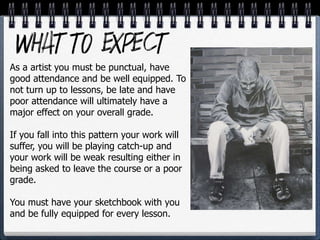
As a artist you must be punctual, have
good attendance and be well equipped. To
not turn up to lessons, be late and have
poor attendance will ultimately have a
major effect on your overall grade.
If you fall into this pattern your work will
suffer, you will be playing catch-up and
your work will be weak resulting either in
being asked to leave the course or a poor
grade.
You must have your sketchbook with you
and be fully equipped for every lesson.
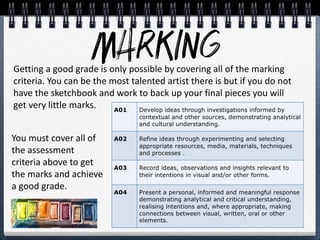
Getting a good grade is only possible by covering all of the marking
criteria. You can be the most talented artist there is but if you do not
have the sketchbook and work to back up your final pieces you will
get very little marks.
You must cover all of
the assessment
criteria above to get
the marks and achieve
a good grade.
You should be trying to introduce
independence into your work to get the
highest possible grade and this can be
done easily by collecting newspaper and
magazine articles/internet information or
gallery visits of artists you like. You do not
need to buy the magazines or books but
be aware of what is going on around you
now in the art world.
https://www.youtube.com/watch?v=yF6EluMNR14&t=49s
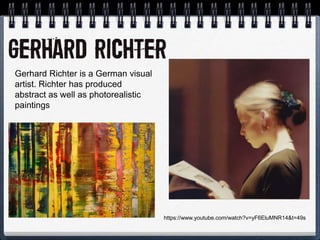
Gerhard Richter is a German visual
artist. Richter has produced
abstract as well as photorealistic
paintings
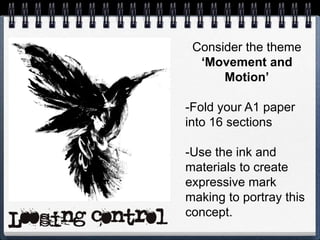
Consider the theme
‘Movement and
Motion’
-Fold your A1 paper
into 16 sections
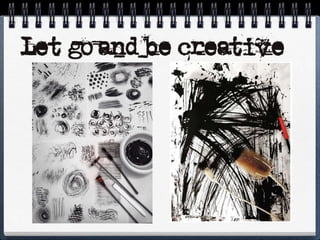
-Use the ink and
materials to create
expressive mark
making to portray this
concept.
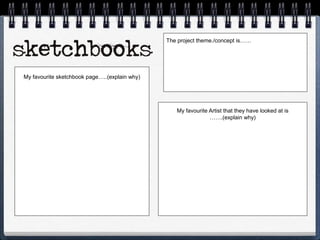
My favourite sketchbook page…..(explain why)
My favourite Artist that they have looked at is
…….(explain why)
The project theme./concept is……
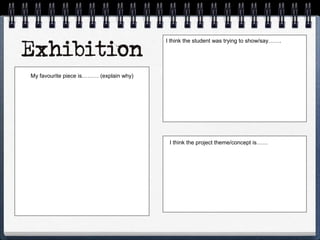
I think the student was trying to show/say…….
My favourite piece is……… (explain why)
I think the project theme/concept is……
There are a range of ideas to get you thinking in a creative way and
approach the theme of ‘Environments’ imaginatively.
There are a range of options that can be done in and out of the home.
You may choose to do some of them in the home and on any walks you
take, and then you may have more options over the coming months if
situations change.
Either way (in the home or out) you will be able to make successful and
exciting work from the ideas on these slides, and you will hopefully have
your own too!
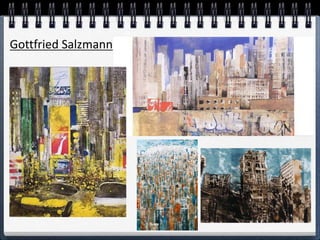
Gottfried Salzmann
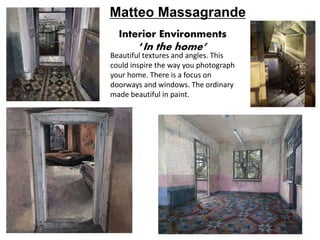
Interior Environments
‘In the home’
Beautiful textures and angles. This
could inspire the way you photograph
your home. There is a focus on
doorways and windows. The ordinary
made beautiful in paint.
Matteo Massagrande
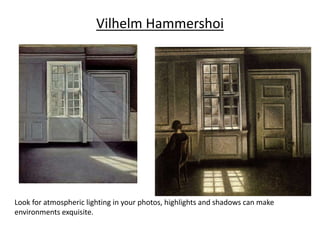
Vilhelm Hammershoi
Look for atmospheric lighting in your photos, highlights and shadows can make
environments exquisite.
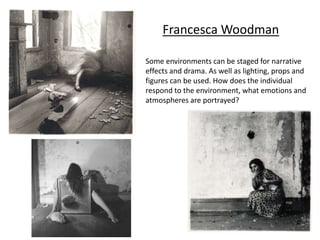
Francesca Woodman
Some environments can be staged for narrative
effects and drama. As well as lighting, props and
figures can be used. How does the individual
respond to the environment, what emotions and
atmospheres are portrayed?
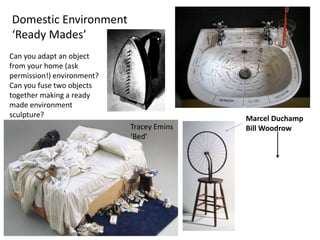
Domestic Environment
‘Ready Mades’
Tracey Emins
‘Bed’
Marcel Duchamp
Bill Woodrow
Can you adapt an object
from your home (ask
permission!) environment?
Can you fuse two objects
together making a ready
made environment
sculpture?
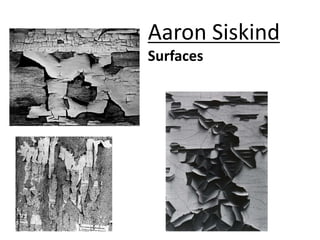
Aaron Siskind
Surfaces
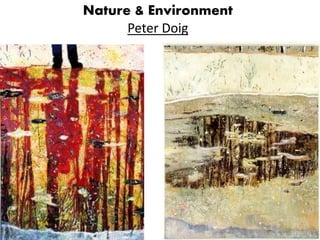
Nature & Environment
Peter Doig
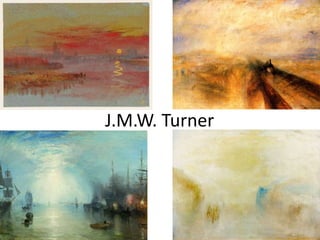
J.M.W. Turner
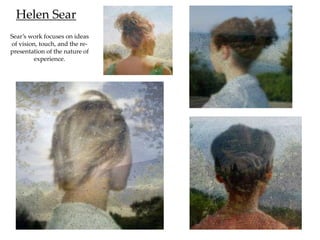
Helen Sear
Sear’s work focuses on ideas
of vision, touch, and the re-
presentation of the nature of
experience.
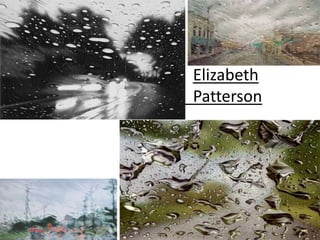
Elizabeth
Patterson
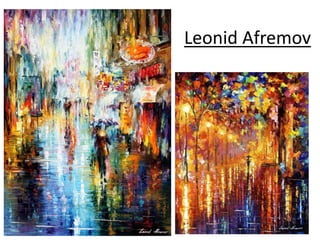
Leonid Afremov
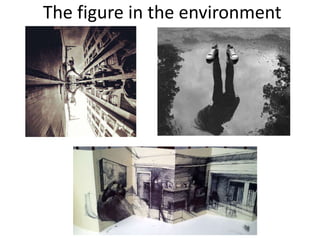
The figure in the environment
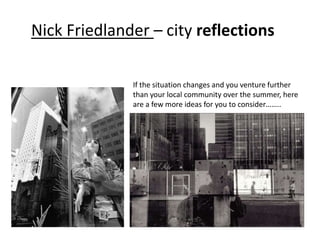
Nick Friedlander – city reflections
If the situation changes and you venture further
than your local community over the summer, here
are a few more ideas for you to consider……..
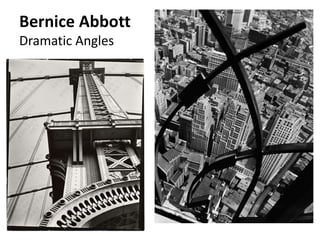
Bernice Abbott
Dramatic Angles
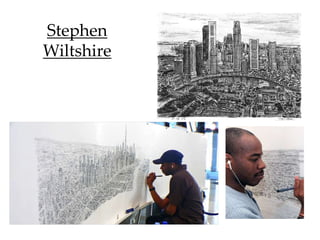
Stephen
Wiltshire
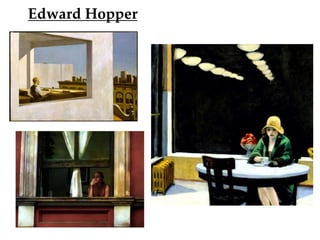
Edward Hopper
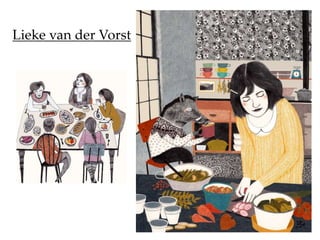
Lieke van der Vorst
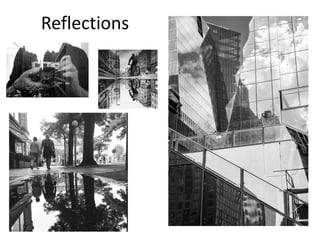
Reflections
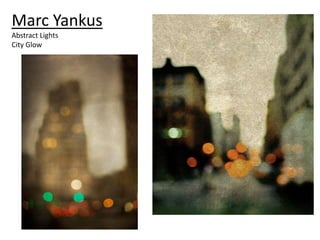
Marc Yankus
Abstract Lights
City Glow
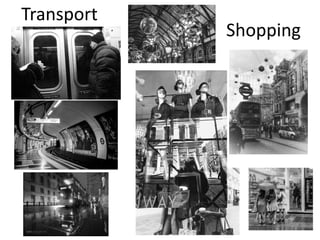
Shopping
Transport
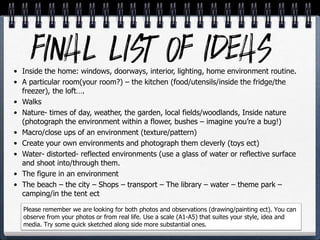
• Inside the home: windows, doorways, interior, lighting, home environment routine.
• A particular room(your room?) – the kitchen (food/utensils/inside the fridge/the
freezer), the loft….
• Walks
• Nature- times of day, weather, the garden, local fields/woodlands, Inside nature
(photograph the environment within a flower, bushes – imagine you’re a bug!)
• Macro/close ups of an environment (texture/pattern)
• Create your own environments and photograph them cleverly (toys ect)
• Water- distorted- reflected environments (use a glass of water or reflective surface
and shoot into/through them.
• The figure in an environment
• The beach – the city – Shops – transport – The library – water – theme park –
camping/in the tent ect
Please remember we are looking for both photos and observations (drawing/painting ect). You can
observe from your photos or from real life. Use a scale (A1-A5) that suites your style, idea and
media. Try some quick sketched along side more substantial ones.
• Tea & Coffee
• Charcoal (BBQ ones will do – break them down)
• Stain paper then lift out highlights with bleach (be careful wear gloves)
• Work on the back of wrapping paper, card board or wall paper for bigger
scales
• Use old wood that you find in the shed/garage (can be big or lots of small
pieces)
• Paint on objects
• Collage materials – use dried out teabags, tissue from amazon deliveries ect
• Use emollition and wall paint.
Have fun with the theme and we look forward to seeing you in September to
share your work and start you’re a Level!
http://artatbeaumontschool.blogspot.co.uk
http://www.pinterest.com/beaumontart/
The Beaumont Art Blog can be found on
the school website and using the link
above. Your Home Learning will be posted
on here, Power Points as well as current
exhibitions and other useful Art links
The Beaumont Art Pinterest can be found on
the school website and using the link above.
This is used for Artist research, Art techniques
as well as good A Level Art examples created
by students to inspire you. Over the summer
create your own Pinterest account and
follow Beaumont Art
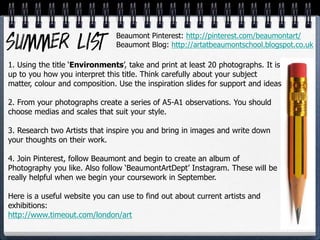
1. Using the title ‘Environments’, take and print at least 20 photographs. It is
up to you how you interpret this title. Think carefully about your subject
matter, colour and composition. Use the inspiration slides for support and ideas
2. From your photographs create a series of A5-A1 observations. You should
choose medias and scales that suit your style.
3. Research two Artists that inspire you and bring in images and write down
your thoughts on their work.
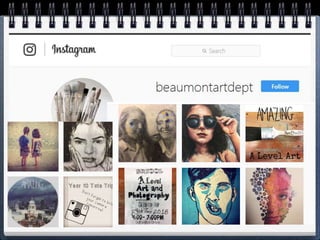
4. Join Pinterest, follow Beaumont and begin to create an album of
Photography you like. Also follow ‘BeaumontArtDept’ Instagram. These will be
really helpful when we begin your coursework in September.
Here is a useful website you can use to find out about current artists and
exhibitions:
http://www.timeout.com/london/art
Beaumont Pinterest: http://pinterest.com/beaumontart/
Beaumont Blog: http://artatbeaumontschool.blogspot.co.uk

A level art induction 21

  • 2.
    Welcome to ALEVEL ART, this is the beginning of a hard, but enjoyable two years. Art is not easy; it’s about hard work, creativity and the will to do well. If you listen to the help, advice and guidance that we will give you and give 100% in every piece of work, and try your best, you will succeed. You’re A level is very important and to get the maximum from your coursework you must complete all set assignments and make sure you live, breathe and eat art. You have chosen this option, so we expect nothing but your best.
  • 3.
    We currently runthe EDEXCEL UNENDORSED ART, CRAFT AND DESIGN course. This allows you the freedom to explore different areas of art, such as painting, printmaking, textiles, photography, graphical communication, sculpture and contextual studies. The course encourages you to create a personal and imaginative approach. The course consists of four units over 2 years: YEAR 12: -Environments -Mock Exam YEAR 13: COURSEWORK (DEVELOPED FROM PERSONAL STARTING POINT) + Essay 60% UNIT 4-EXTERNALLY SET ASSIGNMENT 40%
  • 4.
    Throughout year 12you will be introduced to the different art disciplines through a series of workshops. You will be set assignment tasks based on these workshops, all based around one theme. For each art discipline you will be expected to use your own initiative, research artists, primary images, take good quality photographs and annotate and review your work. We are here to guide you, and you are privileged to have 2/3 teachers that specialise in different art disciplines, but we will not do the work for you.
  • 5.
    As a artistyou must be punctual, have good attendance and be well equipped. To not turn up to lessons, be late and have poor attendance will ultimately have a major effect on your overall grade. If you fall into this pattern your work will suffer, you will be playing catch-up and your work will be weak resulting either in being asked to leave the course or a poor grade. You must have your sketchbook with you and be fully equipped for every lesson.
  • 6.
    Getting a goodgrade is only possible by covering all of the marking criteria. You can be the most talented artist there is but if you do not have the sketchbook and work to back up your final pieces you will get very little marks. You must cover all of the assessment criteria above to get the marks and achieve a good grade.
  • 7.
    You should betrying to introduce independence into your work to get the highest possible grade and this can be done easily by collecting newspaper and magazine articles/internet information or gallery visits of artists you like. You do not need to buy the magazines or books but be aware of what is going on around you now in the art world.
  • 9.
    https://www.youtube.com/watch?v=yF6EluMNR14&t=49s Gerhard Richter isa German visual artist. Richter has produced abstract as well as photorealistic paintings
  • 10.
    Consider the theme ‘Movementand Motion’ -Fold your A1 paper into 16 sections -Use the ink and materials to create expressive mark making to portray this concept.
  • 13.
    My favourite sketchbookpage…..(explain why) My favourite Artist that they have looked at is …….(explain why) The project theme./concept is……
  • 14.
    I think thestudent was trying to show/say……. My favourite piece is……… (explain why) I think the project theme/concept is……
  • 16.
    There are arange of ideas to get you thinking in a creative way and approach the theme of ‘Environments’ imaginatively. There are a range of options that can be done in and out of the home. You may choose to do some of them in the home and on any walks you take, and then you may have more options over the coming months if situations change. Either way (in the home or out) you will be able to make successful and exciting work from the ideas on these slides, and you will hopefully have your own too!
  • 17.
  • 18.
    Interior Environments ‘In thehome’ Beautiful textures and angles. This could inspire the way you photograph your home. There is a focus on doorways and windows. The ordinary made beautiful in paint. Matteo Massagrande
  • 19.
    Vilhelm Hammershoi Look foratmospheric lighting in your photos, highlights and shadows can make environments exquisite.
  • 20.
    Francesca Woodman Some environmentscan be staged for narrative effects and drama. As well as lighting, props and figures can be used. How does the individual respond to the environment, what emotions and atmospheres are portrayed?
  • 22.
    Domestic Environment ‘Ready Mades’ TraceyEmins ‘Bed’ Marcel Duchamp Bill Woodrow Can you adapt an object from your home (ask permission!) environment? Can you fuse two objects together making a ready made environment sculpture?
  • 23.
  • 24.
  • 25.
  • 26.
    Helen Sear Sear’s workfocuses on ideas of vision, touch, and the re- presentation of the nature of experience.
  • 27.
  • 28.
  • 29.
    The figure inthe environment
  • 30.
    Nick Friedlander –city reflections If the situation changes and you venture further than your local community over the summer, here are a few more ideas for you to consider……..
  • 31.
  • 32.
  • 33.
  • 34.
  • 35.
  • 36.
  • 37.
  • 38.
    • Inside thehome: windows, doorways, interior, lighting, home environment routine. • A particular room(your room?) – the kitchen (food/utensils/inside the fridge/the freezer), the loft…. • Walks • Nature- times of day, weather, the garden, local fields/woodlands, Inside nature (photograph the environment within a flower, bushes – imagine you’re a bug!) • Macro/close ups of an environment (texture/pattern) • Create your own environments and photograph them cleverly (toys ect) • Water- distorted- reflected environments (use a glass of water or reflective surface and shoot into/through them. • The figure in an environment • The beach – the city – Shops – transport – The library – water – theme park – camping/in the tent ect Please remember we are looking for both photos and observations (drawing/painting ect). You can observe from your photos or from real life. Use a scale (A1-A5) that suites your style, idea and media. Try some quick sketched along side more substantial ones.
  • 39.
    • Tea &Coffee • Charcoal (BBQ ones will do – break them down) • Stain paper then lift out highlights with bleach (be careful wear gloves) • Work on the back of wrapping paper, card board or wall paper for bigger scales • Use old wood that you find in the shed/garage (can be big or lots of small pieces) • Paint on objects • Collage materials – use dried out teabags, tissue from amazon deliveries ect • Use emollition and wall paint. Have fun with the theme and we look forward to seeing you in September to share your work and start you’re a Level!
  • 40.
    http://artatbeaumontschool.blogspot.co.uk http://www.pinterest.com/beaumontart/ The Beaumont ArtBlog can be found on the school website and using the link above. Your Home Learning will be posted on here, Power Points as well as current exhibitions and other useful Art links The Beaumont Art Pinterest can be found on the school website and using the link above. This is used for Artist research, Art techniques as well as good A Level Art examples created by students to inspire you. Over the summer create your own Pinterest account and follow Beaumont Art
  • 42.
    1. Using thetitle ‘Environments’, take and print at least 20 photographs. It is up to you how you interpret this title. Think carefully about your subject matter, colour and composition. Use the inspiration slides for support and ideas 2. From your photographs create a series of A5-A1 observations. You should choose medias and scales that suit your style. 3. Research two Artists that inspire you and bring in images and write down your thoughts on their work. 4. Join Pinterest, follow Beaumont and begin to create an album of Photography you like. Also follow ‘BeaumontArtDept’ Instagram. These will be really helpful when we begin your coursework in September. Here is a useful website you can use to find out about current artists and exhibitions: http://www.timeout.com/london/art Beaumont Pinterest: http://pinterest.com/beaumontart/ Beaumont Blog: http://artatbeaumontschool.blogspot.co.uk