Academic Interactions 130
IECP
Fall 2015
Nikki Mattson
Agenda
• Conversation Starters
• Brief Review
• Pathways 1
Conversation Starter 130A
• Imagine you were studying a major that
you thought would be a good fit, but after
completing one semester of coursework in
that major, you realized that the reverse
was actually true -- it was not suitable for
you. In this situation, do you think that you
would start another major or that you
would complete what you had already
started?
• (Mohammed Alsadiq/ Undecided)
Conversation Starter 130A
• If men use feminine items like feminine
clothes or makeup, do you think that it
affects their personalities or not? And
why? What are some examples?
• (Hassan Aljaffar/Chemical Engineering)
Conversation Starter 130A
• A lot of voices have arisen over the years
demanding equality between males and
females in many fields. For example,
some activists have advocated for equality
in job opportunities, salaries, hours and
retirement ages. But should males and
females be equal in every field and in
every aspect? Why/why not?
• (Ahmad Emam/mechanical engineering)
Conversation Starter 130B
In the nineteenth century, women did not have many rights
under civil law in America. What do you know about
women’s rights in your country in the past and the present?
Also, more and more female lawyers are playing an
important role in society. When you think about the
particular characteristics of female lawyers, what comes to
mind?
(Intellectual Property Law, Guanrong Chen)
Conversation Starter 130B
• Governments all over the world are trying
to enact laws that benefit societies. Have
you ever questioned the role that a
society itself plays in enacting laws? What
are your thoughts?
• (Law, Ahmad Alhammadi)
Conversation Starter 130B
• These days the concept of being transgender has
become more and more common in societies around the
world. Transgender means that a person has two
genders. By definition one is the physical gender, and
the other one is the acceptance of the gender by the
individual. For example, other people see them as a
men, but they consider themselves to be women. How is
this idea approached/discussed/treated in your country?
(Psychiatry Nursing, Bora LEE )
Video
Quiz from yesterday
1. What is the difference between “gender”
and “sex”?
2. Which country is the home of the fighting
cholitas?
3. What do masculine and feminine mean?
Building Vocabulary
• Using context (how does this work?)
• Why is this important?
• Pg. 4, listening
• Pg. 5, complete B and C individually
• Pg. 5, complete part D as a group
Note-taking brainstorming
1. What is the purpose of taking notes during a
lecture?
2. What equipment and strategies do you usually
use for taking notes?
3. Do you think the equipment and strategies that
you usually use for note-taking are effective?
Why/why not?
What are effective note-taking
strategies?
Note-taking (pg. 6)
Pg.6, part A and B
A
•1. some culture = strict gender roles
•2. children learn gender from watching others
B
1.yr
2.w/o
3.<
4.>
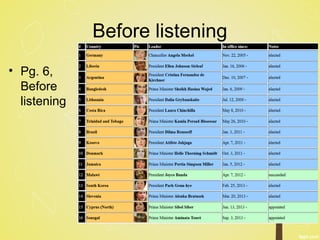
Before listening
• Pg. 6,
Before
listening
Listening and Note taking
• Listen to part of a lecture and try to write
down the main ideas on a piece of paper.
• Check yourself. Did you include the ideas
on pg. 7 (part A)?
Listening for details
• Pre-listening Video
• Listen to the next part of the lecture and
try to complete part C.
• Discussion: pg. 7 – After listening, critical
thinking
Gender and Society – pg. 12 –
Video and Discussion
• Before viewing – part A
• Listening and words in context
• Viewing
• After viewing – pg. 13 – A,B, and C
More Vocabulary
• Pg. 14 – listen
• Pg. 15 - B
HW
• None!

4. conversation starters, pathways 1

  • 1.
  • 2.
    Agenda • Conversation Starters •Brief Review • Pathways 1
  • 3.
    Conversation Starter 130A •Imagine you were studying a major that you thought would be a good fit, but after completing one semester of coursework in that major, you realized that the reverse was actually true -- it was not suitable for you. In this situation, do you think that you would start another major or that you would complete what you had already started? • (Mohammed Alsadiq/ Undecided)
  • 4.
    Conversation Starter 130A •If men use feminine items like feminine clothes or makeup, do you think that it affects their personalities or not? And why? What are some examples? • (Hassan Aljaffar/Chemical Engineering)
  • 5.
    Conversation Starter 130A •A lot of voices have arisen over the years demanding equality between males and females in many fields. For example, some activists have advocated for equality in job opportunities, salaries, hours and retirement ages. But should males and females be equal in every field and in every aspect? Why/why not? • (Ahmad Emam/mechanical engineering)
  • 6.
    Conversation Starter 130B Inthe nineteenth century, women did not have many rights under civil law in America. What do you know about women’s rights in your country in the past and the present? Also, more and more female lawyers are playing an important role in society. When you think about the particular characteristics of female lawyers, what comes to mind? (Intellectual Property Law, Guanrong Chen)
  • 7.
    Conversation Starter 130B •Governments all over the world are trying to enact laws that benefit societies. Have you ever questioned the role that a society itself plays in enacting laws? What are your thoughts? • (Law, Ahmad Alhammadi)
  • 8.
    Conversation Starter 130B •These days the concept of being transgender has become more and more common in societies around the world. Transgender means that a person has two genders. By definition one is the physical gender, and the other one is the acceptance of the gender by the individual. For example, other people see them as a men, but they consider themselves to be women. How is this idea approached/discussed/treated in your country? (Psychiatry Nursing, Bora LEE ) Video
  • 9.
    Quiz from yesterday 1.What is the difference between “gender” and “sex”? 2. Which country is the home of the fighting cholitas? 3. What do masculine and feminine mean?
  • 10.
    Building Vocabulary • Usingcontext (how does this work?) • Why is this important? • Pg. 4, listening • Pg. 5, complete B and C individually • Pg. 5, complete part D as a group
  • 11.
    Note-taking brainstorming 1. Whatis the purpose of taking notes during a lecture? 2. What equipment and strategies do you usually use for taking notes? 3. Do you think the equipment and strategies that you usually use for note-taking are effective? Why/why not?
  • 12.
    What are effectivenote-taking strategies?
  • 13.
  • 14.
    Pg.6, part Aand B A •1. some culture = strict gender roles •2. children learn gender from watching others B 1.yr 2.w/o 3.< 4.>
  • 15.
    Before listening • Pg.6, Before listening
  • 16.
    Listening and Notetaking • Listen to part of a lecture and try to write down the main ideas on a piece of paper. • Check yourself. Did you include the ideas on pg. 7 (part A)?
  • 17.
    Listening for details •Pre-listening Video • Listen to the next part of the lecture and try to complete part C. • Discussion: pg. 7 – After listening, critical thinking
  • 18.
    Gender and Society– pg. 12 – Video and Discussion • Before viewing – part A • Listening and words in context • Viewing • After viewing – pg. 13 – A,B, and C
  • 19.
    More Vocabulary • Pg.14 – listen • Pg. 15 - B
  • 20.