Academic
Interactions
Nikki and Yingxue
Agenda
 Catching Up
 Pathways 6 – A Word of Worlds
(Literature/Humanities)
 Poetry and Fairy Tales
Catching Up – Group Discussion
 What did you do during spring break?
 What were your favorite parts?
 What were your least favorite parts?
Introduction: Pathways Chapter 6
 A Word of Worlds (Literature/Humanities)
What is a Wordle?
 A word picture that expresses frequency.
 http://www.wordle.net/
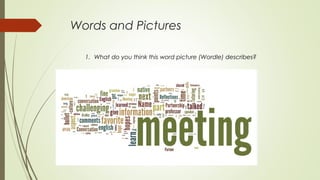
Words and Pictures
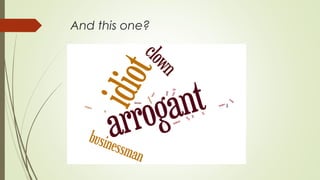
1. What do you think this word picture (Wordle) describes?
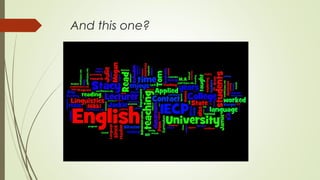
And this one?
And this one?
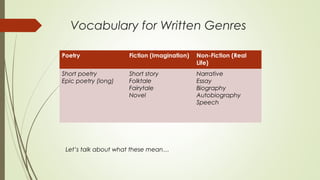
Poetry Fiction (Imagination) Non-Fiction (Real
Life)
Short poetry
Epic poetry (long)
Short story
Folktale
Fairytale
Novel
Narrative
Essay
Biography
Autobiography
Speech
Vocabulary for Written Genres
Let’s talk about what these mean…
Vocabulary Building, pg. 104
 Listen to the audio track based on Pg.104 and pay attention to the words in
blue.
 Pg. 104 B
 Pg. 105 B
Poetry Focus (Handout)
 Read the four poems out loud in groups. on Discuss which one is your
favorite and why with your group.
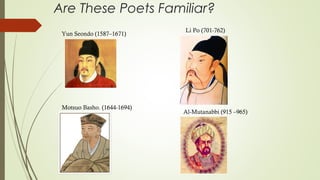
Are These Poets Familiar?
Yun Seondo (1587–1671)
Li Po (701-762)
Motsuo Basho. (1644-1694)
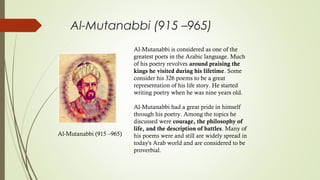
Al-Mutanabbi (915 –965)
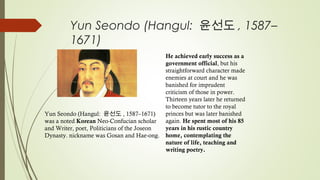
Yun Seondo (Hangul: 윤선도 , 1587–
1671)
 
He achieved early success as a
government official, but his
straightforward character made
enemies at court and he was
banished for imprudent
criticism of those in power.
Thirteen years later he returned
to become tutor to the royal
princes but was later banished
again. He spent most of his 85
years in his rustic country
home, contemplating the
nature of life, teaching and
writing poetry.
 
Yun Seondo (Hangul: 윤선도 , 1587–1671)
was a noted Korean Neo-Confucian scholar
and Writer, poet, Politicians of the Joseon
Dynasty. nickname was Gosan and Hae-ong.
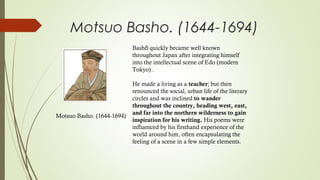
Motsuo Basho. (1644-1694)
Bash quickly became well knownō
throughout Japan after integrating himself
into the intellectual scene of Edo (modern
Tokyo) .
He made a living as a teacher; but then
renounced the social, urban life of the literary
circles and was inclined to wander
throughout the country, heading west, east,
and far into the northern wilderness to gain
inspiration for his writing. His poems were
influenced by his firsthand experience of the
world around him, often encapsulating the
feeling of a scene in a few simple elements.
Motsuo Basho. (1644-1694)
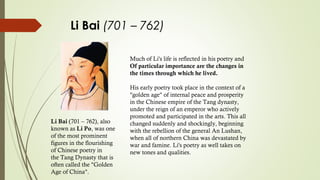
Li Bai (701 – 762)
Much of Li's life is reflected in his poetry and
Of particular importance are the changes in
the times through which he lived.
His early poetry took place in the context of a
"golden age" of internal peace and prosperity
in the Chinese empire of the Tang dynasty,
under the reign of an emperor who actively
promoted and participated in the arts. This all
changed suddenly and shockingly, beginning
with the rebellion of the general An Lushan,
when all of northern China was devastated by
war and famine. Li's poetry as well takes on
new tones and qualities.
Li Bai (701 – 762), also
known as Li Po, was one
of the most prominent
figures in the flourishing
of Chinese poetry in
the Tang Dynasty that is
often called the "Golden
Age of China".
Al-Mutanabbi (915 –965)
 
Al-Mutanabbi is considered as one of the
greatest poets in the Arabic language. Much
of his poetry revolves around praising the
kings he visited during his lifetime. Some
consider his 326 poems to be a great
representation of his life story. He started
writing poetry when he was nine years old.
Al-Mutanabbi had a great pride in himself
through his poetry. Among the topics he
discussed were courage, the philosophy of
life, and the description of battles. Many of
his poems were and still are widely spread in
today's Arab world and are considered to be
proverbial.
Syllable
 What is syllable?
 A unit of pronunciation having one vowel sound, with or without
surrounding consonants, forming the whole or a part of a word
 Amazing
 Every
 Apple
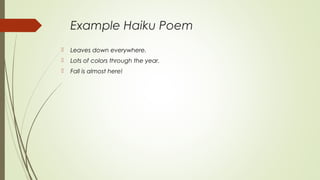
Example Haiku Poem
 Leaves down everywhere.
 Lots of colors through the year.
 Fall is almost here!
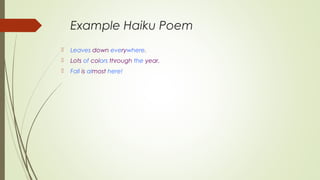
Example Haiku Poem
 Leaves down everywhere.
 Lots of colors through the year.
 Fall is almost here!
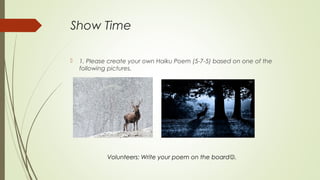
Show Time
 1. Please create your own Haiku Poem (5-7-5) based on one of the
following pictures.
Volunteers: Write your poem on the board.
Activity Two
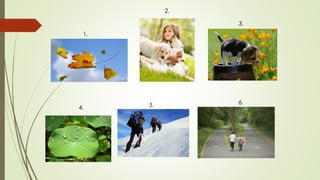
 1. Choose one picture from the next slide and write the first line of a Haiku
Poem. (5 syllables)
 2. After your first line is done, it will be collected and mixed up with others’.
 3. The mixed-up notes will be redistributed. Read the first line, written by
others, (guess which picture it describes) and then create the second line
based on it. (7 syllables)
 4. Repeat step 2.
 5. Create the last line. (5 syllables)
1.
2.
3.
4. 5. 6.
Describing and Interpreting Poetry
1. It is likely that the author…
2. It is probable that…
3. The poem seems to suggest that…
4. It is highly likely that…
5. Overall, I think…
6. This poem seems to be about picture # ____. (class guesses)
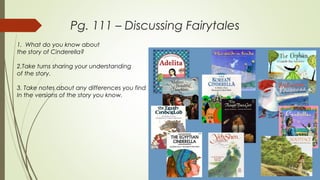
Pg. 111 – Discussing Fairytales
1. What do you know about
the story of Cinderella?
2.Take turns sharing your understanding
of the story.
3. Take notes about any differences you find
In the versions of the story you know.
Cinderella in 5 Cultures
 https://www.youtube.com/watch?v=2o9yTIxPFwM
 What differences did you see?
 What similarities did you see?
Cinderella Comparison
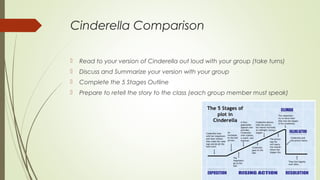
 Read to your version of Cinderella out loud with your group (take turns)
 Discuss and Summarize your version with your group
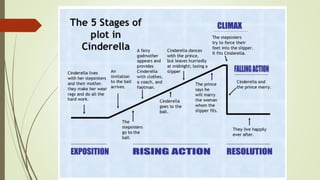
 Complete the 5 Stages Outline
 Prepare to retell the story to the class (each group member must speak)
Analysis Recording
 Make a 3-5 minute recording (voice recorder) describing the similarities and
differences between the 4 Cinderella Stories: The Korean Cinderella, The
Egyptian Cinderella, Yeh-Shen, and The Golden Sandal
HW
 English Central Goal due Sunday by 7PM
 Interview Materials due 3/20

23. introduction to pathways 6

  • 1.
  • 2.
    Agenda  Catching Up Pathways 6 – A Word of Worlds (Literature/Humanities)  Poetry and Fairy Tales
  • 3.
    Catching Up –Group Discussion  What did you do during spring break?  What were your favorite parts?  What were your least favorite parts?
  • 4.
    Introduction: Pathways Chapter6  A Word of Worlds (Literature/Humanities)
  • 5.
    What is aWordle?  A word picture that expresses frequency.  http://www.wordle.net/
  • 6.
    Words and Pictures 1.What do you think this word picture (Wordle) describes?
  • 7.
  • 8.
  • 9.
    Poetry Fiction (Imagination)Non-Fiction (Real Life) Short poetry Epic poetry (long) Short story Folktale Fairytale Novel Narrative Essay Biography Autobiography Speech Vocabulary for Written Genres Let’s talk about what these mean…
  • 10.
    Vocabulary Building, pg.104  Listen to the audio track based on Pg.104 and pay attention to the words in blue.  Pg. 104 B  Pg. 105 B
  • 11.
    Poetry Focus (Handout) Read the four poems out loud in groups. on Discuss which one is your favorite and why with your group.
  • 12.
    Are These PoetsFamiliar? Yun Seondo (1587–1671) Li Po (701-762) Motsuo Basho. (1644-1694) Al-Mutanabbi (915 –965)
  • 13.
    Yun Seondo (Hangul:윤선도 , 1587– 1671)   He achieved early success as a government official, but his straightforward character made enemies at court and he was banished for imprudent criticism of those in power. Thirteen years later he returned to become tutor to the royal princes but was later banished again. He spent most of his 85 years in his rustic country home, contemplating the nature of life, teaching and writing poetry.   Yun Seondo (Hangul: 윤선도 , 1587–1671) was a noted Korean Neo-Confucian scholar and Writer, poet, Politicians of the Joseon Dynasty. nickname was Gosan and Hae-ong.
  • 14.
    Motsuo Basho. (1644-1694) Bashquickly became well knownō throughout Japan after integrating himself into the intellectual scene of Edo (modern Tokyo) . He made a living as a teacher; but then renounced the social, urban life of the literary circles and was inclined to wander throughout the country, heading west, east, and far into the northern wilderness to gain inspiration for his writing. His poems were influenced by his firsthand experience of the world around him, often encapsulating the feeling of a scene in a few simple elements. Motsuo Basho. (1644-1694)
  • 15.
    Li Bai (701 –762) Much of Li's life is reflected in his poetry and Of particular importance are the changes in the times through which he lived. His early poetry took place in the context of a "golden age" of internal peace and prosperity in the Chinese empire of the Tang dynasty, under the reign of an emperor who actively promoted and participated in the arts. This all changed suddenly and shockingly, beginning with the rebellion of the general An Lushan, when all of northern China was devastated by war and famine. Li's poetry as well takes on new tones and qualities. Li Bai (701 – 762), also known as Li Po, was one of the most prominent figures in the flourishing of Chinese poetry in the Tang Dynasty that is often called the "Golden Age of China".
  • 16.
    Al-Mutanabbi (915 –965) Al-Mutanabbi(915 –965)   Al-Mutanabbi is considered as one of the greatest poets in the Arabic language. Much of his poetry revolves around praising the kings he visited during his lifetime. Some consider his 326 poems to be a great representation of his life story. He started writing poetry when he was nine years old. Al-Mutanabbi had a great pride in himself through his poetry. Among the topics he discussed were courage, the philosophy of life, and the description of battles. Many of his poems were and still are widely spread in today's Arab world and are considered to be proverbial.
  • 17.
    Syllable  What issyllable?  A unit of pronunciation having one vowel sound, with or without surrounding consonants, forming the whole or a part of a word  Amazing  Every  Apple
  • 18.
    Example Haiku Poem Leaves down everywhere.  Lots of colors through the year.  Fall is almost here!
  • 19.
    Example Haiku Poem Leaves down everywhere.  Lots of colors through the year.  Fall is almost here!
  • 20.
    Show Time  1.Please create your own Haiku Poem (5-7-5) based on one of the following pictures. Volunteers: Write your poem on the board.
  • 21.
    Activity Two  1.Choose one picture from the next slide and write the first line of a Haiku Poem. (5 syllables)  2. After your first line is done, it will be collected and mixed up with others’.  3. The mixed-up notes will be redistributed. Read the first line, written by others, (guess which picture it describes) and then create the second line based on it. (7 syllables)  4. Repeat step 2.  5. Create the last line. (5 syllables)
  • 22.
  • 23.
    Describing and InterpretingPoetry 1. It is likely that the author… 2. It is probable that… 3. The poem seems to suggest that… 4. It is highly likely that… 5. Overall, I think… 6. This poem seems to be about picture # ____. (class guesses)
  • 24.
    Pg. 111 –Discussing Fairytales 1. What do you know about the story of Cinderella? 2.Take turns sharing your understanding of the story. 3. Take notes about any differences you find In the versions of the story you know.
  • 26.
    Cinderella in 5Cultures  https://www.youtube.com/watch?v=2o9yTIxPFwM  What differences did you see?  What similarities did you see?
  • 27.
    Cinderella Comparison  Readto your version of Cinderella out loud with your group (take turns)  Discuss and Summarize your version with your group  Complete the 5 Stages Outline  Prepare to retell the story to the class (each group member must speak)
  • 28.
    Analysis Recording  Makea 3-5 minute recording (voice recorder) describing the similarities and differences between the 4 Cinderella Stories: The Korean Cinderella, The Egyptian Cinderella, Yeh-Shen, and The Golden Sandal
  • 29.
    HW  English CentralGoal due Sunday by 7PM  Interview Materials due 3/20