Unit 4  Make an Impact Experiential English I
Generation Generation – people about the same age Generation gap – the lack of understanding or differences between older people and younger people Generation X Generation Y
Generational Differences What words would you use to describe the generation younger than you? 1A – 1C / page 40
Vocabulary Activist  – someone who works hard for social or political change Escapist  – someone who escapes the real life Motivated  – very keen to do something, especially because you find it interesting Be aware of  – realize or know Issue  – a subject or problem that is often discussed or argued about, especially a social or political matter that affects the interests of a lot of people Tradition  – a way of doing something that has existed for a long time Apathetic  – not interested in something or not willing to make any effort to change or improve things
Generational Differences 1B Read the two opinions and summarize the speakers’ benefits. Gary: He thinks that young people are slackers, and they don’t care about the world. Briana: She thinks that young people care about the world, but they show it in a different way.
Generational Differences Agree or disagree ? ? ? Comments made by older people The younger generation is bunch of slackers. They don’t know the meaning of hard work. They can’t think long range. They don’t know how to think for themselves. Life is easy for them compared to when we (older people) were young. A B C D E
A Summer Internship   Page 41 Listening activity (at home) Internship – an unpaid job to gain experience. Would you like to be an intern? Why or why not? If you could do an internship, what kind of organization would you like to work for? What would you like to learn as an intern?
A Summer Internship   Culture Note: Internship College students in the U.S. sometimes od an internship during their summer vacation in order to gain work experience in their field before they finish their studies. This can be an advantage when they are looking for a job. Internships can be with non-profit volunteer organizations or with companies.
Schedule Individual Project Aug 19 - First Draft of Individual Project Sep 2 - Submission of Individual    Project Sep 18 - Last Day of Individual Project    Submission Group Project Aug 19 – 21  - Start of Oral Presentation
Modals Degree of necessity (must, have to) Advisability or expectation (should, ought to) Possibility (may, might, can, could) Permission (may, can, could)  Supplement: Unit 4   & 5
Modals Exercise 1 Exercise 2 Exercise 3
Change Your World Page 43 – D1 Read the job requirement for the Activities Coordinator and complete the sentences together.
Change Your World Page 43 – D1 The candidate has to  interview with the organization. He or she is required to  speak some English / prepare students for culture exchange activities . He or she absolutely must  obtain a passport and immunization. He or she doesn’t have to  come to Tokyo . It’s OK if the Coordinator can’t  speak Spanish or Japanese. The Coordinator is permitted to  join in all activities .
Culture Note The Peace Boat Peace Boat is a Japan-based international non-governmental and non-profit organization that works to promote peace, human rights, equal and sustainable development, and respect for the environment. It carries out its activities on a passenger ship that travels the world on three-month Global Voyages. Each one is joined by around 800 participants and visits between 15-20 countries. For more information, see  http:// www.peaceboat.org/english/index.html .
I hate to disagree with you, but… Page 43 – 4 Speaking – A Read the conversations out loud.  What is the relationship between these people?
Agree & Disagree I believe that… I (do not) agree that… I (do not) agree with… I am convinced that… It is my belief that… It is my opinion that…
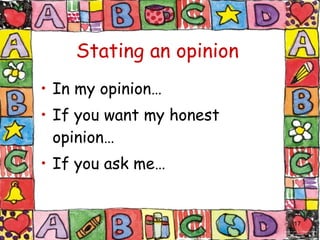
Stating an opinion In my opinion… If you want my honest opinion… If you ask me…
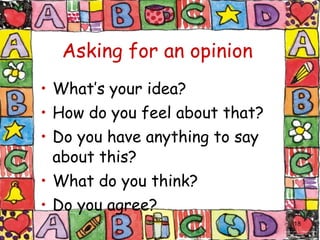
Asking for an opinion What’s your idea? How do y ou feel about that? Do you have anything to say about this? What do you think? Do you agree?
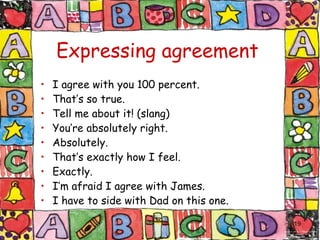
Expressing agreement I agree with you 100 percent. That’s so true. Tell me about it! (slang) You’re absolutely right. Absolutely. That’s exactly how I feel. Exactly. I’m afraid I agree with James. I have to side with Dad on this one.
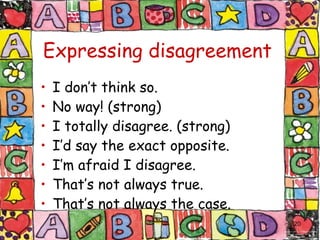
Expressing disagreement I don’t think so. No way! (strong) I totally disagree. (strong) I’d say the exact opposite. I’m afraid I disagree. That’s not always true. That’s not always the case.
Interruptions Can I add something here? Is it okay if I jump in for a second? Sorry to interrupt, but… You didn’t let me finish. (after being interrupted) Sorry, go ahead. (after accidentally interrupting someone)

Modals, Agree, Disagree

  • 1.
    Unit 4 Make an Impact Experiential English I
  • 2.
    Generation Generation –people about the same age Generation gap – the lack of understanding or differences between older people and younger people Generation X Generation Y
  • 3.
    Generational Differences Whatwords would you use to describe the generation younger than you? 1A – 1C / page 40
  • 4.
    Vocabulary Activist – someone who works hard for social or political change Escapist – someone who escapes the real life Motivated – very keen to do something, especially because you find it interesting Be aware of – realize or know Issue – a subject or problem that is often discussed or argued about, especially a social or political matter that affects the interests of a lot of people Tradition – a way of doing something that has existed for a long time Apathetic – not interested in something or not willing to make any effort to change or improve things
  • 5.
    Generational Differences 1BRead the two opinions and summarize the speakers’ benefits. Gary: He thinks that young people are slackers, and they don’t care about the world. Briana: She thinks that young people care about the world, but they show it in a different way.
  • 6.
    Generational Differences Agreeor disagree ? ? ? Comments made by older people The younger generation is bunch of slackers. They don’t know the meaning of hard work. They can’t think long range. They don’t know how to think for themselves. Life is easy for them compared to when we (older people) were young. A B C D E
  • 7.
    A Summer Internship Page 41 Listening activity (at home) Internship – an unpaid job to gain experience. Would you like to be an intern? Why or why not? If you could do an internship, what kind of organization would you like to work for? What would you like to learn as an intern?
  • 8.
    A Summer Internship Culture Note: Internship College students in the U.S. sometimes od an internship during their summer vacation in order to gain work experience in their field before they finish their studies. This can be an advantage when they are looking for a job. Internships can be with non-profit volunteer organizations or with companies.
  • 9.
    Schedule Individual ProjectAug 19 - First Draft of Individual Project Sep 2 - Submission of Individual Project Sep 18 - Last Day of Individual Project Submission Group Project Aug 19 – 21 - Start of Oral Presentation
  • 10.
    Modals Degree ofnecessity (must, have to) Advisability or expectation (should, ought to) Possibility (may, might, can, could) Permission (may, can, could)  Supplement: Unit 4 & 5
  • 11.
    Modals Exercise 1Exercise 2 Exercise 3
  • 12.
    Change Your WorldPage 43 – D1 Read the job requirement for the Activities Coordinator and complete the sentences together.
  • 13.
    Change Your WorldPage 43 – D1 The candidate has to interview with the organization. He or she is required to speak some English / prepare students for culture exchange activities . He or she absolutely must obtain a passport and immunization. He or she doesn’t have to come to Tokyo . It’s OK if the Coordinator can’t speak Spanish or Japanese. The Coordinator is permitted to join in all activities .
  • 14.
    Culture Note ThePeace Boat Peace Boat is a Japan-based international non-governmental and non-profit organization that works to promote peace, human rights, equal and sustainable development, and respect for the environment. It carries out its activities on a passenger ship that travels the world on three-month Global Voyages. Each one is joined by around 800 participants and visits between 15-20 countries. For more information, see http:// www.peaceboat.org/english/index.html .
  • 15.
    I hate todisagree with you, but… Page 43 – 4 Speaking – A Read the conversations out loud. What is the relationship between these people?
  • 16.
    Agree & DisagreeI believe that… I (do not) agree that… I (do not) agree with… I am convinced that… It is my belief that… It is my opinion that…
  • 17.
    Stating an opinionIn my opinion… If you want my honest opinion… If you ask me…
  • 18.
    Asking for anopinion What’s your idea? How do y ou feel about that? Do you have anything to say about this? What do you think? Do you agree?
  • 19.
    Expressing agreement Iagree with you 100 percent. That’s so true. Tell me about it! (slang) You’re absolutely right. Absolutely. That’s exactly how I feel. Exactly. I’m afraid I agree with James. I have to side with Dad on this one.
  • 20.
    Expressing disagreement Idon’t think so. No way! (strong) I totally disagree. (strong) I’d say the exact opposite. I’m afraid I disagree. That’s not always true. That’s not always the case.
  • 21.
    Interruptions Can Iadd something here? Is it okay if I jump in for a second? Sorry to interrupt, but… You didn’t let me finish. (after being interrupted) Sorry, go ahead. (after accidentally interrupting someone)