 Annie Oakley tends to be quite adaptable,
and she finds it easy to fit into most social
set ups and vocational fields.
 There are no particular virtues that can
cause an imbalance in Annie's personality and
life, but she has to work hard and
persistently to develop those special
strengths that she desires to attain.
 Learning to be wisely assertive is a major
lesson to be taken by Annie Oakley
throughout her life.
 Annie Oakley - an American sharpshooter and
exhibition shooter who joined the Buffalo Bill's Wild
West show since age 18 with her husband, the show
marksman Frank E. Butler, and became a renowned
int'l star, performing before royalty and heads of
state - born on Monday August 13th 1860, in Near
Willowdell, Darke County, Ohio, United States.
 Annie Oakley is the philanthropist and humanitarian
who is deeply concerned about the state of the
world, for which she has great compassion and
idealism. She has a utopian personality, and will
spend her life trying to realize some aspect of her
utopian dream, sacrificing money, time, and energy
for a better world.
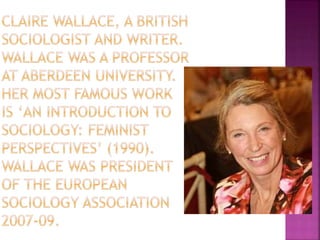
 is Professor of Sociology at the University of Aberdeen
and was President of the European Sociological
Association between 2007 and 2009, during which she
helped to organise the Annual Conference in Lisbon in
2009 and in Glasgow in 2007. She has also been editor
in chief of the international journal European
Societies between 2001 and 2006.
 Claire Wallace started her career on the pioneering
Sheppey project with Ray Pahl looking at the
transformations of work and employment for young
people and households. She developed the idea of
household work strategies in her later work in various
European Union projects where she looked at all
forms of work (domestic, employment, informal
economy etc.) and how they were changing.
 is a range of political
movements, ideologies, and social
movements that share a common goal: to
define, establish, and achieve political,
economic, personal, and social equality of
sexes.
 This includes seeking to establish educational
and professional opportunities for women
that are equal to those for men
 the theory of the political, economic, and
social equality of the sexes.
 organized activity on behalf of women's
rights and interests
 15th Century - The Book of the City of
Ladies, Christine de Pisan
 16th Century - The Superior Excellence of
Women Over Men, Heinrich Cornelius Agrippa
 17th Century - A Serious Proposal to the
Ladies, for the Advancement of Their True
and Greatest Interest, Mary Astell (1694)
 17th Century - A Serious Proposal, Part
II, Mary Astell (1697)
 18th Century - The Education of
Women, Daniel Defoe (1719)
 Feminist literary criticism is used to explore
the inequalities, social injustices and abusive
messages directed toward women
within patriarchal societies and
cultures. Patriarchy is a system of social
organization that traces descent through the
male line and bestows privilege and power to
males on the assumption of their physical
and intellectual superiority over women.
Feminist literary criticism has evolved from
a strictly literary activity to a way of
analyzing and interpreting all forms of
human communication and language.
 Feminist critics investigate cultural expressions of all
forms, including linguistics, visual art and popular
texts, using the concept of dominant discourse.
Dominant discourse refers to the power dynamics
that control the written, spoken and behavioural
expectations imposed upon society and culture by
those in power. One way that women writers
contribute to dominant discourse is by showing how
patriarchy misrepresents the emotional and sexual
experiences of women and by exploring new
narrative strategies that help reshape sexual politics.
Cultural views on morality are “a product of books
and movies like Fifty Shades of Grey,” according
to The Atlantic journalist Anna Green. Feminist critics
say the novel shows “the terrible communication”
between males and females.
 ACTIVITY: 1. THE OTHER GENDER IS... OPINIONS AND FEELINGS
CONCERNING THE "OPPOSITE" SEX
DESCRIPTION: This is a student writing-based activity that explores
preconceptions, attitudes, and anxieties concerning the "opposite"
gender. Discussion is stimulated by student reading of personal
narratives.
MATERIALS: Use student’s writing exercise as material for this activity.
PROCEDURE:
1. Ask students to discuss in writing their feelings and opinions about the
"opposite" gender. Give a required length to insure some thought and
uniformity for reading time when used as a classroom activity. Example:
150 words. Students may want to consider the following questions in
their essays:
• In what ways are you different from other students in your class?
• How are you the same as other students in your class?
• Is friendship with the other gender different from same gender friendship?
How and why?
• Do you change your actions and activities when you’re in the presence of
the other gender? How and why?
2. Separate students according to gender for presentation of essays.
Each student reads his/her paper to the class.
3. Have listeners respond in two ways:
A. Write a short response to the reader.
B. Offer verbal responses. Ask students to find points they agree
with. Explain that responses and viewpoints need to be kept
positive.
4. Bring class back together. Have students volunteer to read their
essays. Allow free discussion. Ask students to consider the
following:
Was the discussion different with the whole class present? Why or
why not?
5. At the end of the discussion, ask students for positive statements
about the other gender and record them on the board under
male or female headings. Point out commonalities. Ask
students to list the statements that could be switched to other
gender column.
 ACTIVITY: 2. ARE YOU ACTING LIKE A MAN OR A WOMAN
DESCRIPTION: This activity is designed to help students understand gender
roles and expectations that are learned in our society. This is a useful
introductory activity on gender roles as related to career and class
choices.
MATERIALS: 1. Newsprint or large sheets of paper divided into three
sections.
2. Markers.
1. Divide students into small groups no larger than 6 students. Groups can
be gender same or mixed groups.
2. Give each group the piece of newsprint divided into three columns. On
the top of the middle column either write “Act Like A Man” or “Act Like
A Woman”. Ask students to make a list of what it means to act like a
man or woman in this column. Each group will have a different heading.
3. On the left column, ask students to write down what people might "say"
or "do" if someone does not act like a man or woman as defined in the
middle column. This portion of the activity can generate a lively and
graphic use of words and discussion. Remind students to be respectful.
Some instructors may want to set ground rules around language usage.
4. Divide the right column in half and ask students to list the jobs one
would choose if they acted like the descriptions listed in the middle
column. For example, the "traditional" female role and career choice
might not include welder, construction worker..., a "traditional" male
role and career choice might not include elementary teacher,
nurse...
5. Hang up the lists for students to view and contemplate. Ask each
group to make a few comments about their lists.
6. Assist students with analyzing these lists. Possible questions for
discussion include:
• How and where do we learn our perception of male and female roles?
• Do these roles and descriptions limit or enhance us in life choices?
• Have you or someone you know ever acted differently from how your
gender is "supposed" to act?
• Have you or someone you know ever stood up for a person who
challenged the gender stereotypes?
• What other conclusions/statements do you have about this topic?
 ACTIVITY: 3. MEN'S WORK OR WOMEN'S WORK? IDENTIFYING AND ANALYZING
TRADITIONAL GENDER ROLES IN THE WORKPLACE
DESCRIPTION: Using the Occupation Checklist at the end of this activity, students will
match jobs and careers to gender. The desired outcome from this activity will be,
the discovery and discussion of persistent gender stereotyping, with its wage and
status implications, in terms of career opportunities.
MATERIALS: 1. Occupation checklist
2. Overhead projector if available
3. Library and Internet resources
1. Introduction: Defining the occupations.
• Hand out copies of “Occupation Checklist” to individual students.
• Read off the listed occupations.
• Describe any jobs that students might not be familiar with.
2. Have students fill out checklist, matching jobs and careers to 'Male,' 'Female,' or
'Both' by circling the correct response.
3. Using transparencies and an overhead projector (if not available use a large chart),
poll the students on each occupation and write the result on the master checklist.
There are many approaches to conducting the following class survey in a meaningful
way.
• Poll students on how and why they answered the way they did.
• Have students conduct research of the occupations. You may want to divide students
into groups and assign each group several occupations.
• Another method would be to find out the areas of controversy, assign groups to
research those areas.
4. The class, with instructor's help, answers the following questions. Ask for a student
volunteer who will plot the results of the questions on the board.
• Which group “male” or “female” had the largest number?
• Which jobs require working with people? Which group had the larger number?
• Which jobs have the most "status," and, of those, how many are designated "males"
and how many "females?"
• Which jobs offer the most salary potential, and, of those, how many are designated
"males" and how many "females?" This will require research to complete.
• Which jobs require the most/least amount of education, and, of those, how many are
designated “males” and how many “females” ?
5. Class should discuss any issues concerning gender as they arise.
The focus should always be steered to "WHY?" Why are some jobs
traditionally gender designated? Why is there an inequity of wage
and status along gender lines?
 SONG
“Run the World (Girls)” – Beyonce
This is an obvious choice. Queen Bey's powerful, high-energy anthem is
everything, from a crowd favorite to a straight-up battle cry.
 MOVIE
Mean Girls – Joan Marcus
There’s a great joke about feminism in Mark Waters’ high-school
comedy classic “Mean Girls,” smashed into a key dramatic exchange.
Newbie Cady Heron (Lindsay Lohan), deep in her first invite-only
lunch with the so-called Plastics, is pumped for information by the
notoriously gossip-obsessed Gretchen Wieners (Lacey Chabert).
Breathlessly, Gretchen asks Cady if she’s seen any cute boys at North
Shore High yet, and when Cady tells her she’s got her eye on Aaron
Samuels (Jonathan Bennett), Gretchen is overcome.
Turns out, Aaron is the ex-boyfriend of Regina George (Rachel
McAdams), queen of the Plastics, and that’s just not okay. He’s off-
limits, girls don’t date their friends’ ex-boyfriends. In Gretchen’s own
words, that’s “just the rules of feminism.”

FEMINISM

  • 4.
     Annie Oakleytends to be quite adaptable, and she finds it easy to fit into most social set ups and vocational fields.  There are no particular virtues that can cause an imbalance in Annie's personality and life, but she has to work hard and persistently to develop those special strengths that she desires to attain.  Learning to be wisely assertive is a major lesson to be taken by Annie Oakley throughout her life.
  • 5.
     Annie Oakley- an American sharpshooter and exhibition shooter who joined the Buffalo Bill's Wild West show since age 18 with her husband, the show marksman Frank E. Butler, and became a renowned int'l star, performing before royalty and heads of state - born on Monday August 13th 1860, in Near Willowdell, Darke County, Ohio, United States.  Annie Oakley is the philanthropist and humanitarian who is deeply concerned about the state of the world, for which she has great compassion and idealism. She has a utopian personality, and will spend her life trying to realize some aspect of her utopian dream, sacrificing money, time, and energy for a better world.
  • 8.
     is Professorof Sociology at the University of Aberdeen and was President of the European Sociological Association between 2007 and 2009, during which she helped to organise the Annual Conference in Lisbon in 2009 and in Glasgow in 2007. She has also been editor in chief of the international journal European Societies between 2001 and 2006.  Claire Wallace started her career on the pioneering Sheppey project with Ray Pahl looking at the transformations of work and employment for young people and households. She developed the idea of household work strategies in her later work in various European Union projects where she looked at all forms of work (domestic, employment, informal economy etc.) and how they were changing.
  • 9.
     is arange of political movements, ideologies, and social movements that share a common goal: to define, establish, and achieve political, economic, personal, and social equality of sexes.  This includes seeking to establish educational and professional opportunities for women that are equal to those for men
  • 10.
     the theoryof the political, economic, and social equality of the sexes.  organized activity on behalf of women's rights and interests
  • 11.
     15th Century- The Book of the City of Ladies, Christine de Pisan  16th Century - The Superior Excellence of Women Over Men, Heinrich Cornelius Agrippa  17th Century - A Serious Proposal to the Ladies, for the Advancement of Their True and Greatest Interest, Mary Astell (1694)  17th Century - A Serious Proposal, Part II, Mary Astell (1697)  18th Century - The Education of Women, Daniel Defoe (1719)
  • 12.
     Feminist literarycriticism is used to explore the inequalities, social injustices and abusive messages directed toward women within patriarchal societies and cultures. Patriarchy is a system of social organization that traces descent through the male line and bestows privilege and power to males on the assumption of their physical and intellectual superiority over women. Feminist literary criticism has evolved from a strictly literary activity to a way of analyzing and interpreting all forms of human communication and language.
  • 13.
     Feminist criticsinvestigate cultural expressions of all forms, including linguistics, visual art and popular texts, using the concept of dominant discourse. Dominant discourse refers to the power dynamics that control the written, spoken and behavioural expectations imposed upon society and culture by those in power. One way that women writers contribute to dominant discourse is by showing how patriarchy misrepresents the emotional and sexual experiences of women and by exploring new narrative strategies that help reshape sexual politics. Cultural views on morality are “a product of books and movies like Fifty Shades of Grey,” according to The Atlantic journalist Anna Green. Feminist critics say the novel shows “the terrible communication” between males and females.
  • 14.
     ACTIVITY: 1.THE OTHER GENDER IS... OPINIONS AND FEELINGS CONCERNING THE "OPPOSITE" SEX DESCRIPTION: This is a student writing-based activity that explores preconceptions, attitudes, and anxieties concerning the "opposite" gender. Discussion is stimulated by student reading of personal narratives. MATERIALS: Use student’s writing exercise as material for this activity. PROCEDURE: 1. Ask students to discuss in writing their feelings and opinions about the "opposite" gender. Give a required length to insure some thought and uniformity for reading time when used as a classroom activity. Example: 150 words. Students may want to consider the following questions in their essays: • In what ways are you different from other students in your class? • How are you the same as other students in your class? • Is friendship with the other gender different from same gender friendship? How and why? • Do you change your actions and activities when you’re in the presence of the other gender? How and why?
  • 15.
    2. Separate studentsaccording to gender for presentation of essays. Each student reads his/her paper to the class. 3. Have listeners respond in two ways: A. Write a short response to the reader. B. Offer verbal responses. Ask students to find points they agree with. Explain that responses and viewpoints need to be kept positive. 4. Bring class back together. Have students volunteer to read their essays. Allow free discussion. Ask students to consider the following: Was the discussion different with the whole class present? Why or why not? 5. At the end of the discussion, ask students for positive statements about the other gender and record them on the board under male or female headings. Point out commonalities. Ask students to list the statements that could be switched to other gender column.
  • 16.
     ACTIVITY: 2.ARE YOU ACTING LIKE A MAN OR A WOMAN DESCRIPTION: This activity is designed to help students understand gender roles and expectations that are learned in our society. This is a useful introductory activity on gender roles as related to career and class choices. MATERIALS: 1. Newsprint or large sheets of paper divided into three sections. 2. Markers. 1. Divide students into small groups no larger than 6 students. Groups can be gender same or mixed groups. 2. Give each group the piece of newsprint divided into three columns. On the top of the middle column either write “Act Like A Man” or “Act Like A Woman”. Ask students to make a list of what it means to act like a man or woman in this column. Each group will have a different heading. 3. On the left column, ask students to write down what people might "say" or "do" if someone does not act like a man or woman as defined in the middle column. This portion of the activity can generate a lively and graphic use of words and discussion. Remind students to be respectful. Some instructors may want to set ground rules around language usage.
  • 17.
    4. Divide theright column in half and ask students to list the jobs one would choose if they acted like the descriptions listed in the middle column. For example, the "traditional" female role and career choice might not include welder, construction worker..., a "traditional" male role and career choice might not include elementary teacher, nurse... 5. Hang up the lists for students to view and contemplate. Ask each group to make a few comments about their lists. 6. Assist students with analyzing these lists. Possible questions for discussion include: • How and where do we learn our perception of male and female roles? • Do these roles and descriptions limit or enhance us in life choices? • Have you or someone you know ever acted differently from how your gender is "supposed" to act? • Have you or someone you know ever stood up for a person who challenged the gender stereotypes? • What other conclusions/statements do you have about this topic?
  • 18.
     ACTIVITY: 3.MEN'S WORK OR WOMEN'S WORK? IDENTIFYING AND ANALYZING TRADITIONAL GENDER ROLES IN THE WORKPLACE DESCRIPTION: Using the Occupation Checklist at the end of this activity, students will match jobs and careers to gender. The desired outcome from this activity will be, the discovery and discussion of persistent gender stereotyping, with its wage and status implications, in terms of career opportunities. MATERIALS: 1. Occupation checklist 2. Overhead projector if available 3. Library and Internet resources 1. Introduction: Defining the occupations. • Hand out copies of “Occupation Checklist” to individual students. • Read off the listed occupations. • Describe any jobs that students might not be familiar with. 2. Have students fill out checklist, matching jobs and careers to 'Male,' 'Female,' or 'Both' by circling the correct response.
  • 19.
    3. Using transparenciesand an overhead projector (if not available use a large chart), poll the students on each occupation and write the result on the master checklist. There are many approaches to conducting the following class survey in a meaningful way. • Poll students on how and why they answered the way they did. • Have students conduct research of the occupations. You may want to divide students into groups and assign each group several occupations. • Another method would be to find out the areas of controversy, assign groups to research those areas. 4. The class, with instructor's help, answers the following questions. Ask for a student volunteer who will plot the results of the questions on the board. • Which group “male” or “female” had the largest number? • Which jobs require working with people? Which group had the larger number? • Which jobs have the most "status," and, of those, how many are designated "males" and how many "females?" • Which jobs offer the most salary potential, and, of those, how many are designated "males" and how many "females?" This will require research to complete. • Which jobs require the most/least amount of education, and, of those, how many are designated “males” and how many “females” ?
  • 20.
    5. Class shoulddiscuss any issues concerning gender as they arise. The focus should always be steered to "WHY?" Why are some jobs traditionally gender designated? Why is there an inequity of wage and status along gender lines?
  • 21.
     SONG “Run theWorld (Girls)” – Beyonce This is an obvious choice. Queen Bey's powerful, high-energy anthem is everything, from a crowd favorite to a straight-up battle cry.  MOVIE Mean Girls – Joan Marcus There’s a great joke about feminism in Mark Waters’ high-school comedy classic “Mean Girls,” smashed into a key dramatic exchange. Newbie Cady Heron (Lindsay Lohan), deep in her first invite-only lunch with the so-called Plastics, is pumped for information by the notoriously gossip-obsessed Gretchen Wieners (Lacey Chabert). Breathlessly, Gretchen asks Cady if she’s seen any cute boys at North Shore High yet, and when Cady tells her she’s got her eye on Aaron Samuels (Jonathan Bennett), Gretchen is overcome. Turns out, Aaron is the ex-boyfriend of Regina George (Rachel McAdams), queen of the Plastics, and that’s just not okay. He’s off- limits, girls don’t date their friends’ ex-boyfriends. In Gretchen’s own words, that’s “just the rules of feminism.”