‫الرحمن‬ ‫هللا‬ ‫بسم‬
‫الرحيم‬
Post insertion denture
problems
Objective:
-To know the problems and complaints that
may face the completely edentulous patient
after insertion of new denture
- To identify the causes of the problems and
complaints
 Most patient have problems of some type while
adjustng to new denture.
 Maintenance after denture insertion is a key to
denture success.
 Therefore, the patient must have scheduled
appointments for his recall visits.
Post insertion denture problems
 Complaints about comfort
 Complaints about function
 Complaints about the esthetics
 Complaints about the phonetics
Complaints about comfort
 Sore spots
 Burning sensation
 Tongue and cheek biting
 Fiery redness of all tissues contacted by denture
 Redness of bearing tissues
 Pain in temporomandibular joint
Sore spots
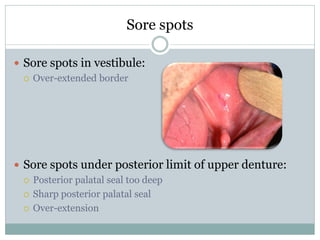
 Sore spots in vestibule:
 Over-extended border
 Sore spots under posterior limit of upper denture:
 Posterior palatal seal too deep
 Sharp posterior palatal seal
 Over-extension
Sore spots
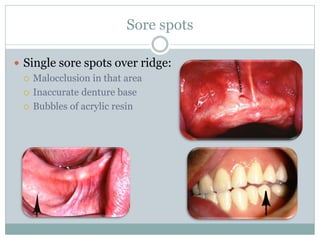
 Single sore spots over ridge:
 Malocclusion in that area
 Inaccurate denture base
 Bubbles of acrylic resin
Sore spots
 Generalized soreness over the ridge:
 Vertical dimension too great
 Inaccurate denture base
HTTP://www.rxdentistry.net
Sore spots
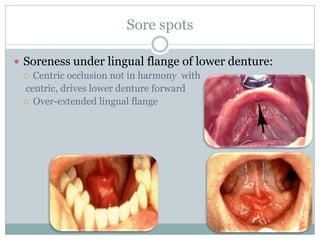
 Soreness under lingual flange of lower denture:
 Centric occlusion not in harmony with
centric, drives lower denture forward
 Over-extended lingual flange
Sore spots
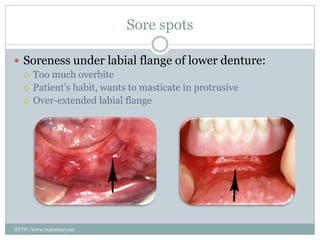
 Soreness under labial flange of lower denture:
 Too much overbite
 Patient’s habit, wants to masticate in protrusive
 Over-extended labial flange
HTTP://www.rxdentistry.net
Burning sensation
 Anterior hard palate and anterior alveolar ridge
areas
 Pressure on anterior palatine foramen
 Bicuspid area to molar tuberosity
 Pressure on posterior palatine foramen
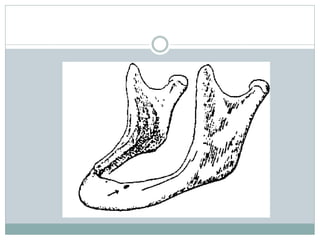
 Lower anterior ridge
 Pressure on mental foramen
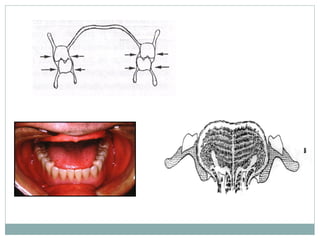
Tongue and cheek biting
 Posterior teeth edge to edge
 Over-closure
 Posterior teeth too far lingual or buccal
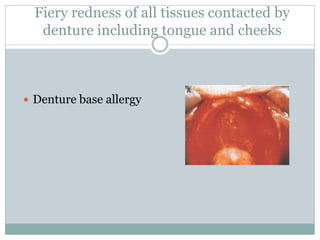
Fiery redness of all tissues contacted by
denture including tongue and cheeks
 Denture base allergy
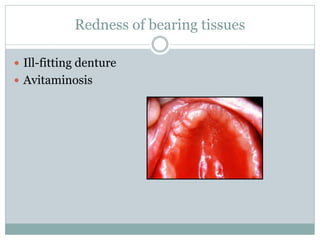
Redness of bearing tissues
 Ill-fitting denture
 Avitaminosis
Pain in temporomandibular joint
 Vertical dimension of occlusal too low
 Centric occlusion not in harmony with centric
relation
 Arthrits
 Trauma
Complaints about function
 Instability
 Swallowing
 Gagging
 Clicking
 Deafness
 Muscle fatigue
 Eating
Instability
 When not occluding
 Over-extension of border and posterior limit
 Under-extended border
 Loss of posterior palatal seal
 Posterior palatal seal on hard palate
 Posterior limit not in hamular notches
 Insufficient posterior palatal seal
Instability
 When not occluding
 Dehydration of tissues due to alcoholism
 Flabby tissues displaced when making impression
Instability
 When incising food
 Loss of posterior palatal seal
 Anterior teeth placed too far labially
 Poor denture foundation (flabby anterior tissues)
 Improper incising habits
Instability
 When occluding in centric
 Mal-occlusion
 Premature individual tooth contacts
 High occlusion on one side of arch
 Upper denture riding on median hard palate
Instability
 When occluding in centric
 Flabby tissues over ridge
 Teeth set too far buccally
 Centric occlusion not in harmony with centric relation
 Difficulty in swallowing:
 Upper denture:
 Over-extension in the posterior
 Too thick in posterior extension
 Lower denture:
 Over-extension in the lingual
 Too thick lingual posterior flanges
Swallowing
 Swallowing
 Over-closure of the vertical relation of occlusion
 Posterior teeth too far lingual-crowds tongue
 Too great vertical dimension of occlusion
Swallowing
 Gagging
 Immediate gagging on insertion
 Over-extension (upper)
 Too thick posterior border (upper)
 Disto-lingual flange too thick (lower)
 Psychological factors
Gagging
 Gagging
 Delayed gagging (2weeks to 2 months after insertion)
 Incomplete border seal allowing saliva under denture
 Mal-occlusion causing denture to loosen, allowing saliva under
denture
Gagging
 Clicking
 Vertical dimension of occlusion is too great
 Unstable lower (borders over-extended)
Clicking
 Deafness
 Excessive reduction of Vertical dimension of occlusion
Deafness
 Muscles of mastication become fatigued
 Vertical dimension of occlusion is too small
 Vertical dimension of occlusion is too great
Muscles of mastication become fatigued
a. Inability to Eat Anything:
Due to:
1-1st time denture wearer ( need time).
2-Cuspal interference.
Eating:
b.Inability to Eat Meat:
Due to:
1-Flat cusped posterior teeth.
2-Low VOD with low muscle efficiency.
3-Unbalanced articulation as no teeth contact on balanced
side to shear the fibrous food.
Improper peripheral seal
Food under the denture
Complaints about the esthetics
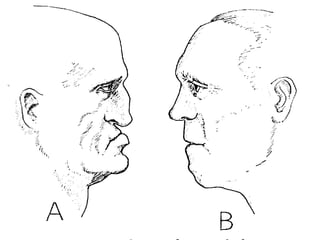
 Fullness under nose
 Depressed philtrum and/or nasolabial sulcus
 Upper lip sunken in
 Shows too much of the teeth
 Artificial look
Esthetic
 Fullness under nose
 Labial flange of upper too long or too thick
 Depressed philtrum and/or nasolabial sulcus
 Labial flange too short, too thin
 Upper lip sunken in
 Upper anterior teeth too far lingual
Esthetics
 Shows too much of the teeth
 Vertical dimension too great
 Incisal plane too low
 Cuspids and laterals too prominent
Esthetics
 Artificial look
 Technique set-up, the teeth are in too regular alignment
(individualize by rotating and shortening some teeth)
 All teeth same shade
 Lack of grinding incisal edges and angles
 Lack of individualizing gingival contours and color of denture
base
Complaints about the phonetics
 Whistle on “S” sounds
 Lisp on “S” sounds
 “D” and “T” sounds indistinct
 “F” and “V” sounds indistinct
•Hassaballa, Clinical Complete Denture
Prosthodontics, 2nd. ed., King Saud University
Academic Publishing and Press, 2010.
Reference:
Post insertion problems

Post insertion problems

  • 1.
  • 2.
  • 3.
    Objective: -To know theproblems and complaints that may face the completely edentulous patient after insertion of new denture - To identify the causes of the problems and complaints
  • 4.
     Most patienthave problems of some type while adjustng to new denture.  Maintenance after denture insertion is a key to denture success.  Therefore, the patient must have scheduled appointments for his recall visits.
  • 5.
    Post insertion dentureproblems  Complaints about comfort  Complaints about function  Complaints about the esthetics  Complaints about the phonetics
  • 6.
    Complaints about comfort Sore spots  Burning sensation  Tongue and cheek biting  Fiery redness of all tissues contacted by denture  Redness of bearing tissues  Pain in temporomandibular joint
  • 7.
    Sore spots  Sorespots in vestibule:  Over-extended border  Sore spots under posterior limit of upper denture:  Posterior palatal seal too deep  Sharp posterior palatal seal  Over-extension
  • 8.
    Sore spots  Singlesore spots over ridge:  Malocclusion in that area  Inaccurate denture base  Bubbles of acrylic resin
  • 9.
    Sore spots  Generalizedsoreness over the ridge:  Vertical dimension too great  Inaccurate denture base HTTP://www.rxdentistry.net
  • 10.
    Sore spots  Sorenessunder lingual flange of lower denture:  Centric occlusion not in harmony with centric, drives lower denture forward  Over-extended lingual flange
  • 11.
    Sore spots  Sorenessunder labial flange of lower denture:  Too much overbite  Patient’s habit, wants to masticate in protrusive  Over-extended labial flange HTTP://www.rxdentistry.net
  • 12.
    Burning sensation  Anteriorhard palate and anterior alveolar ridge areas  Pressure on anterior palatine foramen  Bicuspid area to molar tuberosity  Pressure on posterior palatine foramen  Lower anterior ridge  Pressure on mental foramen
  • 14.
    Tongue and cheekbiting  Posterior teeth edge to edge  Over-closure  Posterior teeth too far lingual or buccal
  • 16.
    Fiery redness ofall tissues contacted by denture including tongue and cheeks  Denture base allergy
  • 17.
    Redness of bearingtissues  Ill-fitting denture  Avitaminosis
  • 18.
    Pain in temporomandibularjoint  Vertical dimension of occlusal too low  Centric occlusion not in harmony with centric relation  Arthrits  Trauma
  • 20.
    Complaints about function Instability  Swallowing  Gagging  Clicking  Deafness  Muscle fatigue  Eating
  • 21.
    Instability  When notoccluding  Over-extension of border and posterior limit  Under-extended border  Loss of posterior palatal seal  Posterior palatal seal on hard palate  Posterior limit not in hamular notches  Insufficient posterior palatal seal
  • 22.
    Instability  When notoccluding  Dehydration of tissues due to alcoholism  Flabby tissues displaced when making impression
  • 23.
    Instability  When incisingfood  Loss of posterior palatal seal  Anterior teeth placed too far labially  Poor denture foundation (flabby anterior tissues)  Improper incising habits
  • 24.
    Instability  When occludingin centric  Mal-occlusion  Premature individual tooth contacts  High occlusion on one side of arch  Upper denture riding on median hard palate
  • 25.
    Instability  When occludingin centric  Flabby tissues over ridge  Teeth set too far buccally  Centric occlusion not in harmony with centric relation
  • 26.
     Difficulty inswallowing:  Upper denture:  Over-extension in the posterior  Too thick in posterior extension  Lower denture:  Over-extension in the lingual  Too thick lingual posterior flanges Swallowing
  • 27.
     Swallowing  Over-closureof the vertical relation of occlusion  Posterior teeth too far lingual-crowds tongue  Too great vertical dimension of occlusion Swallowing
  • 28.
     Gagging  Immediategagging on insertion  Over-extension (upper)  Too thick posterior border (upper)  Disto-lingual flange too thick (lower)  Psychological factors Gagging
  • 29.
     Gagging  Delayedgagging (2weeks to 2 months after insertion)  Incomplete border seal allowing saliva under denture  Mal-occlusion causing denture to loosen, allowing saliva under denture Gagging
  • 30.
     Clicking  Verticaldimension of occlusion is too great  Unstable lower (borders over-extended) Clicking
  • 31.
     Deafness  Excessivereduction of Vertical dimension of occlusion Deafness
  • 32.
     Muscles ofmastication become fatigued  Vertical dimension of occlusion is too small  Vertical dimension of occlusion is too great Muscles of mastication become fatigued
  • 33.
    a. Inability toEat Anything: Due to: 1-1st time denture wearer ( need time). 2-Cuspal interference. Eating:
  • 34.
    b.Inability to EatMeat: Due to: 1-Flat cusped posterior teeth. 2-Low VOD with low muscle efficiency. 3-Unbalanced articulation as no teeth contact on balanced side to shear the fibrous food.
  • 35.
  • 36.
    Complaints about theesthetics  Fullness under nose  Depressed philtrum and/or nasolabial sulcus  Upper lip sunken in  Shows too much of the teeth  Artificial look
  • 37.
    Esthetic  Fullness undernose  Labial flange of upper too long or too thick  Depressed philtrum and/or nasolabial sulcus  Labial flange too short, too thin  Upper lip sunken in  Upper anterior teeth too far lingual
  • 38.
    Esthetics  Shows toomuch of the teeth  Vertical dimension too great  Incisal plane too low  Cuspids and laterals too prominent
  • 39.
    Esthetics  Artificial look Technique set-up, the teeth are in too regular alignment (individualize by rotating and shortening some teeth)  All teeth same shade  Lack of grinding incisal edges and angles  Lack of individualizing gingival contours and color of denture base
  • 40.
    Complaints about thephonetics  Whistle on “S” sounds  Lisp on “S” sounds  “D” and “T” sounds indistinct  “F” and “V” sounds indistinct
  • 42.
    •Hassaballa, Clinical CompleteDenture Prosthodontics, 2nd. ed., King Saud University Academic Publishing and Press, 2010. Reference: