‫الرحمن‬ ‫هللا‬ ‫بسم‬
‫الرحيم‬
Try- in Stage
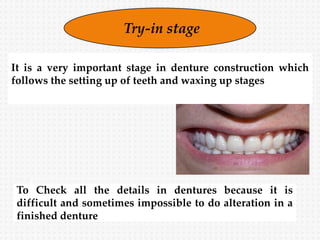
It is a very important stage in denture construction which
follows the setting up of teeth and waxing up stages
To Check all the details in dentures because it is
difficult and sometimes impossible to do alteration in a
finished denture
Try-in stage
Procedures of
try-in
I- Extra- oral examination of trial denture:
- The articulator
- The master cast
- The trial denture bases
- The teeth
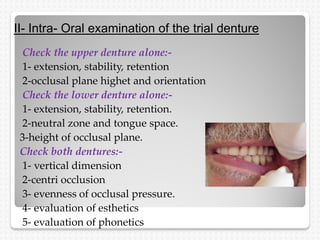
II- Intra- Oral examination of the trial denture:
- Upper denture
- Lower denture
- Both upper and lower together
III- Patient Approval:
IV- Protrusive records:
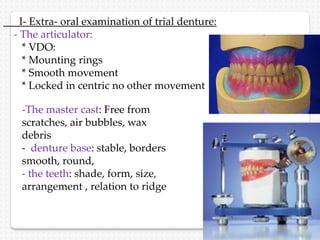
I- Extra- oral examination of trial denture:
- The articulator:
* VDO:
* Mounting rings
* Smooth movement
* Locked in centric no other movement
-The master cast: Free from
scratches, air bubbles, wax
debris
- denture base: stable, borders
smooth, round,
- the teeth: shade, form, size,
arrangement , relation to ridge
Check the upper denture alone:-
1- extension, stability, retention
2-occlusal plane highet and orientation
Check the lower denture alone:-
1- extension, stability, retention.
2-neutral zone and tongue space.
3-height of occlusal plane.
Check both dentures:-
1- vertical dimension
2-centri occlusion
3- evenness of occlusal pressure.
4- evaluation of esthetics
5- evaluation of phonetics
II- Intra- Oral examination of the trial denture
Extension retention
& stability
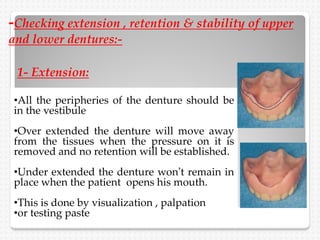
-Checking extension , retention & stability of upper
and lower dentures:-
1- Extension:
•All the peripheries of the denture should be
in the vestibule
•Over extended the denture will move away
from the tissues when the pressure on it is
removed and no retention will be established.
•Under extended the denture won’t remain in
place when the patient opens his mouth.
•This is done by visualization , palpation
•or testing paste
2-Retention of the upper and lower dentures:
-When the patient opens and closes his mouth the denture
must stay in it’s place and considerable force needed to
remove it.
-We have to check the retention of the denture in the
following areas:
1-The anterior part of the denture
(labially)
2-The posterior palatal seal
area (post dam area)
3-Tuberosity region in the upper denture
4-The retromolarpad area in the lower denture.
3-Stability of the upper and lower denture:
- Checking of the stability is done by applying
alternating vertical pressure on one side of the
denture if it rise from the other side this means
that the teeth are outside the ridge in side of the
applied pressure.
- If the denture teeters in the middle it indicates
that the denture is warped in the middle or the
relief area isn’t done properly.
Causes of denture instability:
1- The teeth set outside (more buccally) the ridge
2- Warpage of the denture base
3- Unrelieved hard area.
Height &
orientation of
occlusal plane
tongue space &
neutral zone
Setting up of the lower teeth, and shape of the
polished surface should allow proper tongue
function ( in the neutral zone area)
And to avoid the cramped tongue ( Lack of tongue
space)
Causes of cramped tongue:
1- posterior teeth set lingual to the neutral zone
2- posterior teeth tilted lingually
3- posterior teeth too broad bucco- lingually
Difference between the movement of the lower
denture caused by cramped tongue and lingual
overextension ?
checking both upper
and lower trial
denture
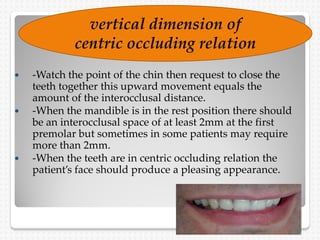
 -Watch the point of the chin then request to close the
teeth together this upward movement equals the
amount of the interocclusal distance.
 -When the mandible is in the rest position there should
be an interocclusal space of at least 2mm at the first
premolar but sometimes in some patients may require
more than 2mm.
 -When the teeth are in centric occluding relation the
patient’s face should produce a pleasing appearance.
vertical dimension of
centric occluding relation
Proper vertical dimension:
 -Patient should be able to speak without
clicking of the teeth
 -No interference with speech
 -Should be able to swallow
without difficulty.
 -Teeth should be visible without excessive
display of the teeth and denture base.
 -Maintaining desirable facial
expression.
-Freeway space:
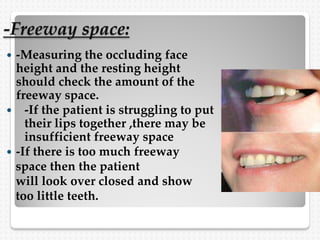
 -Measuring the occluding face
height and the resting height
should check the amount of the
freeway space.
 -If the patient is struggling to put
their lips together ,there may be
insufficient freeway space
 -If there is too much freeway
space then the patient
will look over closed and show
too little teeth.
 - Wrong Vertical:
 In case of too much teeth showing
(which indicates high vertical
dimension) then all teeth will have to be
removed and a new jaw relationship
recorded .wax rims can be added to the
dentures bases and then trimmed to
the desired level.
 Remounting
 - Wrong Vertical:
 When the complaint that too little teeth
are visible
 (low vertical dimension) wax can be
added to the occlusal surfaces of the
teeth until a satisfactory amount of wax is
visible. A new centric relation record
should be made and then removing and
re-setting of the teeth to this new position
 Remounting
Verification of
centric
relation
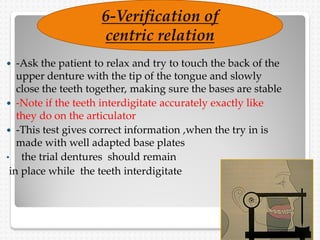
 -Ask the patient to relax and try to touch the back of the
upper denture with the tip of the tongue and slowly
close the teeth together, making sure the bases are stable
 -Note if the teeth interdigitate accurately exactly like
they do on the articulator
 -This test gives correct information ,when the try in is
made with well adapted base plates
• the trial dentures should remain
in place while the teeth interdigitate
6-Verification of
centric relation
Faulty occlusion (wrong centric
relation)
 - Due to an error either in the registration or
mounting the articulator
 - Trial dentures moved from their places due to
poor retention and stability
 - If centric relation is found wrong in the
patient’s mouth a new mouth record of centric
occluding relation is obtained
 - Mandibular cast is detached
and remounted according
to the new record
-Remounting the mandibular cast according
to a new mouth record:-
 Remove the mandibular posterior teeth from
the lower trial denture base
 Place soft wax to replace the posterior teeth
 A new record of centric relation is obtained
 The lower cast is detached from the articulator ,
remounted according to the new centric relation
record
 The lower posterior teeth are then set up in the
new position and waxing up is complete
 The trial dentures are ready for a new try in
-Remounting the mandibular cast according
to a new mouth record:-
Verification For
even occlusal
pressure
Even occlusal pressure:
As the teeth come together, they should
occlude evenly with equal pressure.
Testing:
a.Place two thin celluloid strips between the
posterior teeth, any difference in force of
withdrawal
b.Placing the blade of wax knife between
occlusal surfaces
Causes of uneven occlusal pressure:
- Unequal pressure during J R ( softening of the
wax )
-Errors in seating record blocks on their
respective casts:
warppage , wax debris, touching record bases
at heal,
- Errors in mounting, interferences at posterior
parts of cast
Correction of uneven occluding pressure
 -If it is very slight, it can be corrected by
grinding the teeth after the denture is
processed.
 -If the unevenness is more than slight ,it is
better to take a new centric relation record at
this stage.
 -Remove the lower back teeth ,replace by
softened wax and remount the lower cast.
Esthtics &
Appearance
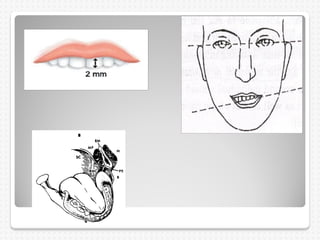
• Occlusal Plane Ant.
•Normally : at rest 2mm should be seen.
•Short lip: 5 to 6 mm of the incisors should
be seen.
•Long Lip : may complete
•coverage of the anterior
teeth.
•The plane of occlusion : should parallel
with ala tragus line & in
the front with interpupilary line
1 - FAC E : -
-The face should be studied in front view, in right
& left lateral profile views
-The effect of the denture & teeth alignment
while the face is at rest & while various facial
expression
THE FOLLOWING SHOULD BE CHECKED
• The horizontal overlap & its effect on the
contour of the lips.
• The amount of upper incisors showing at rest
& smiles
• The prominence of the upper ant teeth &their
effect of upper lip & nasolabial folds
• The alignment of the posterior teeth & the
amount of support they give to the cheeks
2-TEETH
 CENTRAL LINE : get better idea about the
position of central line
 SHAPA OF TH TEETH: should harmonize with
the shape of the face.
 SIZE OF THE TEEETH: should harmonize with
the size of the face.
 SHADE OF TEETH: should correct & suitable for
the patient
 REGULARITY OF THE SET UP :little irregularity
is usually called for to avoid artificial look.
Phonetic test
Phonetic tests
 One of the main objectives in complete denture
prosthesis is Correction of speech defects.
 Bad denture produces speech defects due to
one of the following:
1- Improper arrangement of teeth
2- improper contouring of the palat
3- High vertical dimension of occlusion
4- Lack of tongue space
Patient
Approval
Reference:
•Hassaballa, Clinical Complete Denture Prosthodontics, 2nd. ed.,
King Saud University Academic Publishing and Press, 2010.
Thank you

8 try in ppt

  • 1.
  • 2.
  • 3.
    It is avery important stage in denture construction which follows the setting up of teeth and waxing up stages To Check all the details in dentures because it is difficult and sometimes impossible to do alteration in a finished denture Try-in stage
  • 4.
  • 5.
    I- Extra- oralexamination of trial denture: - The articulator - The master cast - The trial denture bases - The teeth II- Intra- Oral examination of the trial denture: - Upper denture - Lower denture - Both upper and lower together III- Patient Approval: IV- Protrusive records:
  • 6.
    I- Extra- oralexamination of trial denture: - The articulator: * VDO: * Mounting rings * Smooth movement * Locked in centric no other movement -The master cast: Free from scratches, air bubbles, wax debris - denture base: stable, borders smooth, round, - the teeth: shade, form, size, arrangement , relation to ridge
  • 7.
    Check the upperdenture alone:- 1- extension, stability, retention 2-occlusal plane highet and orientation Check the lower denture alone:- 1- extension, stability, retention. 2-neutral zone and tongue space. 3-height of occlusal plane. Check both dentures:- 1- vertical dimension 2-centri occlusion 3- evenness of occlusal pressure. 4- evaluation of esthetics 5- evaluation of phonetics II- Intra- Oral examination of the trial denture
  • 8.
  • 9.
    -Checking extension ,retention & stability of upper and lower dentures:- 1- Extension: •All the peripheries of the denture should be in the vestibule •Over extended the denture will move away from the tissues when the pressure on it is removed and no retention will be established. •Under extended the denture won’t remain in place when the patient opens his mouth. •This is done by visualization , palpation •or testing paste
  • 10.
    2-Retention of theupper and lower dentures: -When the patient opens and closes his mouth the denture must stay in it’s place and considerable force needed to remove it. -We have to check the retention of the denture in the following areas: 1-The anterior part of the denture (labially) 2-The posterior palatal seal area (post dam area) 3-Tuberosity region in the upper denture 4-The retromolarpad area in the lower denture.
  • 11.
    3-Stability of theupper and lower denture: - Checking of the stability is done by applying alternating vertical pressure on one side of the denture if it rise from the other side this means that the teeth are outside the ridge in side of the applied pressure. - If the denture teeters in the middle it indicates that the denture is warped in the middle or the relief area isn’t done properly.
  • 12.
    Causes of dentureinstability: 1- The teeth set outside (more buccally) the ridge 2- Warpage of the denture base 3- Unrelieved hard area.
  • 13.
  • 15.
  • 16.
    Setting up ofthe lower teeth, and shape of the polished surface should allow proper tongue function ( in the neutral zone area) And to avoid the cramped tongue ( Lack of tongue space)
  • 17.
    Causes of crampedtongue: 1- posterior teeth set lingual to the neutral zone 2- posterior teeth tilted lingually 3- posterior teeth too broad bucco- lingually Difference between the movement of the lower denture caused by cramped tongue and lingual overextension ?
  • 18.
    checking both upper andlower trial denture
  • 19.
     -Watch thepoint of the chin then request to close the teeth together this upward movement equals the amount of the interocclusal distance.  -When the mandible is in the rest position there should be an interocclusal space of at least 2mm at the first premolar but sometimes in some patients may require more than 2mm.  -When the teeth are in centric occluding relation the patient’s face should produce a pleasing appearance. vertical dimension of centric occluding relation
  • 20.
    Proper vertical dimension: -Patient should be able to speak without clicking of the teeth  -No interference with speech  -Should be able to swallow without difficulty.  -Teeth should be visible without excessive display of the teeth and denture base.  -Maintaining desirable facial expression.
  • 21.
    -Freeway space:  -Measuringthe occluding face height and the resting height should check the amount of the freeway space.  -If the patient is struggling to put their lips together ,there may be insufficient freeway space  -If there is too much freeway space then the patient will look over closed and show too little teeth.
  • 22.
     - WrongVertical:  In case of too much teeth showing (which indicates high vertical dimension) then all teeth will have to be removed and a new jaw relationship recorded .wax rims can be added to the dentures bases and then trimmed to the desired level.  Remounting
  • 23.
     - WrongVertical:  When the complaint that too little teeth are visible  (low vertical dimension) wax can be added to the occlusal surfaces of the teeth until a satisfactory amount of wax is visible. A new centric relation record should be made and then removing and re-setting of the teeth to this new position  Remounting
  • 24.
  • 25.
     -Ask thepatient to relax and try to touch the back of the upper denture with the tip of the tongue and slowly close the teeth together, making sure the bases are stable  -Note if the teeth interdigitate accurately exactly like they do on the articulator  -This test gives correct information ,when the try in is made with well adapted base plates • the trial dentures should remain in place while the teeth interdigitate 6-Verification of centric relation
  • 26.
    Faulty occlusion (wrongcentric relation)  - Due to an error either in the registration or mounting the articulator  - Trial dentures moved from their places due to poor retention and stability  - If centric relation is found wrong in the patient’s mouth a new mouth record of centric occluding relation is obtained  - Mandibular cast is detached and remounted according to the new record
  • 27.
    -Remounting the mandibularcast according to a new mouth record:-  Remove the mandibular posterior teeth from the lower trial denture base  Place soft wax to replace the posterior teeth  A new record of centric relation is obtained  The lower cast is detached from the articulator , remounted according to the new centric relation record  The lower posterior teeth are then set up in the new position and waxing up is complete  The trial dentures are ready for a new try in
  • 28.
    -Remounting the mandibularcast according to a new mouth record:-
  • 29.
  • 30.
    Even occlusal pressure: Asthe teeth come together, they should occlude evenly with equal pressure. Testing: a.Place two thin celluloid strips between the posterior teeth, any difference in force of withdrawal b.Placing the blade of wax knife between occlusal surfaces
  • 31.
    Causes of unevenocclusal pressure: - Unequal pressure during J R ( softening of the wax ) -Errors in seating record blocks on their respective casts: warppage , wax debris, touching record bases at heal, - Errors in mounting, interferences at posterior parts of cast
  • 32.
    Correction of unevenoccluding pressure  -If it is very slight, it can be corrected by grinding the teeth after the denture is processed.  -If the unevenness is more than slight ,it is better to take a new centric relation record at this stage.  -Remove the lower back teeth ,replace by softened wax and remount the lower cast.
  • 33.
  • 34.
    • Occlusal PlaneAnt. •Normally : at rest 2mm should be seen. •Short lip: 5 to 6 mm of the incisors should be seen. •Long Lip : may complete •coverage of the anterior teeth. •The plane of occlusion : should parallel with ala tragus line & in the front with interpupilary line
  • 35.
    1 - FACE : - -The face should be studied in front view, in right & left lateral profile views -The effect of the denture & teeth alignment while the face is at rest & while various facial expression
  • 36.
    THE FOLLOWING SHOULDBE CHECKED • The horizontal overlap & its effect on the contour of the lips. • The amount of upper incisors showing at rest & smiles • The prominence of the upper ant teeth &their effect of upper lip & nasolabial folds • The alignment of the posterior teeth & the amount of support they give to the cheeks
  • 37.
    2-TEETH  CENTRAL LINE: get better idea about the position of central line  SHAPA OF TH TEETH: should harmonize with the shape of the face.  SIZE OF THE TEEETH: should harmonize with the size of the face.  SHADE OF TEETH: should correct & suitable for the patient  REGULARITY OF THE SET UP :little irregularity is usually called for to avoid artificial look.
  • 38.
  • 39.
    Phonetic tests  Oneof the main objectives in complete denture prosthesis is Correction of speech defects.  Bad denture produces speech defects due to one of the following: 1- Improper arrangement of teeth 2- improper contouring of the palat 3- High vertical dimension of occlusion 4- Lack of tongue space
  • 40.
  • 41.
    Reference: •Hassaballa, Clinical CompleteDenture Prosthodontics, 2nd. ed., King Saud University Academic Publishing and Press, 2010.
  • 42.